

Orphan Bachelors, page 1


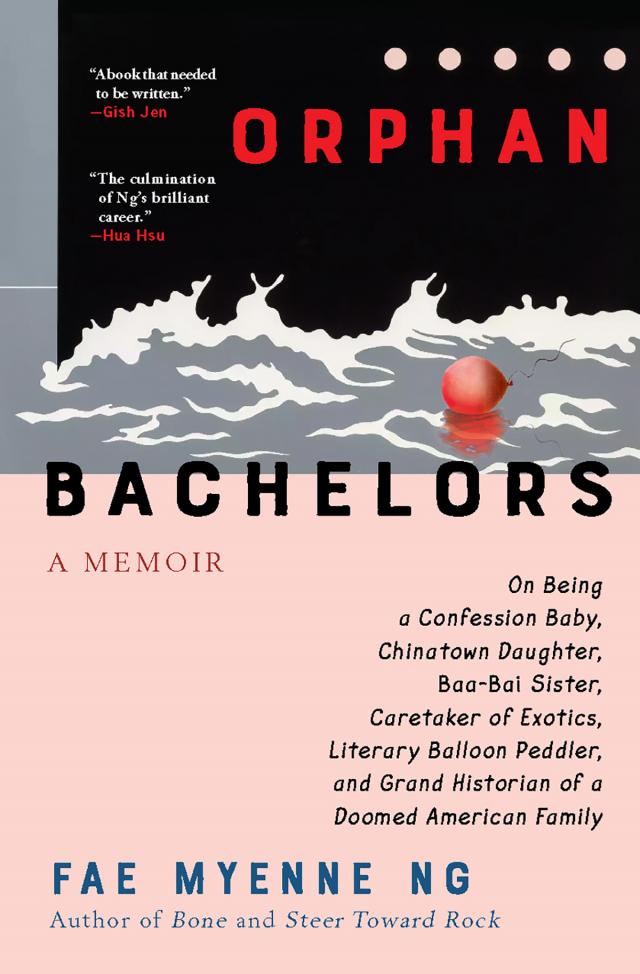
ORPHAN
BACHELORS
Also by Fae Myenne Ng
Bone
Steer Toward Rock
ORPHAN
BACHELORS
A MEMOIR
On Being
a Confession Baby,
Chinatown Daughter,
Baa-Bai Sister,
Caretaker of Exotics,
Literary Balloon Peddler,
and Grand Historian of a
Doomed American Family
FAE MYENNE NG
Grove Press
New York
Copyright © 2023 by Fae Myenne Ng
All rights reserved. No part of this book may be reproduced in any form or by any electronic or mechanical means, including information storage and retrieval systems, without permission in writing from the publisher, except by a reviewer, who may quote brief passages in a review. Scanning, uploading, and electronic distribution of this book or the facilitation of such without the permission of the publisher is prohibited. Please purchase only authorized electronic editions, and do not participate in or encourage electronic piracy of copyrighted materials. Your support of the author’s rights is appreciated. Any member of educational institutions wishing to photocopy part or all of the work for classroom use, or anthology, should send inquiries to Grove Atlantic, 154 West 14th Street, New York, NY 10011 or permissions@groveatlantic.com.
FIRST EDITION
Published simultaneously in Canada
Printed in the United States of America
The book was set in 13.5-pt. Centaur MT Std by Alpha Design & Compositionof Pittsfield NH.
First Grove Atlantic hardcover edition: May 2023
Library of Congress Cataloging-in-Publication data is available for this title.
ISBN 978-0-8021-6221-2
eISBN 978-0-8021-6222-9
Grove Press
an imprint of Grove Atlantic
154 West 14th Street
New York, NY 10011
Distributed by Publishers Group West
groveatlantic.com
For my sister
PROLOGUE
On this rare sunny day in the Outer Richmond of San Francisco, I take my late brother’s tortoises down to the yard for their bath. My neighbor is in her garden and asks if I like gai choy.
“Love it,’’ I say.
“Let me give you some.”
I go to the fence and watch her cut the tall greens at their thick stems. When I reach for the bunch of bright stalks, I feel like a Miss Chinatown receiving her winning bouquet. The plumes of leaves are wider than bamboo and more delicate. I ask, “No slugs?”
“They don’t like it,” Fay says.
My name is Fae, too, but I don’t know if we share the same Chinese character. Another day I’ll ask if hers means smart or favored.
“Right. Too bitter,” I say. Bitter is why I prefer gai choy over bok choy.
“Want more?” she offers.
Before I can decline, she’s sending more over. The tall stalks double in my arms and I feel like a champ. Who wants to be Miss Chinatown anyway? my sister would say.
“Eat only once a week. Otherwise it’s too yin,” my neighbor advises.
Though my mother died in 2003, I still hear her at every meal, admonishing me for eating avocadoes, grapefruit, watermelons, any salad or raw food, all too cooling. Mom believed foods had hot and cold energies that harmonized the body, allowing it to govern health.
“Too much yin,” she’d insist. “That’s why you’re always cold.”
Growing up, this house wasn’t heated. Tim, my youngest brother, put in a heating system when our mother got sick. Living here now, my Chinatown habits stick, and I can’t seem to use it. This morning, when I checked the thermostat, it read 48 degrees, so I put on another sweater, proud not to waste money. When my guy, Ner, complains that all the surfaces are cold, I’m genuinely surprised. He lives off the grid in the Santa Cruz Mountains but says this house is colder than living in the woods.
Since Tim died in 2015, I’ve been taking care of his tortoises, his leopard geckos, and his garden. His Yoshino cherry trees have budded, and the dwarf nectarine trees are blooming. When Fay admires their tight vermillion blossoms, I turn around. Wow.
Three months into the lockdown, pandemic fatigue has made me chatty as a marooned sailor. When I ask about steaming the gai choy, my tongue feels thick. What’s the word for “steam”? I can only think of the word for panfry—similar sounding—but which tone, rising or falling, lifting or flat?
Inside, I’m howling in Cantonese. My father also died in 2015. He was the last person I spoke my ancestral dialect with, and now that he’s gone, there are no more laughing puns, no more witty rhymes, and no more recitation of the “Ballad of Mulan.” Whatever time zone I was in, Manhattan, Rome, or outside the Mojave, my father and I spoke every night. Everyone else had had it with his pontificating so I was the relief talker.
At sea, his steady companion was silence; on land, his talk swelled like a storm. We called it boiling telephone jook, his stories like rice kernels churning in a pot. I knew them all by heart—being tricked by a story to come to America and then being swindled by more lies. Soon, every story was his vow to return to China. I listened with the phone pressed to my ear and filed papers or lay down—and more than once fell asleep.
When my father arrived in 1940, he lived at the Waverly Place, an S.R.O., one of many single-room occupancy hotels in Chinatown. That’s where he met many of the old bachelors. Some had been hatchet men in their day and many still held a knife in one hand, a hammer in the other. Trust was a cautious currency. Any man could be an enemy. Any brother could betray you.
My father called them Orphan Bachelors, perhaps after the name Orphan Island, those foreign concessions in Shanghai that remained unoccupied by the Japanese, or the orphan warriors abandoned by the Qing, or closer to home, the conscripted village boys, maybe even after Fa Mulan, who volunteered to take her father’s place in battle.
By the time my sister and I met them, they were defeated men without descendants, as pitiful as the deformed eunuchs of the Shang dynasty. The Orphan Bachelors sat out their days in Portsmouth Square, their silence seething as their gaze grew more and more furious. Our father taught us to call each one Grandfather.
In our childhood, my sister and I heard no fairy tales, no love stories. We only heard tales of woe. Women cried; men bled. In China, everyone went crazy from unrelenting grief or committed suicide from unrequited love. Those who survived became gambling or opium addicts—or just plain mean. In China, women jumped into wells and polluted the family water; in Chinatown, they jumped off the roof of the Ping Yuen projects, so we never felt safe in the playground. In China, butchers were revered masters of the cleaver. In America, every butcher was handsome because they were among the few males who stayed to work in the ghetto.
We learned that a story’s function was to protect. Like a gung fu disciple, the easy life made a lazy student, and the hard life made a grand master. Our parents didn’t believe in bedtime stories. A story that lulls you into dreaming? Why waste time telling a story that didn’t terrify and teach? Stories were for waking you up not putting you to sleep. Stories were forewarnings so that we didn’t venture into danger. Stories were amulets to save us from committing wrongs that could cut us down or worse, make us lose face.
When our mother told us about the Japanese soldier whose bayonet found her in the tall grasses or about the thugs at the Ping projects who dragged her friend into a waiting car, we knew not to ask why or what happened next. Curiosity only got us a dozen whacks with the chicken-feather duster. Our mother was teaching us about vigilance. If she didn’t offer the story’s ending, it was better not to know. Asking was disobedience: children didn’t need to know the whole story.
Be careful. Be safe. Stay alive. That was the only story.
The sun is directly overhead now, and the yard is hot. In my arms, the huge emerald leaves are drooping. When I ask my neighbor for cooking instructions, my voice reminds me of slaughtering a chicken, the swift and deep slash across its throat, the blood gurgling into a bowl. My Chinese drains out of me. I think of Lima-born Alberto Fujimori, who spoke an infantile Japanese and on his first visit to Japan as Peru’s president, shocked the waiters: How could this dictator order sashimi like an uncouth child?
“Only ginger,” Fay answers about cooking gai choy.
I ask, “No garlic?”
She shakes her head. “They don’t go together.”
That night, I steam the gai choy with ginger and eat it all. I don’t bother making rice, which would’ve horrified my mother, probably even more than Martha Stewart peeling ginger with a spoon.
I hear my mother ask, “Why would you separate yin from yang?”
She could have been commenting on marriage: “Don’t be the wife that eats bitterness.”
I know her deeper worry. Her husband could have been an Orphan Bachelor, but she’d endured his errant ways and kept a family he could always return to. Though I wasn’t at her deathbed, she’s always been by my side. Perhaps writing was a way to hold her marital bitterness in mind and at bay, writing becoming my mourning.
When my father breathed his last, I drove over two bridges before his hearing departed, and I crawled into the house on my hands and knees, calling for him as if we were in China.
If I tell him how long it took to complete this manuscript, he might wink and mention Sima Qian, who chose castration so he could finish his long-overdue Records of the Grand Historian.
My parents couldn’t read my novels in English and when translated, found the simplified Chinese frustrating and gave up. A seamstress who could sew up copies of dresses from sight alone, a sailor who could endure the silence and solace of the seas, their whole lives were consumed with work for the family, they did not want to read a copy of the original. This teaches me that translation is not only the art of deference but also of defiance and that immigration, like any departure from land or language, is the supreme sacrifice.
Inside the home, Mom taught us to call our father Deh, an ancient pronunciation that was long and low, as if pulled from the shadow of the moon.
Mah and Deh taught me to speak and write beyond the story, even beyond translation. They didn’t always get along, but they taught me how to get through life. When painting a tiger, first draw the bones. When building a house, consider the wind. When writing, consider the vessel of time that holds a story. Maybe that’s also a guide on how to read this book. When reading, honor what you can’t fully inhabit.
This book has no simple timeline. I’ve left our fissures in because what can’t be known or forgiven is part of our history. I’ve written our hopes and disappointments, and also our illusions. I’ve tried to respect the unknowable and also the untranslatable. I have borrowed from life to make the story come alive on the page. “Borrowing” is the word my father used to cajole understanding. Of his own life, he often said he was “borrowing” to stay in this country, to stay in this family. As a child, I believed his stories. As a writer, I write his lies. So, perhaps this book can be, as my father was, an alien resident.
I.
ARRIVING
1
My San Francisco was a village of a hundred grandfathers. This was in the early sixties; this was before the brothers. My sister, Wendy, was almost two, I was four, and our father was on land more than at sea, so he took us to Portsmouth Square every afternoon.
From Pacific Avenue, we walked down to Dupont, which was lined with old men, casually elegant in their lifetime suits worn to a sheen, their daily-wind watches on bony wrists, jade bands worn like knuckles of bamboo. Though we were taught to call each one Grandfather, my sister and I gave them our own names: Red Eyed Goong, the grandfather who once lunged at Wendy; Rolex Goong, who would come to our store and leave his watch for a brother; and Candy Grandfather, who always gave us Life Savers. I knew these names were a temporary passport before they died without any descendants.
They were our Orphan Bachelors, as common as those gray birds cooing on window ledges, and like those intelligent birds, the men saw their own reflection drinking from puddles, bathing in gutters, loitering on corners, and leaning against lampposts. I watched them carefully until Rolex Bachelor said, “You have pigeon eyes.”
My father nodded. “She’s smart.”
What did I see? Children had long been absent from Chinatown. One by one, the Orphan Bachelors called out in a continuous song, “Little friend, hello, hello! Pretty sisters, pretty dresses!”
We waved and then continued, turning down Washington to arrive at the edge of Chinatown, to the mouth of Portsmouth Square. Sitting on the long benches and milling along the tall hedges of the park, Orphan Bachelors gathered like scolds of pigeons. Every man had the Chinese Times in hand. Every man shouted: Injustice! Treason! Behead Mao! Assassinate the generalissimo!
The chess tables were always three or four men deep. I couldn’t see the game pieces but heard enough to know winners from losers. Pow! The wooden disks slammed on the cement tables. Saat your minister! Slaughter your king. Wow your mother!
I’m still asking, Where’s the queen?
My sister couldn’t take her eyes off the gung fu Orphan Bachelor practicing tai chi sword and I liked the one who chanted his wooden fish songs, those percussive singing-poems that made me clap my hands. Long Eared Bachelor took us to the platform commemorating where the gold rush was announced. Scholar Bachelor took us to where the first public schoolhouse in California was built in 1848 and the first American flag in San Francisco was raised in 1846. “Four years before California joined the Union,” he pronounced. Where I saw points on a star, he saw petals on a bloom. Scholar Bachelor called it the flowery flag. Why? I wanted to know. Why was America called the Flowery Kingdom?
Scholar Bachelor didn’t answer, so I asked other questions. Where were his wife, his children? Why did he spend nights singing love ballads in the underground music clubs, and why did he wear the same suit every day? Why and what for and how come? Scholar ignored me, so I went around the park and asked other Orphan Bachelors till they called me a mouthy bird, and one by one, they shuffled off, their steps a Chinese American song of everlasting sorrow.
The park was fun but going to Sam Wo was even better. The four-story restaurant was a narrow tower with a staircase like a conch circling into itself. Large plates of steaming rice noodles were sold in the entryway, and waiters carried food on trays above their heads, circling up the one-person stairway.
Edsel was the waiter of the fourth floor. He talked to us in English and made us laugh with his riddles. He told me he’d been a warlord in China. I wanted to ask my father if it was true, but I didn’t know the Chinese word for “warlord,” so I decided that Edsel was “pulling a big gun.”
I loved watching him slide between the tables, slapping a wet towel to clean, depositing chopsticks, and then opening the dumbwaiter as careful as a master thief and delivering the plates to our table like hot jewels. The younger waiters came to the top floor for their breaks and their tones were almost happy, nothing like their grumpy waiter voices. They boasted and told jokes, and then suddenly, one man would crouch down and pinch another man’s genitals, almost like the final twist when making dumplings. Then laughter filled the floor, as loud and maniacal as Laffing Sal at Playland.
There was always a lone Orphan Bachelor by the window that I’d watch as he waited for his bowl of rice king. When the steaming bowl of jook was placed in front of him, I watched for him to pull out a pink paper cone from his pocket and sprinkle the pork bits over the gruel.
“Don’t stare,” my father said. “The man is hungry.”
Often, after our food arrived, I was sent over with a plate of duck. “Call him Grandfather,” he instructed.
The old Bachelor’s nod of receipt gave me a window of worry on who my own father might become: a bum, a man with no family.
* *
The China my mother escaped was a hungry place.
When the Japanese started bombing Canton in 1939, rice was rare in her village. My mother–the girl was nine and in charge of cooking the grain or boiling jook, its watery cousin. One day, it must have been a day of some significance, my mother–the girl had the dinner rice ready when the bomb sirens sounded. She grabbed the clay pot and ran to shelter in the mountains.
What stayed with her wasn’t the hot, heavy cauldron or the gunfire ricocheting as she ran or being in the dark cave, it was that first mouthful of warm rice sliding pass her teeth, its nutty aroma filling her mouth.
That girlhood hunger followed her to America. At dinner, my mother broke down the cost of each dish: the quarter pound of lean pork, the greens, the sliver of ginger, the gas used to quick fry it. Our mother gave us the morsels; she sucked on gristle and bone, so we learned debt. Hunger had been her regular fare, so she made sure we never knew it. That was her menu: sacrifice.
I cultivated a different sort of hunger. Our father’s time at sea was something to imagine, but our mother’s toiling at the sweatshop was something I saw day and night. After school, my sister and I went to the sweatshop to help turn pockets, belt loops, and collars. I stood behind her chair and watched her pushing bolts and bolts of fabric through the stamping needle. Her eyesight would wane and her once-gentle voice became sewing-lady loud in order to be heard over the motoring machines. And after dinner, she’d go to her rental Singer and sew into the night, the gunfire ta-ta-tat-tat invading my dreaming and then my waking. I saw and felt and heard how she ate bitterness. My worry was, How would I ever repay her?


