

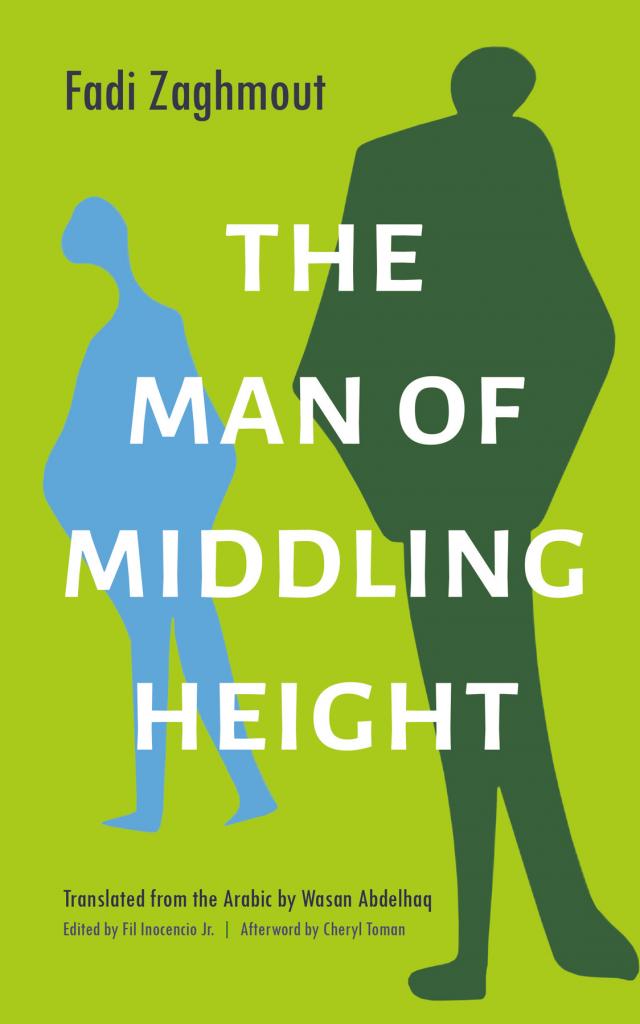
The Man of Middling Height, page 1


Select Titles in Middle East Literature in Translation
Allah’s Spacious Earth
Omar Sayfo; Paul Olchváry, trans.
The House of the Edrisis: A Novel, Volume One
Ghazaleh Alizadeh; M. R. Ghanoonparvar, trans.
The House of the Edrisis: A Novel, Volume Two
Ghazaleh Alizadeh; M. R. Ghanoonparvar, trans.
The Pulse of Contemporary Turkish: Poems from the New Millennium
Buğra Giritlioğlu and Daniel Scher, eds.; Buğra Giritlioğlu, trans.
Salt Journals: Tunisian Women on Political Imprisonment
Haifa Zangana, Christalla Yakinthou, and Virginie Ladisch, eds.; Katharine Halls and Nariman Youssef, trans.
In Search of Walid Masoud: A Novel
Jabra Ibrahim Jabra; Roger Allen and Adnan Haydar, trans.
Sour Grapes
Zakaria Tamer; Alessandro Columbu and Mireia Costa Capallera, trans.
We Never Swim in the Same River Twice
Hassouna Mosbahi; William Maynard Hutchins, trans.
For a full list of titles in this series, visit https://press.syr.edu/supressbook-series/middle-east-literature-in-translation/.
Content advisory: This book contains descriptions of sexual assault and violence. Please read with care.
First published in Arabic by Dar al-Ahliyyah, Amman, 2021, as Ebra Wa Kushtuban.
Copyright © 2025 by Fadi Zaghmout
Syracuse University Press
Syracuse, New York 13244-5290
All Rights Reserved
First Edition 2025
252627282930654321
For a listing of books published and distributed by Syracuse University Press, visit https://press.syr.edu.
ISBN: 9780815611851 (paperback)
9780815657439 (e-book)
Library of Congress Cataloging-in-Publication Data
Names: Zaghmūt, Fādī author | Abdelhaq, Wasan translator |
Inocencio, Fil, Jr. editor | Toman, Cheryl writer of afterword
Title: The man of middling height / Fadi Zaghmout ; edited by Fil Inocencio Jr. ; translated from the Arabic by Wasan Abdelhaq ; afterword by Cheryl Toman.
Other titles: Ibrah wa-kushtubān. English
Description: First edition. | Syracuse, New York : Syracuse University Press, 2025. |
Series: Middle East literature in translation | Includes bibliographical references.
Identifiers: LCCN 2025008274 (print) | LCCN 2025008275 (ebook) |
ISBN 9780815611851 paperback | ISBN 9780815657439 ebook
Subjects: LCGFT: Queer fiction | Romance fiction | Fiction | Novels
Classification: LCC PJ7976.A323 I2713 2025 (print) |
LCC PJ7976.A323 (ebook) | DDC [Fic]—dc23
LC record available at https://lccn.loc.gov/2025008274
LC ebook record available at https://lccn.loc.gov/2025008275
The authorized representative in the EU for product safety and compliance is Mare Nostrum Group B.V.
Mauritskade 21D, 1091 GC Amsterdam, The Netherlands
gpsr@mare-nostrum.co.uk
Contents
Author’s Note
Acknowledgments
Prologue
1.As If I Were Reborn
2.I Saw More of Him under the Light
3.Something about His Height Made Me Attracted to Him Like a Moth to the Light
4.I Didn’t Want to Confess That a New Moon Had Entered My Orbit
5.He Came to Visit Hiding in a Thick Green Dress
6.He Was the Hero in My Dream
7.We Are Not as Different as You Like to Believe
8.As If Our Souls Have Known Each Other Forever
9.Neither a Needle nor a Thimble
10.Oh, Sun! Have Mercy
11.He Is Barely a Cubit and One Palm Tall
12.Shorts Are from Jupiter, and Talls Are from Neptune
13.Every System in the Universe Has a Short at Its Center and a Tall Revolving around Its Axis
14.What the Hell Did I Walk into
15.Doesn’t She Have the Right of Choice
16.There Are No Talls, Shorts, or Mediums—Just People of Different Heights
17.How One Feels about Their Height Is Relative
18.The One Type No One Acknowledges
19.I Realized I Was No Longer a Stranger to the Place
20.How Can I Not Support Someone I Consider Part of My Family
21.What Kind of Monsters Did This to You
22.Tallan’s Testimony
23.How Can I Erase That from My Memory
24.Rocky Was the Last Thing We Needed
25.We Had to Prepare Tallan for the Wedding
26.She Believes Violence Disciplines Talls
27.I Was Saddened by the Realization That We Were Distorting Ourselves to Please Others
28.I Became Obsessed with One Idea
29.I Carried My Promise to Tallan as a Weapon on My Shoulder
30.Playing a Role I Hated and Wasn’t Good at
31.A Language That Would Introduce Tallan from a Different Dimension
32.Revolution
33.I Felt an Unending Darkness
34.What Matters to Me Is for Tallan’s Memory to Be Cherished
Afterword by Cheryl Toman
Appendix
Author’s Note
Our Arab societies suffer from a masculine dominance that has distorted the natural balance of human relationships. Men enjoy numerous privileges in various aspects of life at the expense of women, who have had their freedoms restricted and bodily rights stripped away. We have developed a societal construct in which all human traits are reduced, divided, and distributed according to one’s biological binary sex; one mold for men, another for women.
I am not here to enumerate the horrors our societies endure as a result of this difficult cultural legacy. I do not intend to dedicate this book’s introduction to the humiliating statistics about women’s participation in public life in various Arab countries (Arab States Civil Society Organizations and Feminists Network 2021), the frightening numbers of women that speak of violence directed against them, their lack of inclusion and empowerment, and the discrimination they face in different aspects of life. Everyone should be aware of these facts.
However, I also believe that a collective consciousness is beginning to form, one that cares about women’s rights and gender equality. But as a feminist activist interested in gender issues, I recognize the difficulty of explaining the changing ideas around gender to the general public. Both feminist theory and the reexamination of gender itself are unfamiliar and challenging to the prevailing cultural norms.
The general public does not distinguish between biological sex and gender as a social construct; between male and female as biological attributes, and man and woman as social attributes. The Arabic language, however, (similar to the English language) has words to distinguish between these two structures and has had them since its inception, thousands of years before the emergence of feminist theory. There is a word specifically for describing male as a biological descriptor (zakar, ذكر) and another word for describing man as a social type (rajol, رجل). Within the structure of Arabic, it is not permissible to substitute one for the other to give the same meaning.
From this linguistic distinction came the idea of the novel. Since gender division is created by a set of traits built upon a single biological attribute—that is, sex—why not try to imagine the development of this division in a different way? What if, instead of sex, we combined different traits and distributed them among people based on another biological attribute?
Height, for example?
What would this society look like?
Certainly, there are many factors that play a role in shaping gender. It has a biological aspect, but it has also evolved alongside human consciousness and through its interaction with the surrounding cultural environment. Further, it is crystalized within the linguistic vessel that hosts this consciousness. I tried to address these various aspects of gender’s formation while creating a unique world. The Arabic language, however, created some specific challenges in this endeavor.
Arabic language is a “gendered” language, with its grammatical constructions having gender classifications. Its pronouns are masculine and feminine and its plurals as well, and its words are feminized with the presence of the feminine letter “ta” (ة) or the letter “noon” (ن) of the feminine plural at their ends, and masculinized in their absence. Even inanimate objects are given a gendered dimension in Arabic. We say “this is a chair” (هذا كرسي) (masculine) and “this is a table” (هذه طاولة) (feminine). This demonstrates the importance of language in shaping collective consciousness and the gender identity of individuals.
If I were to imagine a world where gender has developed differently, it would be necessary for this world to speak a different language. If I wanted to give this world its due right, I had to write this story using that language: a language that is engraved with height division.
However, creating an entirely new language is difficult, and even if done successfully, and a story is written in that language, who among the readers would understand it?
I found a solution that I believe served the progress of the story. I leave it in the hands of the readers to judge. I wrote the novel in Arabic in hope that it receives readers’ approval and helps raise public awareness on gender issues. Translating it into English added another layer of complexity to the story. I worked closely with the editor to tailor the gender references to suit the English language, which is a language that is known to be less gendered than Arabic but still has gender engraved in its pronouns and vocabulary.
As the French feminist philosopher Simone de Beauvoir says in her famous book, The Second Sex (1949, 2011), “One is not born, but rather becomes, a woman.” (Beauvoir, 330). In this imagined world, this might become, “One is not born tall, but rather becomes so.” Similarly, inspired by the words of the American feminist philosopher Judith Butler in Gender Trouble (1990, 2006), who considers gender a performative act, I wanted the characters to express their “gender” or let’s say “social type” through their interactions with their environment, to reveal themselves through their own personal conflicts with their surroundings and with the social divisions of their world.
I wish you an enjoyable reading experience.
Best regards,
Fadi Zaghmout
Works Cited
Arab States Civil Society Organizations and Feminists Network. 2021. “Women’s Economic Justice and Rights in the Arab Region.” July 2021. https://arabstates.unwomen.org/sites/default/files/Field%20Office%20Arab%20States/Attachments/2021/07/Womens%20Economic%20Justice %20and%20Rights-Policy%20Paper-EN.pdf.
Beauvoir, Simone. 1949, 2011. The Second Sex. Translated by Constance Capisto-Borde. Vintage Books.
Butler, Judith. 1990, 2006. Gender Trouble: Feminism and the Subversion of Identity. Routledge.
Acknowledgments
I would like to express my heartfelt gratitude to the University of Alabama for their generous subvention, which helped make the publication of The Man of Middling Height possible. My deepest thanks go to Professor Cheryl Toman, whose steadfast support and encouragement from the very beginning has meant more to me than words can express. Her belief in this project has been a source of inspiration, and I am honored to have her insightful afterword grace these pages.
I am immensely thankful to Wasan Abdelhaq, the gifted translator who brought my words to life in English with sensitivity and skill. Her work has been instrumental in making this book accessible to a broader audience. I am also grateful to my dear friend Fil Inocencio Jr. for his meticulous editorial assistance, lending his keen eye to help refine the manuscript before its submission to Syracuse University Press.
To the team at Syracuse University Press, my sincere thanks for your unwavering efforts in bringing this book to life in its best possible form. Your dedication to excellence has enriched this work, and I am deeply appreciative of the care and expertise you’ve invested in every detail.
Thank you all for being a part of this journey; your contributions have made this book richer, and I am honored to share this work with you by my side.
Prologue
Once I realized my need to pour out my love for Tallan on paper, I knew I didn’t want to write it in our spoken language. I refuse to honor the unjust vocabulary, which denies his existence and fails to find a suitable pronoun to define him. I detest the structure and rules of that language which deliberately revolve around height; to celebrate shortness as the ultimate gift, or to denounce tallness as a haunting curse.
Ours is a divisive language revolving around shorts and talls, ruthlessly and irrevocably discarding all those who fall in between.
That is why, today, I will tell you my story in a new tongue, in a language that doesn’t concern itself with height.
A language that embraces and celebrates gender.
This is a language designed to be more just to him and more deserving of the love story that unites the two of us. I am aware that, by using this language, I am creating for him a different world from the one he and I inhabit. I am also aware that, in doing so, I’m hurting others, treating them unjustly. But they don’t concern me. All I want, in sharing my story, is to let it live and breathe in a different language—a language of an imaginary world.
A world in which my beloved is welcome.
1
As If I Were Reborn
The best love stories begin with a crack in the door.
I am referring to those mythical love stories that unfold without prior planning or knowledge at the moment when fate places the beloved in our path. When he stands behind that solid board, waiting silently, unaware that the door in front of him is nothing but a grand gateway transporting him from one life to another.
As if he were reborn.
On the other side of the door stood the other half of this love story. I paused for a moment, puzzled, as he pounded on the door.
“Who is it?”
No answer came.
I reached for the doorknob, not knowing that what awaited me would turn my life upside down. And, as cautious as I was in trying to avoid the bitterly cold weather outside, my hands had a different idea; they opened the door wide, so that I faced someone I had met only in my most intimate dreams.
As if I, too, started a new life.
It didn’t occur to me that this was the moment I was reborn, and it didn’t occur to him, either, that my being was pouring right into his heart. Our love story started without either of us realizing it. It started with a confusion that tinted it throughout.
Despite the intensity of the initial gaze my eyes bestowed upon him, I failed to perceive the enchantment concealed within his depths. My emotions toward him only solidified after a second and third glance, and perhaps a fourth, revealing to me that what I saw before me that day had the power to weaken my heart, shake my knees, and soften my soul.
I would have sent him away if it weren’t for the sadness I spotted in his eyes. And so I surrendered, opened the door as wide as possible, and said, “Hi.”
He replied in a gentle voice, “Good evening.”
2
I Saw More of Him under the Light
Perhaps my response was too quick. “Good evening to you,” I replied, my eyes twinkling in the moonlight.
With a bold confidence and a broad smile, he reached out his hand toward me. This unorthodox move caught me by surprise as talls are not allowed to shake hands with us short ones, but still, I shook his hand, hoping none of the neighbors would see me.
I politely asked him to enter through the door to the right, the one designated for talls. I then went back into the house, stepping into the room where we welcomed them. I was eager to discover the reason for his unplanned visit. It was past their curfew and typically talls weren’t allowed to go out by themselves at such a time.
“Would you like to have some tea? Or perhaps you prefer coffee?”
As a tall, his preference was for tea. So tea it was.
He remained standing in the middle of the room, allowing me to see more of him. Under the light, I could see him more clearly, and I realized there was something odd about his features. Yes, he was tall, but he was more of a medium height, rather than significantly above average. He definitely stood somewhere in the middle, between talls and shorts. He was neither thin like talls nor bulky like shorts. His head was shaved, following the customary practice of talls; a finely drawn line of golden henna started on his forehead and moved down to where his brows met, complementing his wide, warm hazel eyes—a clear sign of his refined background. He wore a traditional light-blue gown beneath a wool coat that didn’t fully cover his broad stature.
I noticed he didn’t take his shoes off at the door.
I hesitated for a moment, but then thought, “Well, if he is brazen enough not to take off his shoes, which is our custom, then I won’t be shy about asking him to do it.”
I have strong views on wearing shoes indoors. Taking off your shoes at the door keeps the house’s energy and ambiance pure and clear. I knew that talls didn’t like it, but I asked him to do so anyway, pointing to the door.
He politely apologized, then slowly and shamefully walked to the door and took them off.
In that moment, I stood astounded by what I saw. He was not even that tall!
And no! He was not a short, either.
He was clearly one of those who stood in the middle ground.
Inside, I was shivering. All through my forty years on this earth, I had never met a medium. As a dressmaker, I’ve spent the last twenty years designing gowns that accentuate the beauty of a bulky short and of a slender tall—never once doing so for a person of middle height.


