

Aether & Ash, page 1


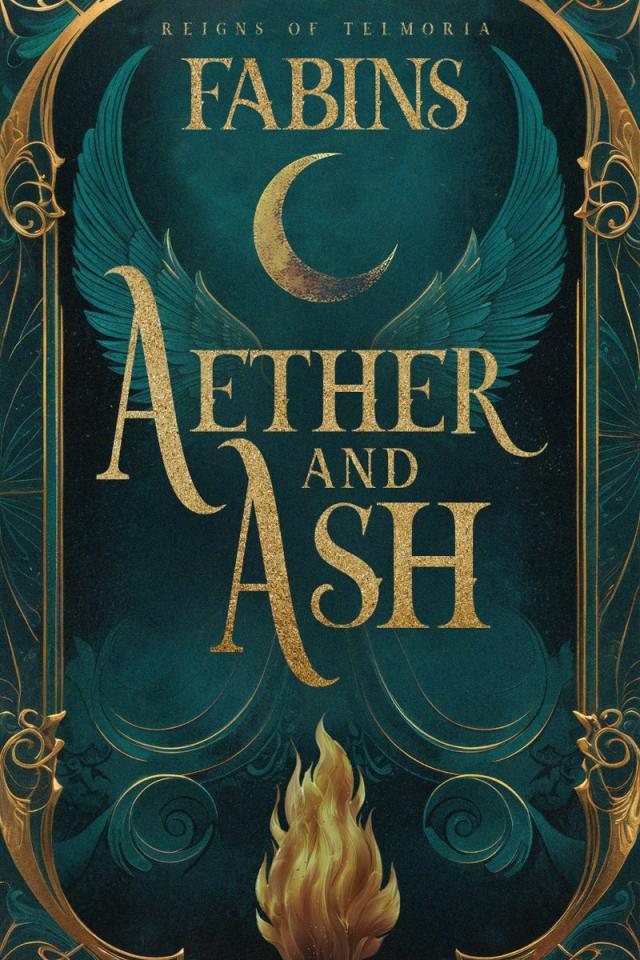
All rights reserved.
No part of this publication may be sold, copied, distributed, reproduced or transmitted in any form or by any means, mechanical or digital, including photocopying and recording or by any information storage and retrieval system without the prior written permission of both the publisher, Oliver Heber Books and the author, Fabins, except in the case of brief quotations embodied in critical articles and reviews.
NO AI TRAINING: Without in any way limiting the author's [and publisher's] exclusive rights under copyright, any use of this publication to "train" generative artificial intelligence (AI) technologies and/or large language models to generate text, or any other medium, is expressly prohibited. The author reserves all rights to license uses of this work for the training and development of any generative Al and/or large language models.
PUBLISHER'S NOTE: This is a work of fiction. Names, characters, places, and incidents either are the product of the author's imagination or are used fictitiously. Any resemblance to actual persons, living or dead, business establishments, events, or locales is entirely coincidental.
Aether and Ash Copyright 2026 © Fabins
Cover design by Dar Albert at Wicked Smart Designs
Sword Chapter Illustration by Chú Ti, @uncl.ti.flash
Published by Oliver-Heber Books
0 9 8 7 6 5 4 3 2 1
Contents
Prologue
1. Mirabelle
2. Mirabelle
3. Mirabelle
4. Damien
5. Mirabelle
6. Mirabelle
7. Mirabelle
8. Mirabelle
9. Mirabelle
10. Mirabelle
11. Damien
12. Damien
13. Mirabelle
14. Mirabelle
15. Mirabelle
16. Damien
17. Mirabelle
18. Mirabelle
19. Mirabelle
20. Damien
21. Damien
22. Mirabelle
23. Mirabelle
24. Mirabelle
25. Damien
26. Mirabelle
27. Damien
28. Mirabelle
29. Mirabelle
30. Damien
31. Mirabelle
32. Mirabelle
33. Mirabelle
Also by Fabins
About the Author
Oliver Heber Books
Prologue
Somewhere in the Silence.
Before the first Bond was ever forged, before Aether was named, there was the Breach. It did not open with fire or thunder. There was no scream in the wind, no tear in the Celestia. Just silence. A silence so absolute, the birds forgot their songs. The trees held their breath. And the world waited, unknowing, as something ancient slipped through.
They called it the First Ripple. A moment when time twisted on itself and the Veil between Realms thinned. And from that place beyond, where light did not reach and names had no weight, came whispers. Not words, but impressions. Hungers. Promises. A touch on the spine when no one is near. A shape in the fog that vanishes when you look too hard. Some were beasts. Some were worse. But they came, in silence or storm, and for a time, nothing held.
Until, at great cost, the wounds were sealed. Contained. And forgotten. A wound healed.
But wounds, if not watched, reopen. A missed rhythm. A shadow where light should fall. A shape that doesn’t vanish when you blink. They’ve been waiting. Watching. And when the first threads have begun to pull loose, it has already begun to wake.
Chapter 1
Mirabelle
Soap suds clung to my fingers like regret, the pool below shivering with each weary plunge. My reflection wavered back at me—red hair limp with steam, eyes dulled by repetition, and not a hint of the girl who once believed she was meant for more.
Seven years. Thirteen escape attempts. Most dissolved into fragile plans by night and unraveled by dawn. And still I stood, elbow-deep in linens, as if this pit were my altar and scrubbing its sanctified ritual.
A wet tunic slapped against my face before the thought had fully formed. Lovely.
I drew a slow breath and peeled it away, the fabric weeping suds down my sleeve. Above, a boy barely past ten beamed like a court jester nailing his finest joke. Behind him lounged an older sibling, arms crossed, amusement flickering in his eye, the true culprit by the look of it.
I held the tunic between two fingers. “Just what I was missing.”
The younger one hesitated, uncertain whether to laugh or flee. In the end, he dropped a crooked bundle of cloth at my feet and scurried off, his brother’s chuckle trailing behind.
In this place, remorse was a luxury, and courtesies were as scarce as freedom. Among commoners, dignity is something you bartered away with age. I sighed and dunked the tunic under, watching it swirl like it was trying to escape. Eventually, I wrung the last of the laundry, fingers pruned and knuckles raw and climbed out of the pit. My skin was damp and itchy from the soap mix, and I smelled like steeped herbs and wet stone.
I grabbed the two wooden bowls we kept tucked behind the laundry hall. We’d had them for years, edges worn smooth by use. Mine had a chip on the rim; Amara’s bore a scorch mark shaped vaguely like a fish, which she insisted was proof she should never be allowed near open flame again.
The queue for noon meals stretched long. All queues were miserable, but noon held a special brutality. Tempers ran high, stomachs hollow, elbows sharper than normal. I took my place in the slow shuffle forward, shoulders hunched against the casual jostling. Midday commoners snapped over scraps, muttering complaints just loudly enough to be heard.
Amara handled them with a grace I couldn’t fathom. A smile here, a quip there, and suddenly people made space for her, gave her extra portions, or just liked her. That sort of magic didn’t come naturally to me. I didn’t charm. I endured.
By the time I reached the front, my feet throbbed. I accepted my bowl without a word: gloopy klea-root mash, a few pale slivers of roasted tuber, and miracle of miracles, a scrap of meat that smelled like it might’ve once walked on legs. Amara would’ve groaned at the kleaf soup, said it felt like swallowing a slug, but I liked it. It was hot. That was enough.
Balancing both bowls carefully, I slipped away from the crowd and headed back toward our shared corner near the Dorm arch. She’d probably be back soon, fresh off her cleaning shift, grumbling about stone floors and sloshed buckets.
I sat cross-legged, the warmth of the bowl seeping into my palms. A thin sheen of sweat clung to the back of my neck, and I could feel it gathering in places I didn’t need it. I shifted with a quiet sigh. My thighs—thick, heavy—rubbed together with sweat slicking between. It was the kind of sensation that always made me want to jump into cold water.
Still my thoughts drifted as I sat, legs folded, bowl warm in my hands. Aether ruled our Realm—Telmoria. Five Clans. Fire for our Atlassian. Shadows, Lightning, Blood, Illusion for the other Clans. It whispered in bloodlines and billowed from sigils. Everyone had Aether in some shape or shimmer, except us. The ones without it scrubbed linens, mopped floors, carried crates.
Majors—those born with Aether—lived with soft beds beneath them, warm meals before them, and servants at their beck and call. In return, they tossed scraps our way: rations every few months, bolts of cloth and linen, the occasional pair of boots. Fire and iron and rules that bent only for bloodlines. Power was written into their bones, and some Royals carried it so thick it shimmered beneath their skin. Elders even more so. I didn’t care. Not really. Not unless their good moods happened to come with second helpings.
I used to dream of Aquaris. It was the only Clan less tangled in bloodline politics, or at least less vocal about it. Outsiders weren’t welcome, but they were tolerated. That was enough. For a while. Then last year, a new Heir took the throne. Young. Ruthless. His first decree? Ban all commoners from entering their borders. No petitions or appeals. Joke’s on him—I’d stopped uttering hope long before he slammed the gates shut.
By then, I’d just begun to piece together the shattered edges of my life, when Amara stormed in and claimed me like a half-drowned stray she refused to let go of. I started hoping again because she hoped. Because she carved a space for me in a world that didn’t have any.
I was taken by the Royals after the raid. After the screamings. They called it mercy, as if mercy came wearing a nametag and handed out Dorm assignments. I was barely twelve. Ash-footed. Mute. They fed me, clothed me, gave me a number and a job. Then tucked me away like a ledger they’d finished balancing.
And I learned quickly: forgotten was safer. The other children didn’t like the red hair and my sharp canines. Or maybe it was the fact I didn’t cry when they whispered about fire and bad blood or pulled the blankets off my cot. Maybe it was the way I always stole them back.
Once, they shoved me into a barrel of wash water and sealed the lid. I kicked until the stars came, until I heard my mother’s voice again. But that was just my own voice, screaming underwater.
Then this girl showed up, all elbows and attitude, a few years later.
“You’re scowling at your soup,” she said one day, sliding into the seat across from me.
“It looked at me first,” I told her. She blinked. Then snorted.
And just like that, we were friends. She was the only one who never asked about my parents. And I was the only one who never asked about her limp. We didn’t need to. We just...knew.
A dramatic sigh cut through the air, followed by the thud of someone collapsing into the grass beside me like the weight of the world had just pinned her down.
“Stars, I’m dying,” Amara groaned.
I passed her the scorched bowl, still warm in my hands. She took it without hesitation, already poking at the greens with a kind of tired malice.
She shoved a bite into her mouth, chewed, then tilted her head toward me. “Is it just me, or does it feel like every part of me is sweating today?”
“Definitely not just you.” I grimaced, tugging at the front of my dress where it clung stubbornly to my breasts. I tried blowing down the neckline, as if that might lessen the hot, sticky mess.
I nodded toward the tree line. “Let’s jump off the forest cliff into the lake?”
Amara grinned. “Already planned on it. Was going to drag you there even if yours was a no.”
I rolled my eyes and kept eating.
“Did you hear?” she asked between bites. “Tomorrow’s events are near the main arena.”
I made a noncommittal noise and tore a strip of meat from my portion. She leaned in with a knowing smirk. “Rumor is, the Young Sovereign might actually be there.”
“I have better things to do,” I said, mouth full.
“Oh, come on,” she nudged me. “Let’s go together. You know what they say, shared thirst builds character.”
I snorted. “I’m already drowning in character, thanks.”
“Well, if we stay here, we’ll have to pick up all the duties of those who go to the arena,” she added, “So.”
She had a point. And unfortunately, she knew it. Before I could craft a reply, she pivoted. “And guess what else?”
“Hmm?”
“Jasper’s been asking about you again.”
I dropped my spoon back into the bowl with a dull clink. “I’m far too exhausted to entertain this conversation.”
Amara grinned into her vegetables. “Suit yourself. But if you’re not interested in a little royal treatment, I’m always here to—”
“Don’t you finish that sentence, Amara.” The smile tugged at my lips anyway.
When the bowls were empty and the breeze had cooled, we slipped away from the crowd and walked the narrow trail that led toward the cliffs, past the kitchen halls and drying lines, the tall trees growing wilder the farther we wandered.
Celestia hung in their usual olive-green dusk, cloud mists curling like sleeping beasts overhead. Ancient trees loomed along the palace grounds, their gold-veined trunks glowing softly in the shade. The blossoms pulsed with slow breaths, like the trees themselves were thinking. Watching. Breathing.
It was beautiful, but in that way a sleeping animal is beautiful—right before it opens its eyes.
The cliffs gave way to a spread of open air, and below, the lagoon gleamed like a shard of star had fallen into the forest and stayed. Deep, cold blue water stretched in a perfect oval, untouched, hidden by the trees above and the cliffs around.
From here, our Clan stretched in layers of green and stone, fire towers and gilded rooftops rising like points on a broken crown. Beyond them, the shimmer of old wardlight flickered faintly across the horizon—the edge of Atlassian.
Sometimes I wondered what it looked like from the outside. If anyone ever tried to look in.
I’m hearing things again...damn this.
Whispers. Always at the edge of sound. Vague, like something half-remembered: getting...not yet...feed…
I closed my eyes and took a deep breath.
I was sleep-deprived. Which wasn’t a lie. The whispers had started a few weeks ago. Always in moments like this—when the air was too still, the trees too quiet. I ignored them, same as always. Sleep, eat, scrub, survive. It worked well enough.
We reached the edge of the drop and kicked off our boots. The stone was warm underfoot, the lagoon below cool and calling. I pulled off the top layer of my dress, folding it over a root.
Amara did the same, tossing hers down with far less care. She grinned at me, wide and bright and wild.
“For old times?”
I returned the smile, though it felt a little softer. “For old times.”
And we jumped. The cold hit like a thousand tiny needles—shocking and sharp and perfect. We squealed, screamed, laughed like the girls we used to be, before chores and trials and raids and rules. Before we learned to keep our heads down and our hearts quiet.
For a moment, the world was nothing but blue and breath and freedom. And for a moment, it was enough.
Chapter 2
Mirabelle
If it didn’t cost us actual nickels to buy replacement strings for this bow, I would’ve given Amara five morris per arrow just to watch her waste the last two. Both had skittered harmlessly off a rock and vanished into a patch of thorns we were definitely not retrieving them from.
“Two morris and a half, straight into the weeds,” I muttered, crouched near the underbrush.
She rolled her eyes and shoved the bow into my hands. “Oh, go on, then. Prove your great destiny as Huntress.”
I stood, drew, and aimed without ceremony. The string creaked under tension, my fingers sore where the linen grip had rubbed raw last week. One breath. Then I loosed.
The arrow hissed through the dusk and struck with a muted thwack.
The brush rustled violently, then stilled. Amara’s head tilted.
“You didn’t—” she started.
“I did,” I said, already moving.
We found the creature draped across a broken root, its feathers iridescent in the dimming light. Long-tailed, fire-eyed, with shimmerplume crests trailing down its spine. Its breathing was slow but steady, the arrow still nestled in its flank—blunted and laced with sleeproot resin. Enough to knock it out for a while. Just a nap.
“Oh stars,” Amara whispered. “That’s a dusk-binder.”
“Looks like someone’s getting a warm supper.”
She turned to me, wide-eyed. “Bella, that pelt alone—Majors will pay for it like it bleeds Aether.”
It wasn’t just rare. It was unheard of this close to the commons. Normally dusk-binders roamed highland cliffs and lunar groves. But here it was. And still breathing.
We didn’t waste time. I knelt by the wing and gently lifted the side to find the underfeathers—delicate, opalescent slivers tucked against the creature’s skin like starlight woven into down. Amara held the cloth as I plucked them, careful and swift. We’d done this before—once. If you were quick and quiet, the dusk-binder wouldn’t even notice what was missing when it woke.
“Three,” I said, easing the wing down again.
“Four,” she corrected, grinning. “That one by the shoulder. Look.”
She was right. I added the fourth, tucking it in with the others. That many would fetch more than a few nickels. We stepped back. I took the arrow from its flank, wiping the resin tip against the grass before slipping it into the pouch.
We didn’t wait. Just backed into the brush and watched as it blinked awake, slow and dazed, then stretched its wings with a shimmer that lit the twilight. It lifted into the air like a wisp of dream and vanished through the trees.
“This’ll fetch more than just bread and root paste,” Amara said, her enthusiasm palpable, fingers nimble even in the half-light. “We could get something real. Searfruit maybe. Or those pickled plum slices with spiced salt.”
“And firebean stew,” I added. “The kind that burns your lips and makes you feel rich while sweating like a mule.”
Her grin flashed. “And paints for me. Reds and whites, not just charcoal.”
I raised a brow. “Think we’ll save it this time?”


