

Beneath an Opal Moon, page 1
part #4 of Sunset Warrior Cycle Series


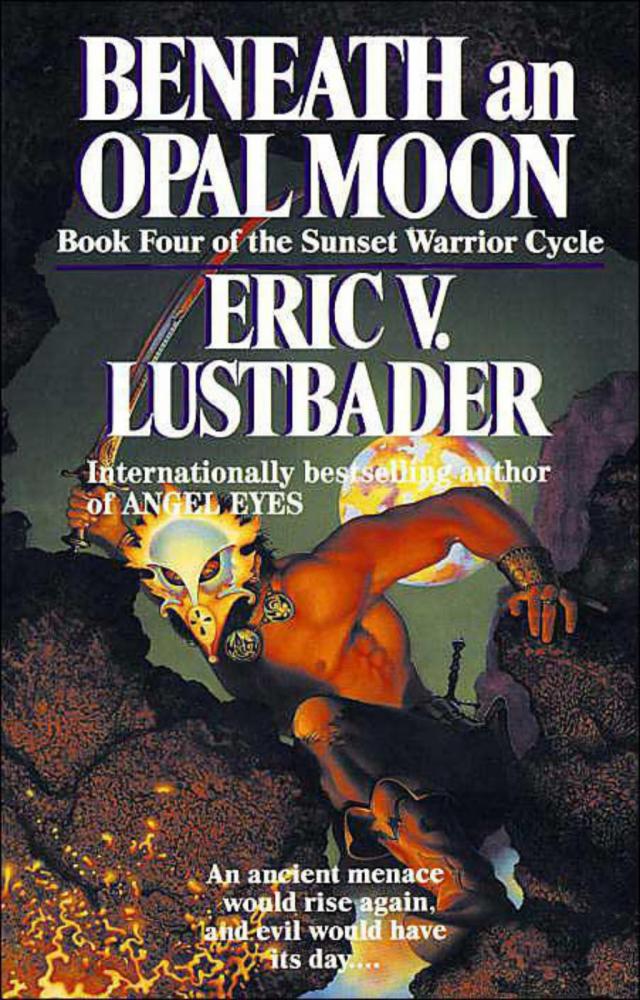
BENEATH AN OPAL MOON
By
Eric V. Lustbader
Published by Fawcett Books:
THE NINJA
BLACK HEART
SIRENS
THE MIKO
JIAN
SHAN
ZERO
FRENCH KISS
WHITE NINJA
The Sunset Warrior Cycle
THE SUNSET WARRIOR
SHALLOWS OF NIGHT
DAI-SAN
BENEATH AN OPAL MOON
BENEATH AN OPAL MOON
by
Eric V. Lustbader
FAWCETT CREST NEW YORK A Fawcett Crest Book Published by Ballantine Books Copyright A) 1980 by Eric Van Lustbader
All rights reserved under International and Pan-American Copyright Conventions. Published in the United States by Ballantine Books, a division of Random House, Inc., New York, and simultaneously in Canada by Random House of Canada Limited, Toronto.
This book may not be reproduced in whole or in part, by mimeograph or any other means, without permission. For information address: Doubleday & Company, Inc., 245 Park Avenue, New York, New York 10017.
ISBN 0-449-21649-7
This edition published by arrangement with Doubleday, a division of Bantam, Doubleday, Dell Publishing Group, Inc.
All of the characters in this book are fictitious, and any resemblance to actual persons, living or dead, is purely coincidental.
Printed in Canada First Ballantine Books Edition: March 1990
For Ralphine
Contents
PREFIGURE: On Green Dolphin Street
ONE: CITY OF WONDERS
Rubylegs
Koppo
Circus of Souls
Snatch
TWO: PURSUING THE DEVIL
The Lorcha
Mer-Man’s Tales
Fugue
Water’s Edge
THREE: THE FIREMASK
Intimations
Demoneye
The Anvil
Sardonyx
The Opal Moon
FOUR: LION IN THE DUSK
Idyll
The Orphans
And All the Stars to Guide Me
Thus we struggle so that our history shall become the salvation of our children.
From the Tablets of the Iskamen
PREFIGURE
On Green Dolphin Street
THE Scarred Man enters Sha’angh’sei at sunset. He pauses before the towering cinnabar escarpment of the western gate and turns in his dusty saddle. Above him, a pair of ebon carrion birds spread their grotesquely long wings, hovering, startlingly set off by the flare of the sky. Piled clouds riding like chariots of crimson fire obscure for long moments the bloated ablate of the sun as it sinks slothfully toward the heights of the city already lost within the thickening haze. It is a unique mark of the sunsets in Sha’angh’sei that the city itself and the land all around it is first engulfed by the purest crimson, sliding, as the sun disappears behind the man-made facade into the amethyst and violet which heralds the night.
But the scarred man’s deep-set eyes, slitted and as opaque as dry stones, study only the winding much-traveled highway behind him and the steady lines of jumbled traffic ox-carts piled high with raw rice and silk, horsemen, soldiers, and traveling merchants, businessmen, farmers on foot moving toward him and the city; the outbound flow is of no import to him.
His horse snorts, shaking its head. Gently, the scarred man strokes its neck below the short mane with a thin red hand. The stallion’s coat is lusterless, matted with the mingled dust of the highway, the caked mud of narrow back roads and the grease of many a hasty meal.
The scarred man pulls at his hat, a floppy felt affair which, constructed anaesthetically, does little more than conceal his long and haggard face. Satisfied at last, he turns and, slouched in his high and dusty saddle, presses against his mount with his heels, riding through the gate. He raises his eyes as he moves, watching the perspective changing, deriving pleasure from the shifting angles as he studies the endless bas-reliefs carved into the cinnabar of the dark western gate, an epic monument to a dichotomy: the triumph and the cruelty of war.
The scarred man shivers even though he is not cold. He does not believe in omens yet he thinks it interesting that he enters Sha’angh’sei through the western gate, erected as a sinister reminder of a particularly odious aspect of man’s nature. But, he asks himself, would it really make any difference if he had made his entry into the city through the green-onyx southern gate, the alabaster eastern gate, or the intricate red-lacquered wood and black iron northern gate? Then he throws his head back and utters a short bitter laugh. No. No. Not at all. For at this hour of sunset they are all stained crimson by the lowering light.
The scarred man breaks into the populous surf of the great city and his journey is slowed by the milling throngs of people as if he is passing through a moving field of poppies. He feels an end to long isolation, far from the companionship of man, a seemingly interminable time with only his stallion, the stars and the moon as his family. Yet as he rides into the explicit riot of the city, his mount walking through the clouds of jostling men and women and children, fat and thin, large and small, young and old, ugly and fair, as he passes the bursting shops, stalls, stands with striped awnings, the tangled buildings with their dense cluster of swinging signs advertising the tempting wares within, he realizes that never before has he felt such an apartness from the warmth of.the family of man. And this peculiar alienness suffuses him with such completeness that his body begins to quake as if he is ill.
He digs his bootheels into the flanks of his mount and shakes the reins, abruptly anxious to reach his destination. Through this vast kinetic sea he jounces, metal jangling, dusty leather creaking, the grime of travel heavy upon him. A torrent of filthy children, their torsos ribbed like corpses, brush against his legs like a separate eddy in this fetid surf and he is obliged to press his boots tightly against the stallion’s flanks lest, howling, they pull them from his feet. He extracts a copper coin from his wide sash and flings it high into the air so that it catches the oblique light. As it disappears into the swirling mass of pedestrians on his left, the children abandon him, rushing to follow the flight of the spinning coin. They plow through the crowd, tenaciously searching on hands and knees in the slime and offal of the street.
He moves on, turning a corner at an acute angle, following the street. He inhales the rich musk of coriander and limes, the heavy incense of charring meat, the somewhat lighter scents of fresh fish and vegetables flash-cooked in hot sesame oil. As he passes the opening of a dark alley, the thick sweet smell of the poppy resin for which Sha’angh’sei is so famous, hits him with such intensity it takes his breath away and he is dizzied.
The din of the city, after so long on the road, alone with himself, is claustrophobically overpowering, a constant harsh cacophony consisting of wails, shrieks, cries, shouts, laughter, whispers, chanting, a glorious babble of voices, testament to the indomitability of man.
Within the deep shadows of the felt hat, the scarred man is hollowcheeked. A long bent nose leads inevitably to thick gnarled lips as if, in his wild earlier years, he had fought with his fists within the hempen circle, as is the wont of certain of the folk of the western plains of the continent of man. His hair is silver, silken, flowing long down his back, held away from his wide wrinkled forehead by a thin plaited band of copper. His face, defiantly hairless, exhibits the tracery of livid white scars puckering the flesh of his cheeks and throat like rain on the surface of a pond. He wears a long traveling cloak of a dark, indeterminate color, owing to the grit of his journey. Beneath it, a tunic and leggings of deepest brown. Hanging from his waist from a simple stained leather belt is a scabbarded curving sword, wide-bladed and single-edged.
He pauses beside a wine stall on Thrice Blessed Road and, dismounting, leads his mount out of the enormous crush of the thoroughfare. As he strides into the dimness beneath the pattemed awning, he spies the wineseller, moon-faced and almond-eyed, arguing with two young women over the price of a leather flagon of wine. With a sweep of his deep-set eyes, the scarred man takes in the curving bodies of the women, their faces tipped high in anger. But they are restless, his eyes, and while he listens and waits somewhat impatiently, his gaze darts this way and that, alighting on a face here, the pale flash of a hand there. For a moment, he observes a man with eyes like olives and black curling hair so long that it covers his shoulders, until he is met by another man and they depart. The scarred man’s head cocks at the thumping sounds of running feet, shouts echo and diminish as a body rushes past outside, elbowing through the crowd. He turns away. He asks the wineseller, now free, for a cup of spiced wine, downs it in one swallow. It is not the rice wine of the region, which he finds too thin for his taste, but the heartier burgundy of the northern regions. He purchases a flagon.
The sunset is fading, the sky above Sha’angh’sei turning mauve and violet as night approaches boldly from the east.
The scarred man leads his stallion left into a narrow alley, crooked and filled with refuse and excrement. There must be bones here, hidden perhaps in the high dark mounds heaped against the sides of the building walls. Human bones stripped of all flesh, all identity. The stench is appalling and he breathes shallowly as if the air itself might be poisonous. His mount whinnies and he pats its neck reassuringly.
The alley gives out at length onto Green Dolphin Street with its dense tangle of shops and dwellings.
At last he comes upon a swinging wooden sign carved in the shape of an animal’s face. The Screaming Monkey, a dark and fumey tavern. He enters and, skirting the multitude of jammed tables and booths, speaks to the tavernmaster for just a moment. Perhaps it is the din of the place which causes him to put his lips against the other man’s ear. The tavernmaster nods and silver is exchanged. The scarred man crosses the room and mounts the narrow wooden staircase that folds back upon itself. On the landing, midway up, his gaze sweeps across the smoky room bubbling with noise and movement. Natives of the Sha’angh’sei region do not interest him; outlanders do. He studies them all most carefully and covertly before he completes his ascension.
He walks silently down the darkling corridor, meticulously counting the number of closed doors, checking to see if there is a rear egress before he opens the last door on the left.
Inside the room he stands for long moments just inside the closed door, perfectly still, listening intently, absorbing the background drift of sounds, setting it in his mind so that, even if he is otherwise occupied, he will automatically hear any deviation.
Then he crosses over the mean floorboards, throws his heavy saddlebags onto the high down bed with its pale green spread, moving ilTunediately to the window, drawing the curtains. When they stop moving, he pulls one side carefully back in the crook of one forefinger, gazing out onto a heavily shadowed alley perpendicular to Green Dolphin Street. He is, he knows, within the heart of the city, far from the long wharves of the Sha’angh’sei delta. Still, if he strains, he can hear the kubaru’s plaintive hypnotic work songs filtering through the hubbub. Peering sideways, he can just make out a slender section of the far side of Green Dolphin Street. A seller of herbed pork and veal is closing his shop and, immediately adjacent, the lights are extinguished in a dusty carpet shop as three brothers, pear-shaped and identical down to their embroidered saffron robes, shutter the windows. They are rich, the carpet merchants, thinks the scarred man, letting the curtains fall back into place. The more prosperous they become, the heavier they seem to weigh, as if they have been magically transformed into living embodiments of the taels of silver which they hoard.
The scarred man quits the far side of the room and, satisfied that the curtains will hold in the light, fires an oil lamp atop the scarred bedside table. One corner is charred as if some former occupant had clumsily overturned the lamp. He reaches into the recesses of his saddlebags, withdraws the newly bought flagon of wine, takes a long drink.
He washes at the nightstand until the water is black with grime and presently he hears light footfalls on the stairs. His head comes up and his right hand grips the hilt of his curving sword. He steps soundlessly to the wall adjacent the door and waits, scarcely breathing.
A knock on the door.
- A young boy, tall and dark-haired, enters carrying a tray of
steaming food. He comes to a halt seeing the room empty. Then the scarred man growls low in his throat and the boy turns slowly around. He tries not to stare at the scarred man but he cannot help himself.
“Well,” says the scarred man. “Put it down.”
The boy swallows hard and nods. He continues to stare.
The scarred man ignores this. “Your father tells me that you
6 Eric V. l:`ustbader
are quite reliable. Is this so?” His voice is thick and husky as if he has something lodged in his throat.
Fright mingles with fascination. The scarred man sees these often aligned emotions flickering upon the young narrow face.
“Well,” says the scarred man. “Have you no voice then?”
“Yes,” stammers the boy, ”sir. I have one.”
“Close the door.”
The boy complies.
“Have you a name?” The scarred man has gone to the night table. He lifts a bit of fowl between the long nails of his middle finger and thumb. The forefinger, in between, juts out oddly. The scarred man swirls the meat in the thick brown gravy, ignoring the long wooden eating sticks Iying at the side of the plate, pops it into his mouth. “Excellent,” he says to no one in particular as he licks the tips of his fingers. “Just the right amount of fresh black pepper.” He turns. “Now “
“Kuo.” Softly.
- “Ah.” The scarred man studies him with an awesomely
intense gaze, but even though he feels fear, Kuo knows that he must not show it. He stands ramrod straight, concentrating on controlling his breathing. He tries to ignore the sound of the hammering of his heart, which feels as if it has lodged itself in his windpipe.
“This is for you, Kuo. If you do as I say.” A silver coin has magically appeared between the scarred man’s fingers.
The boy nods, hypnotized by the shining coin. It represents more wealth than he has had in his entire life.
“Now listen to me carefully, Kuo. My horse is in the stable down Green Dolphin Street. At the first stroke of the hour of the boar you must bring it to the alley at the side of this place. This one.” He points one long forefinger toward the curtained window. “No one must see you do this, Kuo. And once here, stay within the shadows. Wait for me. When I come, there will be another silver coin for you. Is this clear?”
Kuo nods. “Yes, sir. Quite clear.” The secretiveness of his mission has excited him. How his friends will envy him.
“No one must know of this, Kuo.” The scarred man takes a quick step toward him. “Not your friends, not your brothers or sisters, not even your father. No one.”
“There is nothing for me to tell,” Kuo says, delighted with himself. “Who would be interested in my delivering another meal upstairs?”
“Not even that!” And the boy jumps at the force of those terse words, then nods. “No, sir.”
The scarred man flicks his thumb and, shot from the arbalest of his nail, the coin arcs into the air, shining. Kuo’s fingers enclose it and he is gone, swiftly and silently.
The scarred man listens at the door. Then, as the sounds of Kuo’s descent fade, he turns his attention to the food and for a time he is totally consumed in the act of eating.
Sounds drift up to him, given an eerie etherealness by the closed curtains. The cries of the night vendors, drunken laughter, the heavy creak of wooden-wheeled carts laden with tomorrow’s produce and dry goods, the snort of horses, hoofs clip-cropping on the cobbles; a soft wind rustles the leaves of the plane trees lining nearby Yellow Tooth Street. Night.
Soft footfalls on the stairs and the scarred man is up, wiping his greasy hands. He bends, extinguishes the flame of the oil lamp. Silently, he skirts the bed, opens the curtains. Dim, fitful light from the thin corridor to the street seeps into the room as slowly as blood drips from a corpse.
The footfalls cease.
The scarred man has positioned himself well within the deepest shadows of the room with a good line of sight to the door. He stands immobile, one hand gripping the hilt of his sword as the door opens inward to reveal an ebon silhouette.
“Mistral,” comes a whispered voice.
“Who is the messenger?” says the scarred man.
“The wind.”
“Enter, Omojiru,” says the scarred man and the silhouette disappears as the door is closed. There comes the sound of a lock being secured.
“Cascaras,” says Omojiru, “have you found it?”
The scarred man hears the tremor in the voice, barely held in check as he watches the other in the inconstant light. He notes the high forehead, the flat cheekbones, the narrow thinlipped mouth, the intelligent almond eyes and thinks, It was those eyes which took me in. But now I know that he would be nowhere without his father’s influence. I regret his involvement. Not because he is ruthless and unprincipled. He would be useless to me without those traits. But because he lacks the guile he believes he has. That can be dangerous. He sees Omojiru’s lips compress into the narrow line of intransigence preparatory to violent action and he recalls this man’s volatile nature. How different you are from your kin, Omojiru, the scarred man thought. If your father but knew what you planned with me





