

Wolves of Wagria: A Viking Age Novel, page 1
part #3 of Olaf's Saga Series


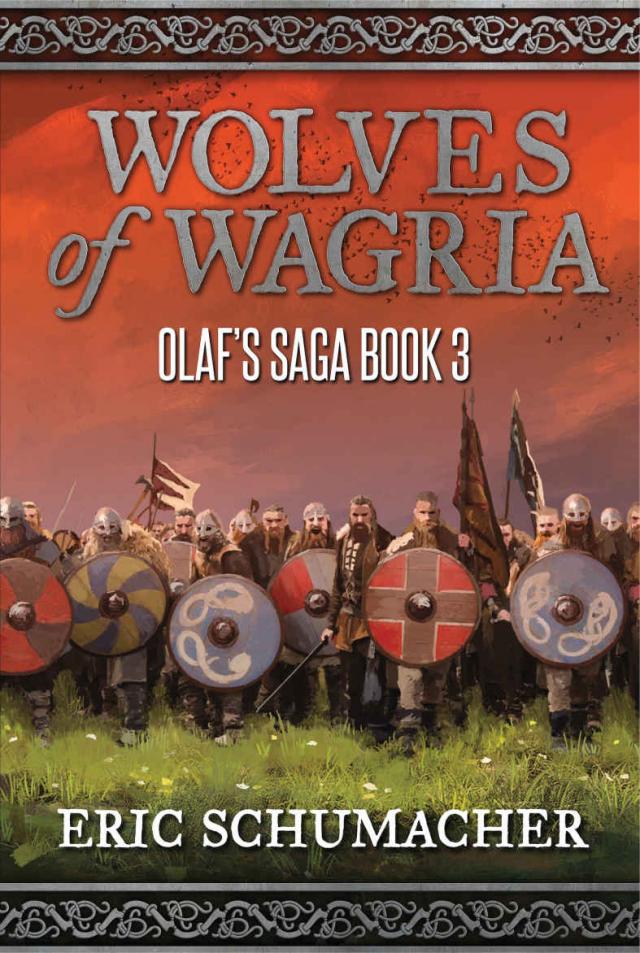
WOLVES OF WAGRIA
OLAF’S SAGA, BOOK 3
ERIC SCHUMACHER
BODN BOOKS
CONTENTS
Wolves of Wagria
Books by Eric Schumacher
Acknowledgments
Glossary
Part I
Chapter 1
Chapter 2
Chapter 3
Chapter 4
Chapter 5
Chapter 6
Chapter 7
Chapter 8
Chapter 9
Part II
Chapter 10
Chapter 11
Chapter 12
Chapter 13
Chapter 14
Chapter 15
Chapter 16
Chapter 17
Chapter 18
Chapter 19
Chapter 20
Chapter 21
Part III
Chapter 22
Chapter 23
Chapter 24
Chapter 25
Chapter 26
Chapter 27
Chapter 28
Chapter 29
Chapter 30
Chapter 31
Chapter 32
Thank You
Historical Notes
About the Author
WOLVES OF WAGRIA
OLAF’S SAGA, BOOK 3
Copyright ©2022 Eric Schumacher
Layout design ©2022 Bodn Books
Published 2022 by Bodn Books
All rights reserved. No part of this book may be reproduced or transmitted in any form or by any means, electronic or mechanical, including photocopying, recording, or by any information storage and retrieval system, without the author's permission.
To Marie, for your steadfast love and support. I could not do this without you.
BOOKS BY ERIC SCHUMACHER
Hakon’s Saga
Book 1 – God’s Hammer
Book 2 – Raven’s Feast
Book 3 – War King
Prequel Novella – Mollebakken: The Rise of Bloodaxe
Olaf’s Saga
Book 1 – Forged by Iron
Book 2 – Sigurd’s Swords
Book 3 – Wolves of Wagria
If you would like to know when the next book in Olaf’s Saga is available for pre-order, or when one of my other books is free or discounted, please join my Readers Club: https://www.ericschumacher.net/readers-club.
ACKNOWLEDGMENTS
This book is the work of many people, whom I would like to thank here. First and foremost, I thank you, my readers, for your continued support, your nudges, your reviews of my work, your comments on social media, and so much more. I hope this novel brings you hours of enjoyment. I again want to thank Marg Gilks, for her early notes and feedback, and Lori Weathers, who took my ideas and words and honed them into the polished prose and story you are about to read. To David Brzozowski for his artistic eye and beautiful layout. And to Andrew Dodor, who even in the midst of war-torn Ukraine was willing to transform my ideas into the art you see on the cover and in the map section. It is to you all, and to the countless others who have accompanied me on this journey, that I owe a huge debt of gratitude.
GLOSSARY
Aldeigjuborg – The Old Norse name for a trading post located where the Volkhov River flows into Lake Ladoga.
Asgard – Asgard is one of the Nine Worlds of Norse mythology and the home and fortress of the Aesir, one of the two tribes of gods. Old Norse: Ásgarðr.
bonder – Free men (farmers, craftsmen, etc.) who enjoyed rights such as the use of weapons and the right to attend law-things. They constituted the middle class. Old Norse: baendr.
borg – The Old Norse word for fort or stronghold.
Bolgaraland – The Old Norse name for Bulgaria.
Borysthen – An island settlement at the mouth of the Dnieper-Boh estuary. Today, it is known as Berezan island.
boyar – A member of the aristocracy in old Russia, next in rank to a prince. They served the prince as his aides and counselors but retained the right to leave his service and enter that of another prince without losing their estates.
Burgundaholm – The island of Bornholm. Old Norse: Burgundaholmr.
byrnie – A (usually short-sleeved) chain mail shirt that hung to the upper thigh. Old Norse: brynja.
Danavirki – Old Norse for "earthwork of the Danes," which was a system of walled fortifications that stretched across a large portion of Danish Jutland.
dirham – A silver coin used as currency in the Byzantine and Iranian empires, as well as across the Viking world.
drekar – The Old Norse word for a Viking longship is dreki. Drekar is the plural form of the word.
Duná River – Believed to be Old Norse for the Danube River.
ell – A former measure of length equivalent to roughly 45 inches (1.1 meters).
Estland – Also Eistland. Old Norse name for Estonia.
Gardariki – The area that formed the land of the Rus. The name means “the realm of towns.” Old Norse: Garðaríki.
Hammaburg – Old Saxon for the city of Hamburg.
Hel – The place most people go when they die. It is also known as "Helheim." Hel is also the name of the ruler of Helheim.
hird – A retinue or warband. Old East Slavic: druzhina. Old Norse: hirð.
Holmgard – The original Rus stronghold situated near the point where Lake Ilmen flows into the Volkhov River. It is often referenced as “Novgorod,” though the town of Novgorod and the stronghold are in two separate places. Old Norse: Holmgarðr.
Jorvik – York. Old Norse: Jórvík.
Kill – Kiel fjord. It is believed the name "Kiel" derives from one of the Old Norse words for bay or gulf.
knyaz – The word for prince in Old East Slavic.
Konugard – Kyiv or Kiev. Old Norse: Kønugarðr.
Midgard – One of the nine worlds of Norse cosmology and the only world inhabited by and visible to mankind. Old Norse: Miðgarðr.
Miklagard – The Great City, or Constantinople. Old Norse: Miklagarðr.
Nepr River – Believed to be Old Norse for the Dnieper River.
Nidhogg – The serpent that gnaws at the root of the world tree, Yggdrasil. Old Norse: Níðhöggr.
nightmen – Public servants responsible for cleaning a medieval town’s public cesspits.
Njord – The Norse god of wind and water. He was also the patron god of sailors and fishermen. Old Norse: Njǫrðr.
Nygard – The Old Norse name for Novgorod, which means “new town.” Old Norse: Nýgarðr.
Orkneyjar - The Orkney islands.
Ostergotland – A district in the kingdom of the Swedes, located in the east of the land and south of present-day Stockholm. Old Norse: Östergötland.
Ox Road – This road stretches from Hamburg northward to Viborg. The Danes referred to it as "Hærvejen," which means "the army road," while the Germans/Saxons called it "Ox Road." It was primarily used as a trade route during the early medieval period.
poliudie – The Rus process of collecting tribute from the Slavic tribes.
Ragnarok – The battle at the end of times. Old Norse: Ragnarǫk.
Saxland – The land of the Saxons, i.e. tenth-century Germany.
Schlei – A narrow inlet of water that flows from the Baltic Sea deep into Jutland. Danish: Slien.
seid – Magic. Old Norse: seiðr.
Starigard – The Old West Slavic name for Oldenburg in Holstein, where the Wagrians had their main fortress and settlement.
Svantevit – The Wendish name for the Slavic god of war, fertility, and abundance. One of the main Slavic deities.
Svartahaf – Believed to be the Old Norse name for the Black Sea.
Sventana – Slavic name for the Schwentine River.
thrall – Old Norse for slave.
Valhall (also Valhalla) – The hall of the slain presided over by Odin. It is where brave warriors chosen by valkyries go when they die. Old Norse: Valhöll.
ves heill - Old Norse greeting meaning roughly "be in good health."
wergeld – Also known as “man price,” it was the value placed on every being and piece of property.
whale-road – The ocean or sea.
Yule – A pagan midwinter festival lasting roughly twelve days. It later became associated with Christmas. Old Norse: Jōl.
PART I
By wandering Saga-man or Scald;
Heimskringla is the volume called;
And he who looks may find therein
The story that I now begin.
The Saga of King Olaf
Henry Wadsworth Longfellow
1
Holmgard, Gardariki, Late Spring, AD 972
A crowd had gathered within the muddy courtyard of the old borg that we called Holmgard. Like me, the throng was there for the duel. But while those in the crowd chattered and muttered in almost giddy anticipation, I stood in silence.
In front of me, my friend and charge, Olaf, paced in the dueling ground, his breath gathering in the cold before his face. Across from him stood one of Prince Vladimir's warriors, a bear of a man named Hastein, who had publicly accused Olaf of sleeping with the prince's wife and earning his position as the head of her guard with his prowess in bed. To protect the princess's reputation and his own, Olaf had challenged the man to a duel. And so here I stood, recently returned from a bloody campaign in Bolgaraland to find myself in the midst of a puddle-pocked yard packed
with warriors thirsty for a fight. And, mayhap, a chance to earn some easy coin.
I glanced up at the dais that lay beside the dueling ground. Prince Vladimir, who was now a teen, scowled beneath his dark brows. Though it had never been proven that Olaf was lying with his wife, the rumors were enough to harm the prince's reputation and his pride. He wanted Olaf dead, and that truth was etched in the dark frown on his face. It mattered not that Vladimir kept a flock of his own whores, just as his father had.
By his side sat his bewitching wife, Olava, with her white-blond hair cascading over her dark sable coat, a visible grimace of concern on her thin face. While Olaf had denied his indiscretions to me and others, I sensed he was lying. He may have been a talented fighter, but he was also a risk taker, and I doubted he could reject the seductive allure of the blond beauty that was Olava, especially if it meant an elevation of his station here in the Rus kingdom, which we Northmen called Gardariki. And climb he had. I had been on campaign in the South for two winters, and in that time, he had ascended to the highest ranks of Olava's household guard. Part of that, I knew, was due to Olaf's popularity, for his way with words, his courage, and his weapons-craft had always won men to his side. I doubted little that Olava's guards served him with reluctance. But it was hard to ignore the rumors, which had reached my ears as soon as I had returned. If those words had bothered me, it was hard to fathom how much they rankled the prince.
"Why do you fight with armor, Hastein? Do you fear my blades?" Olaf's words tore me from my thoughts. He stood in his leather breeks with only a rough tunic on his torso. He had woven his amber hair and beard into tight braids. In each hand, he carried a stabbing sword, or seax. Unless he fought in a shield wall, he never carried a shield. He preferred the freedom of movement his two blades afforded him. Though he was only in his twentieth spring, there was not a man more gifted at fighting simultaneously with two hands than Olaf.
Still, I had my misgivings. A man did not become a prince's household warrior by luck. Hastein was plenty experienced, and unlike Olaf, he was taking no chances. He stood in his chain-linked byrnie that reached to his mid-thigh. On his head, he wore a helmet and carried in his hands a shield and a hand axe. A seax hung from his belt. Fully armored and weapon-rich, he would be a hard man to kill.
"Do not toy with him," I shouted into Olaf's ear over the cries of the mob. "Finish him quickly and be done with this."
Olaf glanced at me, and his lips twisted into that mischievous grin of his. How many times had I seen that grin, and how many times had it led to some misadventure that landed us in trouble? It told me that I had the right of it –– Olaf did not intend merely to fight Hastein. He intended to do something more, though just what, I knew not, and that worried me.
"Olaf," I warned, knowing in my heart that Olaf would do as he wanted. Just as he always had. Bull-headed and bold. That was Olaf. Some would call him foolhardy, but I had known him since he was a small lad, and I knew better. Olaf genuinely believed the gods had great plans for him and so would protect him in his pursuits, whatever they might be. Though I was not so willing to accept that belief, I had a hard time thinking otherwise. He was often the first to rush into battle and rarely did he come away with more than a scratch.
He walked over to me and smacked my right shoulder. I winced, for I had been wounded in Bolgaraland on that shoulder and the wound was still tender. "Do not fear, Torgil," he said to me and winked.
"I am not afraid," I growled, then glanced to my left, where my lord, Sigurd, stood. He was Olaf's maternal uncle, yet even he knew it was pointless to instruct his nephew. So instead, he stood silently and grimly, burly arms crossed over his thick chest as he waited for the duel to begin.
When we were lads, Olaf's father, Trygvi, had ruled a county in our homeland called Vingulmark, but he had been treacherously killed by his adversary Harald Eriksson, the man who now called himself king of all of the Northmen. My father had taken us boys; Olaf's mother, Astrid; and two of her maidservants, and fled east in the hope of connecting with Astrid's brother Sigurd, who lived in Gardariki. Our flight had not been easy. One of the maidservants had died at the hands of bandits. Estlanders then captured us on the East Sea, killing my father, selling Olaf's mother, and turning Olaf; the remaining maidservant, Turid; and me into thralls for the remainder of our childhood. Only by luck, or mayhap the pity of the gods, had Olaf's uncle Sigurd found us and brought us east to Holmgard. That was five summers ago.
Before Trygvi had been killed, I had sworn an oath to him to protect his son Olaf. It was a duty I took seriously despite my sometimes-uneasy relationship with the headstrong lad. And it was a duty I had been unable to perform since Olaf had joined the ranks of Princess Olava's household guard. He had seen it as an opportunity for promotion, as I have said. But now he was in trouble, and I was powerless to protect him.
Prince Vladimir rose and stepped to the edge of the dais, drawing me from my thoughts. A calm settled over the crowd as the warriors turned their faces to the young man.
"We have gathered to witness the duel of Hastein and Olaf. They accuse each other of lies, so we shall let their blades and the gods discover the truth. It shall be a duel to the death. Let no man offer assistance to the challengers." The lad's hard eyes scanned the crowd, then focused on the dueling ground, which was cordoned off with rope. "Olaf. Hastein. Prepare to fight."
"Make it quick," I called to Olaf one last time, then patted his broad shoulder.
The combatants settled into their defensive stances, and the crowd's furor rose to a fevered pitch. The princess sat straighter in her chair. My nerves twisted my gut.
"Fight!" roared Prince Vladimir.
Olaf and Hastein slogged through the mud toward each other and circled, silent beneath the din of the crowd. Olaf poked with his right blade, testing his foe's reactions. Vladimir's man took the poke on his shield and countered with a feint, forcing Olaf away. Hastein pursued, coming at his victim quickly, for with his armor and shield, he had the advantage of protection. Olaf tried to bob back to his left but found Hastein's axe blocking his path. With the rope behind him and Hastein closing fast, Olaf took the only option open to him: he went on the offensive.
I have seen warriors fight and have done plenty of fighting myself, but never have I witnessed an assault of blades like that delivered by Olaf. His hands moved faster than I could track with my eye, forcing Hastein to defend himself as best he could. But it was not good enough. By the end of the attack, he'd felt the kiss of Olaf's seaxes on either arm and his left shoulder. None of the strikes were hard enough to break the chains of Hastein's armor, but I do not think Olaf intended them to be. This was his warning to Hastein. He was telling his foe what was to come.
The crowd howled, though whether in delight or dismay was hard to tell. Olaf backed away and gave Hastein time to collect himself.
"Come on, Hastein," he urged. "The day is growing late, and I am growing thirsty. Do not prolong ––"
Quick as a lightning strike, Hastein raised his axe and tossed it at Olaf's chest. I had not expected that. Nor, I think, had Olaf, who had not yet finished his taunt. His blue eyes went wide as his body twisted to avoid the twirling blade. Later I would recall the collective gasp that shot from the mouths of Olaf's friends, including me. Olaf twisted further as the blade inched closer, then sailed past his torso by a breadth of a hair, if that. Olaf pitched backward into the mud just as the axe twirled into the scattering crowd.


