

I Make Envy on Your Disco, page 1


“What if a city and the people you meet there get so under your skin that you see once more that life is full of beauty and possibility? I Make Envy on Your Disco will remind you that growing older is not just about what you leave behind but also about new beginnings, new relationships, and new ways of living in the world.”
—Anton Hur, National Book Award finalist and author of Toward Eternity
“The characters in this hilarious, wistful, and moving novel will live with you long after you’ve read the last, aching page. I Make Envy on Your Disco is pure pleasure—a celebration of the intense, even transcendent connections we can make when traveling far from home.”
—Carolyn Turgeon, author of Godmother and Mermaid
“In Eric Schnall’s fast-paced and funny debut novel, a successful New York art advisor finds himself perpetually discombobulated on a short business trip to Berlin. Moment by moment, we tag along as he continually loses—and eventually recovers—himself in a city that comes as vividly to life as the eclectic cast of characters he meets along the way. I loved this sharply observed and deeply touching book.”
—Bill Hayes, author of Insomniac City
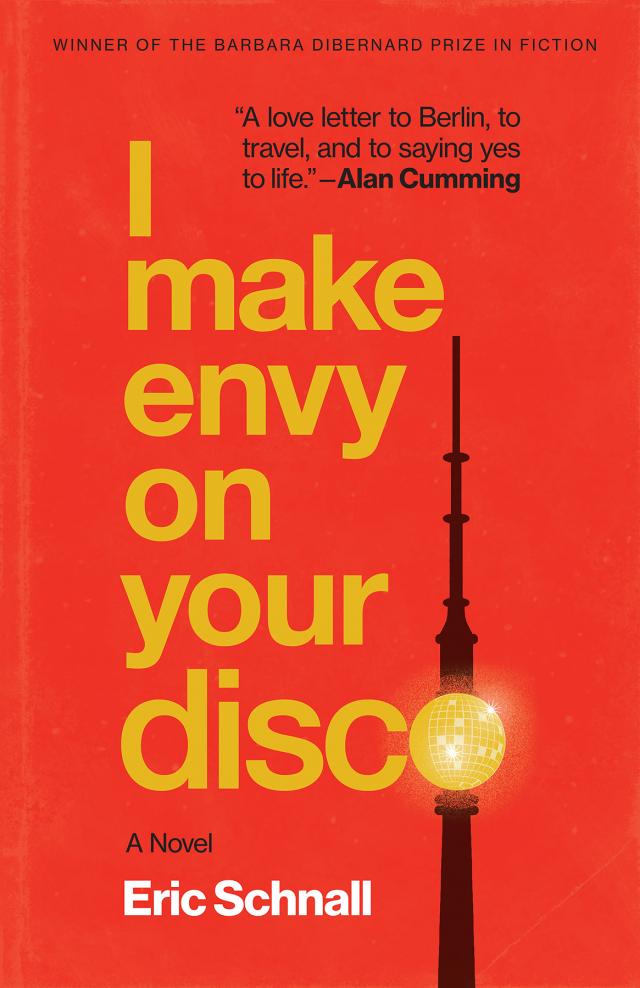
“This is a pendulum of a book, swinging between rolling in smoky Kreuzberg techno clubs and strolling the preppy lushness of New York’s Upper West Side, and never being quite sure when or where we’re going to slip off and land. A love letter to Berlin, to travel, and to saying yes to life.”
—Alan Cumming
“An amazing feat. Wonderful books are like foreign travel itself. You’re dropped someplace unfamiliar, lost in a new language. You begin to feel your way around, and in the hands of a skilled writer like Eric Schnall you slowly but surely fall in love with place, with character, with words, ultimately gaining a new sense of self. I finished I Make Envy on Your Disco completely enchanted, and I can’t wait to book a return trip to Schnall’s work.”
—Steven Rowley, New York Times best-selling author of The Celebrants
“One of the most delightful, smart, surprising, and unexpectedly affirming books I’ve ever read. Not unlike protagonist Sam Singer—who has fled his life in New York for an exquisitely rendered Berlin—I fell in love with every character who crosses his path.”
—Steve Adams, Pushcart Prize–winning author of Remember This
“Eric Schnall’s gorgeous debut is everything you want in a novel—perceptive and witty, melancholy and honest, kind and full of heart. Better yet, his story is populated with the most hilarious and singular characters you could hope to meet on the page.”
—Jenny Jackson, New York Times best-selling author of Pineapple Street
Zero Street Fiction
Series Editors
Timothy Schaffert
SJ Sindu
I make envy on your disco
A Novel
Eric Schnall
University of Nebraska Press | Lincoln
© 2024 by Eric Schnall
Cover designed by University of Nebraska Press; cover artwork by Aaron Goodman.
Author photo by Shax Riegler.
All rights reserved
The University of Nebraska Press is part of a land-grant institution with campuses and programs on the past, present, and future homelands of the Pawnee, Ponca, Otoe-Missouria, Omaha, Dakota, Lakota, Kaw, Cheyenne, and Arapaho Peoples, as well as those of the relocated Ho-Chunk, Sac and Fox, and Iowa Peoples.
Library of Congress Cataloging-in-Publication Data
Names: Schnall, Eric, author.
Title: I make envy on your disco: a novel / Eric Schnall.
Description: Lincoln: University of Nebraska Press, 2024. | Series: Zero Street fiction
Identifiers: LCCN 2023048996
ISBN 9781496239013 (paperback)
ISBN 9781496240040 (epub)
ISBN 9781496240057 (pdf)
Subjects: BISAC: FICTION / Literary | FICTION / LGBTQ+ / General | LCGFT: Queer fiction. | Novels.
Classification: LCC PS3619.C446544 I43 2024 | DDC 813/.6—dc23/eng/20231023
LC record available at https://lccn.loc.gov/2023048996
The publisher does not have any control over and does not assume any responsibility for author or third-party websites or their content.
For Shax
For my parents
For Berlin
Berlin tasted of the future, and that is why we gladly took the crap and the cold.
—Carl Zuckmayer
Contents
Nothing Translates
We Are Nice Here
Schmuddelwetter
Montag
A Stranger in Berlin
The St. Bernard, or a Proper Sandwich
Discombobulated
It’s Going to Snow
Young and Stupid
The World in a Wagon
The Best Schnitzel in Town
Get Ur Freak On
Zugunglück
The Drugs Don’t Work
A Knock on the Door
Painted City
Don’t Sweep Your Wife Away
A Ghost of Me, While I Was Gone
A Needlepoint in Time
Ich Bin Ein Berliner!
A Fool in Berlin
Hello, New York
Reunification
End of the Story
Acknowledgments
Nothing Translates
Everything is a puzzle. The windows open differently here, from the top, the corners slanting inward. There’s no radio, no clock in the room, yet the floors in the bathroom are heated by a switch next to the door. To flush the toilet, I must step on a metal lever. There is no UP or DOWN button on the panel beside the elevator. Instead, I punch in the number of the floor I’m going to. I’m on the third floor, but I press 0 to get to the street. When I ride the train, I buy my ticket from one machine and get it stamped by another, but no one checks my ticket. I just get on the train and sit. When the train reaches my stop, I push a button so the door slides open and I can exit. I’ve forgotten to do this a few times already and have twice missed my stop. Though I have no use for warm marble floors, I’ll leave them on for the length of my stay, because they’re there, I’m paying for them, and they’re controlled by the one button in Berlin I seem to understand.
Some hotels overlook mountains or the sea. My hotel sits at the end of a tramline, tucked away on a side street, hidden from the bustle of Mitte. My room has its own peculiar view: one window faces the street, its slim glass doors opening to a balcony just big enough to step outside for a cigarette, if I still smoked. A cluster of yellow trams sleep below and a maze of wire dangles a few yards from my window, feeding power to the machines. Across the street, an apartment building is covered entirely in graffiti, and in big red letters: FUCK BUSH. And in the distance stands the Fernsehturm, the TV Tower that hovers over Alexanderplatz like a giant steel dandelion.
The other side of my room overlooks a courtyard. Strands of flowering vines crawl up walls, defying the October chill. A small koi pond is lit from below. A few tables and chairs are scattered in the yard, but it’s hard to imagine they’ve gotten much use. It’s been cold and rainy since I arrived in Berlin rather suddenly, less than two days ago.
I go down to the breakfast room. A wall of windows faces the courtyard. German tourists and businessmen sit at square tables eating cake, salami, and muesli. Outside it’s gray and drizzly and the wind is gusty, but they all seem used to it. Most of them, like me, have blue eyes.
The hotel is staffed almost entirely by young women dressed in black. They are all very beautiful. “Guten Morgen,” one says as she leads me to a table. Her name tag reads Astrid. “Kaffee?” she asks, tilting her head to the side. I nod. As Astrid pours the coffee, her blond hair drifts down her shoulder and she sighs, “Soooo . . .” Everyone says this to me. I eventually discover that it means here you go, but not quite. Nothing is what it seems here. Nothing translates. The word bitte means please and you’re welcome and may I help you? When I walk around the city, streets don’t have names like 14th Street or Avenue A. My hotel is between Grosse Präsidentenstrasse and Oranienburger Strasse. That’s two streets and sixteen syllables.
I’ve come to Berlin to see an exhibit at Klaus Beckmann’s Zukunftsgalerie, curated by the owner himself. The latest show at the “gallery of the future” is all about the past. Its theme is Ostalgie, the nostalgia for the products, objects, and way of life that disappeared from the East almost overnight, after the Wall fell, less than fifteen years ago.
I’m an art advisor in New York. I specialize in contemporary art and tell people what to buy. Sometimes I consult for corporations, but mostly I deal with private collectors, which means that these days, I spend a lot of time with the newly wealthy—hedgefunders, trophy wives, Europeans, that sort of thing. I often find myself trapped in their cavernous apartments or strolling arm in arm with them through galleries in Chelsea, dining out with their families, making small talk, just hoping to close a sale.
Walking around Mitte, the neighborhood that bridges east and west, I see graffiti everywhere. But it’s not fuck-you graffiti. It’s beautiful, the wild bursts of color and ridiculous taglines. Art is everywhere—painted on buildings, stenciled on doorways, plastered on pipes. It is raw and, like much of Berlin, reminds me of New York in the seventies and early eighties, the city of my youth.
I picture Times Square: the crowds, the lights, television screens and scrolling headlines, the stock quotes, kidnappings, and natural disasters. Endless information pou
There’s nothing about Berlin that’s on similar display. It’s a cagey peacock with its dazzling tail spread, walking away from you while looking backward. It seems an insular and introspective culture, happy to be on its own, connected by the dark threads of its knotty history.
Daniel would say that I’ve got it all wrong. A city unfolds, takes its time. “Sleep,” he’d tell me. Because first impressions are never right.
* * *
German is a language of scissors and knives. Z’s, p’s, k’s, s’s, and w’s are chopped into an orgy of consonants: Platz, Strasse, Kuchen, Wasser, and Schnitzel. I’d been told that everyone would speak English. But now it seems that many Berliners don’t speak English, or if they do, they try hard not to use it. When I ask the front desk for directions, I am repeatedly handed a map.
I walk down an endless number of streets in East Berlin. The entire city is under construction. New office buildings are being erected, town houses restored, austere Soviet-era structures torn down. Much of the city is draped in tarp and plastic, which hangs from it like peeling skin.
And then there is the Wall. A few slabs are on display, scribbles of love and desperation, pleas for help, a reminder of a once divided city. Though the Wall is almost entirely gone, its scar remains. A brick line snakes through the pavement, showing where the city was separated. With no wall, Berlin is now a city with two hearts and no center. You feel like you’re in the middle of everything and totally lost no matter where you are. Or maybe that’s just how I feel after thirty-six hours of jet lag, overcome with the sort of traveler’s depression that makes you feel like your brain has fallen into your throat.
Everything would be easier if Daniel were here. Someone to speak the language, just a little bit. Someone to tell me where to eat. Someone to know what to do.
Everyone smokes. The clouds rise lazily above me in restaurants and cafés, instead of being sucked down in greedy gasps of nicotine outside office buildings. My clothes absorb the stench and carry it with me. Pretzels, beer gardens, blue-eyed pretty boys walking dachshunds down the street—they are all here. Young women huddle in the Bäckerei scarfing down pastries and espresso, yet they are thin and porcelain skinned. I don’t see a gym or a pink packet of Sweet’N Low. No one seems to drink water. I don’t ask for decaf. I don’t eat dinner before 9:00 p.m. It is not allowed.
* * *
One of the first things I like to do in a foreign city is absolutely nothing. I just stay in my hotel room for an entire day. I read magazines, take a bath, listen to my iPod, watch foreign TV, lie on the bed and jerk off, then order eggs from room service. I don’t worry about crumbs or spooge on the sheets. It feels almost deviant to do this in Berlin, sort of kinky, when I should be out Seeing Everything. It makes me feel disgusted with myself, but that’s okay. It’s become my ritual. I always need one of these days when I travel alone, and by nighttime, I stumble onto the street looking for food.
I go downstairs. A bar sits to the side of the reception area, its windows to the street. The lounge has remained closed since my arrival, but the hotel still plays that ubiquitous trip-hop soundtrack that follows me wherever I go. I don’t see many guests wandering around, and though the lounge is closed, a chandelier still glows at its center and dozens of candles are lit each evening along the mahogany bar. Berlin seems to be big on atmosphere. People are almost beside the point, or additional decoration.
Magda sits behind the reception desk, my least favorite of the women in black. We’ve gotten to know each other quickly. When I first arrived at the hotel—yesterday at seven in the morning—she told me my room wouldn’t be available until midafternoon. “Fifteen and thirty hours,” she said, needlessly referring to 3:30 p.m. in the European way, watching me do the math. And so I wandered around, fueled by endless espressos. It was during this zombie walk that I dropped my BlackBerry while trying to check my email. The trackball fell off and bounced down Rosenthaler Strasse. I watched in amazement as the tiny ball rolled past a man walking his dog, then disappeared behind a tram.
When I finally checked in that afternoon, I asked Magda where to have my phone repaired. She kept repeating “Zatoone by Alexanderplatz! Zatoone by Alexanderplatz!” So I walked to Alexanderplatz but couldn’t find the store. When I returned and asked for the street address, she shook her head and repeated “Zatoone by Alexanderplatz! It is so big, you cannot miss it!”
After my third attempt, she wrote down the information with such exaggerated detail that I found even her rendering of a street address totally aggressive. But as I looked down at the paper I realized Zatoone is how Germans pronounce “Saturn,” an electronics superstore the size of the moon. I found the store, located an English-speaking salesman, and showed him my injured BlackBerry. He shrugged his shoulders and scoffed, “We carry no balls.”
Since then, I’ve tried unsuccessfully to connect my laptop to the internet in the hotel room. Magda has supplied me with cables and endless codes on slips of paper, but nothing seems to work. (“This is your problem,” she told me yesterday. “The World Wide Web is working in the hotel. Your computer ist kaputt!”) The other ladies seem almost interchangeable, but Magda, the manager of the Hotel Hackescher Hof, she’s different. She sits behind the front desk like a bored young queen on her throne, her long brown hair tied into a tight bun, black designer glasses resting at the tip of her nose. Whenever I approach her, she clasps her hands and sighs, as if to say, What now? Cautiously, I walk up to her. “Hi, Magda.”
“Good evening, Herr Singer.” A sprawling saltwater aquarium sits behind her. I watch the striped yellow clown fish dart back and forth, no doubt pleading for escape. “Did you enjoy your nap?”
I ignore her question, annoyed by the judgment I sense in her voice. “Magda, can you recommend a restaurant to me?”
“For dinner?”
“Yes.”
“Herr Singer,” she sighs, “really, I do not know.”
“You don’t know?”
“Yes, I do not know.” She flashes her blue eyes at me. “They are all good.”
Please, I think, just tell me where to eat. This is how our conversations go.
I leave the hotel. It’s cool and damp and my breath hangs in the air. It’s Saturday night and the streets are crowded. I survey the restaurants by the Hackesche Höfe, but I can’t choose. There’s Japanese, Italian, Russian, German. I look into the windows of Cibo Matto. Berliners line the banquettes, drinking wine, laughing. A table of Dietrich lesbians in suits puff cigars and stare at me, bloodhounds at their feet.
When I’m traveling by myself, dinner is the loneliest time of day. It’s too dark to read a book, and I feel self-conscious staring into space with a glass of wine and a blank smile on my face, trying to indicate to people I don’t know that I’m happy to be on my own. This feeling is even more pronounced in Berlin, where every café is lit by the soft glow of candlelight, every table filled with lovers and friends, and each empty seat seems filled with the absence of Daniel and the mess I’ve left back home. After circling the street, I buy a beer and a Döner kebab from an Imbiss stand. I take it back to my room and wolf it down over the bathroom trash can.
At night, by the hotel, there are these prostitutes, about eight of them. I stare at them from my window. They stand in a line next to the tram stop, perfectly spaced, like dominoes. These women have had plastic surgery and their faces and bodies look exactly alike; their cheekbones, lips, and breasts cobbled from a blend of Eastern European porn star and Britney Spears, their noses lifted from a Modigliani. They wear tight white jeans and puffy satin jackets of different colors: shiny pinks, greens, and silvers. I could grasp their tiny waists between my hands. I haven’t seen any takers, but the ladies are kind when tourists ask for directions or to have their pictures taken with them.
I think of my old apartment in the Meatpacking District, back when you still tripped on a calf’s heart on your way to the A train. I would lean out the window for hours, smoking cigarettes, watching transsexual prostitutes approach cars in the middle of cobblestone streets. I’d put in earplugs before I went to sleep to shield out their come-ons and the mad hum of meat trucks idling outside my window as slabs of beef were hauled into the warehouse below. In the morning, when the white sun blasted through my windows and I removed my earplugs, the first thing I heard was the surprisingly loud sound of high heels against cobblestone, like a hammer missing a nail. The meat trucks would be gone, but the ladies stayed until at least seven. I’d run across Washington Street to the bodega for cigarettes and coffee and they’d say hello, wink at me, make me feel safe.


