Grantville Gazette - Volume VIII, page 1
part #8 of Grantville Gazette Series


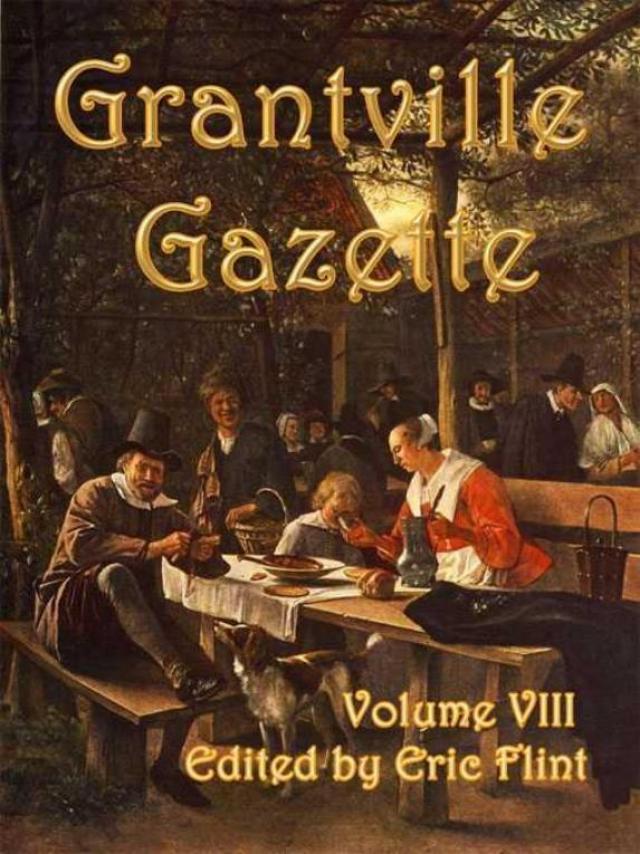
Grantville Gazette-Volume VIII
Table of Contents
Assistant Editor's Preface
FICTION:
Joseph Hanauer: Into the Very Pit of Hell
Not a Princess Bride
The Painter's Gambit
Dear Sir
The Sons of St. John
Prince and Abbot
A Question of Faith
I Got My Buck
Capacity For Harm
Flight 19 to Magdeburg
Rolling On
Three Innocuous Words
CONTINUING SERIALS:
The Doctor Gribbleflotz Chronicles, Part 3 - Doctor Phil's Distraction
The Essen Steel Chronicles, Part 2
Louis de Geer
Butterflies in the Kremlin: Part 1
A Russian Noble
NON-FICTION:
Refrigeration and the 1632 World: Opportunities and Challenges
New France in 1634 and the Fate of North America
Aluminum: Will O' the Wisp?
IMAGES
SUBMISSIONS TO THE MAGAZINE
Grantville Gazette: Volume Eight
Eric Flint
This is a work of fiction. All the characters and events portrayed in this book are fictional, and any resemblance to real people or incidents is purely coincidental.
Copyright © 2006 by Eric Flint
All rights reserved, including the right to reproduce this book or portions thereof in any form.
A Baen Books Original
Baen Publishing Enterprises
P.O. Box 1403
Riverdale, NY 10471
www.baen.com
DOI: 10.1125/0021
First electronic printing, June 2006
Production by WebWrights, Newport, TN
Assistant Editor's Preface
And here we go—on time, just as promised. Grantville Gazette Volume 8 is ready for our discerning readers.
Just what is going on in Europe these days of 1632 – 1635 or thereabouts?
Did you ever wonder where some of the old pick-up lines came from? Iver P. Cooper gives us a possible answer for one of them in "The Painter's Gambit." Tsk, tsk. Artists and their etchings . . .
Industrial magnate Louis De Geer finally gives in to curiosity and comes to visit in Kim Mackey's "Essen Steel Chronicles, Part 2." Of course, he does have his own motives. Not that Josh and Colette don't have theirs, for that matter.
Terry Howard's cracker barrel philosopher, Jimmy Dick Shaver, is at it again in "Not a Princess Bride," and you do have to wonder "who was that up-timer" after you read Barry C. Swift's "Got My Buck."
Virginia DeMarce shows us just how complicated things could be in "Prince and Abbot." Fulda will never be the same after that election. Anette Pedersen addresses "A Question of Faith." Has Father Johannes struggled with his conscience for long enough? That's a question only he can answer.
Richard Evans gives us a slightly darker view of things in "Capacity for Harm," but Russ Rittgers' Chad Jenkins accomplishes a parent's perfect revenge in "Three Innocuous Words."
The rest of the world isn't sleeping during all the changes that are taking place in Germany. Gorg Huff and I figure that something must be going on in Russia, so we told you about it in "Butterflies in the Kremlin," part one of a series. As well, a repressed sect of Christianity finds a new home in Jay Robison's "The Sons of St. John."
Faith in God comes in many flavors. Douglas W. Jones gives us another view of it in "Joseph Hanauer: Into the Very Pit of Hell."
Karen Bergstralh's new-made master blacksmith continues to build his business in "Rolling On," while Dr. Phil falls in love—wonder of wonders, not with himself—in Kerryn Offord's "Dr. Phil's Distraction." And Chris Racciato proves that there's not a new con game under the sun with "Dear Sir."
Our non-fiction in this volume covers a lot of territory, as usual. From "New France in 1634 and the Fate of North America" by Michael Varhola, to the real reason air conditioning was developed in Mark Huston's "Refrigeration and the 1632 World: Opportunities and Challenges." Last, but certainly not least, considering the reception from the Barflies, Iver P. Cooper gives us the rundown on the magic metal aluminum in "Aluminum: Will 'O the Wisp."
Fire up the coffee pot, stock up on the chocolate and settle in for a nice, long read. We hope you'll enjoy our latest offerings.
Paula Goodlett
June, 2006
Fiction:
Joseph Hanauer: Into the Very Pit of Hell
By Douglas W. Jones
Fifteenth of Iyyar, 5391 (May 17, 1631)
The congregation for the Saturday evening service at the close of the Sabbath filled the small synagogue in Hammelberg. Several out-of-town visitors brought the number well above the minimum of ten men required for the service. It was not a congregation that placed great value on formality or decorum. Each man prayed at his own pace through many of the prayers, and at times, there were quiet conversations while slower members of the congregation caught up with the rest.
After the braided candle had been extinguished and the last words of the hymn to Elijah the Prophet had faded, the congregation began to drift apart. Several small groups remained in the schul talking quietly as others left.
"Reb Yakov," a large man said. "I enjoyed your comments on the Torah portion this afternoon. You say you're from Hanau? What brings you to Hammelberg?"
"Who are you again?" the rabbi asked, looking up.
"Yitzach ben Chiam, from Kissingen," the man said. His accent held almost no hint of Judische Deutsch in it, less even than in the speech of the Jews of Hammelberg. If they had not been speaking in a synagogue, the rabbi and his companions would have taken him for a Christian.
"We're on our way to Poland," the rabbi said.
"Poland? It's a long way to Poland, and with the war, is this a safe route?"
"Is anything safe for a Jew in this world? The route up the Fränkische Saale valley is direct enough. Moische Frankfurter here has traveled this way to the Hanover fair twice. He knows the road and he has his father's notes from many more trips. So far, they've proven to be pretty good."
"But the war?"
"Now that King Gustav has left Poland, the war in that land is over, so Polish life is getting better. It doesn't take much to make it better than life in this war-torn land. For the moment, the war is all in the north, and without wishing ill on those living there, we hope it stays that way. Tilly and Pappenheim are tied up at Magdeburg, and that should keep King Gustav busy and out of the way. After we cross the Thüringer Wald, we'll stay well south of the armies."
The conversation continued until only the out-of-town guests remained. Yossie listened quietly; Yakov handled the questions. He and his two companions had faced similar questions a week previously, in the Jewish quarter of Aschaffenberg. That had been their first Sabbath away from home.
After a short while, the two women in the group rejoined their companions. They had spent the Sabbath day visiting with the Jewish women of the town. The synagogue served many purposes. It was a house of prayer and a school for the Jewish children of Hammelberg and it housed the community ovens. The bath house was attached and when there were out-of-town Jewish visitors it served as a makeshift inn.
"It must take a fair amount of silver to travel all the way to Poland," Yitzach said.
"That's why we're traveling with an experienced merchant," the rabbi said. "Reb Moische, why don't you explain how we can afford this trip."
"If we wanted to travel quickly, like a court Jew," Moische said, "we'd hire a coach and trade horses at every town. Where the roads are good, we could make a hundred miles in a day covering the entire distance at a trot. At that speed, we could go to Poland and back in a few weeks.
"If we had expensive trade goods, silk, spices, fine pottery from Delft, we'd hire teamsters from Frammersbach to drive our freight wagons, and we might make thirty miles a day. Before this twice cursed war began, my father could afford that."
Yitzach chuckled. "Is it news that the war has ruined trade?"
"No," Moische answered, "but there are still goods that you can buy low here and sell high there. It does slow the trip to a crawl, stopping at every village to buy and sell, but if you have a horse and a cart and you know the market, well, Yossie, you can make a profit. What have you bought and sold?"
Yossie wondered why Yitzach was so curious about their business. "Not much, but I didn't start with much either."
The merchant grinned. "Didn't start with much. Just books. Now what have you got?"
Yossie had enjoyed the way Moische had parried Yitzach's questions, giving almost no information in his answers. Now, he was puzzled to find that he was being asked to say more. After a Sabbath day spent in study together, they were not total strangers, so he only hesitated briefly before answering. "Well, when we left Hanau, Rav Yankel and I had a chest of copies of the Hanau Prayerbook, unbound, and a few boxes of other books, mostly Jewish but some Christian."
Yitzach ben Chiam looked startled. "So many books? What did you do, rob a Yeshivah or a print shop?"
Yossie chuckled. "We didn't rob it. Rav Yankel and I used to work at Hans Jacob Hene's printing press in Hanau. Master Hene died last year, may his memory be a blessing, and the new owner, well, he doesn't deal in Jewish books the way Master Hene did, so there was little reason for either the books or us to stay."
"So you are paying for a trip with books?"
"We sell an
"You'd better be careful which Christian books you show people in this valley," Yitzach said. "This is a Catholic valley now. If you have books of the lives of the saints, you'll do well, but if you have Lutheran or Calvinist books, be careful with them."
As the conversation wound down, the Sabbath lamp that had burned since Friday evening was extinguished. Aside from small splashes of moonlight shining through the small eastern windows, the only light came from the eternal flame over the ark holding the Torah scrolls. It was not long before the only sound in the building was the sound of gentle snores.
Sunday morning, there was work to be done. Buying and selling within the Jewish community was safe, but it was not a day to travel. Christians didn't like to be reminded that there were Jews living among them on their holy day, so the gates to the Jewish quarter remained closed.
While the merchants traded what they could, Rabbi Yakov ben Pinchas and Yosef ben Shlomo of Hanau worked as teachers in the Hammelberg schul. It was familiar work for the old Rabbi. He'd taught at the cheder in Hanau for many years, working only part time as a typesetter and proofreader at Hans Jacob Hene's print shop. He'd also worked part time as a scribe, writing the occasional marriage contract or divorce papers, or even repairing a Torah scroll when needed.
For Yosef ben Shlomo, the day's work as a school teacher was a new experience. Yossie had been a full-time print-shop worker since his parents died. Not an apprentice, though. Jews could not take apprenticeships in any of the guild trades.
Monday, after morning prayers, Yitzach ben Chiam set off with the group of travelers toward Kissingen. To Yossie, the small horse Yitzach was riding seemed large. Certainly, it was bigger and healthier than the old horse pulling the cart he and his sister shared with the old rabbi.
"Tell me," Yitzach said. "How is it that you can buy and sell so freely? I'm a Schutzjude. I know the laws that limit what we can do."
"Reb Moische, that's your business," Yossie said.
The young merchant, Moische ben Avram, gave a bow from beside the horse he was leading. "At your service. I might ask how you make a living. You face the same trade restrictions as we do."
"I'm a broker, cattle, feed, wine, you name it, I connect sellers with buyers. That's basically all a protected Jew is allowed to do aside from making loans."
"So do you ever take someone's cattle, for example, and give them silver now, before you go to look for a buyer?"
"Sure. Of course, what I do is loan them the value of the cattle, and then the buyer pays back the loan, plus a bit of interest, plus a commission."
Rabbi Yakov coughed. "But of course, you never take more than one sixth of the value."
"What?" Yossie asked. He had been admiring the way Moische had turned Yitzach's question away from their business.
"One sixth. It follows from Parshas Behar. Come Yossie, we just read it two days ago on Shabbos. What the Christians call Leviticus chapter twenty-one, but I forget the verse number. It says 'And if you sell anything to your fellow or buy anything from your fellow's hand, you shall not wrong one another.'"
"I know the text, but where does it say one sixth?"
"That is the oral tradition, the Talmud."
"But it says your fellow's hand, doesn't that mean only other Jews, not the goyim?"
"Except that the goyim around here worship our God, so they aren't idolaters. They bind themselves by the laws against theft and dishonesty, so we must treat them as our fellows in business."
"A good lesson, Rabbi," Yitzach said. "Was it Rabbi Chananya who said that where words of Torah are exchanged, the divine presence is there? But for the sake of argument, since I only act as a broker, not buying or selling, it doesn't strictly apply, does it?"
"Your status as a broker is just a legal fiction to satisfy the Christian authorities," the Rabbi said. "Of course, to support that fiction, you have to give your buyer an exact accounting, so he knows exactly what fee he is paying. A successful Shutzjude must always charge prices that are even more fair and more honest than any Christian merchant or they will cancel your protection and send you packing."
"That puts it well," Yitzach said. "Now, though, I think I'll send myself packing. My horse and I would both rather move a bit faster than you're walking. But, why not spend the night at my place? It's just outside Kissingen. When you reach the village of Aura on the north bank of the Saale, turn north up the hill to the next crossroads, then east across the upland toward Kissingen. My house will be one of the first you come to. It is on the hill looking down on Kissingen, easy to find. But if you get lost, just ask for me by my goyische name, Isaac Kissinger."
The Fränkische Saale valley led them along a winding path to the northeast through a land of chalky hills and vineyards. When the two loaded carts turned aside at the next cluster of farmhouses in the hope of selling something, Yitzach's horse quickly passed out of sight around the next bend.
The travelers slowed in every village they passed to see if they could find someone who wanted empty wine bottles or some of the ironwork Moische Frankfurter had picked up at a forge in the Spessart. They had pruning hook blades, sickle blades, hoe blades and shovel blades for sale. Whenever they had earned a surplus of silver, Moische disappeared into one of the wine cellars along the way to see if he could buy bottles of wine.
Moische did not need to emphasize that it was dangerous to have too much silver. They had already been robbed once on the trip. It was a small loss because the thieves only took silver, not the books, rags or scrap iron that represented the bulk of their wealth at that time. Wine was a more dangerous cargo than rags or scrap, but a thief who could easily take all of their silver would only be able to carry a few bottles of wine.
As required by law, they were all clearly identified as Jews. The three men in the group wore Jew badges, yellow circles, on their outer cloaks. The two women wore veils that were marked with the two blue stripes reserved for the Jews over their hair combs.