

AfterMath, page 1


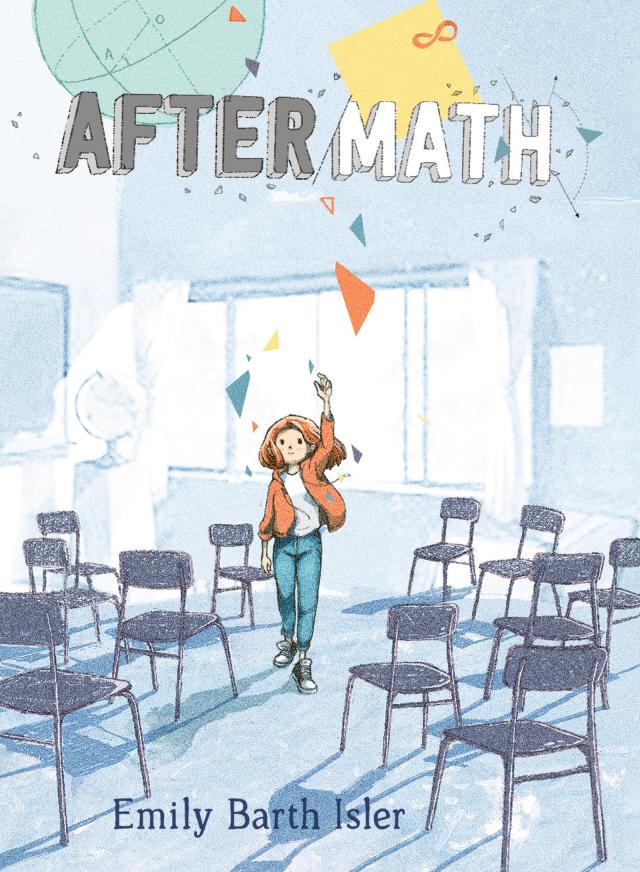
Advance Praise for
AfterMath
“This book is a gift to the culture.”
—Amy Schumer, writer, actor, and activist
“Lucy’s story of grief and healing packs an emotional punch that will tug at your heartstrings long after you’ve read the last page.”
—Edith Cohn, author of Birdie’s Billions
“AfterMath is gorgeously written, infinitely heart-wrenching, and tragically timely. Lucy’s voice is powerful and distinct. I loved this novel.”
—Leslie Margolis, author of Ghosted, We Are Party People, and the Maggie Brooklyn Mysteries
“AfterMath is both heartbreaking and filled with hope. Gentle, nuanced, and honest, Isler’s extraordinary debut will stay with readers long beyond the final page.”
—Alex Richards, author of Accidental
“Parents aren’t perfect, friendships aren’t perfect, and life most certainly isn’t perfect, but this novel comes pretty close to perfect in its fearless and compassionate exploration of the sorrows, struggles, and hard-won maturing of a spunky twelve-year-old as she deals with the aftermath of loss. The losses are real, the pain is real, but so—the author persuades us—is the saving grace of loving connection.”
—Judith Viorst, author of The Tenth Good Thing about Barney
“Emily Barth Isler handles so many potentially explosive topics with grace and subtlety but also with enormous assurance and power. This is a brave, important and even essential novel.”
—Yona Zeldis McDonough, author of The Bicycle Spy and Courageous
Text copyright © 2021 Emily Barth Isler
All rights reserved. International copyright secured. No part of this book may be reproduced, stored in a retrieval system, or transmitted in any form or by any means—electronic, mechanical, photocopying, recording, or otherwise—without the prior written permission of Lerner Publishing Group, Inc., except for the inclusion of brief quotations in an acknowledged review.
Carolrhoda Books®
An imprint of Lerner Publishing Group, Inc.
241 First Avenue North
Minneapolis, MN 55401 USA
For reading levels and more information, look up this title at www.lernerbooks.com.
Cover illustration by Dien Ton That.
Main body text set in Bembo Std.
Typeface provided by Monotype Typography.
Library of Congress Cataloging-in-Publication Data
Names: Isler, Emily Barth, author.
Title: AfterMath / Emily Barth Isler.
Description: Minneapolis : Carolrhoda Books, [2021] | Audience: Ages 11–14. | Audience: Grades 4–6. | Summary: After her younger brother’s death from a heart defect, twelve-year-old Lucy moves to a town that was devastated by a school shooting four years earlier, where she must navigate different kinds of grief.
Identifiers: LCCN 2020012553 (print) | LCCN 2020012554 (ebook) | ISBN 9781541599116 (trade hardcover) | ISBN 9781728417400 (ebook)
Subjects: CYAC: Grief—Fiction. | School shootings—Fiction. | Middle schools—Fiction. | Schools—Fiction. | Moving, Household—Fiction.
Classification: LCC PZ7.1.I874 Aft 2021 (print) | LCC PZ7.1.I874 (ebook) | DDC [Fic]—dc23
LC record available at https://lccn.loc.gov/2020012553
LC ebook record available at https://lccn.loc.gov/2020012554
Manufactured in the United States of America
1-48107-48760-4/8/2021
For Jim.
And for kids everywhere, who deserve to go to school without fear.
Prologue
I’ve never been a “pink” girl. I don’t do princesses, ponies, or purple either, for that matter. Nothing against things that start with the letter P—I’m cool with penguins, prime numbers, peanut butter, and polynomials. I’ve just never liked pink.
“Choose one, Lucy. It’s just wallpaper.”
My mother is holding up three samples for me to see. One is pink, one is purple, and one, literally, has pink and purple ponies on it. What are the odds?
“You’re wrinkling your nose,” she says. She looks more sad than frustrated now, and I feel guilty.
“I’m twelve, Mom. Those are all kind of babyish.” I try to explain, not complain, like they teach you in therapy, but it’s hard not to whine when your mom doesn’t get you at all. And sometimes I don’t feel like being extra nice even though Theo died. He was my brother, but no one is cutting me any slack. Eight months on and I’m supposed to just embrace this “fresh start.” As if a new school and a new town aren’t enough, apparently there also has to be new wallpaper.
“Oh.” My mother looks around the store, at the piles and piles of wallpaper samples and books full of them. I grab one and flip it open to a random page. It’s floral but yellow, which is better.
“How about this?” I ask.
Now she’s the one wrinkling her nose. “Yellow?”
I shrug. “I’m not committed to yellow. I can do green.” My mom squints. “Or blue?” I say hesitantly.
My mother looks exasperated. “It seems like you don’t even really care, Lucy.”
“I don’t,” I say before I can stop myself. “I mean, I don’t have strong feelings.” I’m digging my toe into the industrial carpeting, as if, in the time it will take us to select wallpaper, I might be able to burrow into the ground and disappear.
“Well, I wish you did have strong feelings. It’s your room. I want it to feel like home.”
That’s the problem. She wants it to be my room. She wants our new house to feel like home to me. But that’s going to take a lot more than wallpaper.
We eventually settle on a fresh coat of paint. Blue, which is somehow not a controversial color for either of us.
It doesn’t really matter. Blue paint isn’t going to cover the fact that my room used to belong to a dead girl.
Chapter 1
Kenton, Maryland, and Queensland, Virginia, are 31.5 miles apart via the Baltimore-Washington Parkway, and the speed limit averages 45 mph along the way. However, via I-95, the towns are 38 miles apart but with a speed limit that averages 60 mph. Which is the faster route from Kenton to Queensland?
distance divided by speed = time
via the BW Parkway: 31.5 / 45 = 0.7 hours, or 42 minutes
via I-95: 38 / 60 = 0.63 hours, or about 38 minutes
But in reality, it might as well take seven million hours either way, because it seems like we’re never going back there.
I live in a dead girl’s house. I sleep in her room.
We knew this before we bought the house. Our real estate agent, Cheryl Ann (her full name—who on earth has the last name Ann???), mentioned it during our tour. Well, technically she only said that the couple who were selling the house had lost a daughter in the Queensland school shooting. But I know that my room is the one that used to belong to the daughter, because in my new closet, on the edge of the sliding doors—covered in an anemic, barely-there coat of white paint—I found a vertical set of hash marks, with a date written next to each mark and the name Bette written at the top.
It’s a height chart. I had one just like it on my wall at home. My dad used to measure Theo and me every few months and draw lines where we stood to show how much we’d grown. Then he’d write our names and the date.
I often wonder who sleeps in my old room. Or in Theo’s. Does the kid who lives there now know that they’re sleeping in the room of a dead kid too?
Cheryl Ann also informed us that basically no one has moved to this town in the four years since the shooting, until my family. I don’t blame everyone else for staying away. If it were up to me, I would have.
I hate that we moved. Especially to this town, where practically everyone lost someone. (In case you were wondering, Cheryl Ann lost a nephew.) My parents considered several empty houses here, because so many people have moved away over the past few years. The elementary school where the shooting took place was demolished afterward, and now there’s a garden where it used to be. And the new elementary school across town is tall and modern, with prison-style lockdown safety features and bulletproof windows. The middle school, where I’ll start seventh grade this fall, has gotten security upgrades too. Cheryl Ann made sure to tell us that.
We’ve driven by the memorial park a few times. Sadness seems to hang from the trees like brown, shriveled leaves that never fall off and never get replaced by fresh green ones. It feels like there’s no rebirth here. Only death, and memories, and sadness.
“At least it’s not our sadness or our memories,” my dad said when I asked why we were moving to a town where so many people had died.
“And we got a heck of a deal on the house,” my mom added. Which is kind of sick, when you think about it.
What my parents really care about is that we’re not back in Kenton, where my brother died, where the family we used to be is buried with him.
Not much is changing for them. Both my parents work in Washington, DC, in government jobs. In Kenton, we were twenty-five miles outside DC, in a Maryland suburb with good schools and nice trees and pretty houses.
Now we’re still twenty-five miles outside DC, just in the opposite direction, but it feels like a world away. Queensland, Virginia, is also a nice suburb with trees and houses. And you can buy the houses for cheap because no one else wants to.
“We won’t stand out here,” my parents say to each other when they think I’m not listening. But I’m always listening. I was almost seven when Theo was born. After he was diagnosed with his rare heart condition, I learned early on how to hear what Mom and Dad were muttering, even when I wasn’t supposed to.
My parents get to keep their jobs. Their coworkers and schedules are the same. But for me, everything is new, and everything has changed.
For them, this place is an escape from the memories of the doctors and the specialists and the nightmare. For me, starting seventh grade in this place is the nightmare.
“Lucy, what are you wearing to school tomorrow? Do you need help choosing something?”
I swallow my mashed potatoes. “Nope.”
“That’s not an answer, Lucy,” my dad says.
“Yes it is,” my mom pipes up, passing him the green beans. “I asked if she needs help.”
Dad takes some beans with his fingers. “But you also asked what she’s going to wear. And that isn’t a yes-or-no question.”
“Technically,” I say quietly, “I said ‘nope.’ Not ‘yes’ or ‘no.’ ”
No one hears me. Or rather, no one listens.
“She says she’s got it under control,” my mom says, her smile tense and tight. “We have to let her make some decisions.”
“Okay, but I was just trying to increase communication. That is the point of these family dinners.” If my dad realizes how ridiculous it is that he’s talking about communication and ignoring me at the same time, he doesn’t let on.
“Lucy,” Mom says, almost looking at me but not quite, “I’ll drive you there tomorrow. I can’t come into the school, because I can’t be late for work, but you won’t have to take the bus on your first day. Okay?”
She always ends with “Okay?” but it’s not actually a question. Or the question is always “Okay, did you hear me?” Not “Is that okay with you?”
I smile. I nod. Dinner’s over.
It’s my job to clear the table. After I load the dishes in the dishwasher—stacking them all facing the same way, just how my mother likes them—I linger by the kitchen sink and watch my parents. They sit at our brand-new dining room table, in chairs that are stiff and way too formal-looking. The chairs are upholstered in velvet: hard to get comfortable on and impossible to clean. My mom fell in love with this house mostly because of the dining room, something we didn’t have in our old house. Here, she wants everything to be different. Everything is definitely different, that’s for sure. But, like an unbalanced equation, “different” doesn’t equal “better.”
I’m behind the half-partition wall, so they can’t see me, but I can see and hear everything. So I study them.
My parents are triangles. They are all sharp edges and straight lines, corners and angles. They are pointy and firm. Since Theo died, I’ve noticed how hard it is to hug a triangle. Where do you put your arms? Where do you rest your head?
Together they form a square, but I don’t fit in it. There’s no room.
I am a line. Theo was a line. We both extended, until his line stopped. Mine continues, but I don’t know how to make it pierce through the triangles of my parents sitting at the dinner table, accidentally brushing arms in the hall. I don’t know how to make an angle and then another, to turn back around and get back to where they are. I am a line, and I just keep going. Alone.
I used to get so desperately sad thinking of Theo being all alone in death. I particularly worried about him dying in his sleep, without anyone noticing for a while. So I started regularly sneaking into his room after he fell asleep for naps or even in the middle of the night. I’d put one of my favorite stuffed animals in his crib with him. Then I’d creep back to my own room, satisfied that at least he had Cuddles or Tiger for company, in case that was the day he would start his long journey alone to whatever was after life.
Queensland Middle School’s main office has vibrant 1970s carpet and pea-green walls. It’s easy enough to find when I walk in the front entrance, thanks to a big sign above it with four arrows pointing to the left. Inside, it’s less clear where I am supposed to go.
I stand for a while between what seem like two different reception desks, feeling lost, until a woman who looks like she’s worked there since before the 1970s carpet was laid out pops up from out of nowhere and waves me over to the desk on the right.
“You’re Lucy Rothman,” she says flatly.
I look around, as if maybe there’s a sign above me with my name and four arrows pointing down. “How did you know?” I ask, not wanting to sound rude, but genuinely surprised that she knows who I am. And that she didn’t ask, she just pronounced.
The lady shrugs. “Haven’t had a new student start here in a long time.” And she hands me a stack of papers. Her voice never wavers from a bored monotone, and her eyeglasses slip lower and lower down the bridge of her nose as she stares at me, though that does not seem to bother her.
“Welcome to Queensland Middle School. We hope you enjoy seventh grade.” She says this with such robotic, expressionless boredom that I almost laugh. Maybe I’m just nervous.
I’m so distracted by the receptionist that I don’t notice the other person in the office until the woman gestures to her. “Mara is going to lead you around school until you get the lay of the land.”
I turn to look. Mara is tall and pretty, with long blond hair and a large, funny-shaped freckle on her right cheek that doesn’t at all make her less beautiful. If she thinks the robotic receptionist is funny too, she doesn’t let on.
“It’s nice to meet you,” she says to me.
I smile and mumble, “You too,” and follow Mara outside the glass enclosure of the office. “I have art first with—” I start to say, but she cuts me off.
“I was in one of the classrooms where kids hid in the closet,” she tells me. For a moment I have absolutely no idea what she means. Until it hits me all at once, like a bomb dropping in the middle of the hallway right at my feet, creating a hole in the ground that only I can see. BOOM.
Mara doesn’t seem aware that it’s a bomb. But to me, it feels like I’ve just stepped off a cliff into that crater and can’t find the parachute cord to pull, let alone figure out what to say to this.
I know all about the town. Anyone who has ever watched the news in America has heard of Queensland, where a gunman broke into the elementary school and went on a shooting spree. I just assumed that, the way I don’t plan to mention Theo to anyone here, no one would be talking about the shooting. To me, it seems like Coping 101. Don’t talk about your tragedy in public.
Instead, it’s all Mara is talking about.
“Our teacher was shot, of course. I heard the gunshots, but I didn’t see anyone die,” she tells me as we walk to art class together. “At least not that I remember. I have PTSD, and I blocked a lot of it out. My therapist says I might remember more someday, but my dad says it’s better if I don’t.”
I nod, my head ringing. It all sounds completely surreal. I don’t know what to say. Honestly, I’m thinking about Mara’s plaid dress, and how, compared to it, my jeans and ironic Pac-Man shirt look stupid. And I immediately feel terrible for thinking about clothing when Mara is talking about death and tragedy. It’s just not what I expected.
“Well, now that’s out of the way,” she says. Maybe Mara thinks I wanted to know where she was during the shooting, like I would have asked if she hadn’t offered first. Maybe other people she’s met have been curious, and rude enough to ask, because that’s all outsiders know about Queensland.
And now, like it’s all so very normal, she announces, “This is art.” We’ve reached a room at the end of the hall. The school is shaped like an octagon, and all eight sides/hallways look identical to me. Normally, I would chart the octagon out in my mind, bisect it, cut it into triangles, and arrange it in my mind till it made geometric sense. But I’m still distracted by the details of the shooting that I’ve gotten from Mara, and I can’t quite map it. I am never going to learn my way around.
“Thanks,” I say weakly. I shift my backpack from one shoulder to the other, noticing that Mara just carries a few books in a tote bag.
A boy walks by us—shorter than Mara, with curly, red hair. He nods to Mara and disappears into the art room.
“That’s Donny. His twin brother died in the shooting. They were identical twins. Isn’t that weird? Like, his parents have this exact replica to watch grow up, but they’re still sad. You know?” Boom goes another bomb.


