

A Key To Many Doors, page 1


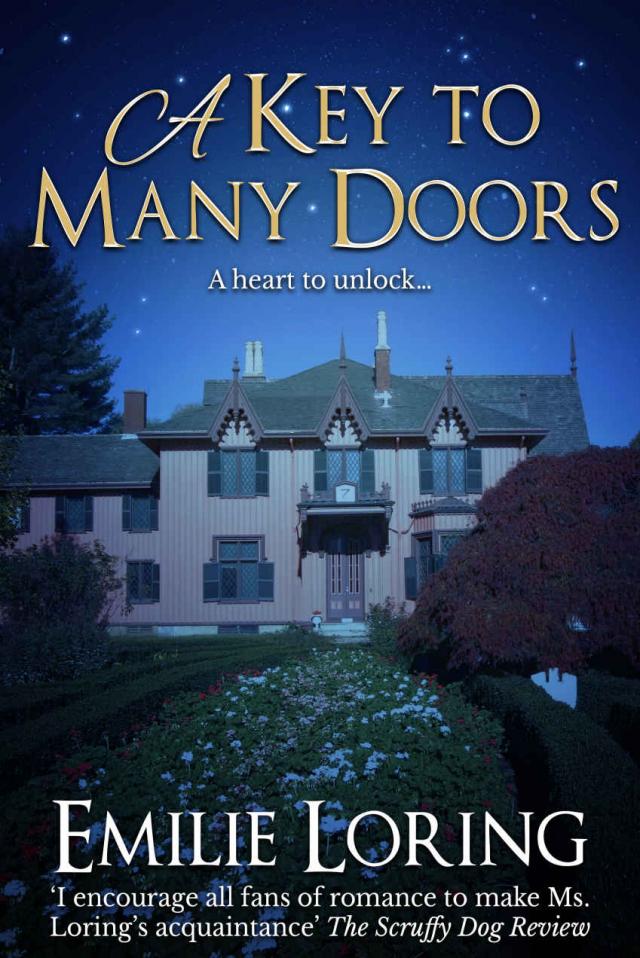
A Key to Many Doors
Emilie Loring
© Emilie Loring 1967
Emilie Loring has asserted her rights under the Copyright, Design and Patents Act, 1988, to be identified as the author of this work.
First published in 1967 by Robert M. Loring and Selden M. Loring.
This edition published in 2017 by Lume Books.
TABLE OF CONTENTS
ONE
TWO
THREE
FOUR
FIVE
SIX
SEVEN
EIGHT
NINE
TEN
ELEVEN
TWELVE
THIRTEEN
FOURTEEN
FIFTEEN
SIXTEEN
SEVENTEEN
EIGHTEEN
NINETEEN
TWENTY
TWENTY-ONE
ONE
THE SHOP, discreet and unostentatious as it appeared from the outside, was one of the most famous in the world. Carefully screened by plainclothes detectives, it admitted only a few customers at a time. Here, but never out of range of watchful eyes, they had displayed before them, in a room that resembled a drawing room rather than a jewellery shop, fantastically beautiful and expensive diamonds.
When Peter Gerard appeared, the manager himself came to greet him, hand outstretched.
“Mr. Gerard! This is a pleasure. We haven’t seen you since you selected that diamond engagement ring. I hope the young lady was pleased.”
Recalling Cynthia’s rapturous exclamation when he had slipped the ring on her slender finger, Peter smiled.
“Peter darling! It’s the loveliest thing I ever saw. It’s magnificent, and it must be fabulously expensive.”
Even at the time he had wished, a trifle uncomfortably, and yet ashamed of feeling any criticism toward his beloved Cynthia, that she had not referred to the money value of the ring.
“It seemed to belong to you, my dearest,” he had told her.
“I’ll never part with it. Never!” She had flung her arms around his neck and given him one of her rare, cool kisses.
“And what,” the manager inquired, bringing Peter back to the present, “may we show you today? A gift for the bride?”
“A gift for the bride,” Peter agreed.
“A pin? A bracelet? A necklace?”
“A necklace,” Peter decided, and the manager beamed.
Attendants brought into the room half a dozen necklaces — there were no display counters in this shop — laid them gently, almost reverently, on black velvet. While Peter inspected them the manager inspected him. He was the third generation of the Gerards to patronize the great diamond merchant, although, until his engagement, he had rarely made purchases, except for gifts for his mother or his cousins. His father and grandfather had long been valued customers of the firm.
There was little of Peter senior in the young man’s face or bearing, the manager thought, but no one could mistake his remarkable resemblance to his grandfather: the same broad sweep of forehead, the same heavy dark hair, the same deep-set dark blue eyes under arched brows, the same rather high cheekbones and beautifully shaped mouth, whose expression of gentleness was offset by the firm chin. A fine-looking man, the manager thought. He hoped that the girl with whom Gerard appeared to be so deeply in love would prove to be worthy of him. Men of great inherited wealth who prefer a life of service without striving for power to one of self-indulgent amusement are rare.
“This one,” Peter said at length and the manager smiled.
“You remind me more and more of your grandfather, old Simon Gerard. He had an infallible eye. That is probably the most beautiful diamond necklace we have ever handled.” He pointed out details. “Naturally, in view of the size and color of the stones, the price —”
Peter lifted a hand to check him. “The groom’s gift for the bride. I wanted it perfect.”
“Shall we send it to your townhouse, Mr. Gerard, or deliver it to the young lady?”
Peter hesitated for a moment, considering. Then he smiled.
It was a smile that transformed his face, making it warmer, younger, irresistibly likable. For a moment something of his father’s lighthearted spirit broke through his usual gravity.
“I’m being married tomorrow,” he said. “I’ll take the necklace with me and give it to her myself.”
“It’s an extremely valuable thing to carry,” the manager said uneasily. “Unless you’d like a guard. We can provide someone.”
Peter laughed outright, a joyous ringing laugh. “Good Lord, man, I can take care of myself. Anyhow, I have a feeling that this is my lucky day.”
“We’ll hope that it is,” the manager said, with no answering mirth on his troubled face.
When Peter, the jewel case tucked carefully into an inside pocket of his overcoat, had started briskly down the windswept street, which was beginning to whiten from a light snow, the manager watched his easy stride, his fine carriage, the proud way he carried his head.
“He isn’t even driving,” he muttered to himself, after looking along the curb for the long sleek black lines of the Gerard town car, for the uniformed driver. “Young men are so reckless. I do hope he’ll be careful. Not that anyone would be likely to suspect him of carrying thirty-five thousand dollars worth of diamonds in his pocket. If he has any sense he’ll deposit the necklace in a safe as fast as he can.”
*
The manager would have been even more perturbed if he could have followed Peter Gerard. Instead of hailing his own car or even a taxi, Peter dived down the stairs of a noisy subway station, wedged his way onto the platform, stood packed against a throng of swaying, pushing men and women, their clothes steaming with wet snow; watched with unseeing eyes the white-tiled stations pass in a blur, unaware of the noise of the train.
Why Brooks had summoned him at all, and summoned him to this preposterous address, baffled him. Why the whole thing had been veiled in secrecy annoyed him. It wasn’t like his boss to act like James Bond. For a rising young diplomat the whole thing was ridiculous.
A rising young diplomat. He had, Peter acknowledged to himself, done well. Resisting all his father’s persuasions to go into the family business; resisting the more insistent pressures of his playboy acquaintances to devote himself to yachting, skiing, sun-bathing, following the perpetual restless holiday seekers; resisting the deepest pressure of all, his longing to become a painter, he had followed the lines he had marked out for himself.
There were, as he had told his father, any number of men in the organization who could handle the business as well as he could. Probably better, because their hearts were in it. He already had more money than he would ever need. Beyond that, the mere accumulation of money could be only a power drive, and Peter profoundly distrusted men who sought power. What he wanted was to be of service to his world. He had too large a share of its benefits.
Because he had put all his heart and mind and energy into the job, because he had an instinctive sympathy for other peoples, because he was willing to try to understand points of view and ways of life unlike his own, he had risen fast in the diplomatic service.
Now the future stretched clear ahead. In one month he was to embark on the most important assignment he had ever held. True, he had worked for it. Until he had met Cynthia he had not permitted any outside interest to deflect him from his course.
Cynthia! He conjured her up in his mind, small, blond, with soft blue eyes, a small red mouth, a helpless, gentle, dainty creature whom he longed to protect. Cynthia! A smile of delight crept over his face.
Then, as his station flashed into view and the train began to slow, the smile faded. Something about the unaccustomed gravity in Brooks’s voice had disturbed him but he had resolutely pushed the feeling aside. Nothing was going to spoil the perfection of this day. In less than two hours, he was going to meet Cynthia and give her the necklace. Tomorrow they would be married. In a month, he would take up his post in one of the great European capitals.
I’ll never be this happy again, he thought unexpectedly. I’m on the crest of the wave. This is the peak moment of my life. He pushed his way through the crowd that jostled and shoved its way out of the subway train at Fourteenth Street.
Union Square is a down-at-heels section of New York City. Here, on summer nights, the disgruntled make passionate speeches, attacking the government and making shrill appeals to the passing crowds who rarely pause to listen. The light covering of snow had added no beauty to the dingy spot; it had simply intensified the discomfort.
The address, which Peter had been asked to memorize — “Don’t write anything down,” he had been warned — was an obscure building, an ancient loft structure, that appeared to be almost uninhabited. An oddly furtive sort of place in which to meet a man like Kendel Brooks. As Peter pushed open the door and closed it behind him, he was aware of a queer kind of premonition that he had taken some momentous step, that nothing would ever be quite the same again.
A shabby, weary-looking old man sat in a worn chair holding a newspaper behind whose shelter he was dozing. After a look at the open-caged, ramshackle elevator, Peter decided not to awaken him and walked up the dirty staircase. There was no name on the door of the room where Brooks waited, but Peter remembered his instructions. It would be the last door on the left on the side of the building facing Fourteenth Street.
Absurd to have this sense of reluctance, but when he knocked on the door and heard Brooks’s familiar deep voice call, “Come in,” he was relieved. What had he expected, he jeered at himself. A gang of thieves? An opium den? A trap of some sort? He had better curb that imagination.
There were three men sitting at a table in the bleak little room. One of them was Brooks, tall, distinguished, suave. The second was a quiet man so ordinary in appearance that one might pass him a dozen times a day without recognizing him. Something in the unobtrusive blue suit, the bland face that gave away nothing, the eyes that saw everything, alerted Peter. FBI, he thought. What was going on, anyhow? The third man, in late middle age, with thinning hair, a disciplined face, and an air of authority, was known to everyone who read the newspapers or looked at television. If a man of this caliber attended the meeting, something big was in the offing.
For a moment Peter stood quietly, relaxed and at ease, while three pairs of eyes studied him. Then the Personage nodded, and Brooks said, “Glad to see you, Gerard. I am privileged to present you to —” He broke off as the Personage lifted a hand in protest.
“I know the name, sir,” Peter said with a smile.
“And Mr. Foster. Mr. Gerard.”
“FBI?” Peter asked.
“FBI,” the other agreed.
The men shook hands and Peter pulled up the fourth chair. The man from Washington took charge of the meeting. Not one to waste words he talked swiftly, hammering home his points. For the first time Peter understood why he had always been so brilliantly successful in dealing with interviewers, in public debates. He was prepared with the facts and he knew how to marshal and present them clearly.
“This, of course,” he concluded, “is not to go beyond this room. Brooks says you are a man whose discretion can be relied upon. We are gambling on the fact that he is showing his usual sound judgment of men.”
Peter drew a long breath. “A conspiracy on such a big scale! It’s hard to take it in.”
There was no reply. The three men were watching him, summing up his reaction to the story, weighing him in the balance.
“Any questions?” the man asked.
“Yes, of course. Why tell me all this, even if you rely on my good faith? What have I to do with it?”
“You have everything to do with it,” the other said. “It is true that the material is being mailed in New York, each time from a different borough, but the core of the organization is in a little New England village. Simonton, Connecticut. Named for your great-grandfather, I believe.”
Peter stared at him in disbelief. “That is impossible,” he said flatly. “There must be some mistake. There simply couldn’t be subversive activities of these gigantic dimensions carried on in Simonton. I know that village the way I know my own hand. I know the people. I —” He broke off as he saw the broad grin on the austere face of the Personage, saw the answering smiles on the faces of Brooks and the self-effacing FBI man.
“That,” the Personage said, “is why we need you there, Gerard. As a matter of fact, you are the only possible man for the job. We have no choice.”
The silence seemed interminable. Then Peter said quietly, “I think what you mean, sir, is that I have no choice.”
There was an awkward pause and then Brooks leaned forward. “Look here, my boy, I’ve known you all your life. I know your family, your background. I think I know your caliber. I know, too, that what we are asking is a tremendous personal sacrifice. It means that you will relinquish a diplomatic post which you richly deserve; that you will be, in a sense, working underground. A job that carries with it no public credit or reward.”
As Peter stared at the table Brooks went on, “You have always believed that service for your country is the most important function you can perform. This service will, I assure you, be far more urgent than any diplomacy you could handle. In a sense, you are the only possible man for the job. As you say yourself, you know the village. You know its people. And what’s more important, they know you. Your presence would go unquestioned, while that of an outsider would be bound to arouse curiosity. But — you do have a choice, Gerard. We cannot order you to take this assignment. We merely ask it of you.”
At last Peter looked up. To the relief of the three men he was smiling.
“If that’s what the country wants of me, I’ll do my best.”
The man from Washington leaned forward, holding out his hand. “We are grateful, Gerard. Truly grateful. And when the time comes, we will try to show our gratitude in an adequate way. A tangible way. There are other, even bigger, diplomatic posts, you know.”
Seeing Peter’s discomfiture, Brooks, who knew him well, broke in. “Of course,” he said practically, “you’ll need some sort of cover. You’ve got to be able to account for going back to the village this winter, when everyone will expect you to take up your post in Europe.”
Peter thought, considering and discarding ideas. “Well,” he suggested at length, “I’ve always longed to be a painter. It’s more than a hobby. I have a studio up at the Connecticut house. I could also claim to have some physical disability, if that would help; say that I have to rest for a few months so I’ll spend the time devoting myself to painting.”
The FBI man nodded. “As long as you know your stuff,” he said warningly. “But if they begin to wonder about you, they will have an expert ask questions that might prove embarrassing. As a matter of fact, watch out for anyone who appears to be curious about your presence in Simonton.”
“I spent a summer studying in the studio of a first-rate man in Paris. I think I can pass their tests.” Peter pinched his lower lip between his fingers while he thought. “Of course,” he said at length, “if at any time it should prove — desirable to arouse their suspicions, to draw their fire if I haven’t been able to smoke them out in any other way, my physical disabilities could prove to be nonexistent.”
“Don’t stick your neck out too far,” Brooks warned him. “If you need outside help we’ll get it to you, but for a case like this it’s safer to be a lone wolf. We’ll give you a number you can call in an emergency if you should need reinforcements.”
“I have a friend up there, best friend I have in the world. If I need help I’ll call him in. I’d trust him with my life.”
“No,” the FBI man said. “No!”
“But —”
“It isn’t your life,” the Personage pointed out, “and you aren’t to trust anyone. Is that understood?”
Peter’s lips tightened but he nodded his head in agreement.
“Now,” the Personage said, smiling faintly, “we come to the most difficult problem. Your wife.”
“I’m not married — yet.” Peter’s smile lighted his face. “I will be tomorrow.”
“And what will happen when you tell her of this sudden change in plans?”
“She is going to be disappointed,” Peter admitted frankly. “Very much disappointed, I am afraid. She has been building a kind of musical comedy glamour picture of acting as hostess for an ambassador in a great European city. But — we love each other very much, sir. Cynthia will fall in with my plans. I can’t conceive of her failing to do that. She’d share anything with me.”
“The point is,” Brooks pointed out, “that this is something you can’t share with her. I am sorry, but that is the way it has to be.”
The Personage stood up, indicating that the interview was at an end. Chairs scraped back. “Get up to Simonton as fast as you can, Gerard. Find those men for us and find them in a hurry. We’ve got to stop this thing. It’s building up like a snowball.” He shook hands, started for the door, turned back.
“I’m pinning a lot of faith in you. We all are.”
TWO
CYNTHIA had agreed somewhat reluctantly to meet Peter in front of the Vermeers at the Metropolitan Museum of Art. She would, he knew, have preferred one of the fashionable cocktail bars but on this one point he had been adamant. As he usually agreed to her wishes without discussion, she had accepted his plan.
Though he would not admit to himself that his lovely Cynthia had any failings, Peter had been disturbed by her liking for cocktails. After they were married, he told himself, that would all change. Meanwhile, he explained tactfully that since their marriage was to be a very quiet one, the service to be performed in the small Manhattan church which the Gerards had supported for generations, it would be unwise for them to be seen together publicly and so arouse the speculations of some gossip columnist. The Gerards, however unostentatiously they might choose to live, were always news.


