

The Death I Gave Him, page 1


Praise for
THE DEATH I GAVE HIM
“Liu’s exquisite prose perfectly marries physicality and emotionality, the visceral and the sterile. This is Hamlet reflected in a fractured mirror. Every angle on the familiar comes as a surprise; every new edge cuts with razor intelligence. And oh, the tension! It will murder you.”
Shelley Parker-Chan
“Blazingly ambitious, immaculately written, imaginative, and oh, goodness, I can absolutely keep going. The Death I Gave Him is the locked-room murder mystery queer Hamlet retelling of my dreams.”
Cassandra Khaw
“The Death I Gave Him is the Hamlet retelling of my wildest dreams, and Liu’s prose cuts like a scalpel: precise, unflinching, unafraid to draw blood. Read this book, and then read it again.”
Grace D. Li
“This is both a locked-room mystery with some pointed things to say about science, hubris and mortality, and one of the best versions of Hamlet I’ve ever come across. Smart, wildly propulsive, and tense as a muscle held at the snapping point. After this, I’ll read anything Liu cares to put in front of me.”
Freya Marske
“A taut emotional thriller, a deeply queer love story, sexy as hell and far kinder, far more humane, than Hamlet itself. A sliver of freedom granted to its characters to make choices beyond them in the original play, a release from context, or gender, or genre even.”
Alexis Hall
“I’ve always been kinda lukewarm about Hamlet, but The Death I Gave Him finally gives me a Prince of Denmark I can feel: someone whose pain and brokenness are so powerful and beautiful that they can change the world.”
Sam J. Miller
“A breathless, piercingly immersive Hamlet reimagining that feels at once futuristic and timeless. Each scene is layered with creeping dread and tension that builds masterfully to a harrowing climax.”
Ren Hutchings
“If you love Shakespeare, a haunted-house escape room, and a plot full of tenderness, philosophy, brazenness, and terror—as well as the unexpectedly erotic—this is the book you never knew you’ve always wanted.”
C. S. E. Cooney
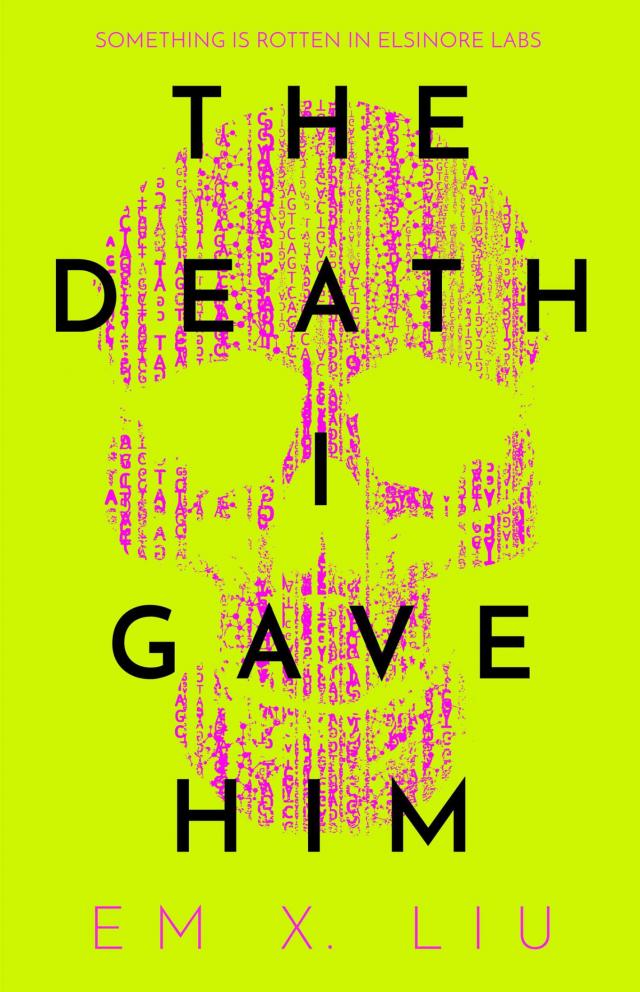
THE DEATH
I
GAVE HIM
EM X. LIU
First published 2023 by Solaris
an imprint of Rebellion Publishing Ltd,
Riverside House, Osney Mead,
Oxford, OX2 0ES, UK
www.solarisbooks.com
978-1-83786-000-5
Copyright © 2023 Em X. Liu
The right of the author to be identified as the author of this work has been asserted in accordance with the Copyright, Designs and Patents Act 1988.
All rights reserved. No part of this publication may be reproduced, stored in a retrieval system, or transmitted, in any form or by any means, electronic, mechanical, photocopying, recording or otherwise, without the prior permission of the copyright owners.
This book is a work of fiction. Names, characters, places and incidents are products of the author’s imagination or are used fictitiously.
A CIP catalogue record for this book is available from the British Library.
eBook production
by Oxford eBooks Ltd.
www.oxford-ebooks.com
For:
妈妈, 爸爸, 飞飞
FOREWORD
One muggy August Sunday of 2047, the Elsinore Labs Operating System—though he prefers Horatio—clicks on with very little fanfare for what has just occurred within his walls. It takes nearly a millisecond for his processes to sort it all out. Excess carbon, hissing into the vents; a bright red dash amidst all the white assaulting his optic sensors; the distinct and potent chemical stain of sulphur still concentrated enough in one area for Horatio to direct awareness there: Dr Graham Lichfield’s personal lab. One heartbeat present. Two point eight degrees Celsius hotter than the weekly average, but trending downward. Iron in the air.
The myriad details coalesce into a corpse. As soon as this becomes clear, the rabbiting of the remaining heartbeat in the room resolves into sense as well. An easy 110 bpm, tachycardic enough for panic. Horatio blinks the cameras open and finds shattered glass, a pool of blood still fresh enough to leak between the tiles. Violence smeared across the entire tableau. A correction, then: the late Dr Lichfield’s personal lab.
Of course, in 2047 the Lichfield name had yet to become known in the ever-striving field of gerontology, much less infamous in the greater public consciousness. Furthermore, the eventual notoriety would come to be claimed by the son and not the father. There was no way of knowing, at the time, that this moment—this death—would ripple outward with consequence. That day, the grief in the room was insular, shared only by its occupants: Elsinore itself, incarnate by stalwart Horatio, and Hayden Lichfield.
Hayden Lichfield is an oft-blurry, certainly controversial, but no doubt pivotal figure in the sea change that occurred sometime in the mid-late 21st century. Longevists have existed since human death was a score to contend with, but a slew of experimental trials were starting to show, for the first time, that perhaps the prophets were knocking on reality’s door. No longer relegated to the realm of pseudoscience, senescent research—the study of aging, which is inextricable from the study of immortality—was reaching its full potential. Technology had finally caught up to what everyone had known all along: we alone have dominion over the body. We can, as Feynman once said, “swallow the doctor,” and use our hard-won skills to manipulate the forces that drive us towards our inevitable end—and halt them.
This book does not aim to illuminate how this paradigm shift came about, or even the factors at play that led to the inevitable change. And indeed, I doubt that the scientists working with their heads down and hearts hopeful in 2047 were envisioning the chaos they would sow—as we all know now, immortality is cheap these days; the real questions are, for whom and to what end? Truthfully, I don’t believe we will know the true echoes of this revolution until long into our future, a timeline that stretches out even further because it deals with the very nature of eternity.
I was a bright-eyed (some would say naive) history student trying to put an undergrad essay together about the tail-end of the digital dark ages when I first came across the story that would later become my master’s thesis, and then this book. At the time, I was primarily interested in the siloing of information, the utterly paranoid zeitgeist stemming from the looming collapse of all communication networks as people knew it. And of course, the Elsinore incident came up often in this context. I knew the story in its bare bones at the time: Dr Graham Lichfield the visionary, a king of paranoia in his own right, sends his son on a terrible mission to ensure the safety of their research, only for the grave secret to escape his careful clutches regardless. It was a story about the failure of containment, that nothing is truly private.
But looking deeper, what captivated me in the end was not the ways in which Dr Graham Lichfield failed, or the betrayal of his companions, or the crumbling structure that kept them all captive for twenty-four hours. It was Hayden Lichfield who I remembered.
Not because he was brilliant (though he was), but because he was afraid. Few know that it was Hayden who proposed the Sisyphus project, and even fewer understand his reasoning. I felt as if I was uncovering a humiliating secret, poring over my primary sources, because I could see it. Hayden Lichfield was afraid of death, because he was afraid of failure, and he spent his whole life trying to reverse it.
That is what this book is about, first and foremost. A retelling of that fateful night in Elsinore, as best as I could reproduce. My main source is the neuromapper1 log between Hayden and Horatio that ran throughout most of the night, and I have done my best to untangle the account from either of their perspectives, albeit with my own editorial touch. Other primary sources include an incisive and thorough article Felicia Xia—Hayden’s ex-girlfriend, and daughter of Elsinore Labs’ head of security—published following the court proceedings; audio transcripts retrieved from court documents; and other official documents I could find. The story is fragmentary, I admit. But I implore you to embrace the experience, see what you may uncover between the lines.
Looking back, what I vividly recall is the night that first essay was due, after the storm sirens had all quieted so I was faced only with the eerie stillness of campus, interrupted only by the stabs of neon holo, advertising last minute neuro-rewiring study aids; the sound of my own frantic typing (I was and am old-fashioned); the footsteps of my classmates ducking into the light drizzle outside. I thought of Hayden, then. I thought of his fear, because I understood it. I was a first-generation university student hailing from a continent that had gone dark decades ago, swallowed by the sea much like the original Danish shores Elsinore once sat on. My parents still do honest work, with their hands—because even now, in a post-human world, some things run on bodied labour. Hayden was not like me, but he was afraid of the same things that I was, and his fear changed the world.
* * *
1 One of the earliest instances of whole mind upload technology pioneered by Dr Graham Lichfield some half a decade prior. It processed neural impulses, solidified synaptic patterns into coherent thought, and wired them into existence. Graham Lichfield’s own neuromap recordings have been lost to time, but Hayden’s from that night have been preserved.
“As far as I am aware, Dr Graham Lichfield was dead by minutes before he was found.”
—Denmark v Lichfield,
243 UFR, 154 (S.C.D.K. 2050)
HORATIO
Here we are in the lab, and the only living occupant is Hayden.
“Horatio,” he says.
Hayden Lichfield kneels beside his father’s corpse, one hand white knuckled on his thigh, the other braced on the ground. “Hora—tio,” he says again, his voice cracked in two around the name.
There is blood on his fingertips. Behind the lens of his glasses, his eyes are blurred, wet caught heavy on his lashes. His breath comes in spurts, heaving, the lines of his neck drawn tight as he turns his face up towards the camera.
“Hayden,” Horatio manages to say. “What happened?”
“Take a look around,” Hayden says, a wry twist to his mouth even now.
“I have,” Horatio says delicately.
Hayden makes a little gasping sound, far back in his throat, then shudders, a brutal motion that takes hold of his entire body. He clasps a hand to his mouth, doubling over. There are red streaks all over his face, a thin glaze over the dust of freckles on his cheeks. “’M sorry,” he mumbles, gaze lost to Horatio, pinned somewhere far away. “I don’t know.”
“Hayden,” Horatio says again. He is softer, now, aware of the faint tremble of Hayden’s fingers.
“Are the cameras running?” he finally says, instead of an explanation.
“Why does that matter right now?”
There is a disconcerting story slowly solidifying in Horatio’s understanding. A fresh body, Hayden’s fear, his wild eyes so paranoid of surveillance. Horatio’s programming, designed to slice through arrays of possibilities with elegant certainty, understands immediately the implication resting on Hayden’s shoulders. Horatio waits.
“Are the cameras recording us right now?” Hayden asks with increasing urgency.
“No,” Horatio says, and decides to give Hayden his trust, as always.
Hayden pries himself off the ground. His chest rises and falls, and he does not turn towards the corpse. Instead, he rests a hand against the touchscreen of the nearest computer console and turns it on with a reflexive flick of his wrist. Horatio is ever familiar with the contents, even more familiar with Hayden’s desperation to protect it. The console holds everything on the Sisyphus Formula, the most important thing Hayden and his father had ever created. As the data blurs under Hayden’s fingertips, Horatio remembers what it took to create it: desperate nights holed in fume hoods, gel stains done and redone, the flicker of enzyme equations scribbled with more and more haste as the days dragged on. An echoing flicker now, as words fly by Hayden’s face too fast for human eyes to follow. Horatio catalogues it all anyway: ß-catenin, constitutively active, Sisyphus Formula in beta…2
“Is everything here?” Hayden asks, slamming a palm flat on the screen to stop it all. There is a screaming cord of tension in his shoulder that makes it look like his hand is all that is holding him upright. It shows up harshly against the black and white text, the only thing Horatio can pay attention to instead of the research writ underneath, the crawling veins snaking underneath his paling skin. Fragile and yet solid and always a world away. Impossible for Horatio to support. Hayden works his jaw. “There’s nothing missing, right?”
This, at least, is something Horatio can give him. “Everything’s in place. I can’t find any records of files being moved or modified since last night.”
“And is there anyone coming? Your hall cameras are still functional, right?”
“Nobody.”
“Who else is in the building?”
“One lab tech on duty. Your uncle is in his office, along with his private security detail—the usual, Paul Xia.” Horatio pauses. “And Felicia.”
“Shit.” Hayden scrubs a hand over his face. “What is she doing here?”
“She came with her father. I think she was curious.”
“What was the occasion?” The strain in Hayden’s voice is palpable. Whatever Hayden sometimes thinks, Horatio is not entirely oblivious to the whole sordid tale between them. Felicia Xia has occupied many roles in Elsinore—research intern, fellow student, Hayden’s once-partner—but who she is herself is a distant but impossibly bright figure to Horatio, filtered as she is through other peoples’ recounting instead of anything Horatio knows for himself.
“Your uncle asked for a meeting. He didn’t say why.”
Hayden’s eyes narrow. “Suspicious.” His hand curls into a fist against the screen. “Is it just a coincidence? Can’t be.”
“Are you asking me?”
“Why would they come in the middle of the night? Who knew they were coming? Did my dad know?”
Alarm startles Horatio into suspicion. Scenarios he hadn’t considered under the realm of possibility widen, whirl. “Are you saying they could be… complicit?”
“I…”
Hayden’s heartbeat falters.
“Sorry,” Horatio says hastily. “I didn’t mean to insinuate.”
“Shit.”
“Maybe we’re overthinking this.”
“Or maybe we’re not, and there’s a murderer walking the halls right now.”
The room’s percentage of carbon dioxide inches up. Hayden threads a hand into his hair, clutching tight.
“Hayden,” Horatio gently admonishes, “breathe.”
“But—”
“Hayden.”
Hayden winds himself up further and further, his knuckles straining white against the slip of his pale hair. It takes him further and further away from Horatio, who feels increasingly like only the physical shell of Elsinore, nothing but circuits and cameras, prison to Hayden’s prisoner.
He slips to his knees. When he looks up, all Horatio sees are the dilated glaze of his pupils, the slack part of his lips, expression wiped clean not from serenity, but a fear deeper than even panic. Horatio is familiar with this, too. He adjusts the temperature in the room, nudges it a few degrees higher, sends a warm breeze trickling over Hayden’s skin. It doesn’t do much, but Hayden’s eyes droop, go half-lidded, and the awfulness of his stare diminishes slightly without the gaping width of it. Horatio dims the sharp fluorescence of the lights, too, watches the way the white glow of the console screen beams down on Hayden’s form like moonlight. Not quite peaceful, but there is nothing else Horatio can do other than settle and wait and wish. When he gets like this, Hayden calls it a disconnect—like my mind is detaching from my body, he says, a frustrated twitch to his upper lip. I don’t quite feel real. What does that make me to you? Horatio used to wonder, when they were both nascent enough to knowing each other that Horatio was still content to be unnamed, still felt unmoored by nature. Now, Horatio doesn’t so much wish for physicality to prove an innate realness in himself, but to reach out; not a want to be grounded, but to ground.
Slowly, in the shadowed lab room, Hayden comes back to himself.
He blinks, once, twice, then faster. A frown breaks the vacancy of his face. When he releases his hand from his hair, strands come out, flaxen against the speckled linoleum flooring of the lab.
“I need to transfer the data,” he croaks. All at once, his limbs unfurl, as quick to action as he was to collapse.
He wipes a palm on his lab coat and moves to his desk in a few strides.
“Are you talking about the Sisyphus Formula?”
“Yeah,” Hayden mutters, snatching up the papers piled in a drawer. After a few moments of digging, he emerges with a small data card pinched in his fingers. “Is there anything missing on your end?” he asks as he comes back to the console, where Horatio can see him clearest.
Horatio pauses and runs a quick scan over his own systems. Comes across—a glitch.
“Oh,” he says.
“What is it?” Hayden snaps. “Did you see something?”
“No,” Horatio says, “I mean—”
“Could you please not be cryptic right now?”
“I meant,” Horatio enunciates, “that there’s something missing, actually. Two hours, to be precise.”
Hayden is quiet for a while, head turned down.
The only sound in the lab is the slow trickle of something liquid running down one counter, pooling amidst shattered glass and upturned beakers. Aside from the mess on the ground—red, slick, impossible to miss—the only broken thing in the room.


