

Bicycles & Broomsticks, page 1
part #2 of Bikes in Space Series


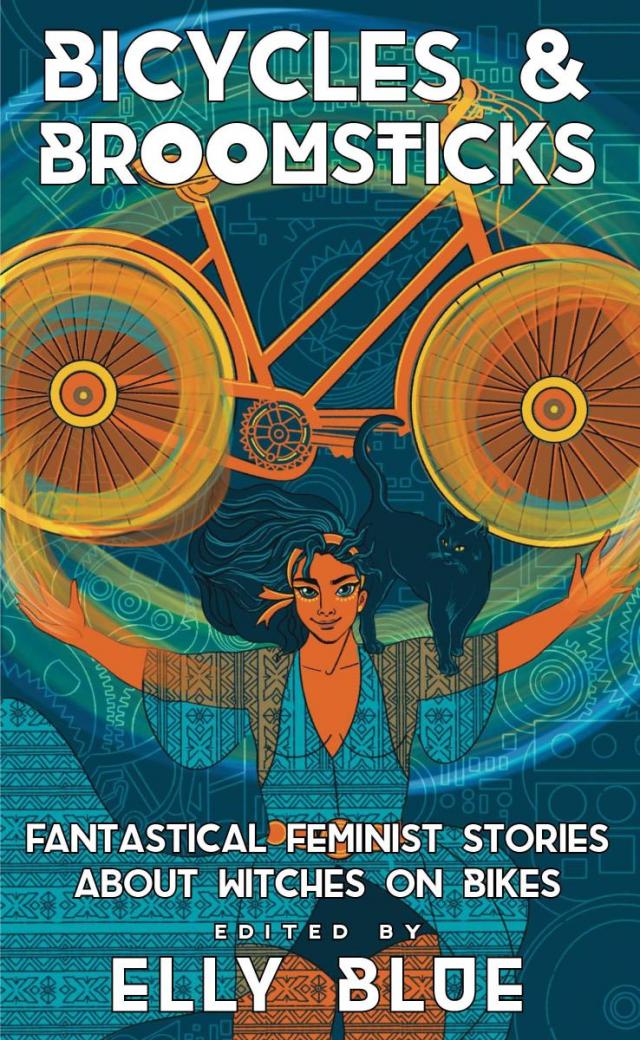
Bicycles & Broomsticks
Fantastical Feminist Stories about Witches on Bikes
Edited by Elly Blue
All content © its creators, 2023
Final editorial content © Elly Blue, 2023
This edition © Elly Blue Publishing, an imprint of Microcosm Publishing, 2023
First printing, January 10, 2023
All work remains the property of the original creators.
eBook ISBN 9781648411311
This is Microcosm #708
https://microcosm.pub/BikesInSpace
Cover art by Gerta Egy
Design by Joe Biel
Thank you to Lydia Rogue, Ru Mehendale, Marley Schlichting, Rose Marshall, and Jennifer Lee Rossman for invaluable editorial support.
This is Bikes in Space Volume 9
For more volumes visit BikesInSpace.com
For more feminist bicycle books and zines visit TakingTheLane.com
About the Publisher
ELLY BLUE PUBLISHING was founded in 2010 to focus on feminist fiction and nonfiction about bicycling. In 2015, Elly Blue Publishing merged to become an imprint of Microcosm Publishing that is still fully managed by Elly Blue.
MICROCOSM PUBLISHING is Portland’s most diversified publishing house and distributor with a focus on the colorful, authentic, and empowering. Our books and zines have put your power in your hands since 1996, equipping readers to make positive changes in their lives and in the world around them. Microcosm emphasizes skill-building, showing hidden histories, and fostering creativity through challenging conventional publishing wisdom with books and bookettes about DIY skills, food, bicycling, gender, self-care, and social justice. What was once a distro and record label started by Joe Biel in a drafty bedroom was selected as Publisher’s Weekly’s fastest growing publisher of 2022 and has become among the oldest independent publishing houses in Portland, OR and Cleveland, OH. We are a politically moderate, centrist publisher in a world that has inched to the right for the past 80 years.
Global labor conditions are bad, and our roots in industrial Cleveland in the 70s and 80s made us appreciate the need to treat workers right. Therefore, our books are MADE IN THE USA
[ Table of Contents ]
Introduction to the 2237 Edition •
Introduction to the 2023 Edition •
Old Goliath by Emily Burton •
Layings Out and Lyings In by Kathleen Jowitt •
Lunar Cycles by Gretchin Lair •
Work Orders by M. A. Blanchard •
Sunbeams, in the Forest by Ether Nepenthes and Mohini Hirve •
When Mastered, a Graceful Accomplishment by A. P. Howell •
Day of the Death Compass by M. Lopes da Silva •
Charms by Hester Dade •
Touching Mars by Monique Cuillerier •
Audrey’s Flying Bicycle by G. J. Craddock •
About the Authors •
Introduction to the 2237 Edition
Since the Great Plague took all the magic from us, the galaxy has been a cold and lonely place, with humans reliant on faulty and fallible machines to transport us, shade us from radiation, and even facilitate our communication and entertainment.
It is up to us archivists to look to the stories of Earth’s pre-magical past. Looking back to when the vast loneliness of the universe and the fraught results of our own technology were even more pressing issues can help us to see how people imagined their future so that we too can find hope again.
Many stories survive of this time when most people had no access to magic, and the few who could capture a glimmering of it were persecuted and villainized. The Great Awakening normalized and honed our magical capabilities, allowing us to settle throughout the galaxy and to live without the destructive tendencies and technologies of the times before. But this golden age ended after barely a century, when the Plague came and burned that nascent magic back into a mere trickle.
Our magic now must lie in our stories, our dreams, and our care for our communities past, present, and future. We remember our brief era of glorious undertaking and expansion with nostalgic pride, but we also remember who we were before. Instead of seeing our ancestors as limited and primitive, we must now view them as role models.
It is with this ancestral respect and curiosity in mind that we republish this volume of stories, found in a personal archive and clearly intended for publication. The ten stories and introduction show multiple things of historical value:
• The specific cultural constraints of the time they were written, which appears to be shortly before the Great Awakening. Clearly magic was conceived of as mythical yet desirable, dangerous yet worthy of defense. In the most realistic stories it is taken as a matter of spiritual engagement, and only the sillier imaginings offer theories of magic that can materially affect the universe.
• These stories reimagine the past and present as well as the future and alternate universes. Clearly the authors’ and editor’s goal is similar to ours—questing inward and outward for meaning in a time of uncertainty.
• The use of the archaic term “feminism” in the collection title is harder to explain to a modern audience. Many treatises have been written about this ancient reliance on a binary system of “gender” that was decided at birth and expected to determine an individual’s identity and societal role throughout their life. It’s a fascinating relic we can take much caution from studying. You can see through the use of the more modern “they,” rather than the old fashioned “she” and “he,” in many of the stories and author biographies that the concept of gender was beginning to fall out of vogue around the time of writing—another moment in history that social historians make much of but bears little relevance to most of us today.
• Our team of archivists has combed the records in preparation for the release of this volume to explain another, even more baffling, of its core themes: the “bicycle.” It seems this was initially a machine powered by human exertion magnified by a system of gears, though powered versions existed as well. It was intended for land transport, primarily on asphalt-paved roads, and primarily used as an individual vehicle for solo transportation or carrying cargo and passengers short distances, and was also used as a sporting device in speed and endurance competitions. The goal of including the “bicycle” element alongside the “feminist” element in this collection of stories appears to be an attempt to connect what the editor saw to be the liberatory capacity of both against a common enemy they termed “the petropatriarchy.” Whether or not it is valid to directly connect gender-based inequities with the economic inequities fueled by the energy-based economy of the time is a matter for historians to debate, but we wouldn’t count it out.
We can’t help but cheer on the optimism of these writers (and, presumably, their intended audience), in hoping not just for a more equitable world, but for one less reliant on the fossil fuels and the resulting climate disasters that caused such upheaval at that time. Perhaps it was this same optimism that sparked the outward movement from Earth after the Awakening, in addition to the rehabilitative efforts planetside that continue, although more slowly and with greater difficulty unaided by magic, to this day.
The real value to these stories is not to settle academic debates about the past, but to get inside the minds and the imaginations of the non-magic users who came before us, from whom we have so much to re-learn about everyday, magicless human life. May they rest in peace—we thank them for all they have shared with us.
Introduction to the 2023 edition
Ilearned to read because of the Wicked Witch of the West. I was three and I was obsessed with the Wizard of Oz, demanding repeated, back-to-back readings to the point that I had the book memorized. The Witch, from her confident navigation of a tornado on her rickety bicycle to her ultimate downfall in a puddle of water, frightened me and captured my imagination. It wasn’t just Miss Almira Gulch; I generally over-identified with the villains in stories. So discovering the redemption of witches in fractured fairy tales, feminist histories, and modern paganism as a teen came as soul-level relief.
When I chose the theme for this volume, I hoped that it would bring out a wide range of interpretations, and I was definitely not disappointed. In these ten stories, we have contemporary neo-pagans, fantasy worlds inhabited by magical creatures, an 1890s midwife, an occultist and wheelwoman of a similar era, and other spellcasters in totally unique settings, from the earnest to the comedic.
A surprise theme emerged (one always does)—of resilience and healing. From the opening story of a resilience spell to the the final story’s hilarious redemption of moving house by bike, and much of what’s in between: bicycles are, in these stories, a sort of spell, cast for a safe haven in a witch’s messy office, a reprieve from profound loneliness, a way to heal a broken household, a forest clearing, and a city beset with magical smog, and even the heart of a robot.
So that’s nice to see further redemption of witch archetypes.
Speaking of themes, I’ve been thinking for a while about changing the tagline for the series from “feminist” to “queer.” The former word’s so deeply loaded with over a century of hostile takeovers and exclusionary tactics. It’s unsurprising when it’s used as a slur, or taken on as a meaningless rallying cry to buy consumer goods. But who knew that the term “radical feminist” would come in recent years to sta
At an event years ago, I was passing out “feminists against freeways” stickers, enjoying the variety of responses. “We have to be against cars now, too?” said one woman who took one with great, resigned weariness. I stammered in confusion, but it’s a clear encapsulation of the difficulty with the word. The idea that in order to be feminist you need to agree with all other feminists, or fundamentally share every platform is baked in… yet it’s so completely counterproductive to building a widespread movement. Or maybe the point is that it’s the engine of building an exclusionary movement where only the agendas of the people with the most powerful voices count.
For the purposes of these volumes, I take “feminist” to encompass plenty of complexity. Boiled down to its simplest form, “not sexist” is the best definition I could come up with at the outset. Today it seems important to add “not gender-essentialist.” The fields of science fiction and fantasy have opened up spectacularly in the decade that I’ve been publishing these volumes, but are still wracked by entrenched stereotypes of macho spacemen and helpless women (if women appear in the story at all), the chosen prince and the vixen who tries to thwart him or the maiden he gets to rescue, etc. Classically, any woman with power or who isn’t primarily defined by beauty must be a villain, or a witch.
So that’s the baseline. But the deeper that questioning of norms and stereotypes goes, the better. I’ll publish a story centering menstruation, pregnancy, or abortion, but nobody needs to have a uterus for the story to be feminist. A perfectly functional submission for this volume simply has a woman, trans, and/or nonbinary main character, or doesn’t specify the protagonist’s gender, and that protagonist isn’t unreflexively defined by their relationships with men. My favorite stories either subtly or overtly play with gender norms, and really, the queerer the better for these volumes. But the bar for feminism here is pretty low—which doesn’t stop a number of submitters every year from failing to clear it.
The bar’s a bit higher for the bicycle element… I ask contributors to make bikes essential to the plot, but I’ll let a bicycle-shaped MacGuffin slip through sometimes for a story I love. My favorite stories are framed in resistance to transportation and energy norms as well as gender norms. I love the word “petropatriarchy,” which sums up so much of what these books seek to reimagine.
Back to witchcraft . . . I think you’ll fall in love with the practitioners in these stories as they struggle to heal themselves, their communities, their worlds, and random kids who show up at their doorstop. Sometimes that means a quiet moment with a crystal or a madcap ride through the city; other times it means turning your opponents into toasters. Whatever healing and resilience mean to you, I hope you find what you need of it in the coming year. In the meantime, please enjoy this book!
Elly Blue
Portland, Oregon
August, 2022
Old Goliath
[ Emily Burton ]
There is a point in adolescence when most young girls embark on a kind of cycle. For my human friend Marietta, this cycle involved hiding menstrual pads up her sleeves. For my cousin Laila, it meant dragging mauled bodies into her parents’ garage every full moon (we’re still working on that).
For me, cycling meant learning to ride a bike. Specifically, learning to ride Old Goliath.
Old Goliath was an ancient mountain bike, barely holding it together after twenty-odd years traveling across the Pacific Northwest. With its adventuring years now behind it, it leaned rustily against the raised-bed gardens in our backyard, remaining upright only with the aid of Mom’s resiliency charm. It stayed in that position for the first twelve years of my life. I spent my childhood perched on its seat, watching Mom sow sunflower seeds and unearth bright purple beetroots from the rich soil of our backyard. Memories of Old Goliath mixed together with memories of my mother: the smell of her perfume, the scratchy wool of her sweaters, the leathery touch of her gardening glove against my cheek.
I stopped resting in the garden with Old Goliath when Mom passed away. Sometimes memories are too painful to relive; sometimes it’s easier to forget them all at once.
Grandma didn’t think so, though. There’s a well-known adage which states that old people grow to look like their pets over time, fluffing up like standard poodles or turning droopy like ancient basset hounds. Thing is, Grandma didn’t age to resemble her hairless cat, Snuggles, or the lizards that ran amuck behind the old folks home. Instead, she steadily became more and more like an elephant. Grandma remembered everything and she stored it all between her two enormous ears.
Three days after Mom’s funeral, Grandma moved into our dilapidated little house on Redwood Street. She needed no tour of the place; she’d lived with us when I was a baby and she still remembered every loose floorboard and creaking step. Most importantly, she remembered the box she’d left behind twelve years ago, when Mom had deemed herself capable enough to raise me alone. It had stayed there, stored away in the attic and seemingly forgotten for all this time. Except, of course, that Grandma never forgot anything.
She sent me up to the attic on a sunny autumn Saturday, with directions to bring down an old cardboard box filled to the brim with spellbooks. I set the box down on the kitchen table with a resounding thud and Grandma nodded smugly.
“You, my dear Athena,” she declared, “have some studying to do.”
If Grandma meant to distract me from my grief, she certainly provided more than enough opportunities. My mother had been a patient tutor, walking me through the occasional untangling charm or quick-fix spell as needed. There was nothing patient about Grandma, though: she turned my bedroom floor into a veritable maze of grimoires, and our whole house into a hazard zone of flying plates, self-lighting hearths, and talking wallpaper. Every hour after school was filled with charms demonstrations, potion-making, and defensive maneuvers. Grandma could turn just about anything into a magical how-to lesson, from baking cookies to banishing wasps from the backyard.
Four months passed in a blur of incantations. Then, one winter afternoon, she suggested I learn a spell from my mother’s childhood grimoire.
“Ella kept her grimoire as a kind of diary when she was your age,” she said gently. She placed a spiral-bound notebook in my outstretched hands.
Mom’s grimoire was nothing like the ancient leather books in Grandma’s collection. Looped writing and scribbled hearts dominated its shiny purple cover, left behind by glitter pens and permanent markers. Left behind by my mother.
I flipped the notebook open, blinking away tears to read the spells scrawled in the margins of every page: recipes for acne and hair removal, step-by-step directions for mixing love potions, and there—on page sixty-five—the words to a resiliency charm. Old Goliath’s resiliency charm.
“I want to learn this one.” I held the notebook out to Grandma, pointing to the spell written in cursive under a section about cursing Algebra teachers.
“A resiliency charm.” Grandma raised a penciled-in eyebrow at me, crossing her heavily-bangled arms over her chest. “You’re twelve years old, Athena. What could you possibly need a resiliency charm for? Your sore old back?”
I scowled at her, sinking into the chair across from hers at the kitchen table. I ran my fingers along a gouge in the table, left behind by one of Mom’s enchanted chopping knives. My eyes stung as if it still floated there, cutting onions under her watchful gaze.
“I just want to learn it, okay?”
“Well, alright then,” Grandma said, nodding resolutely. She ran a finger over one of the doodles in Mom’s grimoire, this time of a bicycle with biceps.
“That’s it?” I asked.
“That’s it.” She dusted her hands off on her long paisley apron, motioning for me to join her in the garden. “Best not to start with human trials. If I remember correctly, your mom used to practice on my old mountain bike.”
I startled, nearly falling off my chair. “Old Goliath was your bike?”


