Ellery Queen's The Golden 13, page 1


Ellery Queen on
the Golden Thirteen:
“The crimes are mostly murder—from homicide to genocide, with weapons and means ranging from gun, poison and strangling to beheading, Samurai sword and mass drowning—with a miracle problem, an impossible crime and the killing of a dog, and with commando tactics, gunrunning and treason added to the spice of death.”
“We think you will be surprised, and in some stories amazed. . .”
—From The Introduction
FROM THE GRAND MASTER OF
THE MYSTERY STORY,
A VERY SPECIAL BOOK—
Here is a collection of the best of the best: each story a first-prize winner in the annual competition conducted by
Ellery Queen’s Mystery Magazine.
Here are stories of suspense, detection, and mystery, including:
THE PRESIDENT OF THE
UNITED STATES, DETECTIVE
H. F. Heard
ONE DROP OF BLOOD
Cornell Woolrich
THE NECESSITY OF HIS CONDITION
Avram Davidson
THE ENEMY
Charlotte Armstrong
THE GENTLEMAN FROM PARIS
John Dickson Carr
JUSTICE HAS NO NUMBER
Alfredo Segre
“Some of the finest. . .in the history of the genre.
P O P U L A R L I B R A R Y
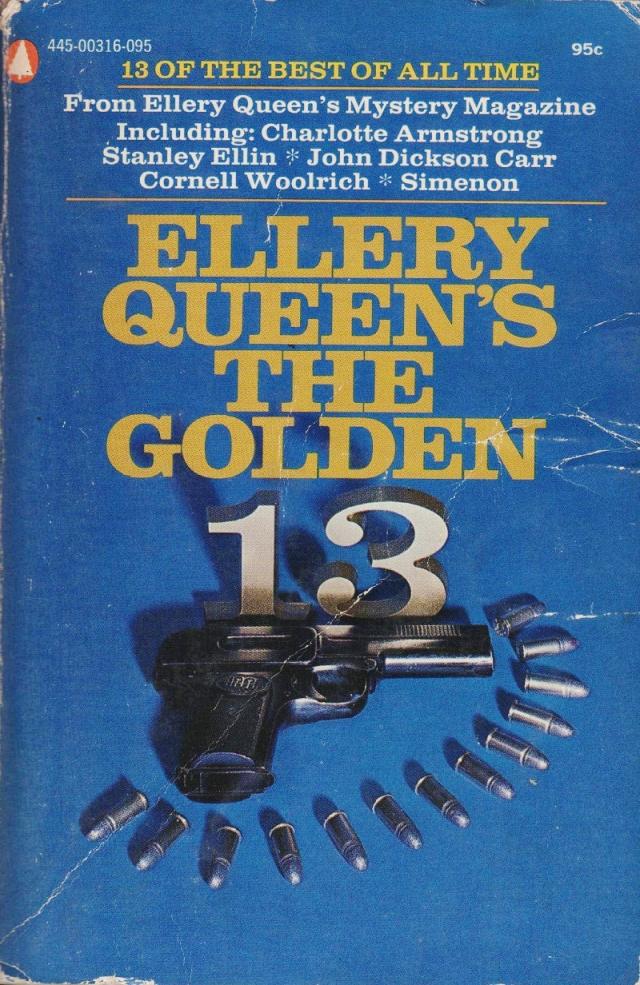
ELLERY
QUEEN’S
THE
GOLDEN
13
POPULAR LIBRARY • NEW YORK
All POPULAR LIBRARY books are carefully selected by the POPULAR LIBRARY Editorial Board and represent titles by the world’s greatest authors.
POPULAR LIBRARY EDITION
Copyright © 1970 by Davis Publications, Inc.
Library of Congress Catalog Card Number: 73-129841
Published by arrangement with The World Publishing Company
ACKNOWLEDGMENTS
A Star for a Warrior by Manly Wade Wellman; copyright 1946 by The American Mercury, Inc. (now Davis Publications, Inc.); reprinted by permission of the author.
The President of the United States, Detective by H. F. Heard; copyright 1947 by The American Mercury, Inc. (now Davis Publications, Inc.); reprinted by permission of Russell & Volkening, Inc.
Justice Has No Number by Alfredo Segre; copyright 1948 by The American Mercury, Inc. (now Davis Publications, Inc.); reprinted by permission of Mrs. Ann Segre.
Blessed Are the Meek by Georges Simenon; copyright 1949 by Georges Simenon; reprinted by permission of the author.
The Gentleman from Paris by John Dickson Carr; copyright 1950, 1954 by John Dickson Carr; reprinted by permission of James Brown Associates, Inc.
The Enemy by Charlotte Armstrong; copyright 1951 by Charlotte Armstrong; reprinted by permission of Brandt & Brandt.
The Cold Winds of Adesta by Thomas Flanagan; copyright 1952 by Mercury Publications, Inc. (now Davis Publications, Inc.); reprinted by permission of the author.
My Brother Down There by Steve Frazee; copyright 1953 by Steve Frazee; reprinted by permission of Scott Meredith Literary Agency, Inc.
Double Image by Roy Vickers; copyright 1954 by Mercury Publications, Inc. (now Davis Publications, Inc.); reprinted by permission of John Cushman Associates, Inc.
The Moment of Decision by Stanley Ellin; copyright 1955 by Stanley Ellin; reprinted by permission of Curtis Brown, Ltd
The Black Kitten by A. H. Z. Carr; © 1956 by Mercury Publications, Inc. (now Davis Publications, Inc.); reprinted by permission of the author.
The Necessity of His Condition by Avram Davidson; © 1957 by Mercury Publications, Inc. (now Davis Publications, Inc.); reprinted by permission of the author.
One Drop of Blood by Cornell Woolrich; © 1962 by Cornell Woolrich; reprinted by permission of the author.
PRINTED IN THE UNITED STATES OF AMERICA
All Rights Reserved
Contents
Introduction—ELLERY QUEEN
A Star for a Warrior—MANLY WADE WELLMAN
The President of the United States, Detective—H. F. HEARD
Justice Has No Number—ALFREDO SEGRE
Blessed Are the Meek—GEORGES SIMENON
The Gentleman from Paris—JOHN DICKSON CARR
The Enemy—CHARLOTTE ARMSTRONG
The Cold Winds of Adesta—THOMAS FLANAGAN
My Brother Down There—STEVE FRAZEE
Double Image—ROY VICKERS
The Moment of Decision—STANLEY ELLIN
The Black Kitten—A. H. Z. CARR
The Necessity of His Condition—AVRAM DAVIDSON
One Drop of Blood—CORNELL WOOLRICH
CONTENTS
COVER
Introduction
FIRST PRIZE WINNER NUMBER 1
A Star for a Warrior by Manly Wade Wellman
FIRST PRIZE WINNER NUMBER 2
The President of the United States, Detective by H. F. Heard
FIRST PRIZE WINNER NUMBER 3
Justice Has No Number by Alfredo Segre
FIRST PRIZE WINNER NUMBER 4
Blessed Are the Meek by Georges Simenon
FIRST PRIZE WINNER NUMBER 5
The Gentleman from Paris by John Dickson Carr
FIRST PRIZE WINNER NUMBER 6
The Enemy by Charlotte Armstrong
FIRST PRIZE WINNER NUMBER 7
The Cold Winds of Adesta by Thomas Flanagan
FIRST PRIZE WINNER NUMBER 8
My Brother Down There by Steve Frazee
FIRST PRIZE WINNER NUMBER 9
Double Image by Roy Yickers
FIRST PRIZE WINNER NUMBER 10
The Moment of Decision by Stanley Ellin
FIRST PRIZE WINNER NUMBER 11
The Black Kitten by A. H. Z. Carr
FIRST PRIZE WINNER NUMBER 12
The Necessity of His Condition by Avram Davidson
FIRST PRIZE WINNER NUMBER 13
One Drop of Blood by Cornell Woolrich
13 First Prize Winners from
ELLERY QUEEN’S MYSTERY MAGAZINE
POPULAR LIBRARY • NEW YORK
Introduction
Dear Reader:
Here, at long last, in an anthology of their own, are the 13 stories that won First Prizes in EQMM‘s international contests—the “Queen’s Dozen” (12 and an extra one for good measure), The Golden 13.
The annual contests sponsored by Ellery Queen’s Mystery Magazine began in 1945 and continued without a break for 12 years, through 1956; after a hiatus of five years the thirteenth (and last) world-wide contest was held in 1961.
Some statistics: about 12,000 manuscripts were submitted to the 13 contests—an average of nearly 1000 entries per year. These previously unpublished stories came from the six continents: from North America—the United States (all 50 states and the District of Columbia), Canada, Mexico, Panama Canal Zone, Dominican Republic, Cuba, Jamaica, St Vincent, and Bermuda; from South America—Brazil, Argentina, Chile, and British Guiana; from Europe—England, Ireland, Scotland, Wales, France, Germany, Italy, Austria, the Netherlands, Belgium, Denmark, Sweden, Portugal, Hungary, and even from Russia; from Asia—Japan, China, India, the Philippines, and before statehood, Hawaii; from Africa—Algeria, Morocco, Egypt, Southern Rhodesia, the Transvaal, and the Union of South Africa; and from Australia and New Zealand.
More than $75,000 was paid to the winners of First Prizes, Second Prizes, and Special Awards of Merit; an additional $75,000 went to Third Prize winners, Honor Roll and Honorable Mention stories, and to special prizes for “first stories,” Sherlockiana, and stories by college students—a grand total of $150,000 for the best new short stories and novelettes of detection, crime, mystery, and suspense written throughout the world in those 13 years.
Would you like to look behind the scenes of judging a prize contest? Suppose we give you three examples of what can happen—in fact, what did happen in three of EQMM‘s contests. Well call the first example Unholy Deadlock.
In that contest 862 entries came by land, sea, and air to our battle-scarred desks. As is our inviolable rule, every submission was read to the last word, and by dint of burning electricity in the blind alleys of the night, our staff readers and your Editors wore that mountain of manuscripts down to a shadow of its original magnitude. The 862 submissions shrank to 25 prize-winning possibilities.
So the judges—at that time, Christopher Morley, Howard Haycraft, and your Editors—had a simple chore: all we had to do was to pick the best story out of 25—and a pretty kettle of fish this turned out to be. It was not too difficult to eliminate 9 of the 25, and these 9 were promptly designated as Honorable Mentions. That left 16. Of these we selected another 9 for Special Prizes, reducing to 7 our possibilities for First Prize. Not bad, eh? We were obviously making splendid progress to our annual goal, and the fact that the finalists boiled down to 7 seemed a good omen. Not only is 7 an admittedly lucky number, but 7 finalists fitted perfectly with our needs—one First Prize and six Second Prizes. The only fly in the ointment was to select the best story of the 7. But what a fly! It proved to be the size of a camel.
Well, we winnowed those 7 down to 3—and there we stuck. If we told you how many times the judges met to re-analyze, reappraise, and reconsider those three stories, you simply wouldn’t believe it: truth is often stranger than fiction but this time it was fantastic. And we could not, for the lives of us, agree unanimously on which of the three stories was better, all around, than the other two. Each story had virtues to recommend it; on the other hand, each story had shortcomings which prevented it from being spontaneously voted the First Prize winner.
We continued to weigh and balance; we continued to dissect and compare; and we did what judges are supposed to do—we judged. But in all honesty we could not arrive at a decision satisfying to us all. So, in desperation, we asked the writers of the three stories to see if they could do some polishing and sharpening, to see if they could raise their stories another notch in quality, and then, in final desperation, we took the three rewritten versions and subjected them to an arbitrary point system. The judges reexamined each story, scoring one point for each virtue, and deducting one point for each frailty. The story with the highest number of net points would be declared winner of the First Prize—and may our best-friends-and-severest-critics have mercy on our souls—which, as it turned out, they did not. It was a grim experience from beginning to end and for a long time thereafter.
We’ll call the second example of the trials and tribulations of contest judges The Horns of the Dilemma. In this year we received 723 manuscripts, all of which were given the most scrupulous editorial consideration. Our staff sifted and evaluated until the 723 stories were reduced to 18 prize-winning possibilities.
But this year two stories of the 18 stood out with unmistakable prominence. The judges—still Messrs. Morley, Hay-craft, and Queen—discussed these two finalists pro and con, backward and forward, up and down and sideways, until we almost knew those two stories by heart. The two seemed so equal in all-around excellence, so equal in individual distinction, that we were faced with a classic instance of six-of-one and half-a-dozen-of-another. In the end it was purely a matter of personal opinion—that highly debatable defense!—which tipped the scales. The judges finally agreed that one of the two stories had, on balance, a slight edge.
Yet what came to pass? Despite the enormous care and patience and thoroughness with which our final decision was reached, despite all our conscientiousness and perseverance, many readers—and to be absolutely truthful, most critics—caviled sharply with the judges and censured them for not having awarded First Prize to the other story!
So the pattern persisted: the judges are wrong, long live the judges!
Now, the third example, which well call The Dark Horse in the Smoke-Filled Room: that year we received 838 manuscripts and every single one was given the most careful critical study. After the initial weeding out we found ourselves with 16 possible prize-winners.
On the night before the deadline of announcing the First Prize winner publicly, after months of weighing, analyzing, and eliminating, the judges met in final conclave. Anticipating another controversy and attempting to avoid the heartache and heartbreak that are the editors’ and judges’ burden, we asked two others to sit in and help. These two extra judges were chosen with hairline concern. One was a fiction reader for a national magazine, and the other was one of the best-selling authors of all time.
We met early in the evening and discussed the 16 finalists at great length. Toward midnight we began voting, and gradually we reduced the 16 possibilities—first, from 16 to 11; then, from 11 to 7; finally, from 7 to 5. At this point in our deliberations we paused for refreshment (this is a factual report). It was now well past midnight and it had been a grueling session. Then, feeling like members of a jury, we cast our final votes for the First Prize winner, each of the judges nominating the story he considered the best of the surviving five. It had been agreed that the story which received the largest number of votes in this final balloting would be awarded First Prize.
Can you guess what happened? No? Then listen: each of the five judges voted for a different story! All five finalists got one vote each! It was a quintuple tie!
What happened after that shouldn’t happen to an editor. We passed through various stages, each stage becoming more dangerous. First, we defended our choices—calmly. Next, we tried to influence the others’ votes—excitedly. In the end, we attacked each other’s judgment—vehemently. Time and again we put our stalemate to another vote, and every time it came out the same way: each judge stuck to his original selection. It was getting later and later, and we were getting nowhere slowly. Obviously, with the deadline an incubus, we had to sweat it out, continue cracking our brains, continue repressing our tempers, until a satisfying—and we hoped unanimous—verdict could be reached.
At thirteen o’clock your Editors remembered an old political maneuver.
We made a “proposition” to the other four judges. Since no one was willing to budge from his original choice, suppose we nominated a “dark horse”? Would the other judges consider a sixth story, one of those previously eliminated, and award First Prize to this alternate choice?
Well, that’s the way it worked out. The judges agreed that if they could not have their original selections they would all pitch for a “dark horse,” amen. You think we were wrong? You think no contest should be decided that way? Well, put yourself in the judges’ shoes. If we hadn’t found one story that we all agreed on, we would either still be in session, with white beards and broken families, or we would have had to declare the whole contest a mistrial—both eventualities obviously impossible.
But of all the thankless tasks invented by the human brain, we defy you to name one that beats being a literary-judge-and detective-story-editor.
Now about The Golden 13—the 13 First Prize winners in this volume. As a group, these 13 stories illustrate the tenacity of detective-story fundamentals. The plots are still fresh and full-bodied; the styles project the modern qualities to be found in so-called serious writing (excluding the avant-garde schools, Black Humor, and the Absurd); the techniques reveal how ingeniously detective-story writers can dovetail physical action and mental reaction, in an imaginative blend of the “sensational” and the “intellectual,” without sacrifice of shock in the former or surprise in the latter. In a phrase—sheer professional, and sometimes inspired, storytelling.
Of the 13 First Prize winners, 10 (a startlingly high number) are detective stories—with a remarkable variety of sleuths including, in chronological order, an American Indian, the President of the United States, an Italian organ grinder, an Armenian tailor living in Paris, a famous historical figure, a schoolteacher assisted by students, a military policeman, a sheriff and his posse, a Scotland Yard chief inspector, and an anonymous plainclothesman as contemporary as the latest law-enforcement electronic device; indeed, all 10 are as contemporary as if they were appearing for the first time in the current issue of Ellery Queen’s Mystery Magazine. And can you imagine a more diversified directory of detectives in only 10 stories!
Of the other three tales in this volume, one is a riddle story that goes far beyond the classical and traditional concept of that subtype of the genre, and two are serious studies of crime, both unusual (but every story in this book is unusual!) and as different from each other as two distinguished stories in the same field can be (but all 13 stories in this book are as different from one another as 13 stories in the same field can be!). Indeed, the 13 stories are an astonishing mosaic of subgenres, species, subspecies—nearly every variety of the detective and crime short story and novelette known to fans and aficionados, including subvarieties hitherto unknown. . .
The crimes are mostly murder—from homicide to genocide, with weapons and means ranging from gun, poison, and strangling to beheading, Samurai sword, and mass drowning—with a miracle problem, an impossible crime, and the killing of a dog, and with commando tactics, gunrunning, and treason added to the spice of death.