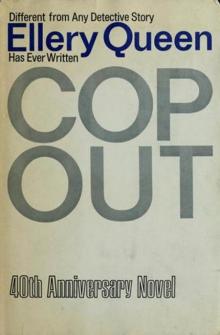
Ellery Queen's Poetic Justice, page 1


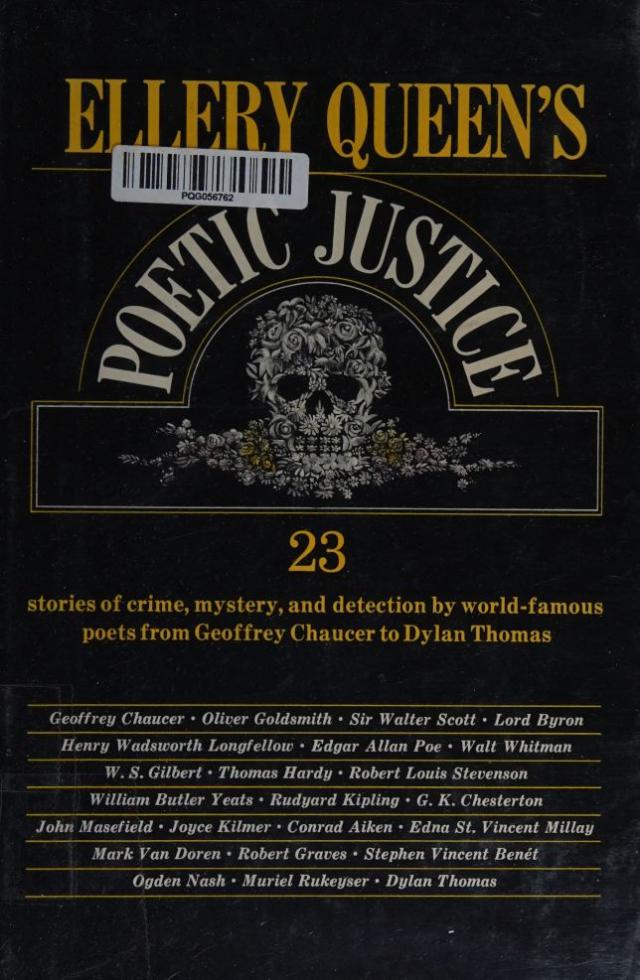
Ellery Queen chose the title Poetic Justice because it combined, in one phrase, the two different yet related themes of this unique anthology — tales of justice written by poets—23 mystery stories by 23 world-famous poets, from Geoffrey Chaucer to Dylan Thomas. More than half of the stories are the only mysteries written by some of the greatest names in Western literature—stories of crime, suspense, and detection by, among others, Longfellow, Walt Whitman, John Masefield, Edna St. Vincent Millay, Joyce Kilmer, and Lord Byron, whose unfinished story was conceived at a fireside scare-session in Switzerland on the same night Mary Shelley gave birth to Frankenstein.
One story is an important critico-historical “discovery.” Edgar Allan Poe’s “The Man of the Crowd,” published before “The Murders in the Rue Morgue,” offered the world its first fictional detective — preceding Dupin! (For an analysis of the internal evidence see Ellery Queen’s editorial comment.)
(Continued on back flap)
Ellery
Queen’s
Poetic
Justice
NOVELS BY ELLERY QUEEN The Roman Hat Mystery The French Powder Mystery The Dutch Shoe Mystery The Greek Coffin Mystery The Egyptian Cross Mystery The American Gun Mystery The Siamese Twin Mystery The Chinese Orange Mystery The Spanish Cape Mystery Halfway House The Door Between The Devil To Pay The Four of Hearts The Dragon’s Teeth Calamity Town
There Was an Old Woman
The Murderer Is a Fox
Ten Days’ Wonder
Cat of Many Tails
Double, Double
The Origin of Evil
The King Is Dead
The Scarlet Letters
The Glass Village
Inspector Queen’s Own Case (November Song)
The Finishing Stroke
The Player on the Other Side
And On the Eighth Day
The Fourth Side of the Triangle
A Study in Terror
Face to Face
BOOKS OF SHORT STORIES BY ELLERY QUEEN
The Adventures of Ellery Queen ‘The New Adventures of Ellery Queen The Casebook of Ellery Queen
EDITED BY ELLERY QUEEN Challenge to the Reader 101 Years’ Entertainment Sporting Blood The Female of the Species The Misadventures of Sherlock Holmes Rogues’ Gallery Best Stories from EQMM To the Queen’s Taste The Queen’s Awards, 1946-1953 Murder by Experts 20th Century Detective Stories Ellery Queen’s Awards, 1954-1957
Ellery Queen’s Mystery
Calendar of Crime
Q.B.I.: Queen’s Bureau of Investigation Queens Full
The Literature of Crime
Ellery Queen’s Mystery Annuals:
13th-16th
Ellery Queen’s Anthologies: 1960-1967 The Quintessence of Queen
(Edited by Anthony Boucher) To Be Read Before Midnight Ellery Queen’s Mystery Mix #18 Ellery Queen’s Double Dozen Ellery Queen’s 20th Anniversary
Annual
Ellery Queen’s Crime Carousel Ellery Queen’s All-Star Lineup Poetic Justice
Magazine (2yt.f1 Year)
TRUE CRIME BY ELLERY QUEEN
Ellery Queen’s International Case Book The Woman in the Case
CRITICAL WORKS BY ELLERY QUEEN
The Detective Short Story Queen’s Quorum In the Queens’ Parlor
UNDER THE PSEUDONYM OF BARNABY ROSS
The Tragedy of X The Tragedy of Z
The Tragedy of Y Drury Lane’s Last Case
14 Ellery
Queens
Poetic
Justice
23 STORIES OF CRIME,
MYSTERY, AND DETECTION
BY WORLD FAMOUS POETS
from Geoffrey Chaucer
to Dylan Thomas
7
The New American Library
Copyright © 1967 by Ellery Queen.
All rights reserved.
No part of this book may be reproduced without written permission from the publishers.
ACKNO WLEDGMENTS
the crucifixion of the outcast by William Butler Yeats: Copyright 1905, The Macmillan Company, renewed 1934 by William B. Yeats, reprinted by permission of The Macmillan Company from The Secret Rose (Early Poems ir Stories) by William B. Yeats, the blast of the book by G. K. Chesterton: Copyright 1935 by G. K. Chesterton, renewed 1963 by Oliver Chesterton; reprinted by permission of Dodd, Mead & Company, Inc. from The Scandal of Father Brown. testimony after death by Mark Van Doren: Copyright © 1965 by Mark Van Doren; reprinted by permission of Hill and Wang, Inc. from Collected Stories, Volume 11 by Mark Van Doren. whitemail by Joyce Kilmer: Copyright 1914 by Smart Set, assigned to Aline Kilmer. By permission of Kenton Kilmer, the steinpilz method (original title, earth to earth) by Robert Graves: Copyright © 1955 by International Authors N.V.; reprinted by permission of Collins-Knowlton-Wing, Inc. from Collected Short Stories by Robert Graves, smith and jones by Conrad Aiken, from The Collected Short Stories of Conrad Aiken: Copyright © 1922, 1923, 1924, 1925, 1927, 1928, 1929, 1930, ’93’. ’932, 1933, 1934, 1935, 1941, 195,0. 1952, 1953, 1955, 1956, 1957, 1958, 1959, i960 by Conrad Aiken; reprinted by permission of The World Publishing Company, Cleveland and New York, the old woman upstairs (original title, the true story) by Dylan Thomas: Copyright 1955. © 1964 by New Directions; reprinted by permission of the publisher, New Directions Publishing Corporation, from Adventures in the Skin Trade and Other Stories by Dylan Thomas.
THE three d’s by Ogden Nash: Copyright 1948 by Hearst Magazines, Inc.; reprinted by permission of Curtis Brown Ltd. (New York), the club by Muriel Rukeyser: Copyright 1950 by Garrett Publications, Inc.; reprinted by permission of Monica McCall, Inc. the murder in the fishing cat by Edna St. Vincent Millay: Copyright 1923, 1950 by Edna St. Vincent Millay; reprinted by permission of Norma Millay Ellis, Literary Executor, a gentleman of fortune by Stephen Vincent Benet: Copyright 1941 by Rosemary Carr Ben^t; repi inted by permission of Brandt & Brandt, from The Last Circle (Farrar, Straus & Giroux, Inc.). markheim by Robert Louis Stevenson: reprinted courtesy of Charles Scribner’s Sons, the three strangers by Thomas Hardy: reprinted courtesy of St. Martin’s Press, Inc., Macmillan and Company, Ltd., and the Trustees of the Hardy Estate, the return of imray by Rudyard Kipling: reprinted courtesy of Doubleday & Company, Inc.
First Printing
Published by The New American Library, Inc.
1301 Avenue of the Americas, New York, New York 10019 Library of Congress Catalog Card Number: 67-26239 Printed in the United States of America
Contents
Introduction
W. S. Gilbert
Muriel Rukeyser
280
THE CLUB
Dylan Thomas
THE OLD WOMAN UPSTAIRS
293
L’Envoi
by Ellery Queen
299
Introduction
Dear Reader:
Say the word softly … books.
See them as images — the tree of life, the fourfold rivers of Paradise, the treasurehouse of jeweled words.
See them as our hope for the future — for a finer world within the world.
See them in your mind’s eye — your friends, your counselors, your comforters …
All these things have beei} said, with gratitude and humility.
So say the word softly. And behold how good and how „ pleasant it is for books to dwell together — for who touches a book touches man, and who touches a great book touches himself.
Books … imagine a row of them, all of different sizes and shapes, tall, small, thick, thin, bound in pastel wrappers or patterned boards or bright cloth — a rainbow row of books of poetry by
xi
Geoffrey Chaucer Oliver Goldsmith Sir Walter Scott Lord Byron Henry Wadsworth Longfellow Edgar Allan Poe Walt Whitman W. S. Gilbert Thomas Hardy Robert Louis Stevenson William Butler Yeats Rudyard Kipling G. K. Chesterton John Masefield Joyce Kilmer Conrad Aiken
Edna St. Vincent Millay Mark Van Boren
Robert Graves Stephen Vincent Benet Ogden Nash Muriel Rukeyser Dylan Thomas
Now, why have we chosen these particular poets? Is there something “special” about them? Do they have something in common besides being famous poets? Yes, they do — these 2Z poets all wrote short stories of crime or detection or suspense.
That is the theme of this anthology — mystery short stories by 23 world-famous poets, from Chaucer to Dylan Thomas, presented in chronological order of the poets’ dates of birth.1
Surprising? Yes — even startling. And yet we hold with Pliny the Younger that “fiction is the privilege of poets” (admitting that Pliny the Younger had a different meaning in mind). And to paraphrase Thomas Babington, Lord Macaulay, we certainly hold that the most wonderful and splendid proof of genius is a great mystery story produced in a civilized age.
And when Shakespeare saw “the poet’s eye, in a fine frenzy rolling,” and saw the poet’s pen, “as imagination bodies forth / The forms of things unknown,” turn “them to shapes,” and give “to airy nothing / A local habitation and a name,” surely he saw not only the poet creating poetry, but with equal integrity, the poet creating prose. Startling? No — not at all. Horace has told us that “poets have always had license to dare anything.” So why not mystery stories? Why not stories of crime and suspense? Why not tales of ratiocination?
We chose the title Poetic Justice for this anthology because it seemed to combine, in one phrase, the two different yet related themes which this unique collection of stories offers — tale
The editor of any anthology can be guilty of two crimes
— the crime of commission and the crime of omission. If we are guilty of the first crime, the evidence confronts you in the pages of this book; if we are guilty of the second crime
— if there is a tale of detection or mystery which you hoped or expected to find in this book but which is absent (a tale, for example, by Robert Frost or T. 8. Eliot)2 — well, that reminds us of a story.
It happened quite a few years ago. One evening in May 1948 — after a cocktail party honoring the late Sir Victor Gollancz on the occasion of the British publisher’s first visit to the United States — a group of us entered a restaurant in New York’s fashionable seventies. There were Louis Untermeyer, the always gay and witty poet and a noble fashioner of anthologies; Philip Van Doren Stern, novelist, historian, and also a noble fashioner of anthologies; Leon Shimkin, the brilliantly practical man of publishing; ourselves; and our respective ladies-in-waiting.
The moment we reached the head waiter and viewed the sumptuous decor of the restaurant’s interior, we knew we had stepped into a high-bracket milieu. We remember one of the others saying — an echo of our own thought — “This will teach me a lesson!” But the meal was excellent, the prices proved not too disastrous, and the table talk (what Victor Gollancz called a “causerie”) was worth the cover charge and more.
We talked of many things — of gumshoes, ships, and sealing wax. And at one point we touched on the conception and execution of anthologies, and if we remember correctly, it was Louis Untermeyer who described a fine anthology as “a scissors-and-taste job,” as distinguished from a “scissors-and-paste job.”
And then we explored the subject of thematic anthologies, especially that thankless endeavor, the pursuit of the perfect anthology. We all agreed that no one had ever put together a truly definitive anthology, let alone a perfect one, and that no one had even edited an anthology with which he had not become unhappy or dissatisfied, sometimes within a slim year of its publication. And then Mr. Stern made a remark that we have never forgotten: every thematic anthology, Mr. Stern insisted, should have a foreword stating frankly that the book is probably guilty of unforgivable omissions, and pleading with readers to write to the editor and list those regrettable omissions; with the benefit of this kindly assistance the anthologist could then revise and expand, could then edit a new edition (repeating the original plea), could then be informed of his continuing omissions, old and new, could then proceed to edit still another new edition (again repeating the original plea) — and so ad infinitum.
Yes, the slogan, the shibboleth which identifies the an-thological tribe, is “Our Book Is Never Done”; Sisyphus is the God of the Anthology, and the burden which every anthologist has borne, still bears, and will forever bear is the irrefutable fact that a perfect or definitive anthology is always “work in progress.”
And if this is true of even a mature anthology, how infinitely more true it is of a pioneering effort! The anthologi-cal theme which invades virgin territory, which hews a rough trail in a previously untrod forest, is particularly vulnerable. But even if the first blundering fails to reach its intended goal (did not Columbus discover America while seeking a passage to India?), who would deny the absolute necessity of taking the first step in the wilderness? Someone must challenge the unknown, and even if his step is halting and lame, even if his first attempt suffers the slings and arrows of outrageous critical disapproval, still any pioneering work is a consummation devoutly to be wish’d — if only for what it does for those who, playing the game more safely, come later.
This anthology, Poetic Justice, is such a pioneering effort, and if we seem to be apologizing, so be it. Poetic Justice — truly a first voyage into uncharted seas — is susceptible to incomplete research, to say nothing of the human, and therefore inevitable, margin of error. But when will research ever be complete? When will the margin of error, both of taste and judgment, ever be conquered? The sad truth is — never. No man in his lifetime, nor a host of men in a multitude of lifetimes, can hope to achieve the definitive or the perfect. But the work must go on, striving always to approach perfection or completion as a limit, as we hopelessly try in mathematics to approach infinity as a limit. The dream of perfection is for the future — and for most of us the future never comes.
And now — shall we join the poets?
— Ellery Queen
Ellery
Queen’s
Poetic
Justice
Geoffrey
Chaucer
(?1340—1400)
Geoffrey Chaucer, usually considered England’s first poet laureate, was born in London (exact date unknown), the son of a middle-class wine merchant. He was a man of impressive worldly affairs who had two separate but not unrelated careers — one, public, the other, private. As a servant of the Crown who was destined to attain wealth and high position, he began his public career at nineteen as a soldier in France in 1359, was captured and ransomed for £16, and before the end of 1368 had risen to be one of the King’s esquires. In 1372 he was sent to Italy as one of three trade commissioners. Further service to the Crown brought him annuities and pensions, and in 1374 he was appointed Comptroller of the Custom and Subsidy of Wools, Hides^ and Woodfells, and also of the Petty Customs of Wine in the Port of London. Later came other political plums and windfalls, and under three Kings, other royal assignments, including diplomatic posts in Italy and France; in 1385 he was made justice of the peace for the county of Kent, and in 1389, Clerk of the King’s Works at Westminster. Altogether, Chaucer had a long and honorable record of civil service — strange business indeed for a great poet! He died in 1400, was buried in Westminster Abbey, and his tomb became, fittingly, the nucleus of what is now known as the Poets’ Corner.
Chaucer’s poetry — his other, and really major career — includes Troilus and Criseyde (1483), Hous of Fame (1484), The Parlement of Foules (?i526), and The Canterbury Tales (1478), the last written in his maturity. The Canterbury Tales, by far Chaucer’s most popular work, reveals his enormous social and historical insight (how well his public service served him in his art!), his sympathy and affection for people of all types and stations, his deep appreciation of the pageantry and vitality of life, his wide range of understanding, and above all, his power of expression. It has been said that his artistic skill has never been surpassed, and surely The Canterbury Tales is the cornerstone of poetry in the English language.
It is from this imperishable masterpiece that we bring you, in “modern” English, an excerpt from “The Pardoner’s Tale” — though no excerpt, no single tale, can do justice to the “series of stories within a story” which Chaucer worked on during the last twelve years of his life and which — an incalculable loss to the world — he never finished. He completed only 22 (plus “The Prologue”) of an intended 120 tales.
The Pardoner, in Chaucer’s age, was a clerical or lay preacher empowered by the Church to raise money for certain religious activities; he solicited payments for indulgences which promised to remit punishment for sins and to pardon guilt. Chaucer’s Pardoner was a corrupt hanger-on of the Church who, through fraud and flattery, gulled the ignorant people with fake relics (in his bag he had a pillowcase which he said was the veil of Our Lady) and fake miracles (“the man who puts his hand in this mitten will see his grain multiply”). His sermon was always the same: Radix malorum est cupiditas (The root of all evil is avarice); and his preaching against greed was cleverly calculated to make his hearers part with their hard-earned money — to the Pardoner’s personal profit. He freely admitted that he preached against the same vice he practiced — avarice; but though he confessed he was himself a cheat, he insisted that he could tell a moral tale. The Pardoner’s grim and grisly tale of murder is an example in miniature of Chaucer’s worldly awareness and sharp irony …