The XYZ Murders, page 1


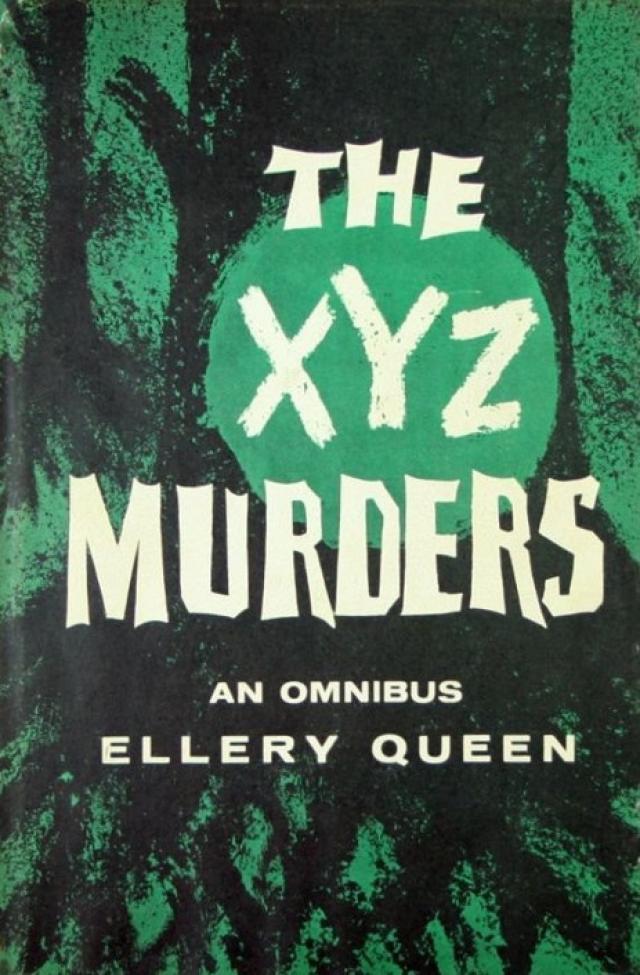
First published by
J.B. Lippincott
1960
The Tragedy of X
A Drury Lane Mystery
Ellery Queen
MYSTERIOUSPRESS.COM
WITH GRATITUDE TO
“TOM” MAHONY
WHO HAS BROUGHT MR. DRURY LANE
BACK FROM THE DEAD
An Open Letter
TO THE READER
Dear Reader:
Nine years ago two young men, who had been collaborating under the single pen-name of Ellery Queen, were persuaded by certain persons and events to write a new series of mystery stories.
The result of their supplementary labors was the creation of Mr. Drury Lane, an aged Shakespearean actor with wonderful sleuthing powers.
Obviously the series celebrating the exploits of Mr. Drury Lane could not be publicly attributed to Ellery Queen, since the Ellery Queen books celebrated the exploits of Mr. Ellery Queen.
So the two young men fashioned a second pen-name; and the introductory book of the Drury Lane tetralogy, “The Tragedy of X,” burst upon an unexcited world as written by one “Barnaby Ross.”
Now to all intents and purposes there was no relationship between Ellery Queen the author(s) and Barnaby Ross the author(s). Each was published by a different house; around each was hopefully woven a great deal of mumbo-jumbo and secrecy; in fact, in one phase of that duo-pseudonymous period in the public lives of the two young men, they actually glared at each other across many unfriendly lecture platforms, each secure behind the barricade of a domino mask … one posing as Ellery Queen, the other as Barnaby Ross, and both pretending furiously to be bitter rivals in the field of mystery authorship. Not all the things they said to each other in the curious hearing of lecture audiences from Maplewood, New Jersey to Chicago, Illinois were complimentary, thus by sheer sculduggery preserving the illusion of rugged individualism.
Nevertheless, a cunning clue has always existed which, if spotted by the alert armchair-detective, would unquestionably establish the relationship between Ellery Queen and Barnaby Ross, and would expose the vile deception they practised upon the trusting public these last nine years.
For if you will turn to the Foreword of “The Roman Hat Mystery” (the first book written by and about Ellery Queen), you will find on page x, lines seventeen to twenty-two, the following remarkable revelation:
“It was said, for example, at the time of his brilliant detectival efforts during the now-ancient Barnaby-Ross murder-case, that ‘Richard Queen by this feat firmly establishes his fame beside such masters of crime-detection as.…’”
It was from this apocryphal excerpt that “Barnaby Ross” was selected when it became necessary to create a new penname—so that Barnaby Ross was really born in the year 1928, at the time the Foreword to the first Queen book was written, although it was not until the year 1931 that he was publicly baptized by his fathers and moved into a house of his own.
So now it can be told: Barnaby Ross was, and is, and will forever be … Ellery Queen; and vice versa.
A word about Mr. Drury Lane. We’ve always kept a soft spot in our hearts for the old coot, who was half ham and half ruffed grouse … mountebank and genius, and quite the most extraordinary detective who ever lived (except, perhaps, one who shall be nameless).
Like his brother (weren’t they sired by the same Machiavellian young men?), Mr. Drury Lane stems from the deductive school—that special branch of which makes a fetish of fairness to the reader; so that in “The Tragedy of X,” as in the Tragedies to follow, you will find all the clues given to you before the dénouement is reached.
So in this solemn hour of resurrection … Vive Drury Lane!
Sincerely,
Friday the 13th of September, 1940
New York
List of Scenes
ACT I
Scene 1. The Hamlet
2. A Suite in the Hotel Grant
3. The Forty-Second Street Crosstown
4. Private Room in a Carbarn
5. General Room in a Carbarn
6. The Hamlet
7. Private Room in a Carbarn
8. Offices of DeWitt & Longstreet
9. The Hamlet
ACT II
Scene 1. The District Attorney’s Office
2. The Weehawken Ferry
3. Weehawken Terminal
4. Inspector Thumm’s Office
5. The Hamlet
6. Weehawken; New York
7. The DeWitt House in West Englewood
8. The Exchange Club
9. The District Attorney’s Office
10. The Hamlet
11. Offices of Lyman, Brooks & Sheldon
12. The Hamlet
13. Residence of Frederick Lyman
14. Criminal Courts Building
ACT III
Scene 1. A Suite at the Ritz
2. Weehawken Railroad Station
3. The Weehawken-Newburgh Local; A Siding at Teaneck
4. En Route to New York
5. The DeWitt House in West Englewood
6. A Suite in the Hotel Grant
7. Michael Collins’s Apartment
8. Consulate of Uruguay
9. The Hamlet
10. Near Bogota
11. The Hamlet
12. The Weehawken-Newburgh Local
BEHIND THE SCENES
The Explanation. The Hamlet
Something About
MR. DRURY LANE
EXCERPTA COMPILED FOR THE PUBLISHER
BY MR. CHARLES GLEN FROM PRELIMINARY NOTES
ON HIS UNFINISHED LANE BIOGRAPHY
Excerpt from Who’s Who of the Drama, 1930 edition:
LANE, DRURY, actor; b. New Orleans, La., Nov. 3, 1871; s. Richard Lane, American tragedian, and Kitty Purcell, the English music-hall comedienne; unmarried. Education, privately tutored. First stage appearance, at the age of 7; first important rôle at the age of 13 in Kiralfy’s “Enchantment,” Boston Theatre; first featured at the age of 23 in “Hamlet,” Daly’s Theatre, N. Y.; in 1909, in Drury Lane Theatre, London, gave longest “Hamlet” run of consecutive performances until that time—24 longer than previous record established by Edwin Booth. Author: Shakespeariana, The Philosophy of Hamlet, Curtain Calls, etc., etc. Clubs: Players, Lambs, Century, Franklin Inn, Coffee House. Member of American Academy of Arts and Letters. Honorary Member, French Legion of Honor. Home: The Hamlet, overlooking Hudson River, N. Y. (railway station: Lanecliff, Westchester County). Retired from the stage, 1928.
Excerpt from New York World story of Mr. Drury Lane’s announced retirement from the stage (1928):
“… Drury Lane was born backstage in a second-rate stock theater, the Comus, in New Orleans during the period in the Lane fortunes when Richard was ‘at liberty’ and Kitty was forced to return to the boards for the purpose of supporting them and the coming child.… Her unfortunate death in childbirth being caused by her exertions before the footlights, the child … born prematurely in her dressing-room after the first act.…
“… so that Drury Lane was virtually reared on the stage, dragged from theater to theater by his struggling father, living in cheap quarters from hand to mouth. His first words were theatrical; his nurses actors and actresses; his education dramatic.… Taking small rôles as soon as he could walk … Richard Lane died in 1887 of pleurisy-pneumonia, his last words a hoarse admonition to his sixteen-year-old son: ‘Be an actor.’ But even Richard’s aspirations for his son fell far short of the heights to which the young Drury eventually rose.…
“… His peculiar name, he said recently, having been deliberately chosen by his parents because of the great theatrical tradition surrounding the hoary Drury Lane Theatre.…
“… said that his retirement is being caused by a growing deafness in both ears—a condition which has now become so aggravated that he is no longer able to differentiate to his own satisfaction between the varying tonal qualities of his voice.…
“… The only exception to Mr. Lane’s decision to forsake his beloved rôles is a curious one. On April 23rd of each year, he says, he will perform ‘Hamlet’ on the full stage of his private theater on his Hudson estate. He has reverently chosen this date because it is the commonly accepted anniversary both of Shakespeare’s birth and death. It is interesting to recall that Mr. Drury Lane has played this rôle more than five hundred times to record houses all over the English-speaking world.”
Excerpt from article in Country Estates, describing Mr. Drury Lane’s estate, The Hamlet:
“… The estate itself is constructed in the purest Elizabethan architectural tradition, consisting of a huge manorial castle surrounded by a miniature village in which Mr. Lane’s personnel abide. Each house in the village is a faithful replica of an Elizabethan cottage, with characteristic thatched roof, peaked gables, etc. All are appointed with modern conveniences, which are cleverly disguised so as not to disturb the period feeling.… Splendid gardening; for example, hedgerows imported by Mr. Lane’s experts from rural England.…”
Excerpt from Raoul Molyneux’s critique in La Peinture, Paris, 1927, of the oils portrait of Mr. Drury Lane, by Paul Révissons:
“… just as I saw him on my last visit.… The tall spare frame, quiet and yet somehow vibrant, the shock of pure white hair worn low on the neck, the gray-green penetrating eyes, the perfectly regular—almost classic—features, so expressionless at first glance and yet so capable of lightning mobility.… He is standing uncompromisingly, as erect as Charlemagne, his right arm draped with th
Excerpt from letter of Mr. Drury Lane to District Attorney Bruno of New York County dated September 5, 193—:
“I am taking the liberty of intruding upon the duties of your office by attaching a rather lengthy analysis, compiled entirely by myself, concerning the current police problem of who killed John Cramer.
“My data came completely from what I have been able to glean from the sometimes unsatisfactory newspaper articles on the case. Nevertheless, when you examine my analysis and solution I think you will agree with me that the juxtaposition of certain facts leads to only one tenable conclusion.
“Please do not take this as a presumption on the part of an aging and retired man. I have become intensely interested in crime, and my services are at your command in any future case in which the solution seems impossible or obscure.”
Telegram received at The Hamlet, September 7, 193—:
CONFESSION SUBSTANTIATES YOUR REMARKABLE SOLUTION OF CRAMER CASE STOP MAY INSPECTOR THUMM AND I CALL TOMORROW MORNING TEN THIRTY TO OFFER SINCERE THANKS AND ALSO TO SECURE YOUR OPINION ON LONGSTREET MURDER
WALTER BRUNO
Dramatis Personæ
HARLEY LONGSTREET, a broker
JOHN O. DEWITT, his partner
MRS. FERN DEWITT
JEANNE DEWITT
CHRISTOPHER LORD, her fiancé
FRANKLIN AHEARN, a neighbor
CHERRY BROWNE, an actress
POLLUX, an actor
LOUIS IMPERIALE, a visitor from abroad
MICHAEL COLLINS, a politician
LIONEL BROOKS, a lawyer
FREDERICK LYMAN, a lawyer
CHARLES WOOD, a conductor
ANNA PLATT, a secretary
JUAN AJOS, consul from Uruguay
DISTRICT ATTORNEY WALTER BRUNO
INSPECTOR THUMM
DR. SCHILLING, Medical Examiner
MR. DRURY LANE
QUACEY, his familiar
FALSTAFF, his major-domo
DROMIO, his chauffeur
KROPOTKIN, his director
HOF, his scenic designer
Witnesses, Officers, Officials, Servants, Attendants, Etc.
Scene: NEW YORK CITY AND ENVIRONS
Time: THE PRESENT
Act I: Scene I
THE HAMLET. TUESDAY, SEPTEMBER 8. 10:30 A.M.
Below, shimmering in a blue haze, was the Hudson River; a white sail scudded by; a placid steamboat waddled upstream.
The automobile pushed its way along the narrow winding road, rising steadily. Its two passengers looked out and up. Far above, framed in cloud, were unbelievable medieval turrets, stone ramparts, crenelated battlements, a queerly ancient church-spire. Its needlepoint rose out of a sturdy forest of green.
The two looked at each other. “I’m beginning to feel like the Connecticut Yankee,” said one, shivering slightly.
The other, large and square, growled: “Knights in armor, hey?”
The car slammed to a stop at a quaint rude bridge. From a thatched hut near by stepped a ruddy little old man. He pointed wordlessly at a swinging wooden sign above the door which said, in old English characters:
The large square man leaned out of the automobile window and yelled: “We want to see Drury Lane!”
“Yes, sir.” The little old man hopped forward. “And your admission cards, gentlemen?”
The visitors stared and the first man shrugged. The large man said sharply: “Mr. Lane expects us.”
“Oh.” The bridgemaster scratched his gray poll and disappeared into his hut. He returned in a moment, briskly. “I beg your pardon, gentlemen. This way.” He scuttled forward to the bridge, manipulated a creaking iron gate, stood back. The car rolled over the bridge, picking up speed on a clean gravel road.
A short drive through the green oak forest and the car emerged into a spacious clearing. The castle, a sleeping giant, sprawled before them, staked to the Hudson hills by puny granite walls. A massive iron-hasped door swung back groaning from the wall as the car approached; and another old man stood aside, tugging at his cap and smiling cheerfully.
They were on another road winding through a riot of cultivated gardens, guarded from the driveway by mathematically precise hedges and punctuated by yew trees. To right and left, off side lanes, gabled cottages rose from the gardens, dipping into gentle swales like houses out of fairyland. In the center of a flower garden near by water dripped from a stone Ariel.…
They came at last to the stronghold itself. Again, on their approach, an old man anticipated their coming and a monstrous drawbridge clanked forward over the sparkling waters of a moat. The immense oak-and-iron door beyond the drawbridge, twenty feet high, opened on the instant; an astonishingly rubicund little man attired in twinkling livery stood there, bowing and smiling and scraping as if he were enjoying a vast secret jest.
The visitors, eyes wide with amazement, scrambled from their vehicle and thundered across the iron bridge.
“District Attorney Bruno? Inspector Thumm? This way, please.” The pot-bellied old servitor repeated his calisthenic welcome and trudged cheerfully before them into the sixteenth century.
They stood in a manorial hall of a vasty awesomeness. Hugely beamed ceilings. Winking metal-armored knights. Pegged old pieces. On the farthest wall, dominating even that Valhalla, leered a gargantuan mask of Comedy and on the opposite wall frowned a twin mask of Tragedy; they were carved out of time-bitten oak. Between them, from the ceiling, hung a prodigious candelabra of wrought iron, its giant candles outwardly innocent of electrical wiring.
Out of a door set in the farthest wall now stepped a queer figure from the past, a hunchbacked ancient—bald, bewhiskered, wrinkled, wearing a tattered leather apron like a blacksmith. The District Attorney and Inspector Thumm looked at each other and the Inspector muttered: “Are they all old men?”
The old hunchback came spryly forward to greet them. “Good day, gentlemen. Welcome to The Hamlet.” He spoke in clipped and creaking tones, grotesquely as if he were unaccustomed to speaking at all. He turned to the old man in livery and said: “Whisht, Falstaff,” and District Attorney Bruno opened his wide eyes even wider.
“Falstaff …” he groaned. “Why, it’s simply impossible. That can’t be his name!”
The hunchback ruffled his whiskers. “No, sir. He used to be Jake Pinna, the actor. But that’s what Mr. Drury calls him.… This way, please.”
He conducted them back across the booming floor to the same little portal from which he had come. He touched the wall; the door slid open. An elevator in this courtier-haunted place! Shaking their heads, they entered the cubicle followed by their guide. They were whisked upward; the elevator softly stopped; another little door popped open at once, and the hunchback said: “Mr. Lane’s private apartments.”
Massive, massive, old.… Everything was old and flavored and redolent of Elizabethan England. Leather and oak, oak and stone. In a fireplace twelve feet wide, topped by a solid beam bronzed by age and smoke, a small fire was burning. Bruno, his brown eyes alert, was suddenly grateful for the heat; the air was slightly chill.
They sank into great old chairs at their guide’s gnomish gesture, crossing glances of wonder. The ancient stood very still near the wall, grasping his beard; then he stirred and said, quite clearly: “Mr. Drury Lane.”
Involuntarily the two men rose; a tall man stood regarding them from the threshold. The hunchback was bobbing his head now, a weird grin on his leathery old face. In spite of themselves, and to their own helpless consternation, the District Attorney and the Inspector found themselves bowing too.
Mr. Drury Lane strode into the room and extended a pale muscular hand. “Gentlemen. I’m delighted. Please sit down.”
Bruno looked deeply into gray-green eyes of utter quietude; he began to speak and was startled to observe the eyes drop sharply to his own lips. “Good of you to receive Inspector Thumm and myself, Mr. Lane,” he murmured. “We—well, we don’t know quite what to say. You have an amazing estate, sir.”