

Must Read Well, page 1


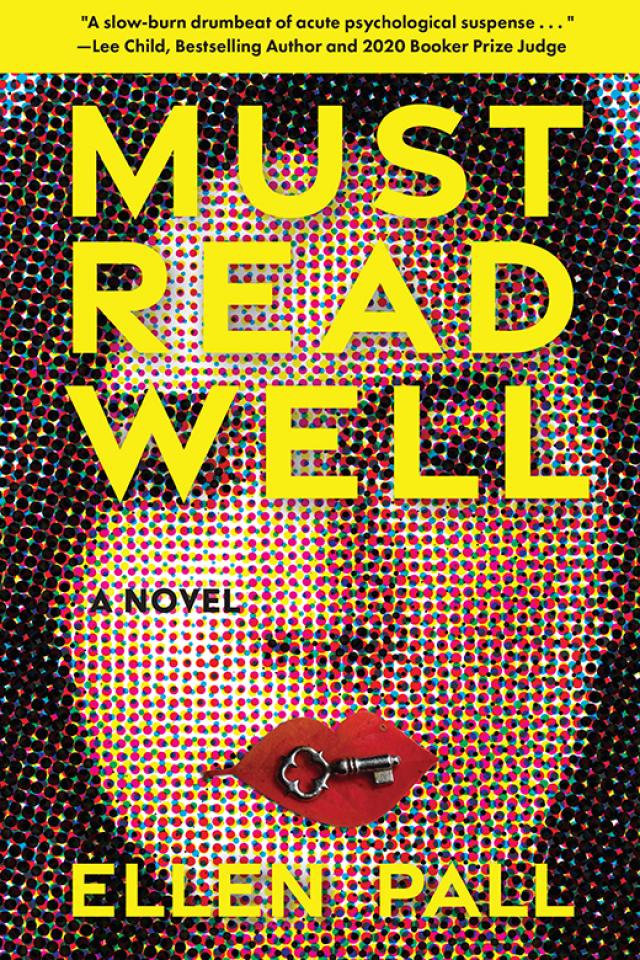
MUST
READ
WELL
A NOVEL
ELLEN PALL
Copyright: Ellen Pall 2022. All rights reserved
This book is a work of fiction. Any resemblance to actual events, people, or institutions is purely coincidental.
No part of this book may be reproduced in any form or by electronic means, including information storage and retrieval systems, without written permission from the publisher, except by a reviewer, who may quote passages in a review.
Cover Design: Christine Van Bree
Interior Design: tracycopescreative.com
978-1-61088-542-3 (HC)
978-1-61088-543-0 (PB)
978-1-61088-544-7 (Ebook)
978-1-61088-545-4 (PDF)
978-1-61088-546-1 (Audiobook)
Published by Bancroft Press
“Books that Enlighten”
410-358-0658
P.O. Box 65360,
Baltimore, MD 21209
www.bancroftpress.com
Printed in the United States of America
ALSO BY ELLEN PALL
Among the Ginzburgs
Back East
Corpse de Ballet
Slightly Abridged
Likewise
CONTENTS
One
Two
Three
Four
Five
Six
Seven
Eight
Nine
Ten
Eleven
Twelve
Thirteen
Fourteen
Fifteen
Sixteen
Seventeen
Eighteen
Nineteen
Twenty
Book Club Discussion Questions
About the Author
ONE
Wrapped in a blanket, mainlining coffee, I sat in the cold light of dawn at the table in Petra Smolnikov’s kitchen scrolling grimly through the morning’s crop of housing ads on Craigslist. It was February 2011—for me, a February of the mind, the soul, the heart, and the wallet as well as the calendar. Ten days before, Tim Gunderson, the man whose life and apartment I’d shared for two years, had announced without warning that he’d fallen in love with another woman. An hour later, I was out of his place and installed in Petra’s.
God bless her, Petra had insisted I come to her at once. We’ve been friends since we were toddlers growing up across the street from each other, both of us only children, in Flyspeck (technically Fleissport), Pennsylvania. I spent a substantial portion of my childhood at the Smolnikovs’ house, eating dinner in their kitchen, watching TV in their den, sleeping in the twin bed across from Petra’s. Irina Smolnikov became a second mother to me—a second mother I sorely needed. And so Petra had no hesitation in offering me refuge, and I had no hesitation in accepting.
The night I arrived and every night since, I had slept on the foldout sofa in her tiny living room. Each morning, I sat down in her similarly tiny but beautiful kitchen (Petra designs kitchens for a living) and opened Craigslist. Unfortunately, though hardly surprisingly, ninety-six percent of the offerings were beyond what I could afford. More than nine years after I’d started at Columbia, a fearful, watchful visitor from another world, I was still at Columbia. I had scraped through on odd jobs, summer jobs, the paltry wages paid to financial aid students for work-study gigs, and as a graduate student, teaching. The rest I had borrowed. By that February morning in 2011, I had a B.A., a Master’s, four years as a Ph.D. candidate, and such a mountain of debt that I wondered if I could live long enough to repay it.
Not only that, I had recently learned that it might be impossible to finish my dissertation.
My heart sank as I plunged through the ads. There were a few bargains. For example, the “Free room and board for fulltime care of dementia mom.” The man who “just wanted someone to cuddle with—a girlfriend-type situation.” There was also the confounding “sublet in sunny jungle loft” and the “laidback” guy in Flatbush. His place I’d seen. He had opened the door in a red velour robe, then sat down with his crotch very much on display. At least he was honest; he was laidback. By the time Petra came into the kitchen, I had closed my computer and set my cheek down on it. Petra placed a hand on my back.
“French toast?” she asked.
“No thanks. Not hungry.”
I sat with my head still down, eyes closed, as the kitchen filled with the smell of butter and eggs and cinnamon. Ten minutes later, Petra set a laden plate beside my computer and sat down across from me.
“Eat,” she said, and I ate. She was washing the dishes when I reopened my laptop and saw the miraculous ad that transformed February into May.
Private room and bath with river view in pre-war doorman Greenwich Village building. Kitchen privileges. Available now. Advantageous terms for quiet female willing to read aloud to purblind landlady one hour a day. Reply with brief work/educational details to ATW1301922@ juno.com. Must read well.
Must read well. A shiver ran through me. I took a deep breath and studied the ad with more attention, but I already knew who had placed it. No psychic powers were needed, only a sharp eye and four years of research. “Must read well”? And “purblind”—purblind was the word of a writer. An elderly writer, probably, since her vision was so poor. Then there was the pre-war doorman Greenwich Village building with river view. How many such buildings were there amid the Village’s quaint townhouses and six-story walkups? A handful, no more. But these clues wouldn’t have been enough on their own. What sealed it was the email address. As I looked at it again, the letters and numbers dropped into their slots. ATW—Anne Taussig Weil. 1301922—January 30, 1922. Her birthdate.
You know that dissertation I mentioned, the one I might be unable to finish? I had titled it “Inadvertent Feminists: Three Mid-century Popular Female Novelists Who Advanced the Cause of Women,” and it was to be a close study of the work and lives and sociopolitical importance of three very successful authors of so-called “women’s fiction” in the late 1950s and early ’60s. My thesis was that although these and a handful of similar writers had been dismissed by critics as mere providers of light entertainment for lady readers at the very moment when other writers, writers of nonfiction, were launching the second wave of feminism, they had in fact had a significant, empowering impact on the lives of at least some of the women who read them.
Of the three authors I’d chosen to focus on, two had proven only too happy to help me. They showered me unstoppably with private and professional correspondence from fifty years before, the phone numbers of their children, siblings, and friends, unpublished manuscripts, ancient appointment books; in brief, more information about, and documentation of, their lives and thoughts and intentions than I could ever use. But the third and by far most important author was Anne Taussig Weil. And she had refused to speak with me.
I knew from the start that Weil, who wrote the 1965 blockbuster The Vengeance of Catherine Clark, must be central to my thesis. Derided by all but a few reviewers, Vengeance nevertheless ignited a brushfire within weeks of its publication. The blaze soon exploded into five-alarm flames that spread across America, then jumped the Atlantic to burn through Europe. It was a bestseller in half a dozen countries there; in the U.S., it soared to the top of the New York Times list, reigned supreme for seven months, then floated up and down in the lower ranks for more than a year. A paperback version amplified its fame and doubled its sales, and when these finally started to slow, the book was produced as an off-Broadway play.
Four years later, it returned to the public eye in the form of a successful Hollywood film. The scene in which Catherine Clark saws her marriage bed in half continues to inspire and delight angry young women today. With its near ubiquity and spellbinding tale of a woman’s drastic revenge on her unfaithful and abusive husband, I believed Vengeance did as much as, if not more than, any other book of its time, highbrow or low, to awaken, energize, educate, embolden, and liberate its readers.
This being the case, as soon as my dissertation topic was approved, I naturally made it my first order of business to set up an interview with Weil. I could have chosen to go through her literary agency (Vengeance was, and is, still in print) but I preferred to start with a personal, woman-to-woman appeal. So, having learned from a 1965 New York Times Sunday Magazine profile that she then resided in a large Greenwich Village building called the Windrush, I visited it on the off chance that she lived there still. And, against all odds, she did, as a casual inquiry to the doorman confirmed.
I went home at once and wrote her a letter explaining my project. With elaborate deference, I asked if I might meet with her. Her input would be so valuable, I admired her style so much, wished so fervently to understand what had most influenced her writing, how she saw the fiction of her contemporaries then and now, whether she considered herself a feminist, and why, in her opinion, her books had had the tremendous and lasting impact they did. (For diplomatic reasons, I said “books” rather than “book” even though all of them except Vengeance sank from view shortly after publication.) The letter might have been a bit on the fawning side, but my admiration for her was sincere. Grace Paley she was not; but whatever her gifts as a writer, her great success had happened. She had published a book that pulled women forward with a mighty lurch. I dropped it into a mailbox and waited for a reply.
None came.
After three weeks, I sent another letter, saying the same things in a different way.
Nothing.
After that, I turned to the farfetched hope of catching her as she went into or out of the Windrush. For this purpose, I made a series of visits there. The building was a tall one—tall for the Village, anyway—a few blocks from the Hudson, with a crisp green canopy announcing its painfully appropriate name. During those wintry pilgrimages, I stood by the hour in the icy gusts off the river, gazing up at its façade like a pining lover, willing her to come out. I stopped every elderly woman I saw on the sidewalk with a tentative, “Anne?” But no such luck; no Anne ever appeared.
Stymied and half mad with frustration, I finally gave up. I would have to make do with the recollections of the few willing former colleagues and acquaintances I could round up for interviews and the secondary sources available to anyone: microfilmed articles from Vengeance’s heyday, contemporary essays and articles about the reaction it provoked in the U.S. and abroad, subsequent novels by other women that (I believed) were spawned by Vengeance, book reviews and essays she herself had written, cameo appearances in biographies of other authors of her time whose work had been recognized as “important,” reviews of her novels, and, of course, the novels themselves.
As I began to move from research to writing, I was keenly aware of the lack of fresh material on Weil. With no choice, however, I soldiered on, and by December of 2010 believed I had closed in on the end. Before the holiday break, I gave my dissertation advisor, Professor Gwendolyn Probst, what I believed were the final two chapters of my dissertation. As I went in to discuss them with her soon after classes resumed, I felt triumphant, elated, certain she would tell me it was ready to submit.
An hour later, I was another woman. Having reviewed the chapters I’d imagined would be my last, Professor Probst felt herself obliged to inform me that she could not recommend I submit my manuscript to the committee as it was. It simply wasn’t substantial enough; it wouldn’t do. The material on Anne Weil was too “skimpy.” I must get more.
I sat listening, sucked deeper and deeper into a vortex of flame-cheeked humiliation. How sure I had been of my imminent success, and how disastrously wrong! By the time I got home, however, self-reproach had turned into desperation. Getting “more material” on Anne Weil was impossible, as Professor Probst knew full well. And on the success of my dissertation hung my future.
While it may not have the glamour, say, of betting your future on becoming an Olympic champion, going for a doctoral degree is a high-stakes game. I had gambled more than $100,000 borrowed dollars—not to mention the irretrievable years since college graduation—on earning my Ph.D. If I failed, I would still have the debt, but not the qualifications for a job lucrative enough to pay it back.
A Ph.D. degree may not be a matter of life and death, but for me, it was certainly the fulcrum upon which balanced one kind of life or another: on the one hand, the life of credentialed prestige that I hungered for, with time and license to defend the work of neglected female writers, to document the power of their impact on their readers, to teach and mentor younger women, and to pursue the highest levels of study and research; on the other hand, a far more circumscribed, less solvent one spent in a world of community colleges and private high schools, if not permanent exile from academia altogether.
That Anne Weil, of all people, had chosen to stand between me and the life I’d worked so hard to achieve maddened me. Yet I could see no way around her. I was by turns furious, terrified, and despondent—and, in retrospect, likely not very good company for Tim in the weeks before he broke up with me.
And so, as soon as I read that little ad, I opened my email and typed in the address given. Gone, for now at least, was the heartsore, homeless waif who had, just minutes before, declined (then inhaled) a plate of French toast in her old friend’s kitchen. In her place sat an energetic, self-possessed woman with hope and a very clear goal. I would tell her who I was and share with her my delight that chance had brought us together in such a way that we could help each other. What an extraordinary boon to each of us! I would happily read to her as long and as often as she liked, and at the same time, I would get to know her, fill the gaps in my knowledge of her life and work, and restore to her the attention, respect, and appreciation she deserved.
Within seconds, I realized what a terrible mistake such an approach would be. Weil had made it more than clear that she wanted nothing to do with me or my dissertation. Why should a chance crossing of paths, an accidental concatenation of needs, change her feeling about that? The correct, the smart, the necessary course of action was to make sure she had no idea of my identity, my interest in her, even my awareness of her. I must present myself as a complete stranger, one who happened also to be her ideal tenant.
A moment later, almost without thought, the text of my reply to her ad appeared in my head in its entirety. I set my fingers on the keyboard and wrote that the room she offered sounded ideal for me. Without naming the college I’d attended, I told her I had a B.A. in English and loved to read. I said that, as it happened, my mother was blind, and that growing up, I’d often read to her. I noted that I had a part-time job with flexible hours writing marketing copy for a small, online business, and that I usually worked at home.
I thought this stable if unimpressive employment would reassure her as regarded the matter of the “advantageous” rent. It was also a little bit true, since I did get an occasional assignment of this sort from a friend whose online store sold imported leather goods. I said that I hoped very much she would consider meeting me, and that I looked forward to hearing from her. I thanked her for her attention. Then, after a brief hesitation, I decided to send the message from my .edu address, to which Columbia graduates are forever entitled. This, I believed, would reinforce the suggestion of literacy, intelligence, modest accomplishment, and trustworthiness. All this I did calmly, steadily, as if my computer and I were one machine.
I pressed send, listened for the little “whoosh” sound of the message on its way, then made it to the sink just in time to puke. I stared at the still recognizable fragments of French toast in disbelief. Who was I? How could I lie to Anne Weil to get her to do what I wanted?
I knew I was capable of dissembling. I had had to dissemble regularly—pretend, lie, hide my true feelings—when I was a child, or I wouldn’t have lived to be an adult. But I had become an adult, and since then, I’d worked hard to learn it was safe (usually safe, at least) to be my true self, to be honest. I’d spent a year seeing a psychotherapist at Student Health twice a week. I’d attended Al-Anon meetings on and off since freshman year. I thought I had left my days of hiding behind me, yet here I was again. What kind of scholar—what kind of person—was I?
–––––––––––––
I washed my mouth out, emptied the sink, scrubbed it with Comet, threw away the sponge, and then, although I wanted to sit at my computer refreshing my email every two minutes, made myself get in the shower. Petra left the apartment just as I was toweling off, calling out a cheerful “See you later!” through the bathroom door. It flew through my head that I must tell Tim about this incredible turn of luck! Then reality returned. It’s quite convenient to cry in a shower. You almost don’t need tissues.
Clean and dry-eyed, I spent a sobering ten minutes with my reflection as I blew my hair into some kind of acceptable condition. My hair is fat. Thick, savage, willful—and as if that wasn’t enough, a particularly brilliant coppery red. I keep it long so I can brush it all back and clamp it into a braid or ponytail, something less menacing than what it looks like when it’s on the loose. That day I coiled it into a big, conservative bun at the nape of my neck, watching myself as I did so. At the best of times I am pale, but that morning I was even paler than usual. My eyes had a weird, glassy look, partly caused by the Shower of Tears, partly by the strain of the last ten days and the tense, desperate hope that when I got back to my laptop, I would find a response from Anne Weil.


