

Untying the Moon, page 3
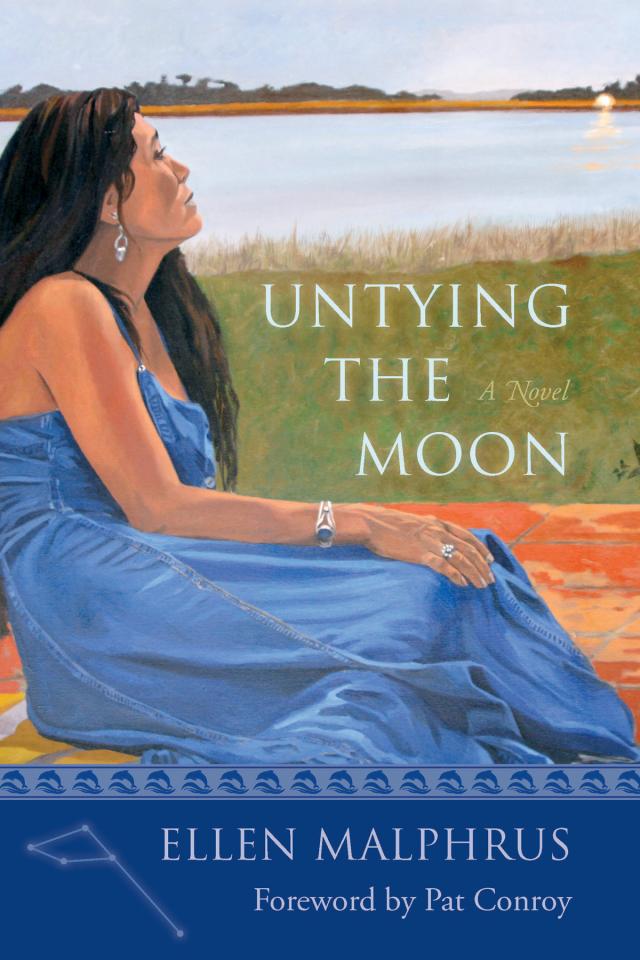


By full dark the warmth of Miss Ruby’s 360 horse hood has long cooled. She buttons her canvas jacket, pulls on a felt hat and thin leather gloves and drives on with the notion of finding an inn, but as she curves past one sign and then another she’s uninspired to stop. The night’s too clear, the road too agreeable, so she holds a course toward the bottom of the Blue Ridge backbone. Orange eyes of occasional critters shine on the roadside, beacons to mark the passing miles, and the nocturnes of Chopin drift among them.
On a particularly high and distant ridge she stops to find Delphinus, the dolphin, her mother Merissa’s constellation, breathing deeply the pleasure of disconnection, her whereabouts unknown to all others on the planet. The sky here isn’t quite so legible as in Maine, but not bad, not bad at all.
Delphinus is a small arrangement of five stars, four that form a diamond—the dolphin’s body—and a fifth for the extended tail. It is often overlooked by the uninitiated, but even those who can’t envision the dolphin itself can easily see the kite-shaped framework. Like Piscis Austrinus, it belongs to the Heavenly Waters family of constellations.
There are stories of the dolphin as Poseidon’s messenger, others of how she rescued the poet Arion from drowning. In the earliest years of childhood Bailey herself couldn’t see what her mother saw in the stars, no matter how earnest her efforts, but then one evening there it was, the gift was finally received. Since then her fascination with all things Delphic and cetaceous has been passionate and ever present.
Now, as she gathers night vision Bailey looks to celestial landmarks, echoing her mother’s ritual, her mother’s words, trying to hear something of her mother’s voice in the sound of her own.
There’s the Big Dipper and the Little Dipper. There are the ladies, and brave Orion the hunter. And there, my darling, is my gift to you. Delphinus, the dolphin stars. When I’m no longer here, look for me there. And when you see stars in the water, I’ll be there too. Stars rose into being from the sea itself, so the sky is but a reflection of the real light that shines beneath the water.
It is their special secret, and Bailey has used it as a litmus test for people all her life. Did you know that starlight comes from under the sea she would ask—a game, rather like St. Exupery’s little prince with his drawing of an elephant being eaten by a boa constrictor. Most people, of course, see only a hat, just as most people only find her question about the stars droll.
Now the elegant solitude of the Appalachian night enfolds her and she hears her mother’s delicate voice sing across the waves of echoed mountains.
Down in the valley,
valley so low,
hang your head over,
hear the wind blow.
Hear the wind blow, dear,
hear the wind blow.
Hang your head over,
hear the wind blow.
Roses love sunshine,
violets love dew,
angels in heaven
know I love you.
Know I love you, dear,
know I love you.
Angels in heaven
know I love you.
That her mother has been dead three years is an unfathomable fact for Bailey. She knows every dancing callous on her mother’s tiny feet, every crease around her velvet blue eyes. She sees the aquarium fish dart each time Merissa jerks and she jumps up to hold her, feels every convulsion of those last eternal hours. Hears the hiss of death zing in its little machine each time another surge of morphine runs through her mother’s tired veins. Ugly, unmerciful death that hovers around the white pillowed bed extracting pounds of flesh and misery before finally concluding the grim business as Merissa thrashes in the arms of her brokenhearted daughter.
Loss.
Gone. Not without avowal, though. Not like Alaska.
But there you are. It’s what was given them to brook and that’s what they did. All her life Bailey has held a belief in the imperfections of destiny, a notion that there are simply glitches in the great scheme of things. Fuckups of fate.
That affairs of the universe occasionally go awry she feels profoundly, but the torment is whether the lapses are benevolent or malevolent—or simply random miscalculations, blunders that may or may not ripple out to ruin. Cantankerous questions that perpetually nag and gnaw. Though she usually comes around to the attitude that things simply get off kilter sometimes, in the case of her mother she rages at the cosmos for the cruelty of timing.
Now, though, she forces herself away from deathbed memories and into her mother’s arms, rocking with the lullaby of low valleys and angel love. Against the falling temperature she cloaks herself with the quilt and sets off again. As the lullaby fades, she slips Santana into the tape deck and settles back into the highway.
Just past Craggy Flats tunnel two white tailed deer, doe and fawn, leap into the road then turn long synchronized necks straight into the headlights where they freeze in disbelief. Tires screech in time-suspended lengths across a patch of hell that echoes through the mountains, but as Bailey veers left the deer bolt to safety, released from the onerous beams.
Three hearts and Bailey’s fists pound as she wails through the blazing pain of her mother’s death and all that came after. For long minutes she cries and curses, gets out of the car and walks the quiet highway. When breath comes she looks once more at the heavens, across the indiscernible valley, says alright then, cranks Led Zeppelin and checks her map for the next campground, one with a hot shower and strong coffee.
BAILEY
(1962)
They, fair haired Bailey and her beautiful deep skinned mother Merissa—half breed to many—arrived in Anchorage after a long day of travel, several long days of travel, and made their way along the docks so Merissa could arrange passage to the small village of her family. Her husband, Bailey’s dad Cecil, was back home in the thick of shrimping season. That Merissa would arrive sometime that week her family was aware. That she had brought four year old daughter Bailey from South Carolina to Alaska for the first time would be a joyful surprise.
They walked onto a pier to watch a family of seals, and as they rounded the corner of a packing house that jutted into the harbor they saw a woman carrying a large tray. Her hair was stuffed under a black net and she wore a long white apron with pink red stains. She’d come to the edge of the walkway to dump a pile of fish guts, and as she hoisted the load she lost balance and fell into the cold cold water.
Without stopping to take her handbag from her shoulders Merissa dove after the big woman. The woman flailed and fought Merissa off, sleeves of her dark flowered dress flashing in every direction, and there was time, it seemed like a very long time, before anyone noticed the commotion, then mayhem began. Bailey, unnoticed, kept getting pushed farther and farther back. Each time she found another way around all the legs, but there wasn’t much room on the walkway and the crowd quickly grew.
When Merissa first dove Bailey was unworried because her mother was always in the water. Bailey could see the big woman needed help and she knew her mother would help her, but the woman fought against her mother, hit her and hurt her, so Bailey began to call, Momma, Momma. The woman fended Merissa off with wide-eyed thrashes until she took them both down. Merissa didn’t come up and she wasn’t there, over and over she wasn’t there.
The crowd watched and grew quiet but for Bailey’s small voice calling Momma, Momma. The whole world splashed and there was so much hair. Merissa’s black hair and the big woman’s yellow-white hair that had loosened around them—arms and hair and the woman’s pink face. And then the woman was gone and Bailey knew it. Merissa burst from the water, gasped, and plunged again. Twice more she did this before she rose near enough the dingy to be caught by two men and hauled into the tipping little boat. Merissa kept saying I have to find her. I have to get to her. Then she went to sleep.
Bailey called and called, Momma, Momma. But no one noticed in the continued chaos as Merissa was covered with stacks of rags and aprons and carried to the bed of a green truck that took her away. Bailey watched the water where the big woman had disappeared and couldn’t understand where everyone was. Her mother would return for her but Bailey didn’t understand what happened to the woman in the water, was transfixed by where she had gone.
Finally the shift boss was made aware of the child and assumed her to be the daughter of the Swede. Who knew?
When the officer told Bailey she had to come with him she screamed and tried to run. He jerked her arm and said Stop it. Pipe down. But someone else stepped past him and held her and stroked the crown of her head and said it will be all right. We’ll find your mother. She had Juicy Fruit and offered Bailey a stick. I need to stay here, Bailey insisted. She knew she should wait for Merissa but they assumed her to be the child of the drowned woman and wouldn’t listen when Bailey said her mother wasn’t drowned, that she flew away but would come back. She pleaded for her father Cecil and for godmother Retta and for Ben—for all of them until the lady with the chewing gum asked her to please be quiet so she was.
They took her to a place where the rooms smelled like licorice and rot, and everyone talked at her, over her, around her about what to do. Words like foster care, next of kin, orphanage, social worker swirled. But then a soft lady with dangly earrings knelt in front of her, asked if she’d like some hot chocolate, and listened to her story, that her mother dove to help the big woman with the apron and almost didn’t come back, but that she would. Bailey answered questions that described a woman like the one at the hospital, not the drowned woman.
The soft lady took her to a sad room with other children and said for her to play with them but she didn’t want to play. Then she looked up and there was her mother in a funny chair, and her mother smiled but it was not her mother’s smile. And in that long moment before Bailey could call Momma, Momma and run to her, their eyes met and the excitement and need, the certainty and joy were blocked by a void from her mother that turned instantly in Bailey to panic and terror and fear beyond bones. Her legs froze, and no matter how hard she tried to call out, her voice would not sound.
It didn’t matter. For in that moment, in the tender clarity of her innocence, Bailey came to know full well and forever that when it matters most, words can do nothing.
She let them take her away, and when they gave her food she ate it and when they showed her where to sleep she got in bed and cried. Goodnight they told her, but there was neither good nor night. She pulled her coat around her, licked the salt from her Happy-as-a-Clam shell, and thought about the other half of the shell in Ben’s treasure box. The next day the soft lady helped bathe her and gave her clothes that smelled like somebody else, and she asked for nothing until Retta came and the nightmare finally ended.
No, not a campground with Murphy this close. Somewhere in the wee hours of the North Carolina night Bailey turns off the crest of the Blue Ridge and begins the spiral that will unwind mountains into hills, hills into flatland, flatland into coast, and she tastes the pull of tidal waters. Miles slow as the fog settles, and while some other time she would thrill with the uncertainty of where the road ends and the side of the mountain begins, tonight she is weary and ghosts gather in the void.
Nearing the turnoff for Cruso she calls from a lonesome booth outside the one pump filling station, and within the half hour she drives into the hollow and echoes her way along a steep gravel road toward the cabin where a popping fire is no doubt waiting.
Murphy opens the door with arms wide and enfolds Bailey before she can even knock.
“Look at you, river girl. A sight for sore eyes, that’s what you are.”
“Hey Murphy.”
They lean into each other and laugh. Lean and laugh.
“Could you use a cup of coffee?”
“I’m here for the full treatment, Murph. Road worn and hungry.”
“How hungry?”
“Hungry enough to wait.”
He stokes the fire, takes her by the hand, and leads her upstairs to the hemlock paneled loft.
“You haven’t seen this. I built it two summers ago and when the weather’s right I’ve been sleeping up here. It’s got a surprise to it.”
“Well?” she says. “Show me.”
“You’ll see.”
Though each can only haze the shape of the other in the half light he says, again, “You’re a sight for sore eyes, Bailey. It’s good to see you.”
“Shhh,” she says. “Show me.”
And he does, with the gentle gestures of a strong man who seldom entwines himself with a woman’s body, especially a woman he holds with such earnest devotion.
She edges toward sleep as he strokes the length of her and kneads the road knots from her shoulders and neck, then whispers and points.
“There’s your surprise, river girl” he says. “Look at it before you nap. There.”
Through a tiny circular window in the pitch of the cabin roof shards of sunrise cast themselves upward over a faraway peak.
“Why is it so much more beautiful like that?”
“Because for just a moment you’re convinced you could hold it in your hands. Now sleep while I cook you some breakfast.”
“Not just yet,” she says and spoons to him in the sweet hush of daybreak.
When she wakes it is to that most exalted of all morning smells—bacon frying—made even more tantalizing when cooked by someone else, someone who knows just how crisp you like it and would do that for you.
She lifts onto her elbows and watches him, barefoot and shirtless, whistling to himself with the ease of someone accustomed to his own kitchen. Follows his taut movements, the long hard back of a working man always a particular pleasure.
“You ought to get yourself a girl, Murphy.”
“Let me know when you’re ready to give it another whirl.”
“I’m serious. Why don’t you get yourself a girl?”
“I do from time to time. Now get your lazy bones down here. I’ve got sweet potato pancakes and bacon, and the best honey you’ve had in a while.”
“You’re the best honey I’ve had in a while. Honey.”
“Yeah, yeah. Tell me more than once a year or two and I might start to believe it.”
They eat in unspoken satisfaction at a table Murphy’s great grandfather hewed from hickory for the cabin that his own father had built. Murphy now in buttoned flannel. Murphy who would never come to the table without a shirt. One of a long line of lean scrapping people who bore pride and sons that began to walk off the mountain two generations back. Until Murphy came of a mind that a weekend here and there at the old home place was not justice to his forbears and so had returned to reclaim the fruits of their labor, the pleasure of their customs.
“Wait a minute. Shouldn’t you be gone by now?” She reaches for more pancakes and honey. “And you’re right. This batch is incredible.”
“Thank you, ma’am. I’ve got a case of it for you. And yes I should be gone, but I called and switched runs with Jake. It’s the Five Falls section of Chattooga—come go with me.”
“White water sounds great, it really does. But I’m gonna pass. I’ve got lobsters that need to get to Kirk’s Bluff.”
As she rises he too stands to pull the chair for her.
“Lobster you say. Where’ve you been?”
“Maine, but that was Sunday. Those boys will soon need a pot.”
He rinses the plates, stacks them on the right side of the deep farm sink, and they walk outside into the crisp mountain air. He picks a blue morning glory bloom from the fence vine and places it in her open hand. To match her eyes.
“You heading back this way?”
“Come on, Murphy. Don’t start.”
She sets the flower on Miss Ruby’s dashboard and opens the refrigerated cooler that takes up half the enormous trunk.
“I’m leaving you two big daddy lobsters,” she says. “Invite one of these pretty little mountain girls over tonight.”
“Thanks coach,” he says but kisses her with a hungry heart.
He loads the honey and an apple basket of picnic, tugs her pony tail when they hug goodbye.
“So long river girl,” he says when she shuts the trunk. “Hold it in the road.”
“You got it, Murph. See you when.”
Into the Pisgah National Forest, Vanderbilt legacy. There are too many cars at Whitewater Falls, but she can’t resist Sliding Rock—a place that has enchanted her since girlhood when she first slid down the glassy side of worn-down mountain and plunged into the heart attack pool at its base. Then climbed the stairway blasted out of rock and slid back down again, squealing and waving her arms wide while her bottom numbed in the cold. As she parks and gathers bathing suit and towel she thinks of long ago native children whooping down this same geological playland, and the children of settlers, and now the children of many scattered tribes.
Three slides later the top of her head is blasting and she changes back out of her swimsuit, exhilarated by the snow melted water, wraps her fingers tightly around a mug of honeyed coffee from the thermos Murphy filled, and drives on along the fern feathered Cradle of Forestry Road. Even the sound of it—Cradle of Forestry—whispers primal comfort, green and encompassing.
It will be the last stretch for a while with no traffic, no billboards, no buildings, nobody, and she wanders and weaves and stops to listen to Looking Glass Creek, savoring the emerald embrace of the antique forest. At each slow curve the world rounds into cascades of sunlight pouring from the mountains. She’s traveled this rain forest road dozens upon dozens of times since childhood, but never has it offered such angles of tender beauty.
The course she follows is the way of spring snow and ice that thaws in the ancient Appalachians and sifts toward the grand Savannah, the mighty Congaree and all their tributaries, gathering minerals and detritus along the way to nurture the shores. And as these vital waters flow toward the coast, summer flounder and blue crabs and brown shrimp migrate in from the cold ocean depths in a ritual of renourishment that has patterned spring through the ages.





