

It Was an Ugly Couch Anyway, page 1


Praise for It Was an Ugly Couch Anyway
“Elizabeth’s wit and writing style are as pure as they are delightful. Readers can expect to feel as if they’re on a rainy-day cafe date with a best friend and will enjoy this honest, funny, and candid trip through stories of a life lived one unpredictable but silver-lined day at a time.”
—BUNMI LADITAN, AUTHOR OF THE HONEST TODDLER, DEAR GOD, AND HELP ME, GOD, I’M A PARENT
“It Was an Ugly Couch Anyway is a delight—wise, funny, beautifully written. I devoured it in a day. And cried a little, for a couch I never sat on. I loved this book.”
—JULIA CLAIBORNE JOHNSON, AUTHOR OF BE FRANK WITH ME AND BETTER LUCK NEXT TIME
“I love reading anything Elizabeth writes because, well, she’s hilarious, and I really admire that in a person. But there’s another aspect of Elizabeth’s writing that’s on fine display in It Was An Ugly Couch Anyway: a grounded, sincere tenderness that anchors every bit of her humor. Whether she’s writing about marriage, health, faith, work, or a complicated real estate transaction (I don’t mean to be dramatic, but I experienced secondary stress), Elizabeth opens the door to her very real life and rolls out the proverbial welcome mat as she shares her stories. The end result is a book with so much heart that it’s going to feel like home to the people who are lucky enough to read it. What an absolute gift.”
—SOPHIE HUDSON, BESTSELLING AUTHOR AND CO-HOST OF THE BIG BOO CAST
“It’s rare to find a book that’s illuminating and very funny, but this essay collection is both. Crack it open for a deep dive into the insanity of Manhattan real estate, and stay for Elizabeth’s clear-eyed and deeply humane insight into modern life in all of its complexities.”
—SHANNON REED, AUTHOR OF WHY DID I GET A B?
“A buffet of honesty, humor, and quirkiness that borders on chaos, Elizabeth Passarella’s writing gives us permission to cherish the strange experiences and honest mistakes that make us human. This book is a heckuva ride and I devoured every word.”
—SHANNAN MARTIN, AUTHOR OF START WITH HELLO AND THE MINISTRY OF ORDINARY PLACES
“Elizabeth Passarella’s collection of essays is a delightful mix of contradictions, like the author herself: a devout Christian with an unholy real estate obsession; a devoted mother who can’t wait for her alone time; a journalist who walked away from a job at a big-time media company; a native Southerner who has wholeheartedly adopted the most liberal corner of New York City as her own. But above all, Passarella’s memoir is about a woman’s fierce determination to find a home for her family (and at a good price too), without losing her humanity, in the building she loves. As her neighbor, I was rooting for her all the way.”
—PAULA DERROW, EDITOR OF BEHIND THE BEDROOM DOOR
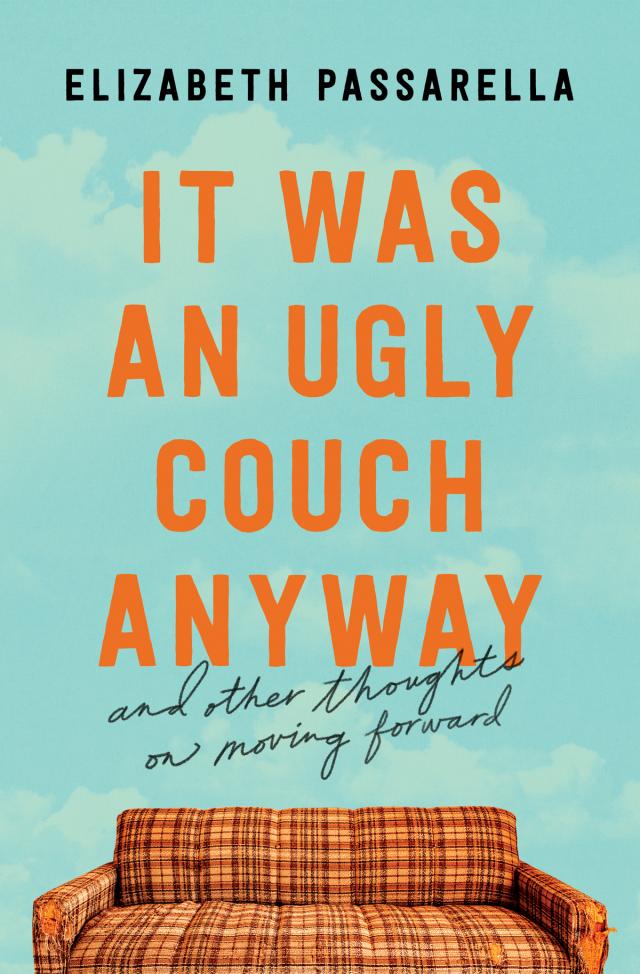
It Was an Ugly Couch Anyway
© 2023 Elizabeth Schatz Passarella
All rights reserved. No portion of this book may be reproduced, stored in a retrieval system, or transmitted in any form or by any means—electronic, mechanical, photocopy, recording, scanning, or other—except for brief quotations in critical reviews or articles, without the prior written permission of the publisher.
Published in Nashville, Tennessee, by Nelson Books, an imprint of Thomas Nelson. Nelson Books and Thomas Nelson are registered trademarks of HarperCollins Christian Publishing, Inc.
Thomas Nelson titles may be purchased in bulk for educational, business, fund-raising, or sales promotional use. For information, please email SpecialMarkets@ThomasNelson.com.
Scripture quotations are taken from The Holy Bible, New International Version®, NIV®. Copyright © 1973, 1978, 1984, 2011 by Biblica, Inc.® Used by permission of Zondervan. All rights reserved worldwide. www.Zondervan.com. The “NIV” and “New International Version” are trademarks registered in the United States Patent and Trademark Office by Biblica, Inc.®
Any internet addresses, phone numbers, or company or product information printed in this book are offered as a resource and are not intended in any way to be or to imply an endorsement by Thomas Nelson, nor does Thomas Nelson vouch for the existence, content, or services of these sites, phone numbers, companies, or products beyond the life of this book.
Some names and identifying factors have been changed to protect the privacy of others.
ISBN 978-1-4002-1901-8 (TP)
ISBN 978-1-4002-1903-2 (eBook)
Epub Edition MAY 2023 9781400219032
Library of Congress Control Number 2022047478
Information about External Hyperlinks in this ebook
Please note that the endnotes in this ebook may contain hyperlinks to external websites as part of bibliographic citations. These hyperlinks have not been activated by the publisher, who cannot verify the accuracy of these links beyond the date of publication
For my neighbors
Sadness is like a little bit of an emotional death, but not a defeat if you can find a way to laugh about it.
—Stephen Colbert
I say too many words to be right a lot.
—Beth Moore
Contents
Cover
Title Page
Copyright
Prologue: Home
Chapter 1: It Was an Ugly Couch Anyway
Chapter 2: What Doesn’t Kill You
Chapter 3: Finding Lois: Moving, Part 1
Chapter 4: But, You Know, Polished
Chapter 5: I’ll Always Have Arkansas
Chapter 6: With My Sincerest Apologies to the Late Nora Ephron and Basically Every Female Writer I Admire
Chapter 7: Like We Own the Place: Moving, Part 2
Chapter 8: Mothers-in-Law Advice on Dealing With In-Laws
Chapter 9: Lost in Times Square
Chapter 10: I Used to be a Dog Person
Chapter 11: How Long for a Passport?: Moving, Part 3
Chapter 12: The Chapter of Questionable Opinions
Chapter 13: Middle School is Awesome
Chapter 14: Lord, Make Me a Spleen
Chapter 15: We Walk Away: Moving, Part 4
Chapter 16: Funerals are the New Girls’ Trips
Chapter 17: Staying Put
Epilogue: Finally, Finally
Acknowledgments
About the Author
Prologue
HOME
I’m being a little bit of a coward about getting my second tattoo, even though going ahead and just doing it would make finishing this book a whole lot easier.
I’m writing this part last. After everything that has happened. Now that I know how it all ends.
I used to think I wanted this tattoo to signify my kids—the three I have and the two I miscarried. I’ve written about it before, almost as if I were trying to hold myself to it. And then a couple of years passed, and I hadn’t managed to come up with anything. No symbol or drawing or phrase felt right to me. It is hard to encapsulate multiple children or the breadth of motherhood in one discreet mark, I told myself. Or maybe being a mother wasn’t the identity I wanted to celebrate, indelibly, on my body anymore. That thought crossed my mind.
By contrast, deciding on my first tattoo was easy. I was twenty, studying abroad in London, and wanted a Jesus fish on my foot. I liked Jesus then. I still like him; I’ve never regretted the tattoo. There was a flat of boys living above me who were part of the same study-abroad program, and one of them, Stefan, said he knew of a tattoo shop in Central London and would take me. Shortly before our appointment we were all packing up our rooms because our semester was ending, and I went upstairs to find Stefan swallowing the boys’ pet goldfish that they’d bought when they moved in. Everyone was leaving the country in a few days, and the boys weren’t sure what to do with the fish. Stefan gulped it down like an oyster. This is the man I trusted to find me a tattoo artist.
If I wasn’t going to get a second tattoo to honor my children, shouldn’t I have just dropped it? Most likely. I am forty-six years old. Not that I believe there is an age cutoff for getting tattoos—absolutely not. The issue was more that I’d lived that long without wanting another one. Why now, in middle age, when I’d been so settled as a one-tattoo person for half my life?
The desire did not go away, though. It kept nagging at me. Some mornings I would roll over to my husband and workshop ideas. “What about your initials? That would be simple. I love you. I could get your initials,” I’d say.
“Are we talking about your tattoo again?” he would ask.
“Yes.”
“No. Your next husband might not like it.”
“That’s not funny.”
“Yes it is. Get whatever you want.”
But I didn’t know what I wanted.
And then one day I was running—something I used to loathe but changed my mind about a couple of years ago, a situation I’ll explain later on. I took a route I’d taken a hundred times before: out the lobby of our apartment building, down the street a few blocks, into Central Park, south to the Reservoir, around it and over to the East Side, then back to the West Side, and north again toward home. In seasons when I was in better shape, I circled it twice.
I used an app on my phone to track my pace, and at the end of every run, the map of my route popped up. What showed on the screen was a loop with a wiggly tail on top, sort of a roundish Little Dipper or a lasso or a golf driver that had melted in the sun. That day, when the map filled my phone screen for the umpteenth time, I remembered a story I’d read a few years ago on a blog. The story was about quirky tattoos. One woman had copie
This is the story. This book, in a way. And I regret to inform you of this meandering truth: that I went from wanting a tattoo that displayed a love of my children to wanting a tattoo that displayed a love of my husband to wanting a tattoo that displayed a love of an apartment building. What can I say? Real estate in New York is a very serious thing.
My husband, Michael, and I bought an apartment a couple of years after we got married. We stayed in that apartment for almost fourteen years. All of our children came home from the hospital to that apartment, and we loved it. But more than that, we loved the neighborhood and the park across the street and the people in our building. As homes often are, that two-bedroom apartment was our anchor, our refuge, when circumstances were constantly changing. We sold the apartment in 2021, and this story I’m telling you is about our half-crazy attempt to stay in the building by purchasing a different, larger apartment on another floor. It involves the widow of the owner—who became my constant phone companion, a massive (gigantic!) hoarding situation, one Christmas card featuring chipmunks wearing tutus, and some medical machinery from the 1950s that I gave away and am now convinced was worth a fortune. Probably not, but I still lose sleep.
While we were in the middle of the saga, on days when Michael and I worried that our dream of staying in the building and buying this much-bigger apartment was never going to come to fruition, I would mention getting my new tattoo. It became my talisman, this path from our home, through my favorite route in the park, and back to our home. Our home we wanted to live in forever, if we could just get some paperwork moving. Michael kept telling me to wait. “You cannot get that tattoo unless we actually own the apartment,” he said. What if we didn’t get it? What if we moved downtown and I had this dumb outline of a map to and from our old place? What if it made me sad for the rest of my life? He was right. I listened, and I did not get the tattoo. But I know why I wanted it so badly. It was something permanent, tying me to a place that I loved in a tumultuous year. And yes, there was a bit of magical thinking that finally taking the plunge would shift the winds in our favor, as embarrassing as that is to admit.
This is a book about moving, which, in general, I hate. See: fighting tooth and nail to stay in the same building rather than having to acclimate to a different subway stop. Yes, it is the story of moving out and trying to move back. But it is also about the displacement we often feel, even when our surroundings haven’t budged. If the wildness and brokenness of the past few years have taught me anything, it is that whatever you think is solid in this world will shift, and that includes your strongest-held opinions about yourself. I have reassessed my stance on everything from running to dogs to whether it was a good idea for me to have children. (If that seems like an outrageous thing to ponder, you might want to skip chapter 9, where I write about losing my child in the middle of Times Square on Christmas Eve.) I also wrote about my evolving perspective on my mother-in-law, which is most likely an even bigger mistake than admitting you lost a child in Times Square. But moving and unpacking—of all kinds—is messy.
These are stories of what we hold on to, and what we can let go. They are about trudging forward without certainty, without a clear destination. They are about looking back on where we’ve been and being okay if it’s maybe worse, or different, than we remember. Sometimes you move through a difficult month or a medical crisis or even a memory and end up in a fresh place. Other times you circle around a wiggly path that in your running app looks like a latke with a hair trailing from one side and return to where you started—but with newfound peace. I hope these stories remind you, as they have me, that we have less control than we think, that the hard parts don’t last forever, and that apartment dreams can come true. You just need a lot of patience and a dumpster.
Chapter 1
IT WAS AN UGLY COUCH ANYWAY
The first thought I had after my husband and I finally decided it was time to sell our two-bedroom apartment was if there was a proper technique for skinning a couch. I needed to get rid of the couch—our real estate agent had said very plainly that it had to go, the sooner the better—and yet I was very attached to the fabric, for reasons I’ll get into shortly. I knew there had to be a way to cut the upholstery in just the right places so that I could strip it off in sheets, like peeling off the back of contact paper.
“You don’t need all of it. Keep a small square of the fabric. Frame it, whatever, and move on,” said my sister, Holland, when I explained on the phone what I was about to do.
“But I want to save as much of the fabric as I can.”
“Why? What do you think you’re going to do with it?”
“I don’t know. Seat cushions. A headboard. So I can keep a memory of him. It’s like when people taxidermy their dead dogs. You know people do that, right? They use the skin to make, like, a stuffed animal replica that then sits in their living room forever.”
“So you are taxidermy-ing our dad?”
I took a drink of my gin and tonic. “Something like that.”
My mother was all for it. “Take pictures,” she said.
My father bought the couch in question in 1968, three years before he married my mother. He ordered it from some family friends who owned an upscale furniture store in Memphis, and while I guess it’s possible that a salesperson talked him into the upholstery, I’ve always assumed it was his deliberate, well-thought-out choice. This was a man who used to order swatches of knit turtleneck fabric in various jewel tones from L.L.Bean so he could match future turtlenecks to his existing sport coats (a service I’m certain no longer exists at L.L.Bean). His couch design was personal. This thing was nine feet long—long enough for two people to stretch out comfortably, my dad always said—and low to the ground, with narrow, boxy arms that were even with the back of the frame. It was a simple, modern couch. And the fabric was a baby-soft velour plaid in the harmonious shades of rust, darker rust, coralish rust, cream, and black.
Everyone but my dad hated the look of the couch. At least, that’s what we all said.
“You’re all going to fight over this couch someday,” he would tell me and my sister.
“No way. It is sooo ugly, Dad. So ugly. Ew,” was our typical response.
It was ugly. But it was comfortable—comfortable in a way that made you see the ugliness differently. Sitting down, you would instantly start petting the velour on the cushion underneath you, absentmindedly running your hands away from the sides of your thighs and bringing them back in, tucking them under your rear end to feel the soft springiness of the cushions. At that point, most people would swing their legs onto the couch (“Wow! You could fit two people end to end on here!”) and lie back, still moving arms and legs across the fabric like they were making a snow angel because they simply couldn’t stop. I have memories of lying on the couch in the summer with bare legs and feeling the coolness of the velour lower my body temperature. Weirdly, it was also cozy and warm in the winter. And durable! That’s the most amazing part. My wedding dress, for which I paid almost $2,000, fell apart—one strap popped loose, and every single covered button fell off the back—in a single evening of dancing. Yet the 1968 velour upholstery on my dad’s couch looked perfect, even after forty years of bottoms and elbows and drooling faces smushed into it. Perfect.
Once my parents were married and raising children, my mother did not want the rust plaid in her living room, even though she, too, knew it was the most comfortable fabric in the world. So the couch lived for a while at my grandparents’ cabin on Lake Mohawk in northern Mississippi. When they sold the cabin, the couch came back to my parents’ house in Memphis. It went into my grandmother’s bedroom next to the garage. When it became necessary for her nurse, Chris, to occasionally stay overnight, Chris would sleep on the velour couch next to my grandmother’s bed. In high school I probably spent more time back in that bedroom watching TV with my grandmother than I might have otherwise, because the couch would suck me in. Perhaps that was part of its magic, holding me there in the final year of my grandmother’s life. When she died, the couch went into the attic, stored on its end like an obelisk to conserve floor space.





