

Disobedient, page 1


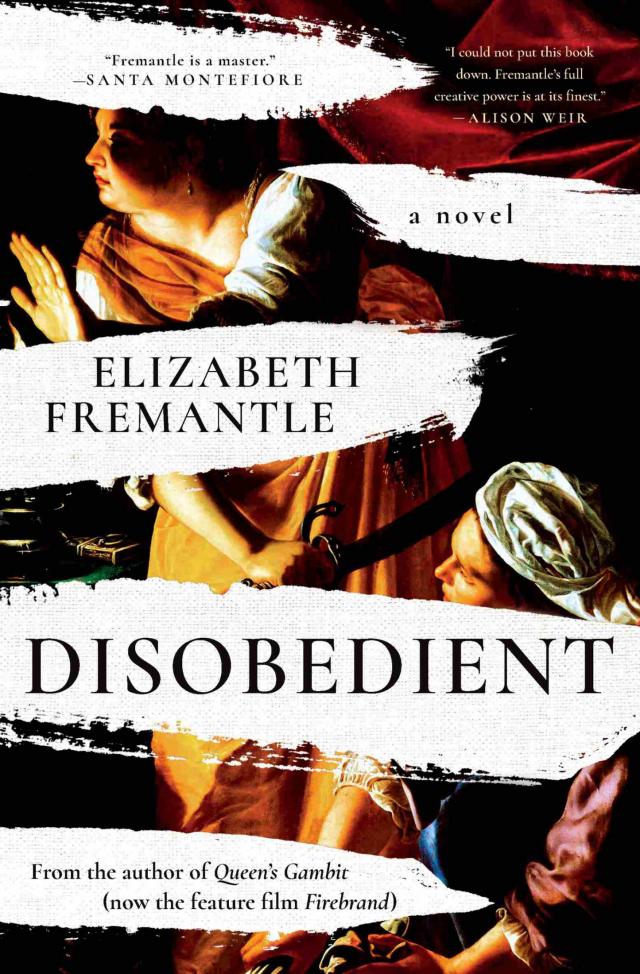
For all the survivors
A note on the text
I have chosen to anglicize the titles of Artemisia Gentileschi’s paintings and also the names of the saints, while my characters’ names are kept in Italian. With very few exceptions the characters are inspired by historical figures though in some cases I have changed their names for fluency. Tuzia Medaglia I have called Zita and her baby Diego, Luca. Of the Stiatessi family, Pierantonio is shortened to Piero; Giovanni Battista, simply Giovanni and Portia I have spelled Porzia. Michelangelo Merisi, more familiar to us as Caravaggio, I refer to as simply Merisi. The Palazzo Conscente is a place of my own invention.
PART I
I’ll show you what a woman can do.
Artemisia Gentileschi
1. Beatrice Cenci
Rome, September 1599…
The studio smells of minerals and linseed. It is silent, save for the rhythmic grinding of the pestle and mortar as an assistant mills pigments at a bench: gaudy splats of colour, glossy with oil.
Artemisia sits motionless. She is trussed up uncomfortably, like a joint of mutton, in a puce silk dress that belongs to another girl. A loose wire in her jewelled headband torments her.
She musters all her self-discipline to keep still, waiting for the moment her father turns away to discuss something with the assistant. Quick as a fly, she digs her nails into her scalp – an instant of blessed relief.
‘Don’t move,’ he blasts. She snatches her hand back into position. It must be true, his warning that he has eyes in the back of his head. She squints at the dark hair hanging to his shoulders, wondering how those invisible eyes can see through such a mane.
She has taken the place of a child whose portrait he is finishing. Artemisia hasn’t seen the girl in real life but knows she is the Pope’s great-great-niece, or something like it. That is why she is wearing the elaborate, scratchy lace and jewels – so her father can add the final touches without ‘further imposing on the young lady’. She is very glad not to be the Pope’s great-great-niece and have to wear such uncomfortable things every day.
The quiet is shattered as the door bangs open and her father’s friend strides in, bellowing a greeting.
‘You’re early, Merisi.’ She can see her father’s irritation in the red flush blossoming on his cheeks. He is usually quick to temper but not with Merisi, or not to his face anyway. Behind his back he calls him ‘that vile miscreant’ and worse things she is not supposed to have overheard: ‘The devil’s taking all my commissions. Everyone calls him a genius. He’s not a genius, he’s a plague sore.’
‘Early? On the contrary’ – Merisi is wearing a grin – ‘we’ll miss all the fun if we don’t hurry.’ He steps towards Artemisia, removing his hat with a flourish and stooping into a deep bow. ‘Michelangelo Merisi de Caravaggio at your service, my lady.’
‘I’m not…’ She stops, unable to remember the Pope’s great-great-niece’s name. ‘It’s me, Arte –’ Realizing that Merisi is teasing, she laughs.
The angelus bells ring across the city. ‘See, it’s already noon.’ Merisi is animated. ‘Help your daughter out of that absurd dress and let’s go.’
‘We’re not taking her with us.’ Orazio hands his palette and brushes to the assistant to tidy away.
‘Why ever not?’
‘It’s not a suitable occasion for a six-year-old.’
‘You wouldn’t say that if she was a boy.’ Merisi winks at her, his thick-lashed eyes black and shiny. ‘Let her learn what becomes of girls who disobey their fathers.’
She wonders what he means.
Merisi removes the jewelled band from her hair.
‘Her mother would never allow it. Be careful with that. It’s worth more than you earn in a year.’ Her father loosens her ties and lifts the heavy dress over her head, leaving her in her shift, comfortable at last.
‘I didn’t know your wife was your keeper.’ Merisi is standing in the doorway, tapping the jamb.
Artemisia watches her father relent with a sigh, as she climbs into her ordinary clothes.
‘Where are we going, Papa?’ She wonders if it will be one of the puppet shows in the Piazza del Popolo. She remembers the man puppet, big red circles painted on his cheeks, beating his puppet wife with a truncheon. Everybody thought it was funny.
‘Isn’t it much more exciting if it is a surprise?’ says Merisi.
‘No!’
He laughs at her. Not in a way that makes her feel silly, like some adults do, but more in a way that draws her in, as if he counts her as one of his friends.
‘Look!’ He is holding out both of his hands. His fingers are long, nails clogged with paint. One hand is fisted, the other open, a coin cupped in the palm. ‘Pick one. You can keep what’s in it.’
She considers for some time which hand to choose, glancing at her father for help. He merely shrugs. She has never had a coin of her own. She could buy something with it.
Her mouth waters as she thinks of the cones of sugared nuts sold in the market that her mother says are too expensive. She is on the brink of making her choice but something stops her. Perhaps there are two coins hidden in his fist. She could buy the sugared nuts and a bag of seed to feed the little birds, or a length of silk ribbon, or a bombolone. She can already taste the sweet creamy ooze of its filling. ‘That one.’ She points at Merisi’s closed hand.
He unfurls it slowly with a low chuckle.
It is empty.
Disappointment washes away her small dreams. Another girl might cry, but not her.
‘Honestly, Merisi.’ Her father is frowning. ‘Getting her hopes up like that. She’s just a child.’
Merisi ignores her father, asking her, ‘What does that teach you?’ as he caches his coin.
She has to think very hard to come up with the lesson she has learned.
‘Not to want more than I am offered?’ she suggests quietly.
She has the feeling of being wrong but her father says, ‘Good girl. That’s right. The moral is that we must all learn to limit our expectations.’
‘I suppose that’s one way of taking it,’ Merisi says. ‘But it’s not what I intended.’
Even though he frightens her a little, there is something about Merisi that Artemisia can’t help feeling thrilled by.
‘What is it that makes you want the thing you can’t see?’ Merisi thrusts forward his clenched hand once more.
Her mind churns for an answer. ‘It might be something even more special.’
Merisi is smiling at her. ‘No one can resist a mystery.’ He turns to Orazio. ‘Not a moral but an observation. Your daughter is uncommonly perceptive. How old did you say she was? Six? You might well have a prodigy on your hands!’
She isn’t entirely sure what a prodigy is but from his expression it must be something good.
‘I wouldn’t know about that.’ Orazio passes Artemisia her coat. ‘One doesn’t really want precocity in a daughter.’
When her father isn’t looking, Merisi slips two coins into her hand, lifting his forefinger to cross his mouth. She hides the treasure in her pocket. The idea of keeping such a secret gives her a warm feeling inside.
Her father takes her elbow as they leave. His grip is tight and she has to run to keep up, weaving through the narrow streets. The crowds become dense, the atmosphere high with excitement, as they jostle forward towards the river. All Artemisia can see are backsides and shirt-tails, the hilt of a knife stuffed into a belt, a baby bundled in a woman’s arms, a donkey leaving a pungent trail of dung in its wake.
They grind to a halt and people begin to shout and push. Somewhere ahead she can hear a great roar go up.
‘Sounds like we’ve missed the wife,’ Merisi says. ‘I told you we’d be late.’
Artemisia, pressed too tightly between strange bodies, feels the fizz of panic. Something hot and wet slides over her hand. She recoils. It is only a dog licking the salt from her skin. She strokes its head, glad of the distraction. It pushes its cool damp nose into her palm.
The throng begins to move. She stumbles on a broken cobble, falling, grazing her palms. A boot stamps, narrowly missing her head. She struggles to get to her feet, the press of the crowd preventing it. Large hands grip beneath her arms and, before she knows it, she is catapulted up, above the crowd, and onto Merisi’s shoulders.
Her father is grumbling. ‘I told you we shouldn’t have brought her.’
Artemisia looks down on the sea of heads surging forward below. Tiny beads of blood are forming on the soft cushions of flesh beneath her thumbs. She blots them on her coat.
Perched up high she can see where the street opens out into a large piazza from where the bridge spans the river. The water sparkles and writhes, boats cluster, jouncing on its surface, sails flapping like Friday washing. The Castel Sant’Angelo squats on the other side, its tower fat and round, bricks blushing in the afternoon sun.
Gulls quarrel as they swoop overhead, white against blue. One lands on a nearby strut at Artemisia’s eye-level. Its beak is big and hooked, the yellow of ripe lemons. Its strange eye swivels before it flings itself back into the sky, the vast span of its wings opening. She watches it sweep upward magnificently, tucking its talons into its undercarriage, imagining she too is propelled on wings up into the endless blue.
Merisi deposits her on the top of a wall, ordering a group of grubby-faced boys to move over, before he and Orazio scramble up beside her. From there she can see an empty space at the centre of the piazza with a circle of hurdles to hold back the crowd. In the middle is a stage, strewn with straw, holding a wooden structure like the one that suspends the angels in the Easter play. A choir of holy brothers is lined up nearby, singing psalms.
‘Will it be a play?’ she asks.
‘In a way,’ says her father, with an odd, knotted look.
Merisi laughs. ‘You’ll see.’ He squeezes her shoulder. ‘There’s Reni! Over there in the stand.’ He is pointing and waving to someone, shouting the man’s name.
And they are on the move again, pushing through towards the side where rows of benches are banked and filled with seated people in colourful clothes.
A man is calling to them: ‘Over here! I’ve kept you a place.’ Artemisia has seen him once or twice at her father’s studio. He is a painter too.
When they manage to reach him, up a set of steep steps, Artemisia overhears him say quietly, ‘Isn’t she a bit young for this kind of thing, Orazio?’
At that moment their conversation is drowned in a chant: ‘Bring out the girl, bring out the girl, bring out the girl.’
More join in, and more, stamping their feet until the entire piazza is thundering with noise.
They sit, she on her father’s lap. A large woman squeezes herself in beside them and they all shuffle up. She is glistening with sweat and waves a fan at her face, spreading a strongly perfumed scent that makes Artemisia feel vaguely sick.
Suddenly the place falls silent save for the rumble of a cart entering the square. The holy brothers break into song once more. Artemisia stands to see the girl better. She is not a small girl like her, but a grown-up girl being led from the cart and onto the stage close to where they are seated.
She is very pretty but her costume is plain. Artemisia has only ever seen two plays and the players had worn gaudy outfits in both. They were all men or boys. She has never seen a girl player before, thought such a thing didn’t exist, and it occurs to her that this may well be a pretty boy.
She (or he) is wearing a sensible dun-coloured dress and is bare-headed, a skein of straight dark hair scraped up onto the top of her head. She seems to be murmuring quietly to herself in prayer and her brown eyes look mostly down at her small white hands, fingers threaded tightly together. Occasionally her gaze flicks up at her surroundings. A just-visible tic in her jaw says she is nervous. Artemisia supposes it must be the occasion, the multitude of people all looking her way. She tries to imagine herself in that position, skin bristling at the thought of so many eyes on her.
Gulls continue to circle above while the girl is walked to the centre of the stage beside a step. The holy brothers sing on, swaying in unison, the hems of their grey cassocks wafting gently as they move, rosaries swinging in time. A big man, bald with a bushy beard that looks as if his hair has slid from his head to his chin, approaches the girl.
She hands him a purse and he says, loudly enough for everyone to hear, ‘Please forgive me,’ then says something else quietly into her ear. Her eyes catch his briefly with what looks like real dread, making Artemisia wonder how it is possible to be so convincing with make-believe.
The girl gets to her knees and the man ties a blindfold over her eyes.
A lone voice from the back shouts something angry. The audience becomes restless and Artemisia is glad they are sitting safely in the seats. The woman beside her is breathing heavily and noisily. Artemisia puts her hand over her nose and mouth to block out the smell of her scent.
When the girl lies down on her front, head on the step like a pillow with both arms splayed out, Artemisia supposes she must be enacting the martyrdom of one of the saints. She racks her brain to work out which of the Virgin Martyrs she is. On her fingers she counts them off from the prayer drummed into her by Sister Ilaria: Dorothy, Justina, Agatha, Lucy, Agnes, Cecilia… She can’t remember the others.
The axe moves in a whistling arc through the air.
It falls with a loud thump.
At once the girl’s leg kicks violently up, flinging her dress almost over her shoulders as the pretend head rolls away. A spurt of red liquid springs up, raining onto the stage to form a gluey pool around her and all over her dun-coloured dress.
The crowd groans and snarls, shifting like rough water.
A warm splash lands on Artemisia’s hand. When she looks it is not red but clear, someone’s tear, or spit, or a splash of the sweat that is now trailing down her neighbour’s face as she shouts and waves a fist.
‘How do they do it?’ she asks. ‘How do they make it so real?’
The woman looks at her strangely. ‘What do you mean, child?’ Her cheeks wobble as she speaks.
‘The play. The martyrdom. It looks so real.’
‘Martyrdom?’ The woman makes a kind of laugh. ‘It’s an execution, poppet.’
It is a moment before the woman’s words sink in. This is not a play, not a boy pretending to be one of the Virgin Martyrs. Her belly hollows out. She is a real girl who is really dead on the platform, with real blood pumping on and on from where only moments ago her head was attached to her shoulders.
‘But who is she? What did she do?’ Artemisia’s voice is small. Blood rushes in her ears.
‘She is Beatrice Cenci and she murdered her father.’ It is Merisi who tells her this.
Artemisia’s hand flies to her throat. Her head swills. Heat drives up through her body. She sways, lids heavy, vaguely aware of a commotion, voices, her name, a sharp slap on her cheek, water poured into her mouth, before the world turns red then black…
* * *
The next she knows she is back at home, her mother’s cool hand on her forehead. She is talking to Orazio who looms with Merisi, two shadowy shapes across the room. Her voice is snappish. She is annoyed. Artemisia’s baby brother has begun to grumble.
‘What can I say? You were right, my love. Always right, Pru. I shouldn’t have taken her with us.’ Her father stoops to kiss her mother’s brow, making all the sharpness drop away. A damp cloth is pressed to Artemisia’s head. She keeps her eyes shut, not ready to wake yet.
‘That poor Beatrice. As if she hadn’t suffered enough.’
‘That’s as may be, but murder can’t go unpunished.’
Artemisia continues to drift in the safety of her mother’s arms, half listening to their conversation as images flash through her mind: the fountain of blood, the rolling head, the girl’s small white hands, like butterflies.
‘This afternoon has inspired me. I’m going to paint a Judith,’ Merisi is saying. ‘Not in the usual way. I want to show her in the moment she decapitates the Assyrian.’ Artemisia can hear the scratch of charcoal on rough paper. ‘Get right to the truth of what it means to take a life.’
‘All that violence,’ her mother says. ‘Is it necessary?’
‘Who is Judith?’ Artemisia asks, sitting up, her curiosity sparked.
They fuss over her: does her head hurt, is she dizzy, can she see clearly?
‘But who’s Judith?’ she asks again.
‘She was a very courageous woman from the Bible,’ her mother says. ‘You will learn about her when you are older.’
‘Was she a murderer too, like Beatrice Cenci?’ Artemisia notices a severe look pass from her mother to her father, as if to say: See what you’ve started.
‘No, my love. She killed her enemy to save her people, the Lord’s people. It is different.’
‘But how is it different?’
‘It just is.’ Her father slams the conversation shut.
Merisi looks up from his drawing. This time, his wink makes Artemisia feel uneasy.
The Judith Fragment
He stumbles, the great Assyrian, Holofernes, a swill of wine spilling.
Canvas walls quiver as he rights himself.
‘Sit,’ says Judith.
Like an infant he obeys, lifting his arms so she can unbuckle his breastplate and sword.
They clatter to the floor.
Her silent prayer circulates.
‘Save me, O Lord!’
He smells of horse and sweat and saddle oil.
She heaves the pitcher, replenishing his drink, tipping it into his waiting mouth.
She thinks of the children of besieged Bethulia, her city, bellies bloated, eyes sunken, awaiting a small sip of gritty water from the almost empty cistern.


