

Pickle Impossible, page 1


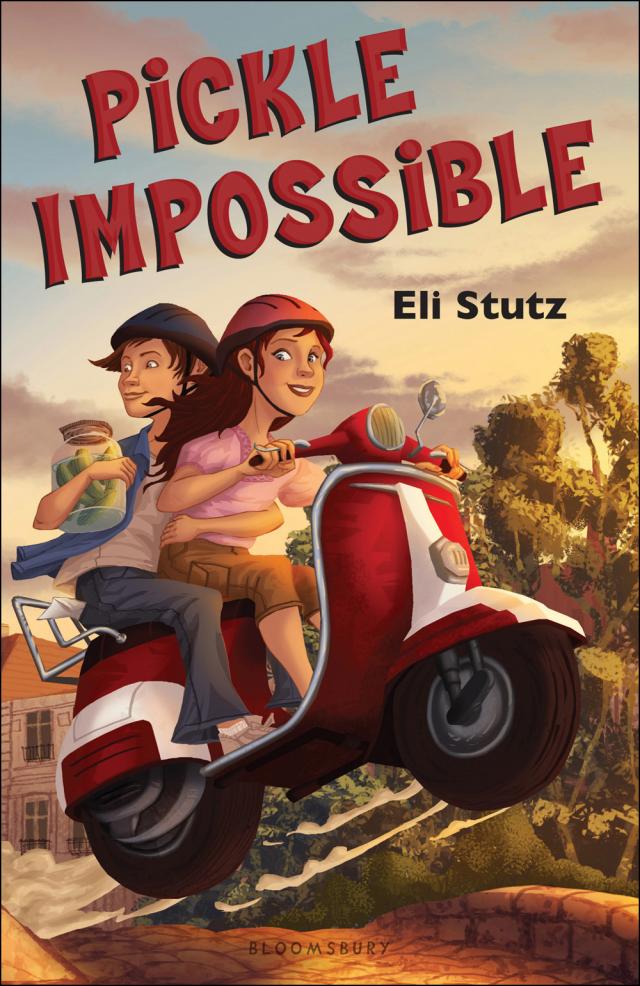
PiCKLE IMPOSSiBLE
Eli Stutz
illustrations by C.B. Canga
Contents
Cover
Title Page
Dedication
PROLOGUE Somebody Is Watching…
CHAPTER 1 The Greatest Story of All Time
CHAPTER 2 Who Will Go?
CHAPTER 3 An Unexpectedly Short Train Ride
CHAPTER 4 The Wet Prisoner
CHAPTER 5 Two Wheels to Paris
CHAPTER 6 Paris Is Perilous
CHAPTER 7 Duel in the Catacombs
CHAPTER 8 A Fox Trap
CHAPTER 9 Mountain Magic
CHAPTER 10 Cliff Hanger
CHAPTER 11 Accelerated Stuff
CHAPTER 12 The Clock Is Fast
CHAPTER 13 The Winning Pickle
CHAPTER 14 One Big, Happy Family?
Geveret Chutzpadickerstein’s Homemade Pickles
Acknowledgments
Imprint
For Tziona, Shoham,
Shalhevet, and Naftali
PROLOGUE
Somebody Is Watching…
The boy set his head down and waited for the gun to go off.
Bang!
With a jolt, he launched himself down the track, pumping his arms back and forth, moving his legs as fast as they would go.
He was aware of the other boys on his left and right—he was in the middle lane, as usual.
Just this once, let it be different, he said to himself. Just this once.
The dust flew from his feet. The wind rushed past his face. He forced himself to go faster.
The finish line came into view.
There were cheers erupting from the stands—the other grades, on recess, were watching. Were they cheering him?
As the white tape approached, he clearly saw two of the other runners pull ahead of him. His chest hurt. He gave one last push.
The tape broke.
The race was over. The crowd was on its feet. But not for him.
He was a few steps behind. As always.
The gym teacher walked over to tell each of the runners their times.
He knew what he would hear before he was told.
“14.25 seconds, Pierre, exactly the class average. Good try.”
The boy collapsed on the earth, breathing hard.
Each time it was the same.
But far off, past the stands, just over the fence and behind a hedge, a girl was watching. She lowered her high-powered surveillance camera and spoke into a walkie-talkie.
“He doesn’t look like much of a threat, Grandfather. Do you want me to keep following him?”
“That won’t be necessary, my dear. Pierre La Bouche will never amount to anything. He’s a cornichon—a good-for-nothing. Move on to the others. Over and out.”
The girl switched off her walkie-talkie. She picked up her camera again and focused it on the boy. His nearly brown eyes looked up, turned in her direction, and squinted, trying to see something. It was almost as if he could see her.
She lowered the camera quickly and ducked beneath the leaves.
Her grandfather’s words echoed in her mind, but still, there was something that bothered her … some small doubt. “My grandfather’s right, he’s just a cornichon,” she told herself. “I’d better get moving.”
Could a good-for-nothing ever amount to anything?
CHAPTER 1
The Greatest Story of All Time
I’m yanked from my home, then prodded and felt,
Bathed in hot juices that make my skin welt.
Locked in a dungeon and left there to stew,
‘Til I’m snatched up and gobbled by someone like you.
What am I?
This is an unbelievable story. But it’s true. This is the greatest, most exciting story you’ll probably read all year, maybe even all of your life. And the best thing about it is that I’m the star. My name is Aurore. That means “first light,” so I guess the name fits!
Today I’m a simple twelve-year-old French farm girl. But by this time next year, I’ll be a famous actress. So remember that name—Aurore. I’m sure that by the time you finish this book, you won’t be able to forget it.
Have you figured out the riddle on the previous page? Can you guess who the girl with the camera was? This story is full of mysteries, so I think I’ll leave you guessing for now.
Just so you know, this book isn’t only about pickles. It’s about something extraordinarily fabulous that happened to me—well, to me and to my friend Pierre. You see, we’ve just had an incredible adventure, across continents, over land, sea, and air, battling criminals of the worst kind, and trying to win … oh, dear … I shouldn’t give away too much—otherwise you won’t read this story, and I won’t become a famous actress.
But first you must be wondering why I am writing this story in English. Well, there is no more patriotic person than myself. And I love my dear homeland, France. (Vive la France! Long live France!) But to become a movie star, my secret plan is to write a famous book in English, because English is the language of America, and in America some Hollywood producer will decide that this book simply must be made into a movie. And then, because he’ll see my picture on the jacket and realize that I’m not only a great storyteller and a heroine but also a beautiful and striking young lady, he’ll call me up and ask if I would do him the honor of starring in a movie based on this book. (Of course, the part of Pierre—whom you’ll get to know soon—will have to be played by a genuine Hollywood actor—you see, the real Pierre is just average at acting, and his looks are just, well, average.) So then I’ll say that I’d love to star in the movie, and everyone will see it, and I’ll win an Oscar for Best Actress, and then I’ll move to America, and then I’ll be … ah, wait. I’m not sure about the moving-to-America part. I guess we’ll deal with that later.
I should warn you that not everything in this story is nice. In fact, some of it is extraordinarily strange. Some of it I don’t even understand myself. But don’t worry, things turn out okay—mostly. I wouldn’t be here to tell the story if they didn’t.
Ah, the story. You must be getting impatient. Well, enough about myself. Let us begin the greatest adventure of all time. Fasten your seat belts, reader, and ready yourself to be blown away. It all starts with … a jar of pickles.
CHAPTER 2
Who Will Go?
This is the best jar of pickles I have ever made,” declared Grandfather Henri La Bouche.
The sun had already gone down on the farm. The La Bouche family was sitting around the kitchen table, in the middle of which stood a very plain-looking jar of pickles.
Everyone looked up and stared at the jar:
Marc La Bouche, the father, was still nibbling on dessert—a croissant, but not a cheese one, of course.
Frieda La Bouche, the mother, was tackling her third cup of coffee, trying to fight off a bout of sleep.
Chantal La Bouche, the older sister, was brushing a particle of dust off her sleeve.
Under the table, little Jo Jo La Bouche was busy tying his brother Pierre’s shoelaces together, something he did almost every day.
And Pierre La Bouche? He was sitting quietly, in the middle of this meeting, wondering what all the fuss was about.
“Our farm is in trouble,” said Grandfather Henri quietly, almost in a whisper. Henri was thin and had wispy gray hair, but fierce blue eyes. His mouth, which was now closed, bulged out strangely at the cheeks.
As he spoke, his voice grew stronger. “For years we have just scraped by, making the finest pickles and selling them in the local markets. The cornichon, the tiny French cucumber, is, as you know, not only a local delicacy when pickled, but also the crowning joy of many great French dishes. Raclette, for example—”
At the word “raclette” (which is a dish made of pickles, cheese, and all sorts of other delicious things), Marc began to choke on his croissant. Marc La Bouche was a balding man with a potbelly, and he was almost always relaxed. But now his relaxed demeanor disappeared, and a look of fear and dismay came over his face. “P-p-please, d-d-don’t mention anything that has ch-ch-ch-… ch-ch-ch-… ch-ch-ch-cheeese in it.”
“I am sorry, my son,” apologized Henri. “I had momentarily forgotten.” Marc’s face relaxed almost as quickly as it had tensed up.
“Our situation is desperate,” said Henri, laying his hands on the table. “If we cannot somehow raise or find $100,000 in the next month, then the La Bouche farm will be sold.”
Marc breathed a sigh of resignation. Chantal rubbed her hands nervously. Jo Jo perked his head up from his mischief. Pierre just stared at the jar of pickles.
“There’s no way we can come up with that kind of money in a month,” said Frieda. “So you mean we’re going to have to pack up this whole kit and caboodle, like they say here—toot sweet?” I forgot to mention: Frieda is from Brooklyn, New York, and still speaks like a New Yorker. She is tall and thin and has long, wavy black hair (not as wavy or as pretty as mine, of course, but quite nice in any case).
“I like it here,” said Pierre. “I don’t want to leave.” It was the first time he had spoken during the meeting.
“Yeah, me too,” said Jo Jo, getting up from under the table. “I don’t want to leave.”
Henri patted Jo Jo’s wild, carrot-colored hair. “Of course, Jo Jo,” he said. “None of us wants to leave.”
Chantal shifted in her chair. “I wouldn’t mind,” she said quickly, “if it means going somewhere cleaner than this
“Chantal!” scolded Frieda. “Don’t talk like that to your grandfather. This farm is no hovel, and we have it great here. My fifteen years here have been the best years of my life.” Frieda became weepy and she nuzzled up to Marc, who put his arm around her supportively. Clearly, the majority of the La Bouches did not want to leave.
“But, Father,” said Marc, “what can we do? The situation is, as you say, hopeless.”
“I said it was desperate. But I did not say that it was hopeless,” said Henri mysteriously, gazing into the jar of pickles before him. “There is one hope.”
Silence. Everyone waited to hear what Henri would say.
“This jar of pickles is our last hope,” he whispered. “In three days’ time, a great event will occur. Look!”
Henri cast a piece of paper—a flyer—onto the table. The La Bouches bent over to read it. Here is what it said:
PICKLELYMPICS
THE GRAND INTERNATIONAL PICKLE CONTEST
The Best Pickle of a Decade Will Be
Chosen by World Pickle Experts
Wednesday, July 15
Graubünden Hall
Bern, Switzerland
THE GOLD MEDAL WINNER WILL RECEIVE
A CASH PRIZE OF $100,000
Deadline for submission of your jar:
precisely twelve noon on the day of the contest
The family was speechless. Henri looked from face to face.
“This is our chance, my loved ones,” he said. “I have poured every last ounce of my talent and my years of experience into this jar of pickles. I am confident that it is the best jar of pickles I have ever made, and it may well be the best jar of pickles in the world. If we win this contest, we can hold on to this farm. Now—which of you will go?”
All eyes turned to Marc La Bouche. He was, after all, the father. Marc looked down. “Did you say Switzerland?” he asked timidly. “Don’t they have a lot of ch-ch-ch-ch … ch-ch-ch-ch …”
“Cheese?” little Jo Jo blurted out. Marc hid his head under his large hands.
“Yes,” said Grandfather Henri, “I’m afraid there may be some of that in Switzerland.”
Marc peeked out from under his fingers. “Then I don’t think I can go,” he said quietly.
They looked at Chantal.
“Don’t look at me,” she said. “I’m not going to travel to Switzerland on some grimy train, to some grimy contest hall, in some grimy city that is famous for its bear pits. What if the seats at the contest aren’t clean? What if I have to use a public bathroom?”
“I’ll go!” cried Jo Jo, jumping up, his green eyes twinkling. “Can I, can I?” he said, prodding his mother. Everyone looked at Frieda. But she was fast asleep, her nose smack in the middle of her third cup of coffee. I should explain that Frieda is a sleepaholic.
“You are a wonderful boy, Jo Jo,” said Henri, smiling, “but I am afraid that you cannot go—you are too young. Besides, there will probably be balloons there—it is a festive contest, and they would only distract you. And your mother cannot go either—she might sleep straight through the contest, miss a train, or, worse yet, fall asleep on the train and end up who knows where. You don’t need me to tell you the story of how your mother ended up on this farm.”
Marc sighed. “Well, then, who can we send? What about you, Father?”
For the first time, Henri looked flustered. He actually turned bright red. “Me?” he asked. And then under his breath, in a low voice: “Who knows? She might be there …” He quickly turned back to Marc and said, “My son, I can’t very well go to a public contest with the way I look.”
Pierre raised his head. Strange, he thought. Grandfather has never worried about his looks before. I wonder …
“Don’t tell us you’re embarrassed about your mouth, Grandfather,” said Chantal. “Some very famous people have a marble mouth, and it doesn’t stop them from going out in public.”
It was true—it really could be said that Henri had a marble mouth, ever since that incident in the trenches (that comes up later in the story). What is a marble mouth? Suffice it to say, he had enormous bulges in his lower cheeks that looked like he was trying to hold at least a dozen large marbles in his mouth.
Henri heaved his shoulders. He looked beaten. “I confess,” he said. “I am quite afraid I would be laughed at … I cannot go.”
And Pierre thought, There must be a different reason.
“Well, then, that’s it,” said Chantal. “None of us can go. The farm is lost, and maybe we’ll move to an apartment building in Paris and start a new life. I say good riddance.”
The rest of them looked glum. Frieda woke up. Slowly, each of the family members got up from the table and started to walk away.
Except for Jo Jo. He had just finished popping the bubbles in his mother’s coffee cup, which had emerged when she breathed out through her nose and into the black swirling liquid (popping bubbles and balloons was Jo Jo’s favorite hobby). “What about Pierre?” said Jo Jo.
Henri swiveled around like a man half his age. His gaze lit on Pierre, who was trying to get up inconspicuously, hoping that nobody would mention his name.
“That’s it, Jo Jo!” he cried, jumping up and down. “Pierre will go!”
Marc walked over to Pierre and tousled his son’s hair (which, like his eyes, was a color closest to but not quite brown). “Father, Pierre is no cross-country traveler. Why, he’s never been farther than Paris, and that was with the whole family last year.”
Chantal snickered. “I wouldn’t trust Pierre to deliver the mail to the neighbors. He’s not a very bright boy. How do you know he won’t get lost or lose the pickles?”
At that, Pierre reddened. He knew it all too well. He really was a very simple boy—he had never excelled at anything. At school, kids called him “the cornichon,” which, besides meaning “pickle,” also happens to be a nickname in France for people who aren’t very successful.
“No!” cried Henri excitedly. “Pierre is the perfect choice. He is not too fast and not too slow. He is not too strong and not too weak. He’s not a genius, but also not a dunce. We don’t need a hero. Just a regular, normal, average messenger to take a jar of pickles to a contest. Yes! Pierre is normal. Pierre is average. Pierre is the perfect man for our job!” Henri turned to Pierre. “Will you take the jar of pickles to the contest?”
“Okay,” said Pierre simply.
“Wonderful!” shouted Henri. “Here, Pierre, take the jar!”
Pierre got up to take the jar. He tripped, falling flat on his face. Jo Jo burst out laughing, pointing at the tied shoelaces.
It worked every time.
CHAPTER 3
An Unexpectedly Short Train Ride
I realized something you might be wondering about when you read this story: how on earth do I know all the things that happened in the adventure? Especially the beginning parts about what happened to Pierre before I landed on the scene? Well, I may say that you are a very smart boy or girl to be asking such a brilliant question. It shows that you are very intelligent and should excel in life and go to university and maybe even become a famous professor. The answer to your ingenious question is that after the adventure had ended, I did interviews with Pierre and his family members about everything that happened and asked them a lot of questions, and they filled me in on all the missing parts. And that’s how I know how the whole story fits together. So this means that not only am I a heroine, but I’m also an amazing investigator, and if somehow my acting career does not pan out, then at least I’ll be able to fall back on being the best detective in France or maybe even all of Europe.
“Au revoir, Pierre!” called Frieda from the platform as the train pulled out of the station. “Good-bye and good luck! We’ll miss you!”
Pierre waved from the window, watching his mother fade into the distance. She had driven him to the train station in the family farm truck. Just before she was out of sight, it seemed to him that she had fallen asleep in a standing position—something only she could do.


