

The Black Book, page 16
part #2 of The Cycle of the Scour Series
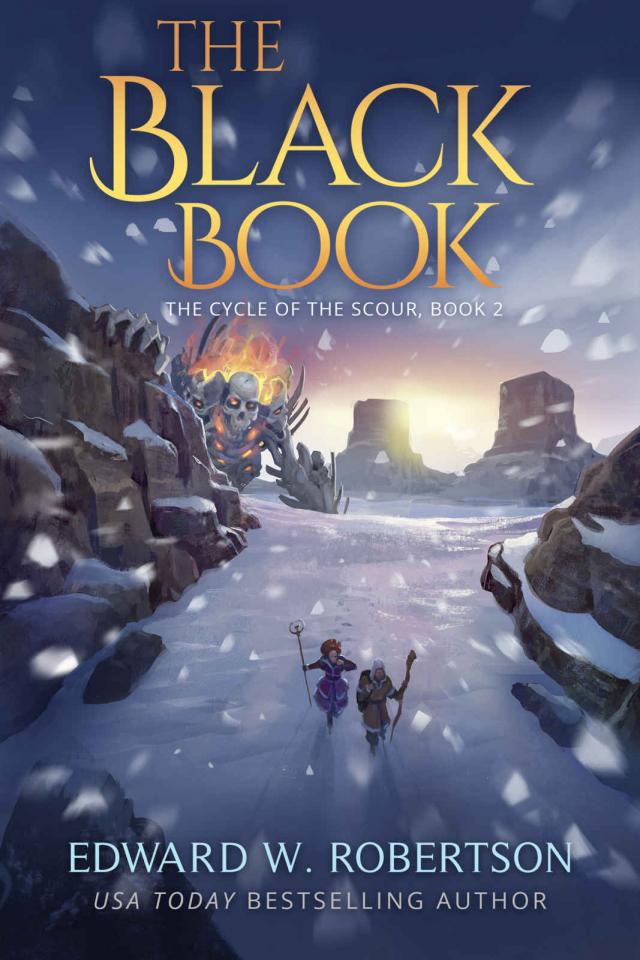


We only had to wait a few minutes before the first two of them arrived. They carried lanterns, which they used to light enough torches for people to move about without stumbling into anything. This done, they moved to the arched doorway and stood there like statues.
The rumble of a wagon approached the southern rim of the mesa, where the path led up from the ground below. By my reckoning, we had less than an hour until dawn. The wagon crested the path and crunched its way to a stop outside the temple.
They brought the bodies next. They arranged them on the floor in lines, much like we did with our wares from the wagon. Men stepped forward bearing pairs of blades: a thick, heavy cleaver, and a long knife, slightly curved forward. They set to work dismembering the bodies.
First came the cleavers. Blades flashed in the torchlight. Separating limbs and heads. I don't know if the sight of it was worse, or the sound: that deep crunch, hideously dull, as if the corpses were grunting deadly at what was being done to them.
I decided it was the sound. I could look away from the grim butchery, averting my eyes to the far wall. But I couldn't close my ears.
It should have been obvious what the workers were up to, but my mind refused to connect the pieces until they turned to their knives, the ones more like scythes, and began to peel the flesh away from the bones.
Beside me, Myla had the glazed look of someone who's just been told their parents had been killed. I wished very much to be able to talk, as much to reassure myself as her, but if we gave ourselves away, they'd add our bones to the pile.
The workers seemed uninterested in the many finer bones, concentrating their labor on the largest and most easily removed. The unwanted parts were heaped in a wheelbarrow and carted out. I wondered if they were burying them, or just dumping them over the edge of the butte.
The eastern sky had gone gray as they wrapped up their work. I thought it might end there, but then four men carried in the corpse of another man and stretched him out on the stone altar. The others had been covered in dried blood from being killed, dirt from being buried, and lividity from being dead for days. This man looked like he might have been slain earlier this very night.
It had an air of ritual to it. I was not surprised when a new figure entered the room. He shed his black cloak; beneath it, he was wearing a black doublet and trousers. The bone-collectors had been Colleners, but this man was dark-haired and fair-skinned.
He moved to the side of the altar, gazing down at what it held. Without taking his eyes off the body, he reached to his hip and drew a steely knife, narrower and straighter than the curved ones the others had used. He held it before him, muttering, likely a prayer by the rote rhythm of it. He lifted the blade high, then brought it down and touched it to the inside of his left arm.
Bright red blood slid down his forearm. He clenched his fist. Shadows shot to him, drawn out from beneath and within the piled-up bones. Myla's mouth fell open. I made myself look appalled at the sight of the nether as well.
Moving as fluidly as a shadow, he bent over the body. He extended its right arm and made one long cut from armpit to wrist. With a series of deft motions—more like an artist than a butcher—he sliced loose and extracted the thick bone from the upper arm, then the two more delicate ones from the forearm. The body's blood was still fluid, not yet clotted, and dribbled freely.
The nethermancer moved on to the left arm, repeating his process. Next he shifted to the right leg. It took him a good amount of extra work to separate the femur from the hip and the knee. As he pulled the bone free, the man on the table sat up and screamed.
His arms dangled from his shoulders like slack ropes. Blood gushed from his wounds while sweat dribbled down his face and torso. He screamed up at the man with the knife, full-lunged, high-pitched bellows, and hooked the heel of his intact leg against the side of the altar, dragging himself toward it.
The man with the knife waved his hand. Black threads reached for the man on the altar. They wrapped around his legs and hips, binding him tight to the altar.
The man with the knife moved to the man's other side and began cutting open his left leg.
I may have fainted then. Or maybe the man with the knife cast an evil spell on me. There's no way for anyone to be sure. All I knew was that I came to very sweaty and tingly with Myla's hand clamped over my mouth like I might start screaming, which didn't make any sense, because I felt downright giddy.
But that must have been caused by my fainting spell—or, again, the evil one cast upon me—because it wore off fast as the nethermancer finished deboning the man on the slab, who was now definitely dead, because he couldn't have more than two thimbles of blood left in his body, judging by how much of it was spilling off the altar.
The man stepped back from his work and motioned to the side. Three men hurried to gather up the body and the organs the nethermancer had removed from it. I thought (or, more honestly, hoped) it would end there, but the sorcerer beckoned to his men once more. Seven of them approached bearing clothed bundles. They set these on the blood-soaked altar and unwrapped them, revealing piles of bones, then stepped back.
The nethermancer placed his palms on the slab, taking in the whole of it. He took up the bones he'd removed from the living man and drew them into the suggestion of a pattern, adjusting a rib here, a tibia there.
This went on for some time. At last he straightened himself, took a step back, and lifted his hands, filling them with nether. He coated the bones with the shadows. The bones flashed silver and purple as the nether sank into their cores.
Next he moved to the opened bundles. Working swiftly, he made his way about the altar, surrounding each of the bones from the man he'd carved up with the ones his servants had brought to him, which looked to be roughly half human and half animal. The sun hadn't yet cleared the eastern mountains, but the temple and all the land was awash with blue-gray light.
Once all the bones were positioned to his satisfaction, the nethermancer drew his knife, cutting first his left palm, then his right. He whipped his hands back and forth, spraying the bones with his own blood, drawing streaks of nether to them like schooling fish. A black haze formed over the altar, the blood spilled from the sacrifice of the deboned man popping up from the stone in beads and sliding to the bones, which absorbed them like rain in the dust.
Hand still bleeding, he reached into a pouch on the hip opposite his knife, drew something out, and cast it into the haze. The air above the slab went black as a shadowsphere. The darkness pulsed once, twice, three times, then dissolved into silent sparkles.
The bones began to move.
They rattled and clicked as they moved over each other. Coming together, bound as if by the strongest resin. Myla suppressed a gasp. Then I saw it, too.
The process finished as fast as a clap of the hands. The construct lay on the altar for a moment, then swung its legs over the side and stood. As it spread its arms and bowed its head to its master, the sun stabbed free from the faraway mountains.
Myla drew back from the hole in the roof and motioned for me to do the same. She cupped her hand to my ear and whispered, "We have to leave. While they're still distracted."
I nodded, but turned back for one last look. Down in the depths of the temple, the construct walked across the room, the fused bones that made up its feet clacking with each step.
We crawled along the edge of the roof until we found a place where the outer wall had collapsed into a V-shaped depression. We made our way down it. Once we had our feet on the ground, we pressed our backs to the wall and caught our breath.
"They'll have sentries on the trail," I said. "We'll have to try the cliffs."
Myla grimaced, then nodded. The ground appeared deserted, yet as we ran west across it toward the mesa's edge, I was deathly certain I was about to hear a voice call out—or that I would feel the cold pierce of the nether driving through my back.
The cliff was sheer. But as we moved a short ways north along it, we found a spot with some slope to it. I eyeballed it, trying to envision a route down to the rubbly scree, then took my first foothold and started down.
A third of the way down, my arms and legs began to tremble. I don't know if it was from the exertion of the climb or from what we'd witnessed in the temple. The slope steepened, forcing me to brace myself against it and hold tight to Myla's hand as she lowered herself to the next ledge. She clung hard to a rock with one hand and helped me down with the other.
We alternated like this twice more before the incline leveled out enough for us to continue without assisting each other. And then we reached the scree, the heaped-up rocks shifting and smacking together under our feet, making me wince with each sound, for the wind was almost dead now, little more than a low whistle over the parched earth.
The rubble led us down to solid ground. I gazed back at the mesa, expecting to see someone gazing back at me from atop its rim. Then I put my back to it and hurried west across the desert.
Myla uttered a noise that I thought was laughter. "What did we just see?"
"They were right, weren't they? The conspirators aren't trying to conjure up any demons. They're crafting new forms of the undead."
"When you walked among the nethermancers in the north—when you fought the demons—did you ever see anything like that?"
"If I'd had to fight wights and towering bony monstrosities, I would have immediately booked passage to the smallest, sleepiest island I could find."
"You may know how to destroy demons. But if these are something altogether new, we could be helpless to stop them."
She fell silent, lost in her own thoughts. While we'd been talking, I'd been distracted, almost at ease. But dread swept over me again. Above the blue of the mountains, the sun stared at us like a great sickly eye. Other than the birds, we were the only thing moving. Most of the land was open dust or hardpan dirt and we were taller than any of the widely-spaced shrubs and sage. The mesa was already half a mile behind us, but if so much as a single one of the nethermancer's men was to go to its edge and glance our way, he'd spot us in seconds.
And his master would send the bone construct to fetch us. There would be no way to hide from it. We could try to run, of course. But our legs were made of flesh and blood. Soon enough, we'd grow tired.
Yet the thing we'd seen in the ruined temple looked like it could keep on running forever.
A figure stood from a shrub just ahead of us. My heart fluttered painfully, but it was Lod. His face was already creased by the sun and old age, but now it was wrinkled with worry as well.
He loped toward us, extending his hands to Myla, who took them. "Did you reach the temple? What did you see?"
We told him. His face went as pale as a Gaskan's. At the end, he closed his eyes. "I should have gone myself. Children your age shoulder never have to see anything such as that."
"In better times, that may be true," Myla said. "But does it feel like we live in those times any more?"
Lod pressed his lips together until they disappeared from sight. "Don't you be saying that. Not yet. Not before you know it's true."
He glanced back at the mesa, then made a spidery gesture above his chest. I hadn't seen it before, but it was clear that it was a ward.
We traveled as three now, bending our course so that the mesa of Collen rose directly ahead. It felt as far away as the eastern peaks. At least the sun was at our backs. I was queasy, and if we'd been walking into its rays, I think I would have thrown up.
To give my mind something to do besides go insane, I counted my steps to try to measure how far we were traveling. But I kept losing count. After a while I didn't seem to be able to count at all: the numbers made no sense, what came after 23, or 47? What difference was there really between any one figure and the one that came right before or after? Did the gods have to think in such petty, narrow terms? I didn't think they did. I hoped they were beyond it.
After that, if I had any thoughts at all, I don't remember them. All I remember is numbness. Frailty. And fear.
Wheels bumbled over hard dirt. I looked up: we had come to the lower city. I tasted the sweetest relief of my life. I'd had no idea how scared I was until we walked once more among normal, cheery Colleners. Most of them glanced away after one look at us. Others laughed and cracked jokes about us being the grimiest tumbleweeds they'd ever seen roll by. Yet I didn't mind their jibes one bit.
We came to the road up to the top of the butte. I prayed Lod would hire a mule team to save us the climb, but for some reason didn't want to ask as much out loud. It was late enough in the morning that, along with the aroma of baking bread and pastries, the smells wafting from the cave-stalls now included spiced and roasted lamb.
"What in hundred hells is wrong with you?"
A man burst out of the cave to my right. I stumbled back and would have fallen down the slope if he hadn't grabbed me roughly by the arm. Under any other circumstances, I would have yelped like a kicked puppy. But I was so dazed and exhausted all I could do was stare.
"Oh," I said to Rowe. "It's you."
"Where have you been? You've been missing without leave for…" He trailed off, leaning closer to me for a better look at my face. He swung back and blinked. "You found it."
"Yeah."
"Come on."
He didn't ask any more questions. Just led us up the road, menacing anyone who got in our way. In no time at all, we stood atop the mesa. A cold wind ambled across the plaza.
As we entered the building where the Black Book had set up operations, a veritable squadron of soldiers and servants leaped forth to accost us. None of them looked happy. They all began to babble at us.
"Shut your stupid mouths," Rowe ordered. "They will see Inquisitor Vara. Immediately."
The men outnumbered us, and surely had orders to drag us off to be punished for desertion or the like. But seeing the anger on Rowe's face—and the dirt on mine and Myla's—they nodded and ushered us deep into the complex. The door to Inquisitor Vara's offices opened from inside before I could reach for the handle. Her personal attendant beckoned me, Myla, and Lod within while gently excluding Rowe.
Vara was seated behind a desk nearly as big as the mesa we were standing on. She gave us the same grave look she'd given me before sentencing me to bound servitude.
"You were right," I blurted. "They're not trying to make demons. They're trying to make undead. Constructs. And they've already succeeded."
Vara drew herself to her full height, which wasn't difficult, and grimaced. "Tell me everything."
Myla launched into a description of everything we'd seen and done since the night before. She'd obviously been rehearsing this, but I found her missing out on some bits I considered quite important, and piped up as necessary to augment—or correct—her story. She shot me a few dirty looks, but the Inquisitor kept encouraging me, so there wasn't anything Myla could do about it.
Vara took notes as we went. When we finished, she gazed down at her parchment for several seconds. "How many bones were used to make the construct?"
"The ritual took a ton of them," I said. "All told, I would say no less than a dozen cows worth of bones. Even that feels like an underestimate."
"That is not my question. How many were used in the bone golem itself?"
"Er…less?"
Myla rolled her eyes. "No more than a tenth of what was used in the ritual went into the construct."
Vara looked as though she'd gone ill. "By the eleven gods who are friends of man. This is even worse than the darkest rumor we've heard."
I cocked my head. "There are rumors?"
"Of human sacrifice, for one. I dismissed it as the usual empty gossip. When dealing with nethermancers, there are always rumors of human sacrifice. But if that rumor has proven true, I fear that the others might as well."
"What are the other rumors, Inquisitor?" Myla ventured.
Vara's hands were spread across the desk. She curled her fingers into her palms. "That the people we are after intend to launch an attack on Bressel. That they will do so soon. And that the priests of Mallon will have no defense against it."
This brought a halt to the conversation that couldn't have been more thorough if we'd all dropped dead. Which, given the rumors, seemed like something we might well be doing soon. Fortunately everyone else looked glum and pensive, too, because at that moment I was thinking about what an idiot I'd been not to have run off with the archives' copy of the Cycle and forgotten all about coming with the Black Book to Collen.
Lod pulled off his brimless hat and turned it in his hands. "May I speak, Inquisitor?"
"Of course, Lod."
"Well, on our way back from the Temple of Lost Exit, I had plenty of time to myself. Now, I'm not much of a thinker, you see. But I'm old enough to be able to remember a great many things, when I put my mind to it. While by myself, I remembered something you ought to know: the graverobbing we stumbled into wasn't the first the Basin's seen in recent days."
"Are you attempting to leave me in suspense?"
"Why, I shouldn't think so."
"Then where else did this happen? And when?"
"Town of Barr. As for when, seems to me it was right before the Earthers' Feast. Just under four months ago. At the time, we blamed it on Mallish thieves, which we like to do whether they were to blame or not. In this here case, I don't see that it can be anything but the same people we just watched raise an abomination."
Vara nodded, looking as dazed as I felt. "We will look into that as well. It will do us no good to assault the infidels here if there are others in Barr who could hear of what we've done and go to ground."
She leaned back in her chair and raised her eyebrows at us. "What you've done exposed us to great risk. You had no authorization to execute such a mission. The punishment for such recklessness is severe." She clasped her hands together. "Laws and punishments are designed to prevent the unqualified from making judgments and taking risks they are not qualified to. Yet you succeeded. Is that because you are more qualified than I believed? Or because some fortune—divine or common—favored you last night?


