Evans of The Earth-Guard, page 1


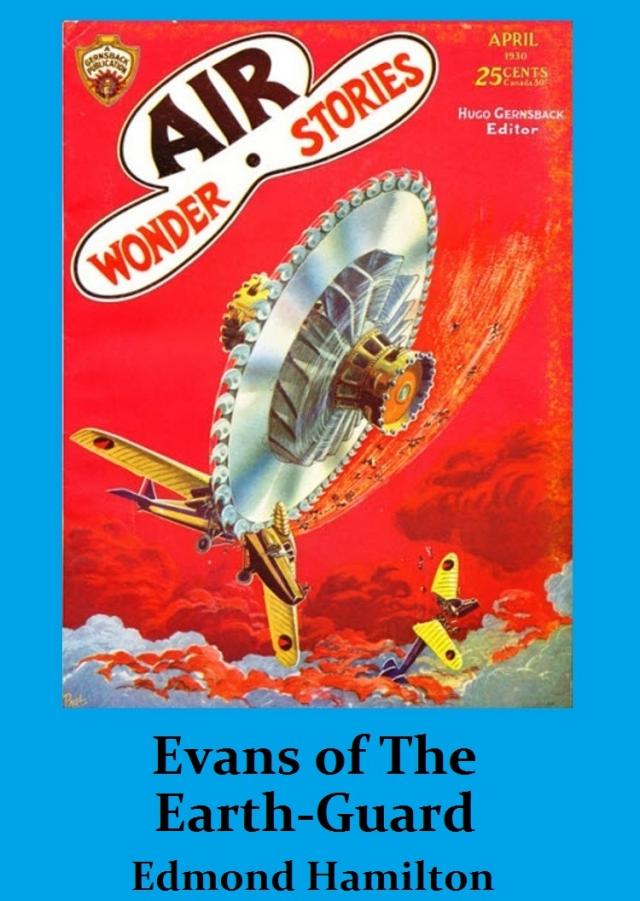
EVANS of the EARTH-GUARD
By Edmond Hamilton
(Illustration by Winter}
From : Air Wonder Stories April 1930 edition
By the Author of “The Space Visitors ” “Cities in the Air,” etc
The grim black rocket, whirling and dipping with an astounding
swiftness, was endeavoring to bring the twisting tittle craft into
the lines of its guns.
THE present likelihood is that the first interplanetary flight will probably be by mean of a rocket-propelled ship. As far as our knowledge goes the rocket seems to be the most feasible means of propulsion because it will reach its greatest efficiency in the vacuum of interstellar space.
If the conditions on other planets, including our moon, are not too prohibitive, it is doubtless true that these planets will be explored for whatever mineral wealth or possibilities of life they may contain. The resulting interplanetary commerce will call into being a host of problems, such as the protection of cargo and passenger shipments against natural and human agents that might wish to destroy them.
In that case, the Earth-Guard that Mr, Hamilton describes so vividly will play a most important part in the protection of such commerce,
Mr. Hamilton, as is usual with him, has, in this story, developed it so that we were unable to predict from page to page what would happen next. And the editors were just as fooled by the surprising denouement as we believe our readers will be.
“ALL Earth-Guard rockets attention! One-man rocket Pallas speaking. Am pursued by pirate rocket believed to be that of the Hawk! I am running toward earth on space-lane 18, now in zone 44-6, but am being rapidly overtaken!”
As the clear voice came from the radiophone before him, Captain Wright Evans slammed over the reply-switch and shouted back into it.
“Earth-Guard Rocket 283 answering. Standing toward you at top speed instantly!”
Then he was up and bursting into the great rocket ship’s squat little pilot-house, where a man seated at the controls turned inquiringly to him.
“Full speed ahead, Calden!” he cried. “The Hawk’s out again and after a one-man rocket not a thousand miles ahead—it’s our chance to get him at last!”
“Full speed it is,” rejoined Calden calmly, his hands flashing forth to flick down a half-score of the banked shining levers before him.
Instantly the great ship lurched and trembled as, from its rear, came thunderous explosion on explosion. In a moment every one of its rear-tubes was firing, and the speed-dial’s arrow was creeping steadily forward until in a few minutes more it registered the ship’s top speed of ten thousand miles an hour. The long gleaming craft, stubby of nose and stem and fully five hundred feet in length, was like a giant projectile, as it tore through the void, belching fire behind it.
From the squat pilot-house set atop it, Evans and Calden gazed ahead. The great gray disk of earth filled a quarter of the heavens before them, the outline of its continents and seas visible here and there through its shifting screen of clouds. Behind them the moon’s silvery sphere was dwindling rapidly, as they had seen it dwindle now for hours. It was hours that the great Earth-Guard rocket with its half-hundred men had been hurtling toward earth after its weary week’s vigil in space, before this call had come.
And weary enough indeed was the vigil that the rocket ships of the Earth-Guard kept around the earth and its moon, and had kept up for more than fifty years. More than fifty years it had been since, back in 1954, the first crude rocket had thundered out from earth into the great void toward its shining satellite. Neither that first rocket nor the twenty-first had reached their goal, but the next one had.
Thus had begun the commerce that now filled all the space-lanes between the earth and moon. In their first flame of exploration, men had headed out toward the nearer planets, too, but they had found them unapproachable because of the fierce guard maintained by their strange peoples. Every ship that had sought to explore another planet had been annihilated on reaching it and we had finally realized that our planetary neighbors were guarding fiercely their isolation.
THERE had remained to earth only its own moon. But that had become swiftly a lure to all adventurous earthlings. Upon the moon’s other side were great mines in which men, dwelling in air-tight cities and toiling in hermetically-tight metal suits, worked the rare metals and minerals in which earth’s satellite abounded. And upon the moon’s earthward side were other great air-tight cities, glass-roofed and luxurious, to which went each year hundreds of thousands of the earth’s wealthy—there to spend their vacations— enjoying the wondrous celestial views, the astounding strength and youth given them by the moon’s lesser gravity, and the chance to view the earth from the outside.
So that there had grown gradually the commerce that kept endless streams of ships moving between earth and moon—great and luxurious passenger-craft laden with the wealthy and powerful of earth; and sleek private ships bound like the others for the luxurious lunar cities. Bulky and battered cargo-rockets had their own space-lanes, carrying metals and minerals to the earth, and returning with loads of supplies and tanks of the liquid rocket-fuel to the moon.
It was inevitable that all this traffic should need regulating, and so there had been formed the Earth-Guard, an organization corresponding to the old Coast-Guards of the nations, but controlled by an international commission of earth’s powers. The Earth-Guard boasted five hundred gleaming rockets that patrolled ceaselessly the space between and around the earth and moon, enforcing peace with their electric guns and guarding the lunar commerce.
For there were those against whom it must be guarded—space-pirates who dashed forth from time to time from hidden bases on earth or moon to harry and hold up in the void the rich lunar commerce. The boldest and most dreaded of them all was that swift and flashing corsair of the void known to all on earth and moon alike as the Hawk, and who for years had been the despair of all the Earth-Guard.
“Lord, if we can get him!” Evans was praying as he gazed out of a port hole from the hurtling ship’s pilot-house. “I get so tired of jabs about him that I’d lose an arm to get him.”
“Well, everyone’s turn comes sooner or later in that game,” philosophized Calden. “It may be the Hawk’s now.”
Evans pulled a speaking-tube toward him and shouted down into it over the roar of the rocket’s explosions. “Hartley? Put full crews on all the electric guns and have them stand ready for action. Yes. And tell them it’s the Hawk we’re after this time—it’ll put them on their toes.”
Calden grinned as a moment later a muffled cheer came up from the gun-rooms beneath “They’re on their toes, evidently,” he commented. “They’re as crazy to get their hands on the Hawk as you are.”
Evans made no answer but started ahead with teeth clenched upon his lower lip, glancing over now and then at the dials that recorded the rocket’s position between earth and moon. This recording was automatic, being dependent on the change in the gravitational power of the two bodies. Evans saw by them now that the rocket was hurtling into the very zone in which the Pallas had reported itself.
Missed!
HE reached to turn a knob and there clicked up into position against the lenses set in the pilot-house window two long metal tubes with eye-pieces that formed powerful binoculars. Gazing ahead through these he kept watch, while with fingers on the firing-levers of the rocket’s tubes Calden kept them steady on their course. Minutes passed before Evans uttered a cry.
“They’re just ahead!” he exclaimed. Then, into the tube— “All batteries ready, Hartley, and use the port guns when we bank.”
“Lord, look at that fellow!” breathed Calden as he too stared ahead. “He sure can handle a rocket—the Hawk can’t get his guns on him!”
Far ahead of them in the void the scene of combat to which they had been summoned was rushing into view. A tiny and shining one-man rocket was dodging and twisting and circling in space, with its firing-tubes flaming first on one end and then on the other to keep it in an ever-changing course. And around it, like a great grim pike rushing a shining chub, was circling and swooping a long dead-black rocket of the same size almost as the Earth-Guard craft. It was the dreaded black rocket of the Hawk, reputed the swiftest craft in space.
The grim black rocket, whirling and dipping with a swiftness of maneuver astounding in a ship of its size, was endeavoring to bring the twisting little craft that evaded it into the line of its guns. As their own ship thundered down on the scene, Evans and Calden saw the one side of the Hawk’s rocket stabbing forth a half-score slender jets of blue fire as its electric-guns blasted toward the smaller craft. But the latter had shot upward in time to avoid the fire, and in the next moment the Earth-Guard rocket was rushing down upon the ebon attacker.
“Fire!” As Hartley’s voice below shouted the order, the Earth-Guard ship poured a deadly fire toward the black rocket of the Hawk. But at the very instant of firing, with a swiftness born of a hundred space-fights, the Hawk’s rocket had shot upward.
“Missed him!” Calden cried. “Look out—he’s tailing—!”
“Over quick!” Evans exclaimed. “Let him have the stern guns, Hartley!”
For in the instant after shooting upward to avoid their fire, the rocket of the Hawk had flashed back down on them in the familiar maneuver of “tailing,” using all the firing-tubes placed in its nose for braking purposes to halt it and reverse it in a flash.
Evans had a lightning glimpse of the great black shape rushing stern-foremost down on them. Then he felt his own rocket dip and dive like light as Calden’s hands flashed on the firing-levers, and for a moment Evans saw the white-lit pilot-house of the other rocket, with the tense figures inside it, before it whirled out of view. He sensed rather than saw the blast of the Hawk’s guns above them as they dived just in time to avoid the deadly missiles.
EVANS heard shouting voices from their own gun-rooms and had no need to cry to Calden the next order, for already the other was straightening out their course and sending their ship soaring upward again. But the long black craft of the Hawk was gone! After that one swift swoop and blow it had flashed off the space-lane into the uncharted void, and they glimpsed it only as a dwindling point of fire that vanished in the next instant.
Evans, filled by a blind fury, whirled to give Calden the order that would send them in wild pursuit, but checked himself as he realized, despite his rage, the futility of such a pursuit. Once out of sight, the Hawk in his immensely swift rocket could laugh at all pursuit, as he had laughed many times. His face a study of conflicting emotions, Evans turned back toward his second-officer.
“Back to our regular course on the space-lane,” he ordered wearily. “He’s got away again.”
Silently Calden headed the great Earth-Guard rocket again toward the great disk of earth. But in a moment he motioned toward something outside and above them. “It’s the rocket the Hawk was attacking,” he said. “He’s signaling” for a contact.”
“Let him come on, then,” answered the other.
Calden pressed the studs that flashed from their own rocket’s nose the answering colored signal-lights, and quickly the shining smaller craft drove down until it hung just over the big Earth-Guard ship. It settled smoothly then on the greater craft’s back, its nose firing-tubes blasting it to a halt. The ring of metal contact-pins on its lower side fitted smoothly into the standardized ring of openings ready for them on the Earth-Guard’s back.
Held thus to the greater craft, the little rocket was carried along through space like a pilot-fish clinging to a great shark. In a moment there was the clang of the contact-door opening, as the occupant of the Pallas passed into the Earth-Guard rocket through the latter’s similar door. In a moment more Hartley, the third officer, was striding into the pilot-house with the man who had been the little craft’s sole occupant.
He was a tall young man with dark hair and dark, laughing eyes. He came forward with hand outstretched to Evans and as the pocket-captain grasped it, he introduced himself.
“Francis Seaworth,” he named himself, “and just now mighty pleased to see you! Indeed, if you hadn’t come when you did, the Hawk would have had me in another minute— I didn’t have anyone to work my gun and could only try to evade him till you came.”
Evans laughed. “What in the devil made you start for earth all by yourself?” he demanded. “Didn’t you hear two days ago that the Hawk was out?”
The other shook his head. “I heard,” he said, “but that’s just why I chose this particular time for the trip. No, I don’t mean that as bravado,” he added quickly, as he saw the incredulous smiles of the three officers. “What I mean is that I knew the Hawk was waiting for a chance to jump on me, and when I heard he was out on the space-lanes again, I thought he’d be too busy at his usual trade to think of me.”
Evans regarded him with more interest. “But what’s the Hawk after you for?” he asked.
Seaworth hesitated. “Well, I wouldn’t want to spill too much.” He nodded toward the other officers.
Evans straightened with interest. “Anything you want to say you can tell me in front of my officers.”
“Well,” said Seaworth, “I’ve been spending the last year as a secret agent of the International Commission, looking for the Hawk’s base on the moon. They had an idea— just an idea—that the Hawk’s base was really inside one of the lunar cities.”
Seaworth Explains
IN a lunar city?” Evans repeated. “Whoever got that idea?”
Seaworth shook his head. “It seemed crazy to me at first too, but there were rumors that officials in one of the lunar cities were allowing the Hawk to come there, and to refuel in exchange for a share of his loot. I was sent up to investigate, and I found out enough to call the Hawk’s attention to me, and this is the second time he or his men nearly got me. I couldn’t find his base, but I did find that there’s a man now on earth who was formerly in his service and who could tell me where his base is if he wanted to. So I started back to earth in my own ship to see him. Well, the Hawk was waiting, and if you hadn’t been within call it would have been all up with me.”
Evans considered. “It did seem mighty queer to us that the Hawk would stoop to holding up one-man rockets,” he admitted, “but that explains it. So they’ve had a secret agent on his trail, eh?”
“A very secret agent,” smiled the other. “My emblem,” he smiled as he opened his jacket and showed a little card sewed onto the inside.
Evans nodded. The card of an agent of the International Commission merited any help he could furnish.
“In fact,” continued Seaworth, “I doubt if a dozen men on earth outside of the International Commission know what I’ve been doing. I’ve got no business, really, telling even you about it, but it’s about all wound up now, for if I get the information I’m after on earth it means we’ll catch the Hawk in short order.”
“Seems like catching the Hawk is work for the Earth-Guard rather than for any secret agents,” growled the bulldog-visaged Hartley. “We’re good enough to chase after all the common scum of space-pirates that are always bobbing up, but when it comes to nabbing the Hawk someone else wants the glory.”
“The glory’s been there for the Earth-Guard to take for some time,” retorted Seaworth acidly. “I haven’t seen it doing it, though.”
Hartley’s face went dull red, and Evans intervened in time. “No use scrapping over it,” he told them. “Anything that Seaworth finds out will help us, and I for one don’t give a continental who catches the Hawk so long as he’s caught. Every time I go into a teletheater nowadays, all I hear is a lot of musty old cracks about the Hawk and the Earth-Guard, and I don’t mind telling you Em getting tired of it.”
Seaworth laughed. “Well, it was nearly a case of the catcher caught with me this time. I suppose I don’t need to tell you that I’d rather make the rest of the trip with you?”
Evans nodded. “Of course. Though as a matter of fact the Hawk’s probably ten zones off by now. That’s always his way—he swoops and strikes and flashes off before anyone can get hands on him.”
“Yes,” said Seaworth, his eyes troubled, “but he happens to want me devilish bad, you see. I’ll admit I’m not going to have much taste for the trip back to the moon—I wouldn’t put it past him to hold up the biggest passenger-ship in space if he knew I was traveling on it.”
“I wouldn’t myself,” Evans said. “But we’re heading back next week after our relief-period. Why not go back with us?”
Seaworth’s face cleared. “Thanks a lot, really, old man. It’s a fact I’ve been worried about this trip back, for if I get what I’m after on earth, it means that when I get back to the moon we can find the Hawk’s base and make a trap of it to catch him when he comes in. And I want to see him put away before I check out—it’s got to be something of a personal duel between us.”
In the next half-score of hours in which they hurtled on toward earth, Evans saw that Seaworth was indeed getting more and more impatient and eager as the great disk grew large before them. He fretted at the delay as they moved in through earth’s atmosphere at slackening speed, and down through the crowded converging space-lanes toward the huge New York inter-stellar station. And when the great Earth-Guard ship shot down into the funnel-shaped landing-framework and came to a halt with all its nose-tubes firing, Seaworth emerged from it with its first officers.
BRIEFLY he assured himself once more that Evans was willing for him to make the trip back out to the moon in the Earth-Guard craft in the following week, and he also made certain that his own little rocket could remain attached to the greater craft and be refueled with it. Then he hastened away in the crowds that poured here and there across and around the great rocket-station.