

Invitation to Murder, page 1


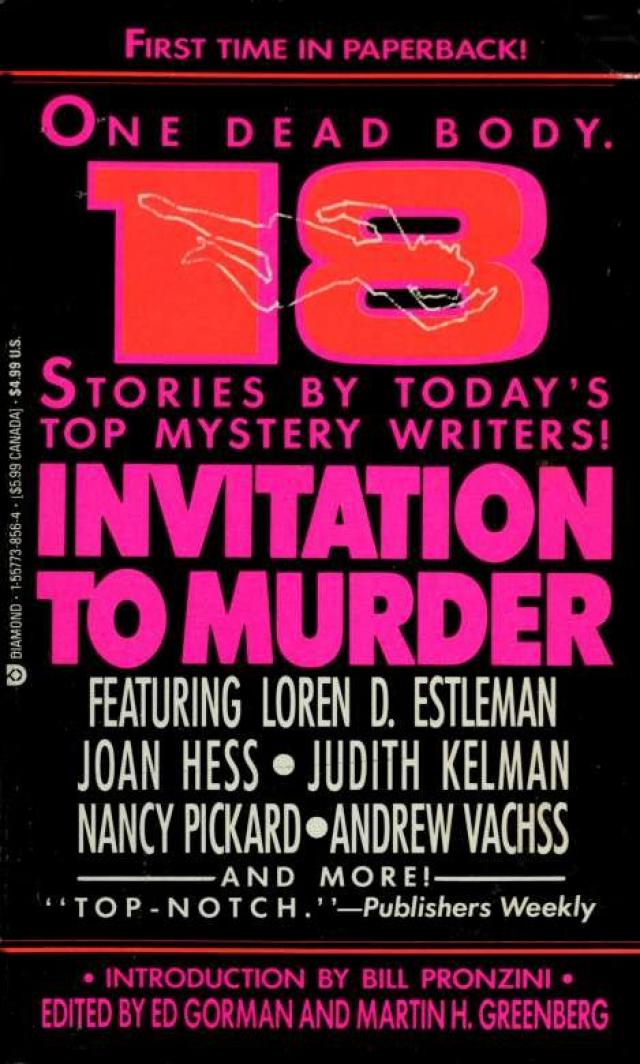
YOU’RE INVITED. . .
. . .to sample the best of today’s top mystery writers in a colorful collection of tales, all based on one captivating premise. . .
INVITATION TO MURDER
Edited by Ed Gorman and Martin H. Greenberg
NANCY PICKARD
takes a psychiatric patient one step closer to a forgotten crime in “The Dead Past”
LOREN D. ESTLEMAN
puts a tough Detroit P.I. on a case of backwoods crime in “Snow Angels”
ANDREW VACHSS
finds that the heart of terror lives at home in “Anytime I Want”
JOAN HESS
unlocks the door to a perfect study in murder in “Dead on Arrival”
. . .and much more!
INVITATION
TO MURDER
EDITED BY ED GORMAN AND MARTIN H. GREENBERG
DIAMOND BOOKS, NEW YORK
This book is a work of fiction. Names, characters, places and incidents are either the product of the authors’ imaginations or are used fictitiously. Any resemblance to actual events or locales or persons, living or dead, is entirely coincidental.
This Diamond book contains the complete text of the original hardcover edition. It has been completely reset in a typeface designed for easy reading, and was printed from new film.
INVITATION TO MURDER
A Diamond Book / published by arrangement with the editors
PRINTING HISTORY
Dark Harvest edition published 1991
Diamond edition / February 1993
All rights reserved.
Copyright © 1991 by Ed Gorman and Martin H. Greenberg.
This book may not be reproduced in whole or in part, by mimeograph or any other means, without permission. For information address: The Berkley Publishing Group, 200 Madison Avenue, New York, New York 10016.
ISBN: 1-55773-856-4
Diamond Books are published by The Berkley Publishing Group,
200 Madison Avenue, New York, New York 10016.
The name “DIAMOND” and its logo are trademarks belonging to Charter Communications, Inc.
PRINTED IN THE UNITED STATES OF AMERICA
10 9 8 7 6 5 4 3 2 1
Introduction copyright © 1991 by Bill Pronzini.
“The Dead Past” copyright © 1991 by Nancy Pickard.
“La Bellezza Delle Bellezze” copyright © 1991 by Bill Pronzini.
“Open and Shut” copyright © 1991 by John Lutz.
“None of My Business, But. . .” copyright © 1991 by Carolyn G. Hart.
“Dead on Arrival” copyright © 1991 by Joan Hess.
“Invitation to Murder” copyright © 1991 by Richard Laymon.
“Darke Street” copyright © 1991 by Gary Brandner.
“Pretty Boy” copyright © 1991 by Billie Sue Mosiman.
“The Life and Deaths of Rachel Long” copyright © 1991 by Kristine Kathryn Rusch.
“Merlin and the Hitman” copyright © 1991 by Teri White.
“Anytime I Want” copyright © 1991 by Andrew Vachss.
“QWERTY” copyright © 1991 by William J. Reynolds.
“A Bunch of Mumbo Jumbo” copyright © 1991 by Jan Grape.
“The Body Beautiful” copyright © 1991 by Judith Kelman.
“Deadtrip” copyright © 1991 by William F. Nolan.
“Still Life With Gold Frame” copyright © 1991 by Rex Miller.
“Who What When Where Why” copyright © 1991 by Barbara Paul.
“Snow Angels” copyright © 1991 by Loren D. Estleman.
The hardcover publishers would like to express their gratitude to the following people. Thank you: Ann Cameron Mikol, Kathy Jo Camacho, Stan and Phyllis Mikol, Dr. Stan Gurnick Ph.D., Luis Trevino, Raymond, Teresa and Mark Stadalsky, Tom Pas, Bob Lavoie, and Bill Pronzini.
And, of course, special thanks go to all the contributors for their fine stories, and to Ed Gorman and Marty Greenberg for the effort it took to get this one together.
CONTENTS
Cover
Description
Title Page
Copyright
Introduction
Bill Pronzini
THE DEAD PAST
Nancy Pickard
LA BELLEZZA DELLE BELLEZZE
Bill Pronzini
OPEN AND SHUT
John Lutz
NONE OF MY BUSINESS, BUT. . .
Carolyn G. Hart
DEAD ON ARRIVAL
Joan Hess
INVITATION TO MURDER
Richard Laymon
DARKE STREET
Gary Brandner
PRETTY BOY
Billie Sue Mosiman
THE LIFE AND DEATHS OF RACHEL LONG
Kristine Kathryn Rusch
MERLIN AND THE HITMAN
Teri White
ANYTIME I WANT
Andrew Vachss
QWERTY
William J. Reynolds
A BUNCH OF MUMBO JUMBO
Jan Grape
THE BODY BEAUTIFUL
Judith Kelman
DEADTRIP
William F. Nolan
STILL LIFE WITH GOLD FRAME
Rex Miller
WHO WHAT WHEN WHERE WHY
Barbara Paul
SNOW ANGELS
Loren D. Estleman
Back Cover
INTRODUCTION
Bill Pronzini
The best ideas are usually the simple ones.
Case in point: this anthology. Each of the eighteen contributors was given the same ultra-basic plot element—the body of a young woman is found in her apartment—and asked to write a story in which that element plays some sort of pivotal role. The contributor was to make use of the component as he or she saw fit: as a starting place, or included somewhere in the body of the story, or saved for the end; as a case of murder, suicide, accidental death, even a supernatural or unearthly happening; as an event that happens on stage or off, in the past or present or future. No restrictions, no taboos. Any type of story, at any length up to 10,000 words, with any tone or slant or message.
What could be simpler?
Cunningly so. The editors, clever fellows that they are, knew that few writers can resist such a subtle tweaking of the imagination, or such freedom to improvise.
The result, predictably, was eighteen unpredictable stories as disparate as the authors selected to write them. None is like any other in style, content, or the use to which the given plot element is put. There are private eye and police investigations, psychological thrillers, quiet (and quietly amusing) cozy-style tales, noir journeys down the mean streets, exercises in cauld grue, and a number of less easily definable delights.
Equally diverse is the lineup of contributors. Represented here are bestselling crime writers (Loren D. Estleman, Andrew Vachss, Rex Miller, Judith Kelman), bestselling horror writers (Richard Laymon, Gary Brandner), well-established and critically acclaimed mystery writers (Nancy Pickard, John Lutz, Joan Hess, Teri White, William J. Reynolds, Carolyn G. Hart, Barbara Paul), a multi-skilled scribe best known for his science fiction (William F. Nolan), and three talented newcomers (Jan Grape, Kristine K. Rusch, Billie Sue Mosiman).
If any anthology ever warranted the descriptive term “mixed bag,” it is Invitation to Murder. And a most appetizing mixed bag it is. You may not like every story, but you won’t find a poorly conceived or poorly written one in the bunch.
Remember the basic plot element as you read each entry: The body of a young woman is found in her apartment. When you’ve finished reading all eighteen, ask yourself what you’d have done with that element if you had been one of the selected contributors.
What story would you have written?
THE DEAD PAST
Nancy Pickard
At first, she was only a new name in the appointment book of the psychologist, Paul Laner, Ph.D.:
“March 3, Tues., 12:10 Ouvray, Elizabeth.”
Then she was a lovely girl in the doorway of his office, young and slim, pale as a ghost, wearing grey trousers and sweater, and her platinum hair caught up at the sides of her scalp with translucent plastic barettes. Her beauty, Laner thought at the time, was the stunning natural kind that is formidable to look upon, and which instantly forms a wall that other people have to scale in order to reach the person behind it. According to the form she had filled out for his receptionist, Elizabeth Ouvray was nineteen years old. Laner, at forty-five, was old enough to be her father, and he felt at least that much more mature than she as he stared at the nervous, ghost-like girl in his doorway.
Indeed, like a ghost who was afraid to materialize, she hesitated, her head down, eyes averted. She looked to him as if she wished she were invisible. Her hair, parted in the middle, hung down from the barettes like curtains pulled over her face.
“Come in,” he said.
She glanced up at him, and smiled stiffly, slightly, as if any facial expression was an effort. Instinctively, Laner wanted to put his hand under her elbow and lead her gently into his office, but he didn’t. The doctor was careful not to touch her, not only because Elizabeth Ouvray looked as if she would flee at the slightest overture, but also because the hand of a male counselor on a female client could be so easily misinterpreted. A comforting pat on the shoulder, a gently intended squeeze of the hand could get even a well-respected psychologist like him into serious trouble.
She scooted past him without speaking, leaving in her wake a lemony scent that made his jaws ache. Saliva pooled on his tongue, and he swallowed. She was, easily, the best looking patient to walk through his doorway in his twenty-three years of professional counseling. He thought it poignant that a woman so blessed in her physical appearance should appear to feel so cursed. Following that thought, Laner experienced such an immediate and intense desire to find out why she felt cursed that he experienced a mild sexual arousal.
“Down boy,” he commanded his libido. “Sublimate.”
Behind her back, he smiled to himself. It pleased him that after all this time in his career he could still get excited about the human mysteries that awaited his unraveling.
“Sit anywhere you like,” he suggested to her.
He observed her as she made the difficult and meaningful choice that faced every new client: whether to sit on the couch in the corner farthest away from him, or the Windsor chair midway between the couch and his desk, or in the rocking chair beside his desk. She finally chose the latter—not, he thought, because she was self-confident enough to sit that close to him or because she craved intimacy, or even because she had a bad back. Rather, he suspected, it was because she felt safer there than she would have felt all the way across the room by herself. The doctor couldn’t help but make an instantaneous diagnosis in layman’s terms: fear—stark, staring, trembling, not-quite-raving fear. This clearly neurotic young woman was afraid of her own shadow.
Laner smiled inwardly at his own Jungian pun.
He felt a warm surge of hope for this new patient and an even warmer surge of self confidence. Eagerly, almost buoyantly, he crossed the room and sat down at his desk, facing her. Sensing that small talk would not relax this patient who had yet to utter a word to him, he launched right in.
“How can I help you, Elizabeth?”
She didn’t hesitate, but said in a soft voice, “I’m afraid.”
Laner was surprised at her directness. But taking that as a cue, he proceeded to be extremely direct and clear with her, himself.
“What are you afraid of, Elizabeth?”
“Everything.” She didn’t smile when she said it.
“All right. Tell me one thing that frightens you.”
“Coming here.”
“Yes, everybody’s nervous the first time.”
Laner purposely cultivated a fatherly appearance in order to put his clients at ease. He knew that when she looked at him she perceived a nice, middle-aged man with frizzly grey hair, a bushy moustache and beard, bright, intense blue eyes and a tactful, sympathetic smile.
He presented that smile to her. “What else?”
“I’m not just nervous,” she protested, as if he had belittled her complaint. Her near-whisper had a defensive, annoyed edge to it. What was this? he wondered. Was she proud of her neurosis (many patients secretly were), or did she already have resources of courage and independence with which to defend herself? That would be a hopeful sign for her prognosis, he thought.
“I believe you,” he said quickly. “What else scares you, Elizabeth?”
“People,” she said, and he was inwardly amused to see her look suspiciously, even furtively at him. “Strangers.”
“I see. What else scares you?”
“Oh God, you name it!” she burst out. “I think I’m really crazy. I must be crazy to be so frightened all the time.”
“Nobody is afraid for no reason, Elizabeth,” he told her. “My experience tells me that we will discover that your fears are the natural, if perhaps rather exaggerated, effects of certain causes. Our job will be to uncover those causes, so that we may eliminate the effects of them. You understand what I’m saying?”
“Yes, but it sounds too. . .easy.”
“Would it make you feel better if I assure you that it probably won’t be easy?” He smiled at her. “We often find that the greater the fear, the more deeply buried the cause. I will help you, Elizabeth, but I can almost guarantee that it will not be in one easy lesson.”
“You’ll help me?”
“I will,” he said firmly, and was delighted to see the relieved expression in her eyes, and the slight relaxation of her tense body. “Tell me, Elizabeth, do you feel scared all of the time?”
“Yes! Every minute. All the time.”
“Right now?”
“Yes!”
“How does that affect your life?”
There was anguish in her eyes. “It ruins it.”
“How does it ruin it?”
“I don’t want to be around anybody. I don’t want to go out, I don’t want to go anyplace. I don’t date. I’ve never had many friends. I was in college, but I quit, and now I just get up in the morning, I go to work, I go home, and I stay at home until it’s time to go to work in the morning.”
“Not much of a life,” Laner commented, gently.
She began to cry. “No, it’s not much of a life.”
He encouraged her to weep the sadness out. In truth, at that point, he foresaw a long and difficult therapy, but he was not for a minute afraid of failing her.
First, the psychologist attempted conventional therapy, fully expecting it to work.
He began by administering psychological tests, which served to confirm his original hypothesis that Elizabeth was deeply neurotic due to abnormally deep-seated fears of undetermined origin. Or, as he commented privately to his wife, “The poor girl’s scared shitless.”
Twice weekly, he asked probing questions and Elizabeth reacted, sometimes calmly, sometimes decidedly not. But none of them was the right question; none of her answers was the answer. Sometimes Laner felt she was telling him the truth; other times, not.
“Tell me about your mother, Elizabeth,” he said.
“She raised me by herself.”
“Where was your father?”
“Pretending I didn’t exist.”
“Tell me how you felt about school, Elizabeth,” he suggested. “. . .about God, Elizabeth. . .about men. . .tell me about your dreams, Elizabeth. . .your daydreams, your fantasies. Tell me, Elizabeth. . .”
Over time, it became clear that she was not getting better. Instead, to his dismay, she grew progressively worse. Her appearance disintegrated. Laner grieved at the loss of her remarkable beauty, at her frightening weight loss, at the acne that ruined her beautiful skin, at her humped, defensive posture, and the sad, grey cast to her eyes.
“I’ve quit my job,” she announced one day.
She lost her insurance, and couldn’t pay his fee.
Laner adjusted his sliding scale to compensate, until finally he was treating her for free, something he had always sworn he would never do for clients because it would increase their dependency on him and destroy one of their main motivations to change.
“You’re taking this case awfully hard,” his wife finally said. What she really meant, he knew, was that he was taking it too personally. “Watch it, Paul,” his colleagues warned, “you’re becoming obsessed by this case.” Their comments infuriated him, although he couldn’t deny them. But he couldn’t quite believe them, either.
It was not conceivable that Dr. Paul Laner could so miserably and completely fail to help one of his patients. No one, he thought, would be able to comprehend it, least of all him. “I’m a good psychologist,” he kept telling himself; in fact, the peer recognition he had achieved over a long career suggested that many considered him to be a great one. But the doctor began to sleep less well, and to be aware of vague, unpleasant stirrings in his chest and abdomen. He did not need a psychiatrist to diagnose: anxiety.
He was not yet ready to call it fear.
But that’s what he was: afraid, terrified that Elizabeth Ouvray was dying before his eyes, a little more every week, incrementally every session. He could not even be sure that his “treatment,” his renowned methods of analysis, were helping to keep her alive. It was even possible that he was—mistakenly, unintentionally, horribly—speeding the painful process of her death.
At the beginning of the final month of his treatment of Elizabeth Ouvray, Dr. Paul Laner tried hypnosis for the first time. It was not a mode of treatment he particularly condoned, believing as he did in the more conventional forms of therapy. Indeed, he had to cram a quick refresher course on hypnosis with a younger, more holistically-inclined psychologist of his acquaintance.


