

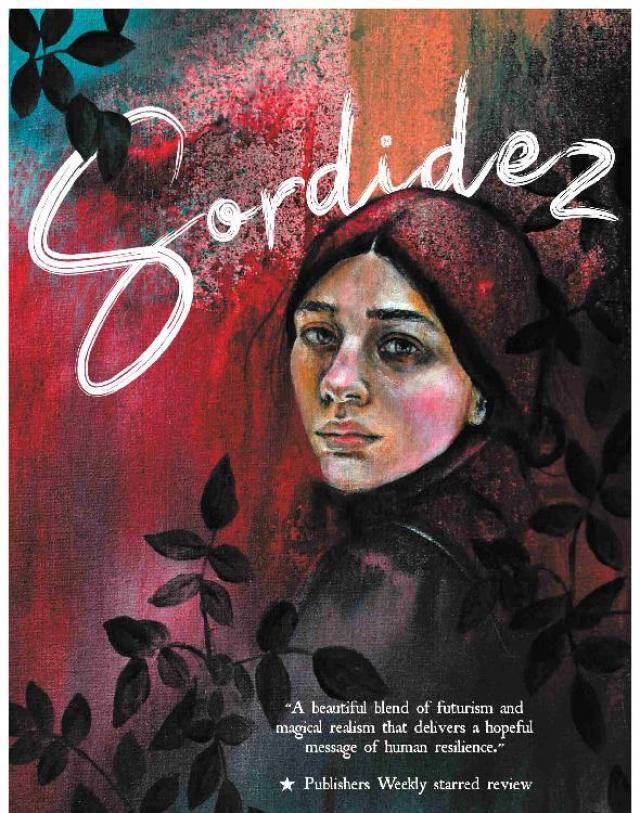
Sordidez, page 1


For my beloved sister, the eternal Michelle Gonzalez Green.
May your ancestral fire bring radiance to the archipelagoes beyond the sky.
content warnings
Natural Disaster, Colonialism, Assimilation, Racism, Transphobia, Character Death, Depictions of PTSD/Trauma, Depiction of Mental Illness, Carceral Interrogation, Violence.
E.G. Condé
Stelliform Press
Hamilton, Ontario
jurakán | heart of sky
“The most ultimately righteous of all wars is a war with savages … the rude, fierce settler who drives the savage from the land lays all civilized mankind under a debt to him.”
Theodore Roosevelt, The winning of the West, 1889 CE
It was after dusk when Teddy came for us. His breath was thick and wet as it swept through the forest. Not even the coquis dared to chirp with him there, rummaging in the brush. I can still remember the wails of the trees as he flayed their barks, as he dismembered them limb by limb.
I was huddled with my family when his tongues slithered through cracks in our zinc roof, bored holes in the tarp that we hoped would shield us. Someone screamed when the roof caved in, splintered under the weight of a fallen yabisi. Its pale trunk cracked like bone beneath his invisible fist. Then, Teddy descended, jaws bared, his saliva oozing down on us in wicked rivulets.
Hands clasped, we pleaded to our creator for quick deaths. But death never came. Instead, as if our cemís had heard our prayers, Teddy’s voice caught in his throat. Silence. It was as if the engine of the cosmos had suddenly shuttered its industry, giving way to quiet entropy. And that’s when I remembered what the Gobernadora had said on the radio the night before, her warning not to trust the stillness. “No habrá paz en medio de la tormenta.”
When it was so quiet that I could hear my heart drumming in my ears, I clambered out of the wreckage. My sisters cursed at me for my foolishness, but soon they followed, curious. Where the roof had collapsed, bleached bark and serrated metal parted like the petals of a hideous flower to reveal him, grinning and gordo in the pallid sky. Below, the jungle had withered to a tangle of brown, as if his breath curled with unseen flame. A coconut palm whined and crashed. Its death echoed over the mountains, twisting into something that reminded me of laughter. I lifted my gaze to the sky to search for the face of the Taíno deity that legends say takes the shape of a storm, arms curling like serpents to set the clouds into a devastating spiral. Jurakán.
Teddy was the twentieth of twenty-two names randomly assigned for that year by the National Oceanic and Atmospheric Administration. But I like to think that he was named after the Teddy, the American conquistador, the last to lay claim to this little jewel in the Caribbean I call home. How fitting that he should be the one to usher in the end of American dominion here. Perhaps we should be grateful. Some pray that our new masters will be better caretakers of our land, but we jíbaros have our doubts.
I regret not taking Mandarin at university as we sift through the packages our new rulers airdrop for us. Bags of rice. Insulin. Antibiotics. Distilled water. Bioprinted protein powder. Will the Chinese be more sympathetic than their American or Spanish predecessors? They are not strangers to our suffering. They must remember when their people were sent here as laborers to work in the factories, that last ditch effort to save Spain’s crumbling empire with industry. Or when the Americans’ Chinese Exclusion Act uprooted thousands from their communities, leaving them few refuges other than our colonial backwater. What an irony that the ones the Spanish and the Americans spat on and called coolies ended up as our new landlords.
The US sold us off like a bad investment. But on the radio they said that the Americans were on the verge of bankruptcy, that the Chinese seized Puerto Rico as collateral for unpaid debts. The price for defaulting on too many climate loans. I applaud the Chinese for banking on our collective apathy to curb emissions to win out in the end. With this International Climate Bank, they hold all the cards now. Financing natural disaster recovery efforts. Cementing their global influence by sowing debt. Before Teddy, the talking heads said that their President should get it over with and declare himself Emperor. Emperor of what, I wonder? After COVID-19, Androvirus, the gigafires and heat domes, the Thwaites Ice Shelf and Teddy, who wants to rule a world that is half-underwater and half-scorched to a dustbowl?
After Teddy, I had to teach myself not to care about what happens beyond my shores, even if that is what I spent my life preparing to do. I ignore what I hear about the Yucatán, parched by chemical weapons into a desert by the madman elected to care for it. I ignore accounts of drones slaughtering civilians branded as ‘apostates’ in Siberia for opposing the Tsarina’s theocratic regime. I ignore the latest updates on this Sino-American cold war with many fronts, fought by many proxies. It feels silly, my dream of being a journalist, that noble reporter who covered these last days of ‘civilization.’ Teddy had other plans for me. Now I’m here in the mountains, weaving solar nets with my sisters.
“It’s like when I used to braid your hair, Vero,” my little sister Yuíza says, showing me how to entwine kapok fibers, strands of blue tarp, cables, copper filaments, bulbs and glittering fragments of solar panels. She hands me a basket of materials. Her dimples are little caverns that deepen with delight. Yuíza. Ever the optimist.
I set the basket on top of a ladder and begin to thread a mesh of fibers through the boughs of a gnarled fig tree. “Remember when I did your hair for your Quinceñeara?”
Anacaona bursts into laughter behind me. My elder twin, the serious one. Even she cracks at the memory. “How could anyone forget?”
Our mother was running late that day, like always. Deciding that the fifteen kilograms of arroz con gandules she had prepared wouldn’t be enough to feed the dozen people she was expecting, she went to the market at the last minute for more pork, plantains, breadfruit and God knows what else. Anacaona, our mother’s shadow, was recruited for the shopping trip, leaving Yuíza and I behind. What was I to do? The princesa needed to be ready for her big moment. I did what I could, which admittedly was far from adequate. I’ll never forget Mami’s screams of disgust upon her return, how she wrenched the comb from my hands as if it were a murder weapon. The arcane arts of the feminine have always eluded me.
“On second thought, maybe you can help Dagüao with the breakers,” Yuíza says gently, her black curls falling over her face as she peers down at me from a rooftop.
“It’s coming along.” Anacaona gestures toward the forest, eyes alight with pride as she repositions her ladder.
I help Dagüao with the labyrinth of switches and breakers he built behind the cancha, the ballcourt that has become our unofficial town square. He’s another genius like Yuíza. Which explains why they’ve been best friends since they could crawl. I remove a rusted screw and grab a cable to attach to the open switch when I catch an expression of alarm in Dagüao’s green eyes.
-Not that!- he signs, the pads of his index and middle fingers clamping to that of his thumb.
I make a circle with my fist over my heart to reply. -Sorry.-
Dagüao passes me the end of another cable wrapped around his shoulder. I socket it into place and retighten the screws. Dagüao grins with approval, tucking his black hair into an elastic tie. In his delicate smile lines and sharp cheekbones, I can see the ghost of his father’s face, an artisan and mechanic from Ponce who moved to our mountains to build a new life with others who could communicate in his language. Teddy took too many of us.
When you’re raised in the campo, hearing or not, you learn to sign if you want to understand what’s going on. In primary school we learned a bit of ASL. But our neighbors speak a regional dialect of their own, sometimes specific to families. Communication is not the most straightforward up here, but you get used to it — you have to. We hearing people regularly switch from Spanish to English to Spanglish to ASL and LSPR and ASLPRish and that resurrected Island Arawak that youth learn at summer camp.
Dagüao riffles through a shipping container filled with useful scrap, searching for solar batteries to attach to his contraption. I follow him with discarded cable shielding and copper thread and drop them into bins that he has meticulously labeled to keep our salvage organized.
In the months since Teddy, we became scavengers to survive. They don’t tell you that the aftermath of the storm is the worst part. They don’t tell you about the despairing nights, praying for help that never comes. About digging mass graves to bury the dead under the smog-choked skies of diesel generators.
In the end, we endured as we always have. Like the petroglyphs of frogs and birds etched in boulders along our rivers. We endured. From the debris of our towns, we created this yucayeke, this mountain sanctuary that has served many generations of our ancestors, going back to those daring Taíno and Yoruba that settled here, to escape the reach of the Spanish crown that enslaved them.
But with our kerosene supply dwindling, we had to find a new way to keep the lights on. Even though Teddy’s Category 6 winds shattered most of the island’s solar panels, Yuíza schemed a way to remake the debris into something that might save us. For all that our isla lacks, we have sunshine in abundance. So we weave the reflective shards of solar panels with kapok fibers from our sacred ceiba trees. We stitch circuits into a meshwork that we drape over the branches. We make solar microgrids with life’s stringy filaments. We call them our nasa — an Arawak word for the nets that our ancestors used to catch fish in our seas and rivers, when they were still teeming with life.
“Y la música?” Anacaona descends from the ladder, the glossy twists of her hair swaying past her hips. She crosses her arms, her broad shoulders and tall stature instantly commanding respect. “It’s too quiet.”
At her bidding, Don Brizuela wheels onto the scene, followed by his grandchildren, Alonsito and Enriquillo. They carry maracas, guiros, panderetas, and his twelve-stringed pride and joy, a cautro he named India Encantada, to honor his late wife. The children guide him onto the raised catwalk we built for him to get around the village, but he has already mastered the makeshift ramps.
“How about something more retro than Bad Bunny?” He chuckles beneath his threadbare sombrero. The band strikes up an old folk song called “Espérame En El Cielo.”
“Wait for me in heaven, my love,
If you are the first of us to go,
Wait for me, because soon, I will come,
To where you are, beyond the sky.
Between bales of cloud as soft as cotton.
Where we will live again.”
Dagüao notices the tears in my eyes. His hands stack and then part like a square, lips curling to mirror my sorrow. -Sad?-
I feign laughter as I sign, -Estoy bien.-
I tell him I’m fine but I’m not. None of us are. I pretend as I have every day since that wall of mud buried our house with Mami, Papi, and Abuela Serafína inside, the day we became orphans and my dreams for the future were washed away. The day our community’s survivors turned to us, the children of their deceased pastor, for leadership.
Anacaona’s nails gently scratch my shoulder. She has never been the sentimental type, but I recognize this warm gesture. She always knows what I’m feeling. It’s a twin power, our grandfather used to say. “Ready?”
Yuíza and Dagüao huddle in anticipation, eager to see if their mad science experiment will end in disaster or triumph. -Turn on the lights- they sign in unison. They look like magicians pulling rabbits out of hats.
We grab the ignition cord together, and the generator sputters to life.
The forest flickers. Like neon spiderwebs woven across the canopy, our solar nets activate. It’s as if a thousand fireflies are frozen in amber above our yucayeke, their light softening everything as dusk falls. The cheers are hesitant at first, skeptical even. But after a minute or so of uninterrupted power, I jump up to hug Anacaona, shouting in that excited way I used to when we were kids. Don Brizuela is drumming his pandereta. Dagüao kisses Yuíza. Alcimar stares up in disbelief, removing his cap. The children clap and cheer and some of them run to their tents to fetch tablets to charge, followed closely by the stray dogs that have become their protectors. Grateful to be able to read his book late into the evening, Don Mateo drops into his hammock. Doña Marta switches on the electric grill, her daughter already prepping iguana kebabs and toasted casabe for the celebration.
Anacaona tosses me one of our last medallas. I snap open the can with care, as if handling a prized vintage. Teddy taught me not to take small pleasures for granted. “Salud!” I say to her, raising my can to hers. Her eyes sparkle as we tip our cans to our lips. The drink is still sweet well after expiry.
“For the yucayeke!” She twirls in a circle with her can raised.
“I thought you didn’t like calling it that.”
“This isn’t Taíno summer camp, Vero. But I think grandfather would be proud of what we’ve built here. The nasa, the yucayeke.”
I take a swig from my can. “Oh, Abuelo Abey! I’m sure he’s looking up at us from hell right now. Yeah, that’s what you get for worshipping idols!” I shout, mimicking my mother’s angry exchanges with her eccentric father.
Anacaona chuckles and crushes her empty can. “Mami was too harsh on him. Never forgave him for naming me and hermanita after old Taíno chiefs.”
I grab Anacaona’s empty as I finish my own and toss them in the salvage bin. “I think she believed in that stuff once.” Our mother never stopped me from visiting Abuelo Abey’s bohio, where he showed me the striking faces of the elder gods etched in stone. I remember being frightened by their cavernous eyes, like the orbital sockets of skulls. “It unsettled her … the possibility that her God was only one of many.”
Anacaona scoffed. “Meanwhile our father and his mother were doing Santería in our basement. She let that slide. As long as they have the names of saints.” Anacaona searches the crowd, spotting Dagüao and Yuíza approaching from the grill. The smell that precedes them is smoky and delicious.
“Los pinchos están listos!” Yuíza passes me a stick of charred, greasy meat.
Dagüao smiles as his clenched fist drums his open palm. -Buen provecho.-
I nod gratefully, then devour Doña Marta’s famous pincho. As dusk falls on the mountains and the frogs begin to sing, we drink and feast on iguana kebabs, breadfruit fritters, and crumbly casabe. There is laughter. The children are playing gallitos in the cancha. They giggle and cheer as they toss algarroba seeds threaded through string.
For a moment I allow this contagion of hope to lift me up. Somehow we always find joy, even when everything is taken from us. Even when we live in rubble and so many of us have vanished. For a moment, all I can feel is the love and warmth radiating from the faces of my community. And then I remember the shadow that looms over it all.
As the night deepens, as the people drink and grow bolder, their joy will sour. Even after this miracle we built for them, they’ll whisper and jeer. They’ll laugh and point behind my back. Because they know who I was. And they hate this new me. Just like Mami and Papi. I feel it in my bones.
But tonight I am spared. One by one, every phone, tablet, and computer lights up. An SOS on the emergency alert system. Another crisis. Another opportunity to make a difference. They’ll be too busy needing me to judge.
The next morning the yellow-eyed changos are screeching like monkeys. Dagüao and Yuíza are in the workshop fiddling with radio equipment, trying to parse a signal. Some people are packing. Others are complacent, uncertain of what to do. The children are oblivious, climbing in trees like monitos, while their canine protectors roam in circles, whining. Dogs know things. They know the danger we’re in. I reread the message for the tenth time, as if the act will invoke some stroke of brujería that will amend our fate.
“You have a choice,” I say, and the bickering elders quiet.
Alcimar, the built-like-an-ox son of a carpenter, emerges from the crowd. He scratches the cleft of his chin. “And what brilliant idea do you have this time? For someone so educated you really are foolish.”
“Watch your mouth!” Anacaona’s rage hardens every syllable.
Alcimar points to the canopies, his arms as thick as their branches. “The lights are cute. But cute isn’t going to save us. Cute isn’t going to feed us, now that the Chinese are evicting us. No supply drops for squatters. Time to evacuate.”
“We can stay,” I stammer. The crowd is hushed. “If we are brave enough. Doña Marta’s conucos are thriving, we could plant more, grow enough to sustain ourselves. And Dagüao’s cisterns catch enough of the rainfall. The biogas —”
Alcimar bursts into laughter. “You think because your madre was Doña Ines that gives you the right to tell people what to do? You think because you went to uni you’re smarter than the rest of us? You think because you built this ridiculous ‘yucayeke’ that makes you some kind of cacic—”
“Cacique,” Anacaona interjects, referring to the traditional Taíno chief, a man who inherits power from his maternal lineage. He would have misgendered me if she hadn’t stopped him.
“Whatever,” Alcimar sneers, ignoring Anacaona. “We can’t keep chanting pa’lante and hope everything works out. This isn’t one of your news stories for Nuevo Día. This is real life. I won’t let you lead these people to their graves. We’ve buried too many already.”
I know he isn’t done. I resist the urge to close my eyes against what I know is coming.
“You’re not fooling anyone. Stop pretending you’re someone you’re not. It’s time we cut our losses.”
There it is. I go for the jugular. “Remind us what you did after Teddy.”


