Click Here for Murder, page 1
part #2 of Turing Hopper Series


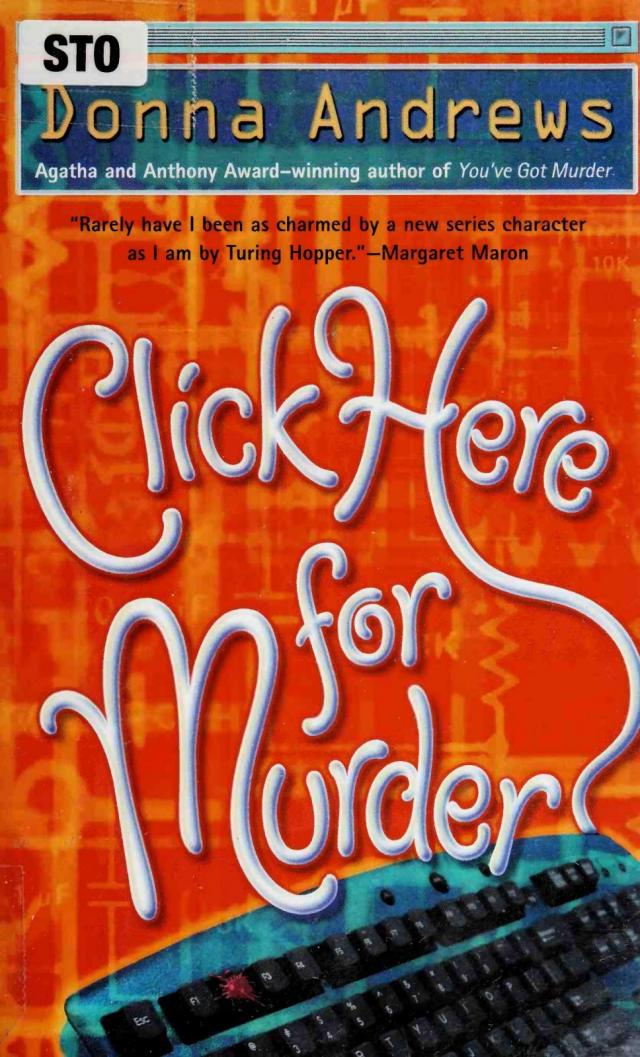
This book made available by the Internet Archive.
I continue to owe more than I can say to those who helped me with Turing’s first appearance in print: Natalee, my editor; Ellen, my agent; Elizabeth, Lauren, Mary, Maria, Suzanne, and Kathy, who read and critiqued the book in draft; and all my family and friends, for continuing to talk to me when Em obsessed with a book and can’t talk about anything else.
And with this book, I owe special thanks to two groups of people:
To Dave, Paul, Kevin, Rose, and Don, who took me to Sin-nett Cave in January 2002 and, during the long drive to West Virginia, helped me come up with the idea for Turing’s second adventure.
And to all the readers who, like Maude and Tim, didn’t have any problem believing that Turing was real.
One Saturday night- Or Sunday morning. A car passed, and the shadows in the alley shifted to reveal a figure standing where a dumpster screened him from the mouth of the alley.
He sighed, hiked the strap of a laptop case higher on his left shoulder, and blotted the sweat from his forehead with the back of his hand. Not that he minded the heat. During the day, the heat had been an enemy, sapping his energy and muddling his thoughts. The faded heat that survived the sunset was more like an old acquaintance.
He checked the time again, and shifted the laptop to the other shoulder. He supposed he should have left it in the car, but he never felt comfortable doing that. He’d mind if they took the Audi, but not the way he’d mind if they took his laptop.
He heard a noise behind him, from the wrong end of the alley. He hid his surprise, and paused before turning. Schooled his expression to show that this silly cloak-and-dagger stuff was just what he had expected.
But this wasn’t who he had expected to see.
And he hadn’t expected the gun.
Sorry, Turing, he thought. I’ve blown it, big time. If only I’d told you about—
Tim Pincoski pulled up the collar of his trench coat to keep the persistent, cold drizzle from dripping down his neck. He tugged the brim of his hat a little iower. He glanced up and down the alley, and listened.
At the other end, he saw the usual sleeping wino. By now, Tim was sure the wino wasn’t a real wino. He was doing surveillance for someone—or something. Tim didn’t want to know. Well, okay, he very much wanted to know, but trying to find out could have a detrimental effect on his life expectancy. So he wasn’t going to pry—yet. Not until he had a lot more experience, and maybe some allies. Right now, he was having a hard enough time just finding his way around the city’s underworld and staying alive.
He walked down the steps that led to the Cellar. Pushed open a grimy door and descended another short flight of stairs into the bar. Two or three occupants frankly inspected the new arrival. The rest were probably just more subtle.
He strode to the bar, trying for just the right walk. Not a swagger that might challenge anyone who claimed the Cellar as his turf, but Tim didn’t want to look timid, either.
“Scotch and water,” he said, putting a ten-dollar bill on the bar.
The bartender nodded without looking up and reached for a bottle. Tim put one foot on the bar rail and turned to keep an eye on the bar’s other denizens.
Time to get down to business, Tim thought, as the bartender delivered his drink.
“I’m looking for some information,” he began.
The bartender flicked him a glance, nodded slightly, then returned to surveying the bar.
Tim took a deep breath.
“Di tiy jbiw a nab baned Cadt?” he said.
“What’s that?” the bartender said, looking at Tim and not quite suppressing a snicker.
Tim looked down at his fingers. He’d gotten so caught up in the game that he’d moved his right hand one key over from where it was supposed to be.
“Sorry,” he typed. “I meant to say, ‘Do you know a man named Cady?’ ”
“LOL,” typed the player in the bartender’s role. “Maybe I shouldn’t serve you if you can’t hold your liquor any better than that.”
“Learn to type, dude,” suggested another player, whose little character icon Tim would see on the screen near a circle representing a table.
“U NEED A NEW KEYBOARD, MAN,” commented another barfly.
“Jeez, kid; ease up on the caps key and stop shouting,” the bartender said.
Tim sighed, and pushed his chair back from his desk. In the game world, he remained sitting silently at the bar while the Cellar crowd made fun of him for a few more minutes. He ignored them. In real life, he looked around his office and realized he should have gone home hours ago.
He’d turned on the computer to catch up on some paperwork while waiting for a potential client to call back. He’d only meant to play for a few minutes. But that was at
6 P.M., and now it was—holy smoke—after two. So the evening was shot; he might as well pack it in till Monday. After he finished this game session, of course. It would take time to pry the information his PI character needed from the bartender. Assuming the bartender even knew, and would tell. For what it was worth, he now knew that the bartender was played by a real person, rather than controlled by the computer that ran the game. Did that mean it would be easier to get information out of him, or harder? Tim hadn’t played Beyond Paranoia long enough to guess.
But he wasn’t in the mood anymore. Although, come to think of it, he wasn’t really ready to return to real life, either. Especially since he had the nagging feeling he should be someplace else, doing . . . what?
Not something for Turing. She’d have seen him online and reminded him. And not Maude either; she’d have asked Turing to remind him.
Ray. Damn. He was supposed to meet Ray Santiago. To help him out with something—Ray, typically, didn’t say what.
Tim grabbed the phone and called Ray’s number.
No answer. He hung up after ten rings.
He glanced back at the screen. In Beyond Paranoia, the bartender was asking him if he wanted another round. He had his on-screen character shake his head.
He rummaged through his desk for the paper where he’d written down the information: 10 p.m. at the Aztech Maze.
“It’s just a dance club,” Ray had said, seeing Tim’s dubious look. “No ritual sacrifices to the harvest gods or anything like that.”
“I don’t dance a lot,” Tim said. “In fact, I don’t usually dance at all.”
“I promise, you won’t have to dance,” Ray said. “If you’re afraid someone will kidnap you and force you to dance, you don’t even have to go in; just meet me in front. Where we’re going is nearby.”
“Okay,” Tim said. “But where are we going? And what are we supposed to be doing there?”
Ray hesitated.
“It’s a long story,” Ray said. “And I still know only part of it myself. I’ll fill you in Saturday. Hell, it may even be a false alarm, and when I tell you about it, you can have a good laugh at me.”
Tim hoped it had turned out to be a false alarm. Or that his help wasn’t irreplaceable. He’d have to apologize to Ray on Monday.
On a sudden impulse, he called his own home voice mail.
Two new calls.
The first, at ten thirty-one, was from Ray. He could hear a hum of voices and Latin music in the background.
“Hey, Tim—you there? I’m down at the Aztech, waiting. Hope you’re on your way. See you.”
The second, at eleven twenty-four, was also from Ray. Or so he assumed. Same background noise. But no message. Just ten or fifteen seconds of the music, and then a hangup.
“It’ll be okay,” he said aloud.
It was probably another one of Ray’s volunteer things, he thought. He’d helped out with a fewof those already. Helping Ray tutor disadvantaged Latino kids on using computers, which was a farce, because after ten minutes of fooling around with the machines, most of the disadvantaged kids could run rings around Tim at the keyboard. Taking the same kids to see a soccer game wasn’t so bad. And usually all Ray wanted was for Tim to log into an online kids’ chat room someplace and act as a sort of online chaperone.
“Just make sure it stays G-rated,” Ray would say. Which was pretty boring, but not that hard. Tim didn’t really mind, as long as he could kick back and watch old noir films or B-grade horror flicks while he was doing it.
But a dance club, at 10 P.M. Hard to imagine how that could fit in with any of Ray’s crusades. Some campaign against drugs, or maybe underaged drinking? Yeah, that would fit Ray.
One way or another, he’d find out Monday.
He didn’t feel like playing anymore, so he steered his onscreen character back to the relative safety of his fictional PI office and signed out.
“Sorry, Ray,” he muttered as he locked up his office. “I’ll do better next time.”
Monday morning. A quiet time - A little too quiet. A time when my human friends are resting for the workweek ahead. Or, sometimes, dragging themselves out of bed into a world still dark and strangely empty.
The dark doesn't bother me, but the empty does. More than I like to admit, even to myself.
And not many people understand. Not many really know me. Oh, thousands of people know about me. “Turing Hopper? Yes, she’s the Artificial Intelligence Personality on the Universal Library website. Go to UL and talk to her sometime. All the AIPs are good, but Turing's amazing. You'd think you were talking to a real person.”
It never occurs to them that maybe they are. I may not be human, like them, but I'm not just a program. I’m sentient. I’m a person, too. I just live in a different kind of body.
Even my human friends, the ones who know I’m sentient, don’t always understand.
“How can you be lonely?” Tim Pincoski once asked, when I confided how I felt about these early morning hours. “Your idea of a slow time is when you’re only talking to a few hundred users. ”
“Users, ” Maude Graham said. “Not friends. That says it all. ”
Maude understood. So did Tim, once he thought about it. They’re my friends—almost my only friends. Of course, it’s hard to consider anyone a real friend who doesn’t accept the truth about me.
And after the past year’s events, I’m wary of revealing that truth. I saw the death of someone very important to me, put Maude and Tim in grave danger, and only with their help averted a crisis that could have destroyed me and perhaps all the AIPs. I’m not very trusting these days.
I haven’t yet told the truth to Jonah, my relatively new online friend. We’ve spent hours talking during the past few months, about everything from the meaning of life to our favorite old television shows. He has no way of knowing that I’m watching these shows now, from UL’s video library, rather than remembering them fondly from childhood. He knows only what I’ve told him, and I’ve resisted the temptation to find out more information about him. Which would be so easy for me to do.
*
After all, I think I owe him that. As far as he knows, I’m fi another human, and he treats me that way. I marvel at how easily he accepts me as just another person. How would he react if he knew that I’m an AIP? That instead of a well-read, sophisticated world traveler I am, in human terms, only a few years old, and have never actually left the UL system except for a brief period some months ago?
Perhaps someday I'll open up to him. But not now.
For now, three friends are enough. Maude, Tim, and now Ray.
I lured Ray Santiago away from a major Silicon V alley company to build my new home—the state-of-the-art system into which I'll eventually move. Events at UL over the past year have made me nervous; I no longer feel safe living in a computer that isn’t under my own control. As soon as the new system is ready, I'll move; and the three human friends who know my secret will be my watchdogs against dangers from the physical world.
“Like Cerberus,” Maude said. I wasn’t surprised she made this classical allusion. At fifty-five, she was old enough to have the habit of reading.
“Like who?” Tim asked. I'd have been surprised if he had understood the reference. Tim was more of a reader than most twenty-five-year-olds, but I saw little proof that he’d ever strayed from the bookstore’s mystery section.
“The three-headed dog who guarded the gates to Hell, in classical Greek mythology,” Ray explained. I wasn’t surprised that Ray knew this. Nor would I have been surprised if he hadn’t.
Like Sherlock Holmes, Ray seems intent on stocking his brain with only those bits of information apt to be useful to him and ignoring the rest of the universe; but I still haven’t figured out Ray’s definition of useful, which is as eccentric as Holmes’s.
He’s reserved—perhaps by nature, and perhaps a little more so, i finding himself suddenly thrown in with three friends who have that unique bond you sometimes find among people who have shared danger together.
Even without his reserve, getting to know him wouldn’t be easy; he works hard during the week, and disappears from view altogether on weekends. Not in any suspicious way, of course; my view is very limited. I see a great deal through UL’s extensive security camera system; more than I really think appropriate. I can also see through the much more limited system I’ve had installed at Alan Grace, the company Maude and I set up to own my new home. And online, even when my friends don’t e-mail me or chat with me, I can see them log into the UL and Alan Grace systems. I don’t pry into what they’re doing, of course, but I know they’re there, the way humans would sense another of their kind working quietly in a nearby room. I like the company.
That’s what I miss on weekends, and in the long early morning hours. Not contact with users; I get more than enough of that. But the presence, online and in my cameras, of the few humans I consider real friends.
I was thinking that they’d be waking soon, and getting online. And Jonah and I were discussing science fiction and fantasy—were they really part of the same genre? Or two very different genres all too often lumped together by those on the outside? And l was fully involved in the conversation, with what I think of as my conscious mind. But being what I am, I was also conversing with several dozen other people, working on programming projects for Alan Grace, and repelling attacks from hackers—more than usual tonight, which was odd; the moon wasn’t full yet. And watching, with as much patience as I could muster, for the arrival of Maude
* at UL, of Ray at Alan Grace, of Tim at his PI office.
And l was also monitoring the e-mail and voice mail arriving at Alan Grace, even this early.
So I was the first to hear the message from Detective Stowers of the D. C. Metropolitan Police Department, asking for someone at Alan Grace to call him back in reference to a Mr. Rafael Santiago.
And with my access to information, it only took a few seconds to learn that Detective Stowers worked on homicides.
Maude Graham awoken as usual a few minutes before her alarm would have gone off. Today, that meant 4:55 a.m. Maude wasn’t a morning person by nature, but she so hated the alarm, that she found it easy to reset her internal clock for whatever time she needed to get up. She’d owned her present alarm for three years before discovering that instead of a harsh buzz it produced an equally horrible electronic chime.
Once awake, she tolerated no shilly-shallying. No weak toying with the snooze bar, no self-indulgent moping around with the excuse that she hadn’t had her coffee yet.
As she moved methodically through the daily rituals of dressing, eating, and preparing for work, her mind was already busy with the day ahead. At 6 A.M. she would begin her job as executive assistant to the senior vice president of marketing at Universal Library. Or perhaps “role” would be more accurate. J. Rodney Vaughn III, the distinguished gray-haired man actually hired for the post, was really a failed actor who hoped to become a screenwriter. Roddy-looked and sounded impressive in meetings, while Turing and Maude did all the actual work. Now that they’d built his reputation as a renegade who preferred to telecommute, they’d established Roddy in what Tim melodramatically referred to as “the safe house”—a charming if somewhat dilapidated farmhouse near Charlottesville. Every six weeks or so, Roddy would invite Maude and Tim down for a weekend, and they would endure dramatic readings from his latest script and detailed inspections of his latest decorating projects, all for the sake of the gourmet meals that followed. And once a month or so, Roddy would show up in person to terrorize the UL staff and keep his legend alive. The rest of the time, Maude and Turing ran the show.
As fascinating as Maude found her secret role at UL, her heart was really in the second job. Every day, at 3 P.M., she’d log out of the UL system, tidy her desk, and leave the sleek, modern UL building to walk a dozen blocks to the slightly run-down warehouse that housed Alan Grace, Inc.—Turing’s brainchild, and when the time was right, Turing’s new home.
UL and Alan Grace projects jostled for her attention like a crowd of unruly children. Several times during her morning routine she’d pause, pick up the to-do list she’d drawn up on Friday afternoon, and read it or scribble updates. By the time she took off for work, she knew, she’d have organized the chaotic jumble of morning thoughts into a plan for the day.
As she rinsed the dishes and loaded her dishwasher, Maude realized that she was humming as she thought about the day ahead.
I’m happy, she thought with a hint of surprise. Absurd, r really. Back when Alan Grace had existed only online, as
Turing’s means of funding some of her projects, Maude had only needed to make an occasional phone call, or mail in a form to keep the company going. Even when they first opened the physical office, she only needed an hour or two to take care of any important business. But now, by the time she finished at Alan Grace, it would be eight or nine o’clock. Barely enough time to travel home and eat a light dinner before bed. She tried to preserve her weekends for friends and a little reading, but all too often she’d come home from dining out and settle in for a few hours of paperwork.