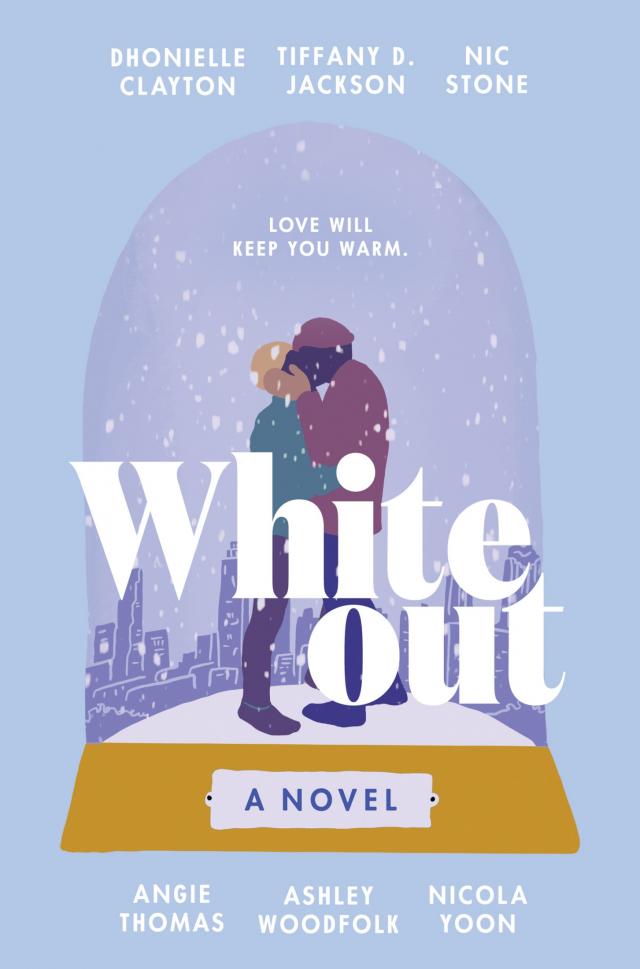
Whiteout: a Novel, page 1


Dedication
To Black kids everywhere:
your joy and love warm the hearts of the world.
We still see you.
Contents
Cover
Title Page
Dedication
One: Stevie
Two: Kaz
Three: Stevie
Four: E.R.
Five: Sola
Six: Jordyn
Seven: Stevie
Eight: Jimi
Nine: Stevie
Ten: Ava & Mason
Eleven: Stevie
Authors’ Note
Acknowledgments
About the Authors
Books by These Authors
Back Ad
Copyright
About the Publisher
WEATHER.COM REPORT
ATLANTA
H: 36°F L: 18°F
Special Weather Statement Until Midnight EST
Issued by National Weather Service, Atlanta, GA
AFFECTED COUNTIES
Cherokee, Clayton, Cobb, DeKalb, Douglas, Fayette, Forsyth, Fulton, Gwinnett, Henry, and Rockdale
A historic winter storm is gaining strength along the East Coast, dumping record-breaking snow accumulation from Jacksonville, FL, to the nation’s capital, coupled with a threat of coastal flooding from Savannah, GA, to Wilmington, NC, and 70 mph offshore winds. The National Weather Service has reported that large swaths of the southern United States will see up to eight inches of snowfall, prompting emergency conditions across four states.
Heavy snow and high winds have created near-whiteout conditions. Authorities ask that everyone stay indoors and avoid all unnecessary travel. Icy patches likely on roads. All flights at Hartsfield-Jackson Atlanta International Airport have been grounded, and a winter storm warning is in effect from 3:00 p.m. through 12:00 a.m.
One
Stevie
Morningside—Lenox Park, 3:01 p.m.
THERE ARE INFINITE ways that terrible night could’ve turned out differently.
Some quantum theorists believe there’s another you out there. Another me. That our universe is really, really big—infinitely large—and because of that, there are only so many ways matter can arrange and rearrange itself. Eventually, everything has to repeat, they say.
So there’s another version of this reality. A parallel one. Another me. Another you. Another version of the people we might love. Another outcome to every mistake we’ve made . . . living in another version of this universe as if we’re only a deck of cards shuffled and reshuffled, beholden to the numbers.
I should know. I understand the science. I have the highest GPA possible in my grade, shattering all the records at Marsha P. Johnson Magnet (or MPJM, as we call it). I could’ve tested out of high school in the ninth grade, but chose to stay for . . .
Whatever. Anyway, back to the point. There are infinite ways that terrible night could’ve turned out differently.
Imagine if I hadn’t gotten so wrapped up in my experiment that Sunday afternoon, and hadn’t left the lab late covered in calcium sulfate and stinking of acetic acid, my super-long locs needing a refresh and my hands tinged green from overflowing graduated cylinders.
Imagine if I actually had taken the time to look like a perfectly put-together girlfriend, someone worthy of being loved instead of an overly anxious mess. And if that anxiety didn’t push me to make the most catastrophic decision ever as I tried to get myself to relax. I can’t even face what I did.
Or even the night before it all happened: Imagine if I hadn’t wasted our Saturday presenting my girlfriend, ex-girlfriend, my hopefully still girlfriend, Sola, with my charts, animated brain models, chemical equations, and study data for my AP Chemistry midterm project on love. The hypothesis posited that love was simply a biological response built into human brains to ensure the survival of the population . . . so is it even important?
Imagine if I hadn’t pontificated on my hypothesis, drilling down on how my results proved that love holds an overblown significance in our society and is most often wielded to make people believe that having a partner is some sort of accomplishment.
Being the smartest person in the world . . . now that’s a feat.
Curing cancer . . . ending pandemics . . . those are achievements.
Building libraries in communities that lack them . . . something to shout about.
Being in a relationship, though? There’s no need for a trophy or gold sticker . . . right?
Imagine if my whole experiment hadn’t invalidated our relationship.
Back to the awful Sunday night in question: Imagine if I hadn’t been so on edge, worried about being impressive, trying to show off that I was, in fact, the smartest person in school and would be able to go to the college of my choice; that I could identify every Nigerian dish her mother had made with the correct pronunciation, even as an outsider; that I could be so perfect, Sola’s parents and aunties and uncles and cousins would like me accept me. Accept us.
Accept our love.
If I hadn’t talked so much.
If I hadn’t been such a pompous ass.
If I hadn’t driven home that way.
Maybe in a parallel universe, like the one the quantum theorists theorize, that other version of me is less awkward, less nervous, less needing to know everything to feel tethered to reality, and maybe that me didn’t ruin her relationship three days ago. Maybe the cards were shuffled differently there. Maybe there’s an outcome where I didn’t blow up my life.
A knock rattles my bedroom door. “What—I mean, yes?”
The door creaks open. Pop crowds the doorway, forehead molasses brown and crinkled like the gingersnap cookies Aunt Lisa brought over yesterday for the holidays.
“I’m going to pick your mom up at the aquarium so we can go Christmas shopping at Lenox Mall.” Pop’s gaze scans my bedroom, the purse of his lips telegraphing his unhappiness with its current state. His once perfectly neat, perfectly behaved child would never have a messy room. Future scientists are never messy.
“First, you can drop the ‘mall,’ Pop,” I correct, fixing my eyes on the observation log in my lap. “While it’s technically correct, colloquially, it’s just Lenox. Second, you shouldn’t say Christmas shopping because there are other winter holidays happening right now, and more to come later in the month. It’s not inclusive.”
Pop sighs. “Stop giving me a hard time, baby girl.”
I cringe and look up. Pop knows how much that second word grates. How limiting it feels right now. How I’m trying to figure things out. I’ve told him. “Don’t call me that.”
He puts his hands in the air. “Sorry. Forgot all your new rules.”
“They’re not new, Pop.”
“Well, I’m still making sense of it all too,” he says.
“So am I,” I mutter, feeling like everything I thought I knew about myself, Sola, my experiments, the world, is changing.
Pop sucks his teeth. “Look, I’m just here to remind you that you’re still grounded.”
“I haven’t forgotten.”
“That means no visitors.”
I refocus on my log. “She doesn’t want to see me, so no need to worry there,” I say. “Pretty sure I ruined everything, and since you all won’t let me have my phone back, I can’t even do anything about it.”
He sighs and starts his lecture on consequences for one’s actions, blah blah, full-on rolling into Reverend Josiah Williams mode. “And no leaving this house.” He clears his throat like he always does before he has to be a hard-ass. “You better answer the house phone when I call to check in.”
“I know.”
“Do you?” Pop strides deeper into the room. “’Cause lately it seems like all the things I thought you knew, things I taught you, went straight out the window . . . and you’re acting like you lost all the sense you got. Where is my brilliant girl?”
I curl deeper into my window nook and gaze out at our front yard. The sky is a powdery white as precipitation drifts down. “No two snow crystals are alike. Did you know that?” But there’s no avoiding his monologue about my current moral failings and his surprise that his poster child, his only child, could mess up. He quotes some scripture that goes in one ear and out the other, and I wish I could remind him that we’re not in his megachurch and he’s not at the pulpit. That the last thing I need to hear about is “respecting my parents” and “following my elders’ leads.” It’s too bad he can’t tell me what to do when you’ve made the worst mistake of your life and hurt someone you love.
I cut in again: “Some are flat plates with dendritic arms shaped like small columns. Pencil flakes or needles, you could call them.”
“You really talking to me about snowflakes, Stevie? Did you hear anything I said to you?”
“Snow crystals. The word snowflake is more a general term. Could mean one single snow crystal or a few of them all stuck together.”
“Stephanie Camilla Williams!” Pop’s voice deepens in that warning way, the kind when Black dads say your name, you know you’re toeing the line.
“It’s Stevie,” I mumble, crossing right over it.
“Stevie.” (Pop hates calling me that but has acquiesced because he knows I’ll just keep correcting him.)
“What? It just started snowing, and I thought you should know, so you’d be careful. All that condensed water vapor coming out of those clouds”—I point out the window—“could make the streets messy. Statistically, there will be an average of six point seven
“Aren’t you glad you aren’t going?” Pop winks, then darts over to kiss my forehead before I can protest. I’m going to need a surge of endorphins to get through what I have to do tonight. “Be our perfect gir—I mean, child, please,” he says as he exits my room.
I want to grumble that I’m not a child anymore. That I’m almost seventeen, but it wouldn’t matter to him. I will be a child even at forty, because he’s the “elder.”
I gaze out the window again, watching as Pop’s car backs out of the garage, then disappears up our street and out of view.
I sigh and thumb through my observation log, combing through all the experiments I’ve done. The failed ones, the adventurous ones, the complicated ones, the prize-winning ones.
I can’t stop flipping to the one that blew up my relationship. It stares back at me. My once pride and joy, earning me an A+ for the semester. The one that sparked an argument that bled into what was supposed to be one of the biggest nights in my relationship history with Sola—one where I finally got to meet her parents, not just as her best friend . . . but as her girlfriend.
Date: 9/8
EXPERIMENT TITLE: LOVESICK, THE OXYTOCIN OBSESSION
SCIENTIFIC QUESTION: What is the biochemistry of modern teenage love?
I gaze at my data tables of saliva samples and oxytocin measurements. Data that supported my theory: teenagers who claim to be “in love” will have oxytocin levels that mirror those of a person addicted to recreational drugs. Maybe if I hadn’t chosen this experiment or told Sola about it at all, we wouldn’t be in this mess. I wouldn’t be in this mess. But I told her everything. Because I always tell her everything.
I slam the log shut and walk to my desk. I pluck the tiny LEGO bouquet I always keep there, squeezing it over and over again, hoping it’ll slow down my heartbeat. I click a button, and the automatic blinds I had installed across the left wall of my room lift. Instead of revealing a stretch of windows, there’s a map of my life laid out across my mom’s wallpaper like a complex multitiered mathematical equation.
I wish life was as easy as a chemistry experiment. Choose the right reactants and blend them the right way to yield the product you desire. Chemistry makes things simple. If you know how the elements behave, you can predict the results. Voilà: no one gets hurt or burned . . . frustrated or disappointed.
The life wall journey begins with my baby pictures, then includes every newspaper clipping about my genius-level IQ and science experiments, with headlines shouting about the youngest-ever kid to break the world record for mental math equations completed in under a minute. There are articles about my desire to be a biochemist, and there’s my series of medals, and there are cheesy portraits of me with famous scientists and politicians, all fawning over me being a tiny smart person. All before sixth grade . . . all before meeting Sola.
Everything changed when I met her. Which is evident in how much space she takes up on this wall. Her kid photo is here too, right next to one of me holding a trophy from my middle school science fair. Her little-girl face stares back at me. Round and chubby cheeked, hair beads hitting her shoulders.
I can almost hear the click clack they used to make every time she turned her head to be nosy.
On Sola’s first day of sixth grade, the front office lady, Ms. Townsend, marched her into Mr. Ringler’s classroom. That click clack of her braids echoed in between all the introductions. Her dark brown skin glistened so much, my mama would’ve said she looked like candied pecans fresh from the oven. And Sola was grinning so hard, my cheeks throbbed in sympathy.
I remember being jealous. Her ability to step inside a room full of people she didn’t know and just smile. And not just a regular, sheepish smile . . . no, the deeply happy kind, as if somehow she was excited to be the new kid or felt like she’d just started a brand-new adventure or something. She wasn’t afraid that someone would call her cheesy.
I spent a lot of time making sure people didn’t know how I felt. I could be angry or sad or frustrated or even happy, and no one would ever know. I could control every one of my facial muscles. But Sola let it all shine through.
She’d plopped down next to me, filling the empty chair at our two-seater desk. I’d tried to ignore her, burying myself in Mr. Ringler’s math worksheets or playing with the LEGOs hidden in my side of the desk. If I didn’t make eye contact, maybe she’d stop glancing over at me.
“Hey,” she’d whispered. “Excuse me . . .”
I’d pretended to not hear anything, but then a little paper tent appeared in my line of sight. I couldn’t resist opening it. Inside sat a gummy worm and a story about its dastardly life as a worm burglar. I giggled and looked up to find her intense (and beautiful) brown eyes aimed right at me.
She unleashed that sunshiny smile. “We’re going to be best friends. I know it,” she said, her voice confident and tone prophetic.
“How do you know?” I couldn’t look away from her.
She pushed another worm in my direction. “Because you laughed at my story. Which means you get me. And I knew you’d like it, which means I get you.”
I tried to hide a smile, then pretended to pay attention to Mr. Ringler’s fractions (even though I already knew how to do them). While she ignored the math lesson, scribbling away in her journal—writing more stories about the worm burglar, I presumed—I made a tiny bouquet of LEGO flowers and left it in her side of the desk when she went to use the bathroom. I waited the whole rest of the day for her to find it, and when she did, she beamed like I’d left her a million dollars. At that moment, I knew: I wanted to make her smile like that forever.
Now, I set my own LEGO flower bouquet back on the desk in my room. Over the years, I’ve made dozens of these, leaving them in her locker or on the dashboard of her car or tucked away in her purse. A tiny way to remind her that I love her and I’m always thinking of her, even when I go quiet and get lost in my work and can’t get the words out.
I run my fingers over the wall and sigh, tracing how Sola intersects with almost every milestone in my journey. She probably should’ve been there from birth. There are pictures of her—of us—everywhere: hanging out after school while our classmate Kaz and I tutored people struggling in science; avoiding my dad’s sermons and hiding with Porsha in the wings of his church; going to hear Jimi sing at gigs all over the city; sending old-fashioned care packages to Evan-Rose at her fancy boarding school (a school where Sola and I went to sleepaway camp, and that we almost wound up attending); the two of us hanging out at the aquarium with Ava, staring up at the largest saltwater fish tank in the United States, while my mom handled boring fish logistics stuff in her office.
I move down the life wall to my most prized section: everything laid out under the words THE FUTURE.
All of my our plans sit there like a dream poised to evaporate into thin air.
Howard University after high school.
A shared apartment in DC.
A gap year post-graduation, to travel the world together.
A job in a lab or with a big pharmaceutical corporation so I can earn enough for her to stay home, write, and become a best-selling romance author.
Marriage.
Three kids.
Lifelong love.
Forever happiness.
An anxious bubble balloons in my chest. I grab my observation log and hug it close, hoping it can make the bubble burst. “You have to fix this, Stevie,” I say to myself.
I flip it open again and pore over the elements of my newest experiment. The most important theory I’ll ever test.
EXPERIMENT TITLE: MY GRAND PLAN TO FIX THE ULTIMATE SCREWUP.
SCIENTIFIC QUESTION: Can you get someone to forgive you and love you again?
HYPOTHESIS: If Stevie combines the proper romantic elements to create the perfect romantic gesture, then Sola’s heart can be recaptured.
I recite the step-by-step plan, all the people I’ve already texted, all the favors I’ve requested, all the parts of this experiment that have to work for me to achieve my desired outcome. The biggest and riskiest pseudo chemical equation of my life. The only way to fix all the things this version of me has done in this version of the universe.
I dart to Mom’s home office at the front of the house and retrieve my phone from the safe that she doesn’t think I know the code to. But Mom chooses numerical passcodes the way most people do: she uses an already-meaningful set of numbers for easy memory retrieval. For five-digit codes, the house number where she grew up—52404—is her go-to. Her ATM pin is the last four digits of her phone number: 9860. The eight digits for her cell phone? Her and Pop’s wedding anniversary: 10221995. And this safe? It’s my birthday: 1230.