Borrowed Pain: MM Romantic Suspense, page 1


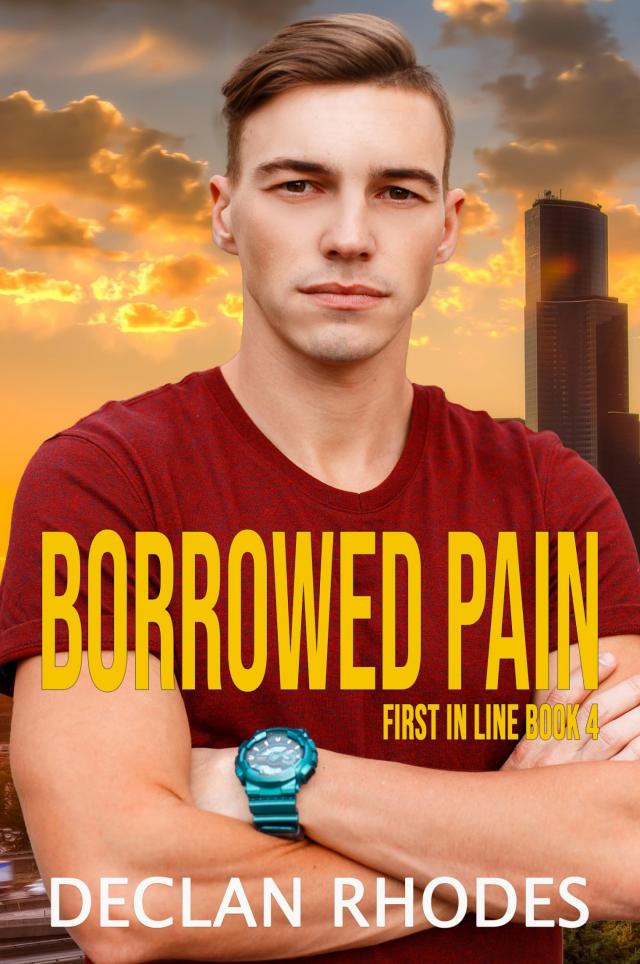
Borrowed Pain
Book Cover by Declan Rhodes
Model and background images sourced from Getty Images.
Copyright © 2025 by Declan Rhodes
All rights reserved.
No part of this book may be reproduced in any form or by any electronic or mechanical means, including information storage and retrieval systems, without written permission from the author, except for the use of brief quotations in a book review. All characters appearing in this work are fictitious. Any resemblance to real persons, living or dead, is purely coincidental.
Trigger Alerts
This book discusses the aftermath of suicide as well including depictions of toxic psychotherapy. Please be alert if this content triggers you.
Playlist
Silent Service: Rowan’s Playlist
Nine Inch Nails – “The Fragile”
This one feels like me—obsessive forward motion with hairline cracks running through. I keep patching myself together with discipline, but the fracture lines are always there.
Massive Attack – “Angel”
Heavy, relentless, shadowed. When I’m locked on to something, I don’t stop. The song builds the same way my focus does, until there’s nothing else but the hunt.
Interpol – “Leif Erikson”
Detached but aching underneath. I’ve never been good at saying what I want out loud, but this track sounds like my late-night thoughts when the guard slips.
Radiohead – “Everything in Its Right Place”
The repetition calms me. Loops and patterns feel safe—order out of chaos, even when emotion seeps in sideways.
Trentemøller – “Moan” (Radio Edit)
Sparse, hypnotic, like the sound of an empty city block at 2 a.m. It’s how my solitude feels when I’m driving with nothing but my thoughts for company.
PJ Harvey – “Rid of Me”
Sharp edges, raw nerve. I recognize myself in that volatility—push too close, and I bare teeth. It’s not pretty, but it keeps me alive.
The National – “About Today”
This one cuts deep. The weight of not doing enough, not saying enough—it’s the track I heard after cases went wrong. I don’t let myself linger in regret, but the song does it for me.
Depeche Mode – “Walking in My Shoes”
If you knew what I carried, maybe you wouldn’t judge me so hard. That’s the whole point of this one. My flaws are obvious—I dare people to look anyway.
Chelsea Wolfe – “Feral Love”
Dark, instinctive, dangerous. The growl of this track reminds me of the part of me I don’t talk about—the pull toward the edge, and the way intimacy can blur with menace.
David Bowie – “The Motel”
Slow build, menace wrapped in beauty. I reveal myself the same way—piece by piece, never all at once. Bowie understood that kind of unraveling.
***
For Miles
I’d never admit this out loud, but I leave one track at the end that doesn’t belong with the rest: Leonard Cohen – “Dance Me to the End of Love.”
I tell myself it’s there for the irony, gravel voice and all. But the truth? It’s the one place I drop the armor. That song is for you.
Available on Spotify — https://open.spotify.com/playlist/5YHpvB45zipdr3EhPD82Zj
Contents
1. Miles
2. Rowan
3. Miles
4. Rowan
5. Miles
6. Rowan
7. Miles
8. Rowan
9. Miles
10. Rowan
11. Miles
12. Rowan
13. Miles
14. Rowan
15. Miles
16. Rowan
17. Miles
18. Rowan
19. Miles
20. Rowan
21. Miles
22. Rowan
23. Miles
24. Epilogue - Rowan
Author's Note
Also by
About the author
Chapter one
Miles
The rich aroma hit me before I'd even made it through Ma's front door—a rosemary and garlic blend that meant home. It bypassed my brain entirely and burrowed straight into my chest.
Coats crowded the entry hooks—Marcus's neat navy jacket, Alex's lived-in hoodie, and the expensive scarf Dorian pretended not to care about.
"There's my baby," Ma called from the kitchen, not turning around as she stirred something that required her full attention.
"Your baby's thirty-two and has a mortgage," I said, kissing her cheek. The scent of her rose hand cream blended with the goodness simmering on the stove. "Nice apron. Very domestic goddess meets witness protection program."
Ma swatted at me with her wooden spoon, missing by design. "Don't sass your mother. Go sit. Your brothers are already making noise."
Marcus had colonized one end of the dining room table with paperwork—James angled in with a tablet; Alex perched on Michael's chair arm, smirking; Dorian steadied Matthew's breadstick mid-gesture, keeping his story from turning into a fencing match.
I took my usual chair—the one with the loose back Marcus promised to fix—and slid into my role: youngest, entertainer, the pressure valve. Lately, the role was a tight fit.
"—and then," Matthew said, adopting his official lecture voice as he waved the breadstick for emphasis, "the emergency vehicle executed what can only be described as an unfortunate parking maneuver. Direct collision. Right into Dr. Klein's sedan. Sirens blaring, hazards flashing, Klein frozen in place with his coffee like he'd seen it all before."
I watched him for a beat, registering the familiar rhythm of his voice, how he leaned forward when he got to the details, and the slight pause before he delivered the punchline. He always flipped into courtroom formal when he told work stories, like he was testifying under oath. I straightened in my chair and sank into his voice like slipping into an old coat.
"'Doctor,'" I said, perfectly mimicking Matthew's slightly nasal tone and that courtroom formality he fell into, "your vehicle has experienced what we in the professional community call a catastrophic parking outcome."
Michael snorted. Marcus looked up from his papers with a half-smile, suppressing a laugh. Matthew threw the breadstick at my head.
Dorian snatched it mid-flight and broke it in half. "Penalty for unsportsmanlike carbohydrates."
"I do not sound like that," Matthew protested, but he was grinning.
"You absolutely sound like that," I said, settling back into my chair. "You get all PBS documentary when you're telling work stories. Very soothing for the grieving automobiles, I'm sure."
Ma appeared at my shoulder with a platter piled high. "Leave your brother alone. He saves lives."
I accepted the platter. "So do I, with fewer sirens and flashing lights. Feelings."
"Feelings don't count," Michael said. "Too easy."
A brittle laugh bubbled up from my chest. Ma's eyes were on me for a second—that maternal radar that had always been too sharp for my own good—before she moved on to fuss over Marcus's empty water glass.
It was Sunday dinner, same as it had been for years—the voices and slightly barbed affection that defined the McCabe family ecosystem.
But it was all sitting a little off-center.
The conversation drifted to hockey—Marcus with Kraken stats, Michael declaring Seattle couldn't beat a college team, Matthew defending Grubauer with season-ticket fervor.
I should've jumped in with my coach impression. Instead, I picked at the napkin until the threads separated.
Sleep had been garbage lately. Not caffeine-jitters or deadline brain. Heavier. I lay there replaying sessions that had ended hours earlier.
Mrs. Kim, who always offered me lemon drops, had made a breakthrough after the car accident—then someone called about a specialized residential program. A veteran finally opened up about Kandahar, only to disappear after mentioning he'd been recruited for intensive treatment.
And Iris—
Three clients in six months. All making real progress. All suddenly contacted about cutting-edge programs I'd never heard of.
I told myself it was a coincidence. Survivors seek more help. My gut disagreed.
For the past several months, when my apartment went quiet at night, I'd put on the Silent Service podcast to hear Rowan Ashcroft's voice. Not the cases—they already haunted me enough—but the voice itself. Low, unhurried, threaded with a rough edge. More than once, I lay in the dark, hard for a man I'd never met, chasing sleep to the sound of him.
I forced my attention back to the table. Sunday dinner wasn't for work or late-night fantasies. Sunday dinner was for family, and pretending the constant weight on my shoulders belonged to someone else.
My brain had never respected boundaries. Fragmented images flickered through my head: Iris's hands shaking as she gripped her coffee cup during our last session. She was smaller somehow, like something inside her had started collapsing.
There was a call that came after, in the middle of the night, her voice so thin I barely recognized it.
"I shouldn't have gone there, Miles. Something's wrong. Something's really wrong."
Marcus's voice brought me back to the present, "—don't you think, Miles?" He stared at me expectantly, eyebrows raised.
Everyone was looking at me, meaning I missed something important enough to warrant group attenti
"Absolutely," I said with the confident conviction that had gotten me through grad school. "Couldn't agree more."
Matthew snorted. "You have no idea what we're talking about."
"Sure, I do. Hockey. Very... hockey-ish stuff." I grinned and took a bite of Ma's roast, which was perfect but tasted like sawdust in my mouth. "Lots of skating and... stick things."
"Stick things?" Michael's deadpan delivery made everyone snicker.
"It's a technical term." I doubled down on the bit because that's what I did—kept it light and kept them laughing. Kept the focus anywhere but on the fact I'd been somewhere else entirely for the last five minutes.
Ma's hand settled briefly on my shoulder as she passed behind my chair, and I caught the scent of her rose cream again. Such a small thing, but it anchored me. It reminded me of where I was and who I was supposed to be.
The family entertainer. The one who protected everyone else from drowning in whatever darkness they dragged home—Marcus's need to control everything, Michael's SWAT ghosts, and Matthew's savior complex.
I'd been good at it since I was twelve, when I learned that making people laugh was easier than watching them grieve.
So why did my latest laugh feel forced? Why was my smile pasted on instead of genuine?
Ma's sharp blue eyes focused on me again. They'd always seen too much. She said nothing, refilled my water glass, and moved on.
She knew. Ma always knew when one of her boys struggled, even when they desperately tried to pretend otherwise.
Twenty minutes later, Marcus pushed back from the table with a satisfied grunt. Michael stretched, his chair creaking under the movement, and Matthew eyed the last dinner roll.
Marcus stood. "Alright, I should head out. Early morning tomorrow."
"You always have an early morning," Matthew pointed out. "It's like you schedule them specifically to avoid cleanup duty."
"I helped last week—"
"You rinsed three plates and called it even."
"Boys." Ma's voice cut through the brewing argument. "Nobody's leaving until these dishes are done. All hands on deck."
It happened every week. We staged our usual half-hearted protest before falling into the cleanup routine. That's what McCabe men did. We looked after our own.
I was already gathering plates. It was easier than sitting still and letting my mind wander back to more dangerous territory.
"You don't have to do that," Marcus said, appearing at my elbow with a handful of glasses.
"I know." I took them from him and added them to my growing collection at the sink. "But if I don't, you'll stand here debating the most efficient dishwashing technique for twenty minutes, and Ma will never let us leave."
"I don't debate dishwashing techniques."
"You debate everything, Marcus. It's your superpower. Very useful for fire safety protocols, and less useful for family dinner cleanup."
He snorted but didn't argue. He knew I was right. Soon, the whole crew was in motion, everyone slipping into well-worn roles: Marcus and James were stacking plates, Michael and Alex were loading, and Matthew and Dorian were drying. We had it all down to a science—cleaning patterns that required no discussion or coordination.
Most Sundays, the warm water and familiar sounds of my brothers moving around Ma's kitchen soothed me.
My work phone buzzed, the one I used for client emergencies.
A call, not a text.
Sunday. 7:30.
I almost let it go to voicemail. Almost.
The buzz came again, and my hand moved to my pocket. Occupational hazard of working with people in crisis—you never really stopped being on call, even when you were technically off duty.
"Work?" Michael asked, glancing at my phone.
"Probably nothing," I said as I strolled toward the back door. "Give me two minutes."
The porch was cooler than the kitchen. I shivered slightly in the October air, sharp with the promise of rain. I inhaled the faint, lingering scent of coffee beans from Grounds For Thought three blocks over.
Lights flickered on in neighbors' windows, and the distant hum of Sunday night television filtered through thin walls.
I hit the voicemail button, expecting to hear the shaky voice of a client having a panic attack or someone looking for an appointment first thing Monday morning.
Instead, I listened to a voice I didn't recognize, digitally distorted, but unmistakably deliberate.
"Dr. McCabe, you don't know me, but we must talk about Iris Delacroix. About what really happened at Riverside. About why she's not the only one."
The phone nearly slipped from my fingers.
My blood turned to slush.
Iris… Iris Delacroix.
I hit replay, my thumb shaking against the screen. Surely I'd misheard. It was a call intended for someone else, some other Dr. McCabe dealing with a different crisis.
I listened again. Whoever it was had planned the call down to the digital distortion that made them impossible to identify.
They knew about Riverside.
The full conversation with Iris returned. It was 2:30 AM, eighteen months ago, a voice so thin and shaky I'd barely recognized it as the woman who'd been making such progress in our sessions.
"Miles, I shouldn't have gone there. Something's wrong. Something's really wrong."
"Where, Iris? Gone where?"
"Riverside. The place they told me about. They said it would help, said it was the next step, but Miles— "Her voice cracked. "They're doing things. Things that aren't... this isn't therapy. This isn't helping."
"Iris, slow down. Tell me exactly—"
"No. No, I can't. I signed things. Legal things. But Miles, promise me you won't write this down. Promise me you won't put this in my file."
God help me, I'd promised. She'd sounded so broken and terrified. I thought I was protecting her.
I'd kept that promise even after they found her body on the pavement outside her apartment building a week later, even when the police asked if she'd mentioned anything unusual in her last session. When her sister called, desperate to understand what had driven Iris to jump,
I'd kept my word and hated myself for it every day since.
The phone screen blurred. I gripped the porch railing so hard my knuckles bleached white, my breath coming in short, sharp bursts that fogged in the cool air.
About what really happened at Riverside. About why she's not the only one.
The caller knew something I didn't. Something about Iris and the place that had broken her so severely she'd rather die than live with whatever they'd done to her.
And they had my number. My professional number was the one I gave to clients in crisis.
Which meant they knew precisely who I was.
I hit replay again. Then again.
It was a blocked number. The caller hadn't gotten that far by being careless. The implications crashed over me in waves.
Someone had been watching. Listening. Waiting.
For eighteen months.
I was sweating despite the cool air. The familiar sounds of my family filtered through Ma's kitchen window—the clatter of dishes and Michael's low rumble of laughter.
It was a world away from where I was standing.
Why she's not the only one.
The words echoed in my head. Other clients? Other people like Iris, broken by whatever happened at this place I'd never investigated, never questioned, never—
You failed her.
The thought tore into every tender spot. I'd had pieces of the puzzle—Iris's panic, her fear, and her insistence that something was fundamentally wrong with the treatment program. And I'd done nothing.
I'd kept her secret, yes, but I'd also let her disappear back into hell. A week later, she was dead.
How many others had there been since? How many clients had I failed to protect because I focused on honoring confidentiality instead of asking the hard questions?
Through the window, I glimpsed Ma moving around her kitchen, probably wrapping the leftover roast in enough foil to survive a nuclear winter. Marcus gestured about something. Matthew laughed at whatever Michael had just said.
They had no idea their baby brother stood ten feet away, drowning in the implications of a thirty-second voicemail.
Breathe in. Breathe out. Pocket the phone. Go back inside.