

One Day You'll Leave Me, page 1


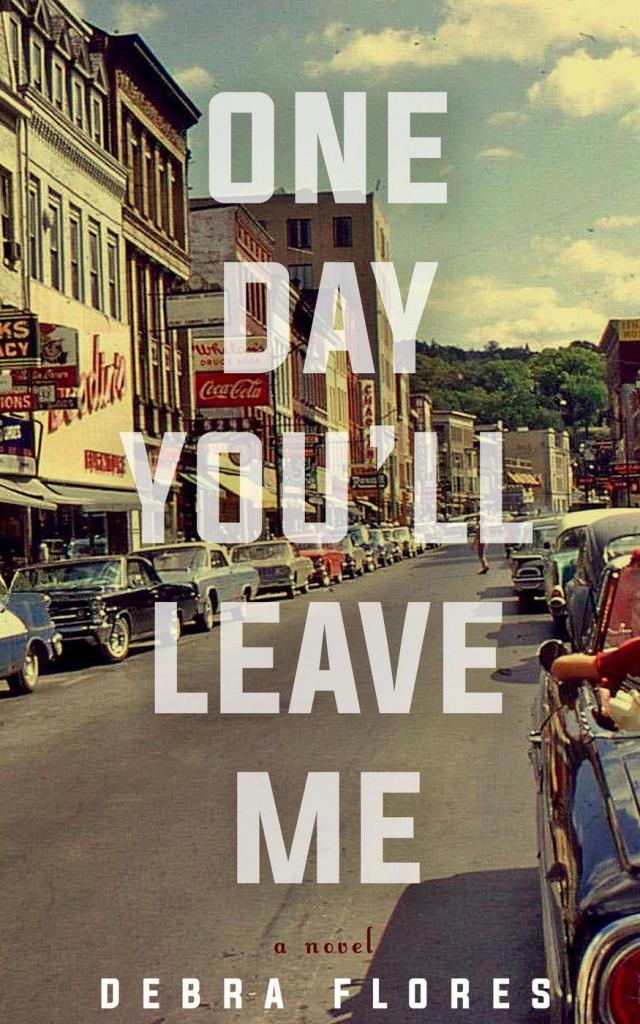
One Day You'll Leave Me
Debra Flores
Published by Debra Flores, 2019.
This is a work of fiction. Similarities to real people, places, or events are entirely coincidental.
ONE DAY YOU'LL LEAVE ME
First edition. December 17, 2019.
Copyright © 2019 Debra Flores.
ISBN: 978-1393356202
Written by Debra Flores.
Table of Contents
Title Page
Copyright Page
Dedication
1
2
3
4
5
6
7
8
9
10
11
12
13
14
15
16
17
18
19
20
21
22
23
24
25
26
27
28
29
30
31
32
33
34
35
36
37
For L.
1
My mother died when I was fourteen years old.
It was in the summer of 1985 and it was right out of the blue. There was no adjustment period, no prolonged illness. No time to get used to the idea of being a kid without a mother. One day she just grabbed her keys and walked out of the door, off to buy a pair of shoes or pick up some dry cleaning maybe, I don’t know. She didn’t tell me. An hour later she was lying in her mangled tiny Ford Escort on the highway, lifeless. Gone forever.
I had to sit on our brown scratchy sofa alone, for forty-five minutes, with two police officers hovering over me until our next door neighbor could track my father down and bring him home.
“Do you understand what that means? That your mother is dead?” the female officer asked me in a soothing voice, after I took the news stoically and didn’t break down into hysterical sobs.
Of course I knew what it meant, I was fourteen years old.
She put her arm around my shoulders and rubbed at my arm. “She might be in shock, poor thing.” Her partner nodded his head sympathetically.
Maybe she thinks I’m so out of it I can’t even hear her.
My hearing is fine.
My mother’s dead. I get it.
I also got that she expected me to cry. If not big heaving sobs, at least a tear or two. But I just didn’t have it in me.
What can I say? I was trained not to cry so I didn’t cry.
My mother would have been proud.
When I was seven, a stray cat wandered into our backyard while I was munching on a ham sandwich and reading a picture book on our patio. He looked like he was on his last leg. Scrawny, a large bald patch near his crooked disjointed tail, and a very noticeable limp. I immediately scraped off as much mustard as I could from the ham and fed him every last bit, then ran in the house for more. It probably wasn’t a good idea to stuff him the way I did, he immediately threw up, but I couldn’t help it. You see a hungry animal, you feed it. And he was hungry.
Of course he stayed, and of course I kept right on feeding him. Within a week or two, my newfound cat friend (who I named Leo) had perked up. Both his bald spot and limp were slowly diminishing, his ribs weren’t as visible, and his meow came back. My mother wasn’t very happy with the situation, she made a show of being upset about it, but, to my surprise, a couple of cans of cat food started appearing in our pantry each week. Yet still, when, six months later, one of the neighborhood dogs got loose and killed him, instead of sympathy when I broke down crying, what I got was contempt and disdain.
“It was a cat. Do you know how ridiculous you look crying for a stupid cat?”
My mother always said crying was only for deaths. I guess that didn’t include deaths of felines you’d grown to love.
It took me a while to learn but eventually I did. Displays of emotion, as far as my mother was concerned, were distasteful and unseemly.
“Quit cackling like that, you sound like a clown.” When I laughed a little too loudly for her liking.
“It’s a movie, stop that nonsense, or else flip it off if you can’t handle it.” When I’d had the nerve to yelp at a scary scene.
“Go to your room, we’re not going after all. Once you learn to behave correctly we’ll see.” When I’d whooped, clapped my hands and jumped up and down at the prospect of visiting Six Flags Over Texas.
By the time I was ten I no longer had to try to contain my emotions, the “correct” way to react now just came naturally to me. The teacher announces we’ll be taking a field trip to the zoo next week? You remain in your seat and don’t make a sound. You can nod, if you’d like, that’s okay, but to act like the untrained monkeys around you? Stomping and cheering and shrieking? Unacceptable. I was starting to see my mother’s point of view.
My father wasn’t much help. He was away on business most of the time. Or that’s what I was told anyway. It wasn’t until I was nearly eleven that I began to realize dentists don’t actually make out of town house calls. What was he supposed to be doing? Filling cavities in a kitchen? Extracting wisdom teeth while his patient watches Family Ties on the living room TV? It was a year after that that I realized what it meant.
If my mother had a problem with it, that he was home only a few days out of the month, she hid it well. Then again, she had to didn’t she? Unless she wanted to be a hypocrite and actually display some sort of emotion. But really, I don’t think she cared. When I think about it I can’t recall there ever being any sort of tension in the house whenever he was there. I never sat, shoulders scrunched up, at the breakfast table, ready to duck at any moment in case pots and pans started flying across the room. No, she would cook the eggs, cook the bacon, then slide some on to my plate, some on my father’s, and then leave the kitchen. Leave me to sit there with my silent father as he drank a cup of coffee beside me.
Maybe she’d gotten so good at hiding her emotions she just didn’t have them anymore.
I never got to that point.
But she’d done her damage.
And it went beyond that.
Because affection requires emotion doesn’t it? Therefore, affection, along with crying, complaining, laughing, pouting, all of it, was out.
As a kid, I remember being jealous all the time. Of my friends. Not because they had better clothes than I did, or the newest and coolest toys. That they got cable the year it came out. I had all the material things I needed, or wanted, most of the time. No, I was always jealous of my friend’s mothers. It was so bad I used to fantasize about getting hurt somehow while at someone else’s house. Nothing too extreme. A scraped knee or a twisted ankle. But I would have been okay with a broken bone too. Just to have someone fuss over me. Even if just for ten minutes.
“Are you telling me your mother never, not once, hugged you? Ever? As in never? That’s impossible.”
“That’s what I’m saying.”
No one ever believed me. They thought I was exaggerating.
And she wasn’t even content to make my life miserable when she was alive, she kept right on at it after she was gone.
If she hadn’t chosen to get behind the wheel after drinking half a bottle of vodka, I wouldn’t have had to be sent off to live with relatives who were essentially strangers to me. My father made a half-hearted attempt at being a single father for a few months before deciding to make a clean break from his old life. I visited him and his new wife and baby twice, in Hawaii, before I turned eighteen. Then there were phone calls, then letters. Then nothing. I haven’t heard from him in three years. I don’t even know where he lives these days.
For four years I hopped around from relative to relative. An uncle in Austin. A cousin in New Mexico. My aunt Jane in Alabama. My grandparents, also in Alabama.
That was a treat. My grandfather, who didn’t see eye to eye with my mother (big surprise there), was an ex-cop who’d been kicked off the force. I was never told why he’d been fired but I could take an educated guess. He was a big man who liked to punch things. Mostly people. I couldn’t understand how my mother could have grown to be such an emotionless woman when her father was nothing but a raging ball of emotions.
Years later, when I was twenty and having had plenty of time to reflect on just what a sad and apathetic woman my mother was and how it had affected me, my aunt tried to give me one of those she-wasn’t-always-like-that sob stories.
Something about her father not allowing her to marry her high school sweetheart or something to that effect, I didn’t pay much attention. It wasn’t my fault she was a teenager back in the stone ages, back when your parents could dictate who you would or wouldn’t marry. And anyway, what difference did it make who she married? As if that excused her behavior.
“You need to cut her some slack,” my aunt Jane had said. “She did the best she could. She made sure you were fed and clothed didn’t she? You didn’t freeze to death did you?”
“They do the same for inmates on death row. That doesn’t make prison guards great parents to the inmates does it?”
“You call me, when you figure it out. After you’ve hit a few bumps in the road and life smacks you upside the head. Because it will. You think it has already,” she said, and laughed, sending a cloud of putrid cigarette smoke in
It took me twenty-four years to finally understand what she meant.
2
San Antonio, Texas 2010
When I walked into the cafeteria that day, Friday July 9th, 2010, I was thinking about presents and the fact that I hadn’t bought one for the party I would be attending the following day.
I’d put it off and now it was too late. I could have ordered nearly anything I wanted to online and had it delivered straight to my door in two day’s time. Now I was going to have to go to an actual brick and mortar store after work. Like it’s 1987.
How barbaric.
The television, mounted on the wall just beside the entrance, was on, as always. I only glanced at it as my assistant James and I, walked past it. The news. Same old, same old. Politics, crime, weather. Right now one of our senators, something something Yates was speaking into a bank of microphones while standing outdoors on the steps of some important building or other. Her white hair was being whipped around her head by the wind as she leaned far over the podium in front of her and jabbed her finger at the camera accusingly.
“She must have had men crawling all over her when she was younger,” I’d told my friend Janice a few years back.
“Yeah, I can imagine. For an older woman, hell for any woman, she’s striking. And that screw-you-I’m-in-charge-here attitude doesn’t hurt either. Very alluring.”
I couldn’t disagree with her on the striking part, but I’d have to take her word for it on the attitude. Politics wasn’t my thing.
“...over six hundred thousand missing persons cases in the U.S. alone. What we need...”
That’s all I caught her saying as we passed by before we were out of hearing range only five feet away. The volume was set on low, as always, and the closed captioning was on, as always. In case anyone was interested. No one ever was.
Who needs TV when you have a smartphone?
By the time we made it to the back of the large room, to one of only two empty tables left, the TV and thoughts of presents and parties, had left my mind completely.
“Walter wants those spreadsheets on his desk by the end of the day,” James said, looking at his phone one last time before setting it on the table along with the pile of folders he’d carried in with him.
“Well then Walter’s going to be disappointed.” James nodded with a grin. He didn’t like Walter any more than I did.
Usually, if I don’t skip lunch entirely, I’ll have something at my desk, a chicken sandwich or veggie wrap delivered from one of the nearby restaurants, or I’ll have James bring something up from this same cafeteria. But that’s rare, having him fetch me lunch. It didn’t sit well with me, it felt too close to the old female secretary having to make the coffee scenario for my liking. It didn’t matter that the roles were reversed, it still bothered me.
But today, because I was hungry enough that skipping lunch wasn’t an option and I wanted something a little more substantial than a few vegetables stuffed into a wafer thin tortilla, I accompanied James downstairs.
He didn’t remark on it, but I knew he must have thought it was strange. We hadn’t, in the three years he’d been with the company, ever had lunch together even though we got along well. We talked about things other than business, but not much, and never too personal. How’s your daughter adapting to high school? Have you tried the new restaurant at The Quarry? This heat is unbearable isn’t it?
And today was no different. As soon as we sat to eat, folders splayed out between our two trays, we began discussing the upcoming advertising campaign. Or tried to. We didn’t have to shout to one another but it still took some concentration to hear each other over the usual generic busy cafeteria noises. The clunking sound of ice being dispensed into paper cups at the soda fountain. The clanging of pots and pans coming from the kitchen. The hum of several conversations taking place all at once and all around us. The sound of forks and knives scraping and clanking against ceramic plates. Someone dropped an empty tray on the hard-tiled floor, cursed mildly, then picked it up and chucked it, noisily, on to the return counter. The cash register was beeping away, the cash drawer opening and closing.
So it should have been impossible really. To hear anything from the front half of the room, much less the TV. Even if it were turned up beyond the first one or two bars on the volume graph. My back was to it. There were at least nine or ten tables between it and where I was sitting, each nearly full with people eating and chatting away.
And yet, halfway through the lunch hour, as I sat, one hand holding a fork, the other rifling through a small stack of papers James had just slid in front of me, I heard it.
“All I need are the contracts, which should be deliv-”
“Shh,” I said, cutting James off and raising a finger in the air.
Music. I heard four beats before I snapped my head to the side.
I closed my eyes, trying to isolate the sound, trying to filter out all the laughter, a ringtone from someone’s phone, the shouts for more bread coming from the kitchen seeming to echo and reverberate around the room as if it were an empty cavern.
A few beats more and then the music was accompanied by a voice. It was a girl’s voice, or a woman’s, I couldn’t be sure. The fork I’d been holding rattled as it landed on the plate in front of me.
“Karen?”
“Shh!”
I caught the first few words of the lyrics before I opened my eyes and twisted in my seat to face the TV. I tried, in vain, to catch the rest of the words, but it was useless. Everyone seemed to have raised their voices up a notch all at once. On the TV only a single white note showed up on the screen in a small black box, no closed captioned lyrics.
Why is everyone shouting? Why now?
I stood and made it halfway across the room, my eyes never leaving the screen, before I had to stop and lean against a wall. The music was still there, I could hear the rhythm of it, but the girl’s words were drowned out by the voiceover.
As far as I could tell, it was a commercial for an Alzheimer’s drug. A rapid series of different scenes of a couple through various stages of their life. Young, on the beach, pants rolled up and frolicking in the surf while holding hands. A wedding scene followed by a scene of an infant in a crib being watched over while it slept. A living room was next, the now middle-aged couple with their three children plus a dog on a couch. And on and on until it cuts to an elderly couple with pained expressions on their faces as they sit in a doctor’s office. The scenes play again, through the eyes of the old man, but this time the faces of his wife and children are blurred and distorted. The implication being that he’s lost his memories of them.
There wasn’t anything special about it, it was pretty formulaic, still, when it was over, and the music faded away, my throat felt constricted, and my eyes had begun to sting.
Getting teary-eyed over a commercial? And at work? I had half a second to feel like a fool before I felt a hand on my back.
“Karen? What’s going on? Are you okay?”
I turned my head to the side and saw the bottom half of a black skirt, legs, black heels. One of my hands was still braced against the wall, the other one was on my knee. When did I hunch over?
“Yes...yeah, I’m fine.”
“You sure?”
When I straightened up I found Margaret, who works in accounting (I think), staring at me, her hand still resting on my back. The noise level all around me seemed to have gone down appreciatively and when I turned to my side I could see why. At least half of the people in the room had come to a halt to stare at me as well. Some of them with forks halfway to their mouths. Embarrassing.
“Yes, I’m okay,” I said, nodding, even managing to give her a weak smile.
“Cafeteria food? Looked like you were going to be sick there for a second,” she said, with a smile of her own, but a nervous one. Like she was worried she might have to step back quickly in order to avoid getting splatter on her shoes.
“What?”
“You were clutching at your stomach.”
Was I?
“Oh. Yeah, maybe.”
“Are you sure you’re okay? You look a little pale.”


