

The Monosexual, page 1


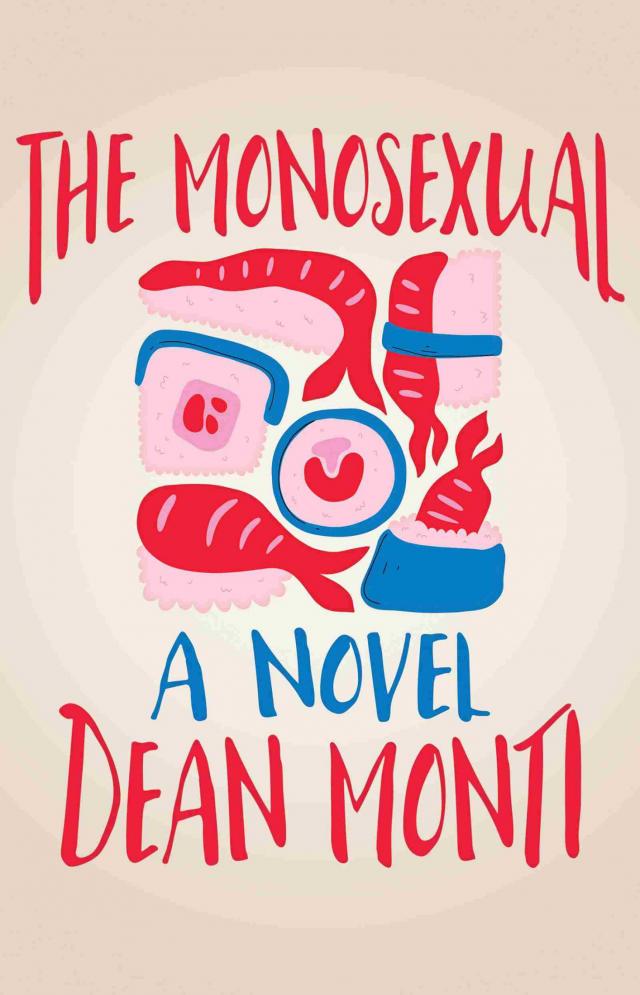
Copyright © 2024 by Dean Monti
All rights reserved
Printed in the United States of America
FIRST EDITION
This is a work of fiction, and is not intended to resemble anyone living or dead.
“I’ve Got You Under My Skin” from Born to Dance
Words and Music by Cole Porter
© 1936 by Cole Porter
Copyright Renewed and Assigned to Robert H. Montgomery, Trustee of the Cole Porter Musical & Literary Property Trusts Publication and Allied Rights Assigned to Chappell & Co., Inc.
All Rights Reserved
Used by Permission of Alfred Music
Requests for permission to reprint or reuse material from this work should be sent to:
Permissions
Madville Publishing
PO Box 358
Lake Dallas, TX 75065
Cover Design: Jacqueline Davis
ISBN: 9781956440898 paperback
9781956440904 ebook
Library of Congress Control Number: 2023952539
For Julie
Table of Contents
Chapter 1
Chapter 2
Chapter 3
Chapter 4
Chapter 5
Chapter 6
Chapter 7
Chapter 8
Chapter 9
Chapter 10
Chapter 11
Chapter 12
Chapter 13
Chapter 14
Chapter 15
Chapter 16
Chapter 17
Chapter 18
Chapter 19
Chapter 20
Chapter 21
Chapter 22
Chapter 23
Chapter 24
Chapter 25
Chapter 26
Chapter 27
Chapter 28
Chapter 29
Chapter 30
About the Author
Chapter 1
(rip, rig, and panic)
When Vincent comes to, the first thing he notices is a long, shiny, silver post. Almost like something a very tall person might employ for hanging some very long trousers, but for the serif hooks jutting on either end of the T-shape at the top of the contraption. Attached to one of the hooks is a plastic bag, long and bloated, like a whale’s condom or a carry-out sack for a submarine sandwich, but filled with a colorless liquid. The liquid is moving through a thin, hollow, clear plastic tubing that is connected to… him, as best as he can tell. He isn’t absolutely sure, because he can’t move his head. Or his arms. Or anything, really. But he is initially and primarily concerned about his head.
He isn’t sure if his inability to move his head has to do with some restraining device—put in place by the same people who have connected him to a tube—or if he can’t move his head because of fear or a lack of will on his part. He also harbors a third, nagging, improbable but persistent scenario: that perhaps he can’t move his head because of some actual physical condition that prevents that from happening. Like, say, not having a neck anymore. Or a fully intact head.
He isn’t at home. This much he knows for sure. The walls surrounding him are painted in drab seafoam green. Hospital green. He’s in a hospital room. But he has no clue how long he’s been unconscious or any memory of how he got there. He believes it’s daytime because he’s woken up in a partially sunlit room. But it could be morning, afternoon, or early evening.
His head is facing the left wall. Without moving, he can make out the words on a poster: WHAT IS YOUR PAIN LEVEL? And just below it, there are drawings of faces that run the gamut from copasetic to cringing. Vincent is neither copasetic nor cringing, but nor does he feel confident, which is absent from the selection of facial expressions. The poster doubles as an advertisement for a pain medication. He appreciates being in a place that understands the value of pain medicine. The poster also doubles as a wall calendar. It tells him it’s 1999. He knows he’s nowhere near being in a place where he could party like it’s 1999, but the year seems correct.
Vincent is aware, on some level, of being worried and scared, but he’s also in an odd state of not caring too much that he is worried and scared. It is this forced sense of relaxation and self-acceptance so profound and so foreign to him that leads him to the conclusion that the colorless liquid dripping from above and into him must certainly be morphine. Vincent has felt the effects of morphine once before, some years back, in a bitter battle concerning a traveling kidney stone. He recognizes the cool, compulsory calm of sedation.
As time passes in the wake of his newfound consciousness—but he also can’t see a clock to gauge how much time—he indulges in doing what he can do with his eyes. He can fix his gaze on small specific areas. He is even able to focus, if hypnotically and narcotically, on the plastic bag and the tube and the metronomic time it seems to keep as it keeps a steady drip drip drip into his arm. Or what he hopes is still something he would recognize as his arm, anyway.
He first registers the silent drip as a simple staccato in his head, but soon it begins to suggest a more rhythmic, ostinato phrasing and, ultimately, begins to suggest a more specific musical passage, and then a specific song with a specific singer.
Not just a voice, but The Voice. It is the talented Mr. Francis Albert Sinatra, accompanied by Nelson Riddle and his band of Intravenous Solutions, gently administering solution and song:
I’ve got you / drip drip
Under my skin / drip drip drip
I’ve got you / drip drip
Deep in the heart of me / drip drip drip
So deep in the heart
That you’re really a part of me / drip drip
I’ve got you / drip drip
Under my skin / drip drip drip
It goes like this, chorus after chorus, for the first few hours or days or however long it is that makes up that initial post-traumatic episode of his life. Post-traumatic. It’s natural to assume that whatever happened to him must have been traumatic. The telltale trappings of hospital infirming all about him. Morphine coursing through his veins. He might also be able to assume the most traumatic part of the trauma is behind him. He is, after all, in a hospital. He has not opened his eyes and witnessed any immediate peril—like his face pressed against the white dividing lines of a highway, or the fast-approaching horns of a charging rhino. Then again, a charging rhino might help him with geography. He isn’t in Africa, or at the Lincoln Park Zoo in Chicago.
Chicago. He is from Chicago, isn’t he?
But even though he can presume to be from the Windy City and under a doctor’s care, he doesn’t know what’s left of him. Because his field of vision is limited, he doesn’t know if he has a neck or how much of a body he has. If he is lacking a critical body part, anything more than a fingernail, then he feels he should be in a full-blown state of trauma, rather than feel that he was safely in a post-traumatic stage.
With each drip of intravenous solution, he considers the many possible permutations.
Head, but no neck or body.
Head and neck, but no body.
Head, neck and one arm for the intravenous tube, but no legs.
Head and body, no legs.
Head and legs, no arms.
Head and arms, no neck or legs.
She loves me.
She loves me not.
She loves me.
She loves me not.
I’ve got you / drip drip
Under my skin / drip drip drip
As a boy, Vincent had listened to Old Blue Eyes on thick vinyl record albums played on his father’s Admiral stereo. So many times, in fact, that by the time the diamond cartridge had repeatedly navigated and etched the grooves of the vinyl ten, fifteen, one hundred times, the record had its own unique sound of imperfection. This is what remains in his memory. In an era of pristine CD sound, his mind can’t help but fill in the crackles and skips of his youth.
Sinatra’s music had frequently been a source of comfort to Vincent. Now, an adult in his mid-thirties, the same music evokes painfully bittersweet memories. Memories that can further damage his heart. A heart that, for all he knows, might literally be damaged.
But if the song wreaks havoc with his heart, it is also a healing, meditative mantra, one that keeps his mind off nagging images of broken, dismembered, or missing parts of the rest of his body, parts that remained frustratingly just beyond his ability to see and assess.
As the tune continues in his head, he becomes aware of another repeated, rhythmic pattern, beyond the imagined staccato of the IV drip. Something else is keeping time. It is his right index finger against his right thigh. He can now confirm that he has a working, mobile index finger on his right hand and sensation in his right thigh. These are encouraging bits of self-realization.
He inches his hand just a few inches left, to find out if his genitals are there. Important. As he does so, he feels as though he may have bumped against something familiar, although he may have overshot and grazed his other thigh. He can’t tell for sure. He lacks a scintilla of sexual arousal. But if the fish weren’t jumping and the cotton wasn’t so high down south, he prays things are, at least, intact.
What is that song? Summertime. Is it summertime? No. It’s not. Feels like summer, though. Hottish. Where would it be hottish? He glances around again to make sure the room is free of rhinos.
Something—again, he assumes it’s the morphine—is keeping panic in a thickly padded, special delivery envelope with his name on it and saving it for him for later. Sooner or later, he figures, the fluid-dripping bag must deplete itself to the point of needing new dripping fluid, and the person in charge of fluid-dripping bags will tell him what has happened to him. He can be patient. Patience is his middle name.
No, it isn’t. It’s Albert. Vincent Albert Cappelini. Isn’t it? Yes.
For a while, what seems like a very long while, nothing happens to Vincent except, possibly, the imperceptible wearing off of morphine, and with it, the slow but steady return of some connected and associative ideas.
The next thought that occurs to Vincent is that he does not know if it is a good thing that he has regained consciousness. Yes, he has come to. Inherently a good thing. But come to what? What life is he waking up to? Could things be so bad that a coma would be preferable?
He tries to move his eyes. Not his eyelids, just his eyes. And then he feels pain. Real pain. Pain of piano wires pulled too taut. Straining. Sharp, overtuned. Not exactly screaming pain, but his mouth is already pursed to form the words “more morphine,” rehearsing it, in case he needs to suddenly shout it to a distant hospital worker. He shifts his gaze to the ceiling and unfocuses his eyes and this seems to relieve some of the pressure. He can hear (both ears seem functional), but only the muffled sounds of doors opening and closing, hospital (?) carts squeaking down hallways, voices that belong to strangers. Conversations out of context and with no laughter.
When Vincent closes his eyes again, memories are on the fringes of becoming less amorphous, more sharply defined. But he’s not sure he’s ready for that. So, he keeps his eyes open as long as he can, until a new round of fatigue overcomes him. Occasionally, when his eyelids flutter open after he’s had them closed, he expects to see “fly me to the moon” written in little black letters on a yellow Post-it note stuck on the ceiling.
There is a reason for that. This is not due to head trauma or some ocular malfunction caused by an unknown blunt force. If he had been lying on his back in his own bed, in his own apartment, he could have indeed opened his eyes and seen “fly me to the moon” affixed to his ceiling on a yellow Post-it note above his bed.
It is this specific knowledge, this lack of a fly me to the moon Post-it note on the ceiling that convinces him that things are happening that are out of his control. Bad things, probably, but he tended to be a glass-half-empty person, or the kind of person who feels he has been given a faulty glass to begin with. A cracked glass, or a cup without a bottom (not to be confused with a bottomless cup of coffee, which he remembers is a fine thing indeed).
He is alive and breathing on his own. Important. He is not in any immediate pain. He is apparently under a doctor’s care. He has at least one working finger, a responsive right thigh, a sense of rhythm, and maybe his genitals.
He does not know how much of a man is left of him, however, because he can’t see his genitals. Genitali obscuri. Why does he pseudo-Italianize that thought? Less important, perhaps.
What else does he remember about himself? He enjoys a quiet, early morning diner and a bottomless cup of coffee. What else? He enjoys an Old Fashioned on the rocks in the evening. Is he old fashioned? He likes classic films. The Marx Brothers. Frank Capra. Preston Sturges. He likes foreign films. Particularly Bergman, Kurosawa, and Fellini. He can’t remember the names of the films he likes. Probably due to the morphine.
Wait a minute. Wild Strawberries. 8½. Duck Soup.
It’s coming back.
He likes the outrageous jazz stylings of the late multi-reedman Rahsaan Roland Kirk who was blind and could play three saxes at once. Crazy song titles.
“Half a Triple.” “Slippery Hippery, Flippery.” “Rip, Rig, and Panic.” Okay, random, but also pretty specific.
He likes jazz, in general. Monk, Miles, and Coltrane, vocalists like Ella, Nat King Cole. And Sinatra, of course. He can name every album Sinatra ever recorded. He can’t do this at the moment, however. Probably the morphine.
But he knows Sinatra is important. Important in general, but particularly to him. Why?
Melissa likes Sinatra. No, she loves Sinatra.
Important, yes. But too painful. Why?
Never mind. It is a new kind of painful to abruptly remember Melissa. Her face, her eyes, her smile, her hair. Her head-to-toes. Her voice. Her everything.
Think of something else, quick. Don’t dwell on Melissa. What else is important? The pigs? No, not the pigs. Well, yes, maybe the pigs. The sunburned pigs had somehow gotten him here, to this hospital bed.
Pigs on a hot tin roof.
Chapter 2
(pigs on a hot tin roof)
(A few days earlier, Chicago, February, 1999. Friday morning)
Fly me to the moon.
Five little words written in black ink on a little 2x3 yellow Post-it note.
When the simple little Post-it note isn’t at home with him in Chicago, Vincent travels with it. So far, the note has graced his hotel bedroom ceilings in New York, Baltimore, St. Louis, Roanoke, Salt Lake City, Washington, D.C., and New Orleans. Within 24 hours the note will be above a hotel bed somewhere in sunny San Caliente, California, the location for a seminar on skin care and sun exposure featuring keynote presentations by leading dermatologists from around the world.
Giornale della Faccia, Italy’s leading dermatology journal, has hired Vincent as a freelance writer to cover the event. All he has to do is write it in English—they translate it into Italian for their journal. And although Vincent can read very little Italian, he likes seeing his stories printed in a Romance language. He likes to think they are somehow better in Italian. He fondly recalls the first time he saw verruche genitali in an article he’d written. How sweet the sound. Much more lyrical—and far less menacing—than genital warts.
Vincent has, until recently, spent several years as a medical writer and editor at Skinformation, the Skin Monthly, a well-respected, nationally known medical journal for dermatologists, based out of Chicago.
Although Skinformation, Giornale della Faccia, In Your Face, The Wart Report, and similar niche-market medical magazines have no real readership beyond the confines of a dermatologist’s overcrowded inbox, Vincent writes in-depth articles that are informative, accurate, and appreciated by his physician audience. And while he is not a well-known journalist in the larger world, he is, in the world of dermatology reportage—a world of rashes, alopecia, contact dermatitis, and the like—Vincent A. Cappelini’s byline has become familiar and well-respected.
Vincent had steadily earned the respect of his boss, the editor-in-chief at Skinformation, a silver-haired, perpetually frowning dermatologist, Professor Donald Reeves. Dr. Reeves had his own personal skin condition—rosacea, which gave him an unfortunate, slightly bulbous, W.C. Fields nose, and cheeks like Bing cherries. But no one on staff ever spoke of his condition. Not while Vincent had worked there.
Vincent’s abrupt departure from Skinformation came in the wake of a run-of-the-mill assignment from Dr. Reeves: go to Roanoke and cover a conference on sun exposure. The drill is familiar and simple. He attends seminars across the country, tapes the lectures on micro-cassettes, takes notes. Back at his keyboard in his cube, he could easily knock out a draft and fill out his story with what senior editors and well-meaning journalism teachers call “quotable quotes.”
“Make sure you get quotable quotes,” was the sole directive he’d received from Dr. Reeves about his Roanoke assignment. Vincent could be relied on to take care of the rest.
When Vincent returns from the Roanoke conference, he writes a good, comprehensive article about the seminar and about the dangers of sun exposure. He peppers the story with quotable quotes. All that is left to do is to embellish it with an interesting photo and caption.
During one of the lectures in Roanoke, one of the dermatologists had projected a slide that had caught Vincent’s eye. In the aftermath of a flood in rural Iowa, several pigs from a hog farm (referred to as a “swine finishing facility”) had found themselves stranded on the roof of a tin barn.
It may have been a question of priorities in a state of emergency, saving people before pigs, or it may have been that the pigs were simply unreachable. In any case, the pigs met their fate roasting on a hot metal roof under an August sun in Iowa with temperatures well above 90 degrees. These are hogs scheduled for slaughter, so a long, happy lifetime was never in the cards for them. But since they died a slow death from the heat, their plight was viewed—by the audience of dermatologists in Roanoke, anyway—as tragic. A photo projected on a screen at the seminar had captured the dead pigs, their shining pink hides glowing crimson under a bright sun.


