

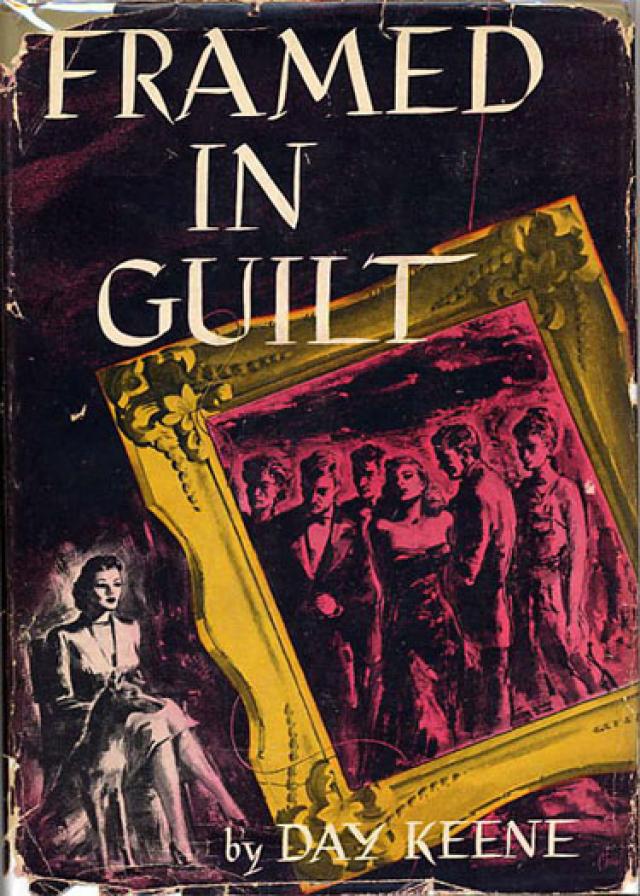
Framed in Guilt, page 15


Slightly startled, Robin looked up, smiling. "Oh, yes, sir. I think he's wonderful. It's all right for me to look at him, isn't it? I mean, at such close quarters?"
Stanton looked at the child to see if he was being ribbed. He didn't seem to be. As big as a minute, with an intonation and a broad A decidedly British, the six−year−old handled words with the ease of a Caltech professor. "Of course it is," Stanton assured him. "You like horses?"
"Very much," Robin said. He explained, "I've seen lots of them in the cinema but this is the first time I've ever been so close to a real live one."
"Why don't you pet him?" Stanton suggested.
Robin was beside himself with joy. "May I? May I give him a piece of sugar?" He grubbed in the pocket of his jacket and came up with a sugar cube. "I saved mine from tea this evening just in case I might meet a horse."
Stanton passed a hand over his eyes. Everything happened to him. Only this wasn't happening. It couldn't.
Attracted by the timidly offered cube of sugar, Danny Deever lowered his head, nibbled the sugar off. Robin's palm, then nuzzled him for more as Robin squeaked happily. "He likes me."
Amused, Stanton picked him up so the boy could pet the big Palomino's high−arched neck and well−curried withers. "What's your name, son?"
"Robin."
"You're British, aren't you?"
"No, sir," Robin said promptly. "My mother is English. I am an American. My father was an American aviator."
He stroked Danny Deever's nose. Stanton studied the boy's happy face in tardy suspicion. "Your mother's name wouldn't by any chance be Eve, would it?"
"Mmm−hmmh. Do you know her?"
"N−no."
Fond of his new friend, Robin confided, "There's been some trouble between my mother and father and we've come to straighten it out. His name is Robert Stanton and he writes wonderful stories for the cinema and makes a lot of money. Do you know him?"
"I'm beginning to wonder," Stanton said. This was a new approach to something, just what he didn't know. But whatever the girl's story was, it was good. It would have to be good to fool Hi Lo. The big Indian liked a good time but he believed a man should meet his obligations. A supposedly deserted wife and child would explain the punch in the jaw. His mouth suddenly dry, Stanton thought of Bale's remembered story concerning the wealthy American officer who had married an English girl. It was true then. And Grace Turner had written or cabled the girl before she died.
Robin squirmed in his arms. "You're holding me too tight."
"I'm sorry," Stanton said. He felt better than he had felt in weeks. This, then, was the pay−off to the whole affair. Once the girl had gone on record that he wasn't the Robert Stanton she had married, Inspector Treech's wanted motive would blow up in his face. No possible suspicion in the death of the Turner girl would remain attached to his name. "So your father is Robert Stanton, eh?"
"Yes, sir." Robin wasn't too certain. "I think this is his ranch. But I was asleep when Mother woke me up and told me to get dressed. My, she was angry."
"She was, eh?"
"Oh, yes." Robin slipped one arm around the neck of his new friend. "It wasn't nice of Father not to even phone after we came such a long way, was it?"
The question baffled Stanton. "What sort of a person is your mother?"
"She's nice."
It was natural the boy should think so. It was very possibly true. The girl wasn't to blame if someone had played a shabby trick on her. "And as soon as you reached the ranch you came out here all by yourself to see the horses?"
Robin shook his head. "No. Mr. Chief Hi Lo Jack brought me out here." He confided, "He's a real Indian."
"And your mother?"
"I beg your pardon?"
"I mean, where is your mother now?"
"I think she's in the house. A Miss Marta took charge of her. Both Miss Marta and Chief Hi Lo seemed quite shocked when they found out who we were."
"Yeah. I can imagine," Stanton said. Still carrying Robin, he walked back up the path. "That bunch of boozers should be cleared out by now. Let's you and I go see your mother."
There were a few stragglers in the garden but most of the crowd had gone. Stanton checked the remaining cars in the parking lot. Ferris' foreign job was still there as was the Man−son Cadillac. He thought the new Chrysler belonged to Johnny Hass and the big Buick to Ed Wilcox. He was pleased they had refused to leave. He wanted witnesses to this.
Marta was standing in the kitchen doorway. She took Robin from his arms, spluttering, "This time of night and a baby his age not yedt in bed after traveling five thousand miles to see his father." She glowered at Stanton as her Swiss indignation overwhelmed her. "Ach, Mein Gott! A father to deny his own son. What yedt is this world coming to?"
"Now, just a minute, Marta," Stanton attempted to defend himself. "Don't go off the deep end until—"
He stopped. Marta was no longer paying any attention to him. Robin cradled in her lap, she unbuttoned his collar, stripped off his coat and shoes, and began work on his stockings. "Gives it a hot bath, a cup of hot chocolate, and bed for you, young man."
"Real chocolate or cocoa?" Robin bargained.
Feeling like a fool, Stanton shifted from one foot to the other. Then, shrugging, he walked on down the long hall into the high−beamed, sunken living room.
Manson was sitting closest to the door. In the short interval since Stanton had last seen him, the producer had picked up quite a package. He rose unsteadily as Stanton entered the room and gripped his arm as if to assure him he was standing by. His plump face red with indignation, Johnny Hass said, "Hi, heel."
Sitting next to his wife, a beautiful white−haired woman, Ed Wilcox looked at Stanton thoughtfully, but said nothing.
Joy was standing with Ferris in front of a roaring log fire that one of the group had built. Her eyes were hard and accusing. The corners of her mouth turned down. "So there was a reason why Romeo lagged in his courtship. You weren't quite heel enough to make love to me with a wife and child living in England. Yet you would have married me. We would have been on our way to Las Vegas if she hadn't shown up. And wouldn't that have been a pretty mess?"
"I ought to punch your face in," Ferris said. "I may attempt it yet. God knows I'm no angel. I've cut a pretty wide swath. But this is a single man's prerogative. I can't begin to tell you the extent of my contempt for—"
"Nix," Patton said from the window. "You folks don't know what you're doing to Mr. Stanton. If he is married to this dame he's in one hell of a spot."
"Please." The black−haired girl sitting in the high−backed wing chair by the fireplace stood up. "This is, after all, my show. And with the exception of Miss Parnell who is also vitally concerned, I wish you would all clear out as Mr. Hi Lo suggested."
No one moved. She continued:
"This is a personal matter between my boy's father and myself. And if my temper hadn't made such a fool of me—"
"So you are Eve," Stanton said. He crossed the floor and Winston Churchill lying beside the chair stood up to form a barrier between him and his mistress. "So you are Eve," Stanton repeated.
The girl turned toward his voice, a wry smile on her lips.
"Why the note of doubt? Surely I haven't changed so much that you don't recognize me. I am merely seven years older and no end wiser. Hello, Bob. Or should I call you Lieutenant Stanton? Just how does a deserted wife greet her husband? You are a writer. You should know."
An angry retort on his lips, Stanton realized for the first time the significance of the dog. There was no sight in the girl's blue eyes. The knowledge made him somehow very sad. This was the first time to his sober, or intoxicated, knowledge that he had ever seen her. But he had seldom, if ever, been so drawn to a woman as he was drawn to the blind girl. It was as though he had looked for her all his life—and here she was. It was almost a physical pain not to take her in his arms and tell her so.
"Well, why don't you kiss your wife?" Joy asked.
"If you try to I'll slap you," Eve said. "I didn't come here to be kissed. All I want is what is rightfully due Robin."
Stanton lied. "I wouldn't think of kissing you." The English girl was obviously proud. He didn't want to hurt her in front of the others by telling her that while she might have married a Robert Stanton, he wasn't the man to whom she was married. "But, as you say, this is a personal affair and I wonder if we couldn't discuss it better privately."
She shook her head, much to Beatrice May's relief. Stanton watched her bobbing curls, enchanted. He wanted to take them in his hand and never let go again. It must be the Lennie complex in me, he thought. But this is the girl. This is it.
"No," Eve said. "That was the way I meant it to be. But my temper spoiled that. I couldn't help it. I slopped over when I heard laughter and music and smelled perfume and good things to eat and drink and Robin told me there was a pool and people in evening dress were dancing in a lantern−lighted garden." She wasn't asking for pity. She was merely making a statement. "Life isn't very pleasant in England these days, you know. And despite his pint of milk and a hot lunch at the school every day, there were times when Robin didn't have enough to eat. And then when I thought of how you had promised me that—" Her sightless eyes were wet with angry tears. "But no matter. That's past. I really blew my top when I learned the party was being given to celebrate your engagement to another woman." She asked if Robin were in the room.
Stanton said he was not.
Eve continued. "I'm sorry I made a scene. I apologize. But I couldn't help telling your aborigine servant I thought it wasn't cricket for a man to allow his son to be deprived of the very necessities of life while he lived like a virtual nabob."
His face dark with concern, Hi Lo entered the room through one of the French windows opening on the patio. "The boy isn't where I left him. He—" Seeing Stanton, he glowered.
"Come in. Come right in, my good aborigine servant," Stanton said. "And don't worry about the boy. I found Robin admiring Danny Deever and he is now in Marta's hands."
Hi Lo swept the room with his eyes. "I thought I told you folks to clear out."
"Not a chance," Joy said. "No man, not even the great Robert Stanton, is going to make a fool of me. If what this girl has told us is true, Bob, I'll run you out of Hollywood and pictures if it's the last thing I do."
Stanton wished her luck, then said, "All right. If we must wash our soiled linen in public, let's be at it. Here is my story, Eve. I never saw you before."
Wilcox called, "Shame."
Hass said angrily, "You really mean that, Bob?"
"I do. She may be married to some Robert Stanton but I'm not that Robert Stanton. I never saw her before."
Her cheeks flaming, Eve asked, "But you do admit your name is Robert Stanton?"
"I do."
"You are a cinema writer?"
"I write for the movies."
"And you were a first lieutenant in the United States Army Air Forces?"
"I was."
"And you were shot down over Bremen while flying as an observer with a British wing?"
"That also is true."
Eve was positive. "Then you are the Robert Stanton to whom I am married and I will thank you not to deny me. If it is Robin who is worrying you, I'm sorry. I would have told you of Robin before but I thought you were dead. You were so officially listed."
Stanton sighed, perplexed as how to straighten out the matter. It was far more serious than anyone in the room, with the exception of Patton and a tardily mentally awakened Hi Lo, realized. He asked Eve, "How did you learn I was still alive?"
Eve said, "Grace Turner wrote me a letter. She saw a clipping concerning you and Miss Parnell in one of the papers and sent it along. You remember Grace. She was a witness at our wedding."
"That does it," Stanton said. "That fixes everything just fine."
In the ominous silence that followed, Eve wondered what she had said that was so wrong. Her other senses quickened by her blindness heightened her perception of the tension.
"Well, I'll be damned," Wilcox said finally. "I think we'll take Hi Lo's suggestion and clear out. I don't want to become involved in this."
Puzzled but determined, Eve said, "You might have written, Bob."
"Now look, honey," Stanton protested. "You don't realize what you're doing to me." He laid his hand on her arm and she brushed it away angrily.
"Stop calling me honey. And don't you dare touch me."
Ferris stepped away from the fireplace. "Stop badgering the girl, Bob. Haven't you any common decency?"
"No. It would seem I'm fresh out," Stanton admitted wearily. "I don't know how I'm going to prove it but I have to. This girl is a stranger to me."
"Oh, but I'm not," Eve protested. "I'm your wife." Hot tears trickled down her cheeks and she made no effort to wipe them away. She might have known it would be like this. If Robert hadn't cared enough to let her know he was alive, it was only natural that he would deny her. He didn't want a dowdy little blind girl for a wife. He wanted Joy Parnell. She should never have come in the first place. She had no proof of anything she said except her marriage license and Robin's birth certificate naming him as father. He could deny them, too, claim they were forgeries. He had money, standing, and connections. She had nothing. And because he was ashamed, because he wanted to marry another woman, he was willing to throw her and Robin to the lions.
"Don't, honey," Stanton pleaded. "Please don't cry. We'll get this figured out somehow."
Eve clutched at straws. Still, Robert didn't sound like that sort of a man. His voice was richer, fuller, more gentle than she remembered it.
Stanton studied the weeping face. If it weren't for the Grace Turner angle it would be easy to admit she was his wife. He liked her. He liked the boy. Emotion fought with reason. Maybe she was his wife. Maybe he did know her. Maybe he had married her on one of his few drunken sprees snatched in the face of almost certain death during those early days of the war.
He asked her, "Where were we married?"
Eve said promptly, "Lychester Chapel, Mayfair."
"On what date?"
"October tenth, 1941."
"I was sober?"
"You were sober."
Ferris said, "I'm afraid you can't wiggle out of this one, Bob. You were in London in the fall of 1941. I know you were because I saw you there. That was before I went into the Army. I was doing a play with Madge Gare and you and I got drunk at the Crillon bar."
"That's right," Stanton recalled the incident. "I was there then " He turned back to Eve. "Now tell me this, honey. You have our alleged marriage license with my signature on it?"
"I have."
"The original or a reasonable facsimile?"
"The original."
"Fine. My signature should settle this thing one way or the other." He looked at Joy and from her to Johnny Hass and Hi Lo. "To everyone's satisfaction including, I hope, Inspector Treech." He turned back to Eve. "And we lived together for how long?"
The girl's sightless face lifted. "Please don't misunderstand me. I am not asking for charity. I am not requesting you to support me. If your love was so short−lived, it isn't fair you should. I don't want, I wouldn't accept, one penny from you."
God love the child,
Stanton thought. She means it. The independence of her.
Eve's chin lifted still higher. "My blindness makes no difference. You aren't responsible for that. But we did spend a month together. And fortunately, or unfortunately, however one cares to view the matter, that month produced Robin." Her smile was wry. "Children are, after all, one of the main byproducts of marriage. But do have this straight in your mind. For myself I ask nothing. And I told Attorney Hanson so this afternoon."
Stanton said, "Hanson?" You don't by any chance mean Shad Hanson, with offices in the Guarantee Building in Hollywood?"
Eve sensed the ugly something re−enter the room. "Y−yes, I believe that was the address. I asked the clerk at my hotel for the name of an attorney familiar with picture folk and he recommended Attorney Hanson. I conferred with him this afternoon and he promised to contact you at once."
"But he didn't," Stanton said quietly. "He didn't call me until nine−thirty tonight. Then when I drove up to his place in the hills he wasn't there."
Bulking large in one of the French windows, Inspector Treech asked, "Are you positive of that, Stanton?"
This is it,
Stanton thought. As soon as Treech learns who Eve is and that Grace wrote her a letter I'm on my way. He attempted to bluff it out with little hope of success. "What are you doing here? Where do you come in on this, Treech?"
Inspector Treech said, "Where Homicide usually comes in, after the body is found."


