

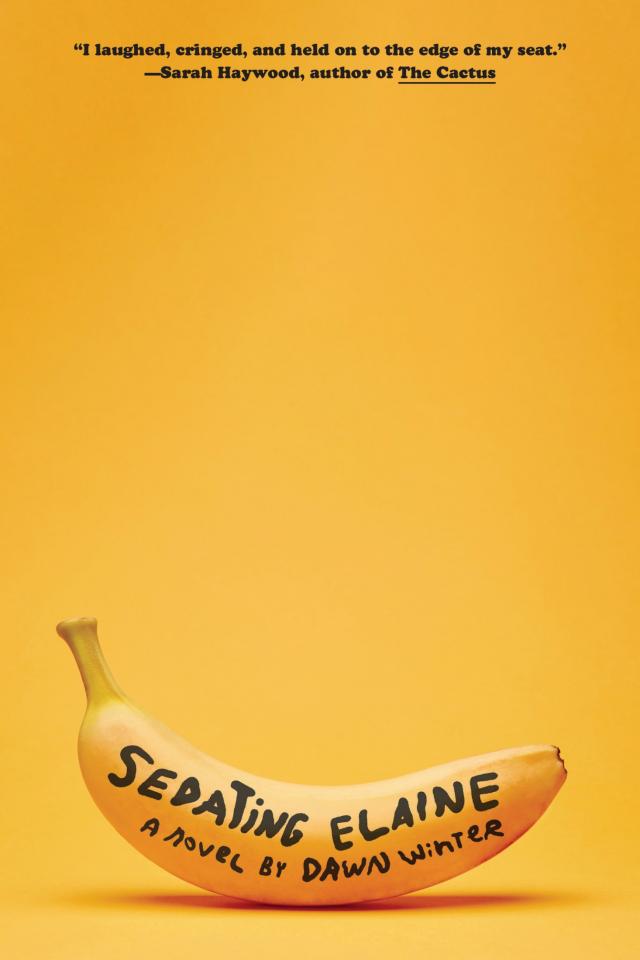
Sedating Elaine, page 5


King had been at the restaurant for decades, minus a few absences at Her Majesty’s pleasure. He was a heavily tattooed bodybuilder who sang opera and gulped down egg whites from a huge bowl set aside for him by the chefs when the yolks were taken for crème brûlées. He took his job seriously: No smear or smudge or mark allowed, glasses gleamed, cutlery shone, and if a chef returned a plate with the tiniest remnant of cheese on it, King would bellow at his KP, “What the fuck you doing to me? You tryin’ to make me crazy? Eh?” and glare with such fury, they could only mumble, “Sorry, King,” never entirely sure if he was serious or not.
“Unbelievable, that’s what this is. Clean it again!”
“Yes, King. Sorry, King.”
No one knew what he had done time for. It seemed irrelevant. Despite the bulk and roar of him, he was not really an angry man. None of them were. Bellowing and slamming was just part of kitchen life, to be heard, to keep momentum, to push on through the continuous physical and mental focus that is a restaurant dinner service.
Today, it was busier than usual due to a new early-week special. Frances scarcely had time to think about Elaine or her plan or anything else. Then, a couple of hours into her shift, King walked past with half a side of beef on his shoulder. “King,” she shouted, “I need to ask you something.”
“Okay, take your time,” he said, glancing at the beef.
“Sorry. Sorry. I know it’s short notice, but could I swap shifts with someone, or take some holiday? I’m sorry. Family emergency. I only found out today.”
“Ah, Puppy, what you doing to me?” He shrugged the beef up on his shoulder. “You tell me this now?”
“I know, I know, I’m sorry.”
“What’s going on with you?”
“Just family stuff. Sickness.”
He clicked his tongue in his cheek and said, “Look at me, I’m holding this cow, I don’t have time to fight with you. I’ll talk to you about this later,” and he went to leave.
“Please, King,” she begged. “You know I never ask for time off.”
King rolled his eyes because this was true. She didn’t like to give such short notice but what choice did she have? On the bus ride to work she had texted Dom and asked for his help. He had replied that she had a nerve. She said she knew she did, but could he help, just this once—she had the money coming, after all. He’d agreed with one word: okay. Off the bus, she lit a joint and rang him as she walked the five minutes to work. She told him, briefly, what she needed, which he said wouldn’t be a problem—he could get his hands on something that evening, in fact. “But you’ve got to be careful with this stuff,” he said.
“What do you mean?”
“Too little or too much and it’s not going to be fun.”
“That’s fine. Just get it for me, will you?”
“No, listen to me—you don’t want to wake up in some random place. Or, if it’s for someone else, you’ll need to keep an eye on them. It’s a little unpredictable, how people react to it at first.”
“Like what?”
“I can tell you the rough dose but you’ll have to feel it out to begin with. Might make you nuts, might not work at all. Plus some people feel really sick on it. Others go a bit crazy.”
“It sounds fucking dreadful.”
“Nah, nah, it’ll do the trick, no worries. Someone I knew, their cousin took it, didn’t wake up for three days straight. Didn’t remember a thing. He said it was like being in stasis.”
“That’s more like it.”
“But like I said, it can be a little unpredictable at first. Everyone reacts differently. The right amount for one person won’t be the right amount for someone else.”
“Okay.”
“So, is it for you or someone else?”
She hesitated, then said, “Someone else.”
“I’m not going to ask why,” he said, which was clearly a way of asking why.
“Good,” she replied. “Don’t. I can pick it up tonight? After work.”
“Usual place. Midnight.”
“See you then.”
Whilst she had not been thinking about Elaine during her shift, she had been distantly mulling over this conversation with Dom, and had concluded she should stay at home, ride out the coming days until she got the money, keep an eye on Elaine, and hopefully get some rest herself. A less scrupulous person would have called in sick, but she respected King too much to leave him in the lurch while she drugged her girlfriend. The oddness of this did not pass her by, but she chose to ignore it. It was all about timing with King. Had he been joking around with one of the chefs or standing outside smoking, his response likely would have been, “You take time off when you’re dead, Puppy. Living is for working and working is for living. Now fuck off—I’m busy.” Stopping him beneath the weight of beef as he hurried past, heading for the door, was not in fact bad timing, but perfect timing. His own idea of politeness did not allow him to pass by without responding, and she knew he’d soften at a little pleading and “family problems.” And she knew the beef was heavy. Frances had played him, and she had won.
“I’ll change your shifts,” he shouted now, waving his free hand in the air. “It’s fine, it’s fine, it’s fine, I work overtime anyway, overtime are my normal fucking hours in this place. I’ll change your shifts, you work less hours this week, but I can’t give you all time off, Puppy, you can’t ask me like that, here today, you need to give notice, you know that. But look, it’s fine, it’s fine, I’ll sort it out for you, an easy week for Puppy,” and he shunted off as Frances shouted, “Thank you—I owe you one,” but he just waved his hand in the air again and vanished through a door.
Frances felt responsibility keenly. Responsibility in her job. Responsibility for her home. And responsibility for Elaine’s wellbeing once she drugged her up. That she should care enough to feel such responsibility but still go ahead with her plan was, of course, also odd, and again she noticed the oddness, and again chose to ignore it.
The rest of her shift went quickly, as always. As she was finishing up, King stopped by her and said, “Oh. Puppy. Got some old carrots for you. You want them?”
“Yes, please.”
“In that tray over there by the blender, okay? What you use them for, anyway? You got rabbits?”
“I do what I can with them, that’s all.”
The truth was, she turned their leftover vegetables into soups and stews, but didn’t want anyone in the kitchen to know that she cooked, no matter how basic the meal, or else suddenly there would be no excuse. “Oi! You! KP, you can cook, we know it! Peel this ten kilo of potatoes! Now, Puppy!” And so she would be dragged from her isolated little world by the sink and shoved into the heart-poundingly-insane world of the chef. As far as they were concerned, she lived off takeaways and noodles, and long may they believe so.
* * *
—
On the back seat of the near-empty bus she put her feet up and closed her eyes, immediately entering the restorative semi-slumber well-accustomed users of public transport are apt to find in an instant, a skill they have honed. She dozed, eyes jumping open with the occasional jolt of brakes or lurch of accelerator. Outside, the rain fell like crystals, flashing in the streetlights and headlights and trickling down the windows. The strip light in the bus was purple, the sky outside was the dim orange of night, the colours of life all a muddle and peculiar; it was easier to keep one’s eyes closed and avoid the strangeness than sit there as part of it. She did not quite dream, but the sound of passengers getting on and off entered the same space until she could picture them perfectly without opening her eyes, imagining what the old man with the cough looked like, the drunken woman, the two girls who whispered. When she opened her eyes again, a man with a single bead of sweat, or rain, dangling from the end of his nose had taken the seat in front and had turned around, watching her.
“You looked very peaceful,” he said.
Streetlights flashed across his face. The droplet didn’t fall, but clung there and wobbled. He smiled at her, all teeth in the purple light. Frances drew her jacket tighter around her, and he said, “I’m just saying you should be careful. Your bag is on the floor and you look so obviously vacant and indifferent. And lovely.”
She gathered up her bag in her arms and slid across to the other side of the bus, feeling exposed and tired. The man smiled and turned away, looking out of his window. She stayed awake the rest of the way.
Dom was late. By the time he arrived she was drenched and tired, and almost tempted to cancel the whole thing. He arrived in a black coat with a fur-lined hood, said, “There you go. Two drops. No more to start with. See how it goes,” and handed a bottle to her. “I’ll add it to your tab,” he said with a smirk. Before she could say anything, he had turned and was gone. She suddenly felt very alone in the world. She would have liked him to stay a few minutes and talk to her, about anything, or even just sit in silence and smoke. She realised she was afraid, the sort of fear that creeps in so stealthily from such an unclear place that it takes a while to notice it is there at all. Just his company, his cigarette smoke, even his slight threats, would have given her a sense of normality. She put the bottle in her pocket, picked up her bag of carrots, and headed home. Hopefully Elaine was already asleep.
4
It was the next day, and it was hot. The sun had risen, undisturbed and unfiltered, into their bedroom at five a.m., announcing that summer was suddenly here. Forecasters heaved sighs of relief: That yellow orb was like a crystal ball to them, clear, high, predictable pressure, straight, unwavering, uncomplicated sun. People would no longer curse them; in fact, they’d temporarily become good guys, even heroes. For once, they didn’t have to use the cloud/rain/sun symbol that equated a bewildered shoulder shrug. It wouldn’t last forever, but for the next few days, at least, they could hold their heads up high and smile at the dinner table with their families because of a job well done.
Elaine was tying her running shoes and Frances was leaning against the wall.
“Are you sure you don’t want to come?” Elaine said, looking up. “It’s beautiful outside. It’ll do you good.”
“No.” Frances smiled. “You go. I want to cook.”
Elaine stood up and jogged on the spot. “Funny little Frances. Who wants soup when the sun’s shining? Only my Frances, that’s who.” She kissed Frances’ forehead, and Frances smiled, again, saying, “Well. Have a nice run.”
“I won’t be too long. Ten K or so.”
“Take your time. Enjoy it.”
“Bye. Love you!”
Finally the door closed.
Elaine had not been asleep when Frances returned from meeting Dom. She had, in fact, made a point of sitting up, waiting, two glasses of wine poured. The night had been long and hard. Frances’ first thought on waking was to get to the café, get the process started; Elaine was a fussy eater, but she couldn’t resist a cinnamon latte. But before she had the chance Elaine sprang out of bed, gay as a mascot on a cereal advert, announcing, “The sun’s out! The sun is out!” and that she was going for an early run. “Come on!” she chimed. “Let’s go together, in the sunshine. It feels like a holiday!” But the prospect of some time in the peace and quiet was not to be missed. Frances almost didn’t mind that the latte would have to wait; as long as Elaine was out, she was happy. But Elaine dithered, choosing her running gear, changing a shoelace, playing with her hair, answering her phone, as Frances stood in the hallway by the wall and waited. Now, at last, she was gone, and Frances was alone in her flat. It felt very still, very static, without Elaine’s presence. It felt once again hers and hers alone.
She wandered to the window with a pre-rolled joint between her fingers and looked down. The shiny top of Elaine’s head appeared, bent over as she fiddled with her watch, then her earphones. It was almost laughable, Frances reflected, how completely unaware Elaine was. Unaware that she might be spiked at any moment, unaware of how she made Frances feel, unaware of the little lies and deceptions occurring daily around her. Off she jogged without a care in the world. It was as if they were experiencing two completely different realities running in parallel, which of course they were, but only Frances was aware of it. Her life is not what she thinks it is, Frances thought, watching Elaine disappear. Then she opened the window and sat on the ledge, smoking.
In truth, she was a little relieved. Call it nerves or conscience, she didn’t feel quite ready. When it came to the crunch, she wasn’t sure she had the guts to go through with it at all, no matter how badly she wanted to. Just knowing the stuff was in her bag was, for now, enough. She could use it at any time. An impromptu trip to the café would not seem out of character, day or night. She could always act impulsively. There’s no rush, she told herself, exhaling slowly, eyes heavy, no rush. She could always be good and change her mind, pour the stuff down the sink. She had options, and options always give the illusion of power.
* * *
—
Onions, garlic, chilli. They hissed and sizzled in the pot as she chopped the carrots one by one from the bag. How she loved making soup! The simple act of transformation, from ingredient to meal, whole hard globe of onion turned to delectable translucent slivers—it was like sorcery. The freedom of flinging in herbs, the earthy colours of turmeric, paprika, coriander, and the fixability of almost any mixture, learning from experience how to balance flavour, season blandness, and sweeten or spice up as one desired, turning each pot of humble beginnings into a bowl of absolute comfort. Glimmering noodle soups, sweet onion soups, garlic soups, bean soups, and any number with an egg plopped or poached inside. Like so many people who struggle, Frances sought solace in food. It had long been her escape, ever since she was a child heating up tinned cream of tomato on the stove, sprinkling in broken crisps as makeshift croutons. For some people, the comfort is in the eating. For others, in extravagance, lobsters and caviar and fillet steaks. For many, the reassuring control of denial. But for Frances, the real pleasure was in the cooking. Enveloped in the scent of roasted garlic, cloves plump and pouting to be plucked, she found more relaxation than most do in the hottest, headiest rose garden.
She stirred all the ingredients together and added stock. Carrots bobbed to the surface in a cluster. She turned the heat up, brought it to a boil, then left it to simmer.
What with the sun and steam, the flat felt stifling, so she opened all the windows and let the fumes and fury of traffic drift in. She listened to it a moment, peeling an orange, then sat on the sofa and ate, relishing the tear of segment from segment, a minute act of violence. Head back, heels up on the coffee table, she chewed loudly with her mouth open, because she could, because she was alone. She lobbed the peel in the direction of the bin. Outside, on the street, a woman squealed—the sound reared up through the window, high above a distant siren—and it suddenly felt like Elaine was right: This was a little holiday, and she could do what she liked. Sticking a fingernail between her back teeth, she picked out a piece of orange flesh and flicked it across the room. Then, looking side to side, as if checking that no one was there, she slid a hand down inside her trousers and closed her eyes.
Adrienne. Frances allowed the name, the face, the person, to enter her mind and body. Adrienne. Impossible not to love a woman who smells and feels so cool, natural, unfathomable, like a beautiful relic at the bottom of the sea, permeated by minerals and miracles. So many times they had lain here in a multitude of knots—limbs and hair and fingers—letting the chilly midnight air rush upon their nakedness, encouraging them to tangle tighter. From the sofa to the bathtub, toe-sucking ’til the water chilled, and then to bed, where night became timeless. Stumbling down the sleeping street to buy wine and bacon and chocolate, they giggled in the aisles at their hair, their scent, their so very obvious sex, and they kissed there, knowing security cameras were on them, hands sliding beneath shirts and down the backs of underwear. Frances tried, now, to picture brutality instead. It had become her slight act of revenge since heartbreak, fantasising hate-fucks she half hoped Adrienne would feel. Clenched eyes, clawing, biting, fisting, binding, anything she could imagine, she tried, using every muscle of imagination to claw the insides of her. She couldn’t do it. Since she herself had suffered Elaine, it had become harder and harder to indulge this way. Adrienne’s face, pained and confused, churned up no feeling other than sorrow, and she stopped, she gave up, gave in, kissed, apologised, and was received, forgiven, loved again. She remembered the way they lay side by side in a mirror image, stroking and kissing, breath musty with lust and half-drunk merlot. The urgency of the moment, the holding back, never wanting it to end, building to the whisper “I’m close. Shall we stop? I can’t stop…” And then, a key in the door—slam—and Elaine’s voice calling, “Hellooo? Baby? I’m home. Where are you?”
“For fuck’s sake,” Frances muttered, removing her hand, slapping it on her thigh, trying to catch her breath. “That was quick,” she shouted.
Elaine appeared in the living room, sliding her fingers through her damp hair and smiling with a flowering cactus in one hand.
“I only did a few miles in the end—it’s roasting. The florist on the corner was selling these outside. Got you one as a present. Well, us. A house-warming. Something for the flat, for us to nurture together.”
She kissed the top of Frances’ head, then picked up the orange peel and dropped it in the bin. She peered into the bubbling pot and said, “Carrot and coriander? Jesus, it’s hot in here.” Frances remained slumped down on the sofa, feet a foot apart on the coffee table, pulse receding resentfully.


