Jackie, page 1


By Dawn Tripp
Jackie
Georgia
Game of Secrets
The Season of Open Water
Moon Tide
Copyright © 2024 by Dawn Clifton Tripp
All rights reserved.
Published in the United States by Random House, an imprint and division of Penguin Random House LLC, New York.
Random House and the House colophon are registered trademarks of Penguin Random House LLC.
Library of Congress Cataloging-in-Publication Data
Names: Tripp, Dawn Clifton, author.
Title: Jackie: a novel / Dawn Clifton Tripp.
Description: First edition. | New York: Random House, 2024.
Identifiers: LCCN 2023034227 (print) | LCCN 2023034228 (ebook) | ISBN 9780812997217 (hardcover) | ISBN 9780812997224 (ebook)
Subjects: LCSH: Onassis, Jacqueline Kennedy, 1929-1994—Fiction. | Kennedy, John F. (John Fitzgerald), 1917-1963—Fiction. | LCGFT: Biographical fiction. | Novels.
Classification: LCC PS3620.R57 J33 2024 (print) | LCC PS3620.R57 (ebook) | DDC 813/.6—dc23/eng/20240122
LC record available at https://lccn.loc.gov/2023034227
LC ebook record available at https://lccn.loc.gov/2023034228
Ebook ISBN 9780812997224
randomhousebooks.com
Cover design: Donna Cheng
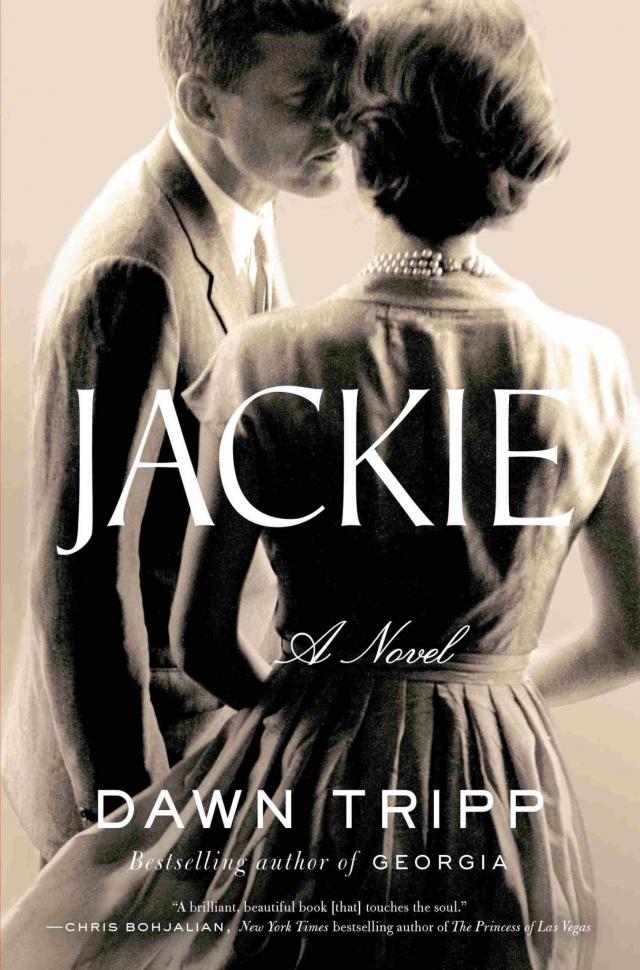
Cover photograph: Douglas Jones for Look Magazine, August 6, 1957 (courtesy of the Library of Congress, Prints & Photographs Division: LC-L9-57-7228-HH)
ep_prh_7.0_147266666_c0_r0
Contents
Dedication
Author’s Note
Epigraph
Chapter 1
Part I
Chapter 2
Chapter 3
Chapter 4
Chapter 5
Chapter 6
Chapter 7
Chapter 8
Chapter 9
Chapter 10
Chapter 11
Chapter 12
Chapter 13
Part II
Chapter 14
Chapter 15
Chapter 16
Chapter 17
Chapter 18
Chapter 19
Chapter 20
Chapter 21
Chapter 22
Chapter 23
Chapter 24
Chapter 25
Chapter 26
Chapter 27
Chapter 28
Part III
Chapter 29
Chapter 30
Chapter 31
Chapter 32
Chapter 33
Chapter 34
Chapter 35
Chapter 36
Chapter 37
Chapter 38
Chapter 39
Chapter 40
Chapter 41
Chapter 42
Chapter 43
Chapter 44
Chapter 45
Chapter 46
Chapter 47
Part IV
Chapter 48
Chapter 49
Chapter 50
Chapter 51
Chapter 52
Chapter 53
Chapter 54
Chapter 55
Chapter 56
Chapter 57
Chapter 58
Chapter 59
Chapter 60
Part V
Chapter 61
Chapter 62
Chapter 63
Part VI
Chapter 64
Chapter 65
Part VII
Chapter 66
Acknowledgments
Sources
About the Author
_147266666_
For my father
Author’s Note
Jackie is a novel, a work of fiction inspired by the life of Jacqueline Kennedy Onassis. It is the story of a woman who projected a myriad of selves and who was, at her core, a deeply private person, with a nuanced and formidable intellect. It is also the story of a love affair, a complicated marriage, and the fracturing of identity that comes in the wake of unthinkable violence. A lover, a mother, a wife, Jackie reckoned with the decades-long challenge of living in the glare of the public eye, learning to harness the power surrounding her, to forge an authentic life and emerge as her true self: a brilliant, fiercely creative woman who grew up to be an artist and whose medium was fame.
E. L. Doctorow once said, “The historian will tell you what happened. The novelist will tell you what it felt like.” In Jackie, that interstice is what I wanted to explore—the space between what took place and what she might have felt; what happened to her and how the world perceived it versus how she might have experienced it.
I came to Jackie’s story through a photograph. It’s not a well-known image, but to me it was striking. A black-and-white photograph of Jackie and Jack, in the summer of 1957, at the airport. Her back is to the camera, her skirt filled with wind, a triple strand of pearls around her neck. She is standing with Jack in a doorway. He leans in toward her, perhaps to say something, perhaps to kiss her goodbye. It fascinated me—that photograph and the intimacy captured between these two young people. It was clear they had little idea they were being photographed. The moment was private, a faint tension between them, a stiltedness or a longing held in check, something said or left unsaid, and, also, a vulnerability, a tenderness. I found it a moment of heartbreaking beauty, a leave-taking. Jack might have been setting off on a campaign trip. Jackie was pregnant by then with Caroline. I studied this photograph, and to me, it was like fire. Over the next few days, I wrote several different passages about it, longhand, from both Jack’s and Jackie’s perspective. In Jackie, they each remember the photograph years after it was taken, and it matters to each of them for different reasons and in different ways.
Who was Jackie? Who were Jack and Jackie together, before they were myth? When they were just two people, not well known—young, newly married, with all the incipient joys and thorns that come with a complex love affair. Who were they? As people? Who was she?
I printed out that image, their bodies in shadow, their faces close, a bright rush of the white sky behind. The vulnerability in that tentative intimacy became the heart of this novel. I researched for years before I felt I could begin to write. The story seemed too immense at first, too public. So much had already been written. But the deeper I moved into the research, the more I began to feel how incomplete our collective understanding of Jackie might be. Doris Kearns Goodwin, who knew Jackie, once said: “Culturally something happened between her and the decade that she lived in….” This statement, for me, was a key. I found it exhilarating—the possibility of creating a novel that could be an extended interrogation of Goodwin’s words.
I read many, many books about Jackie, Jack, Bobby Kennedy, and other historical figures featured in this novel. A list of works I found particularly helpful is in the Sources section at the end of the book. I also read countless articles, magazines, newspapers. I read letters and spent time at the JFK Library. I went to see places where Jackie had traveled. I read poems she loved. I read lines of Caroline’s and John’s about their mother’s passion for books and literature. In the introduction to a collection of poems I read to my sons years ago, Caroline reflected on how she inherited a love of poetry and language from her mother, and how that love gave rise to her desire to instill a similar love in her own children, “not only because of the pleasure it will bring, but because the power of ideas, and the ability to express them, is the greatest power we have.” Those words stayed with me. They said something not just about Jackie but also about a driving belief that she had passed on to her children.
Looking at photographs, even iconic photographs—Jackie and Jack on a sailboat before they were married; Jackie holding Caroline as a baby with her little teeth digging into her mother’s string of pearls; Jackie in a white column dress, whispering with Jack in a White House corridor; Jackie and Bobby in the years after Jack was assassinated; Jackie riding her bike alone in Aquinnah—I began to wonder not about those images per se but what might have happened directly before a photograph was taken, what might have happened directly after. I began to seek out photographs that captured her when she might not have known the camera was on her: a photograph of her swinging Caroline through the surf; another of her kneeling next to John, their backs to the camera as they watch Jack leave in a helicopter from the lawn. There was a moving, free simplicity in those candid images. What might she have been thinking, feeling? There were so many facets of her—those she projected, and those projected onto her. Jackie, Jacks, Jacqueline, Miss Bouvier, Mrs. Kennedy, Mrs. Onassis, Jackie O.
At the same time, I felt that almost everything I read or learned seemed to miss dimensions of what was most human and, in doing so, missed a kind
Early on, it became clear to me that her love for her children and her identity as a mother were fundamental to her character, as was her determination to construct—with measure and intention—a relatively normal life for Caroline and John and to nurture in them a spirit of inquiry and a sense of responsibility to the larger world. I saw this reflected not just in her words about her children but in their words and care for her as she aged. I was fascinated by her desire to explore, observe, learn; by her faith in the power of art and literature as forces of social change. I realized that if I wanted to write about Jackie, I needed to absorb historical sources and nonfiction accounts, and then I needed to leave it—all of it—to enter the story in a new way, to try to capture the spirit of a bold and brilliant young woman who falls in love, builds a family, endures unthinkable violence and shattering loss. A woman who rises out of that broken dark to create a legacy, who seeks to embrace life, love, work, and continues to grow, with purpose and grace—taking risks, making mistakes, often deeply public ones. That was the story I became riveted by, a story told through a human lens, which felt close to emotional and psychological truth.
Jackie’s moments of irreverence were interesting to me, but I expected those, no matter how unexpected the swerves in her humor were. What I found revelatory was her passion, her genuine warmth, and the unique bond between her and Jack. Looking closely at candid photographs of Jack and Jackie—including that 1957 photograph and other moments of intimacy when they might not have known they were being observed—I felt how they were aligned, conspiratorial even. There was something deeply beautiful and real between them, an integrity in how they understood each other—with all their strengths, flaws, willfulness, play. Something resonant and irrevocable in the love that existed between them.
Jackie described herself once as “an outsider.” I love that she bit her nails and read everything. That she loved the books of theologian Reinhold Niebuhr, as well as the novels of Irish writer Edna O’Brien. She memorized whole stanzas of Tennyson’s “Ulysses” and would devour books of poetry to find lines she’d give to Jack to integrate into his speeches. She often explicitly stated she would prefer to erase her own authorship. In her career as a book editor, she didn’t like her name to be in the acknowledgments. That was interesting to me, and given all that’s been written about her, it felt new and integral to a holistic understanding of a woman and her complicated relationship with power—a woman who’d been written into myth and who had, at certain stages of her life, taken a role in forging that myth even as she was living it. I wondered how Jackie’s love of art, literature, and stories might have given rise to an instinct to incarnate art and myth through her own life. Throughout this novel, I wanted her to strike against that boundary between self-as-subject, as a perceiving, sentient being, and self-as-object, constantly being watched, deconstructed. I wanted to render the consequent sense of disconnect that can come with that split and how a woman might have worked to reconcile various dimensions of who she was and what she wanted with how the world saw her. She was clear, in her own intention, that the White House restoration was about restoring an integrity—a beauty and grace—that might express the past and future ideals of a nation, not its exact historical past. That process of the restoration felt aligned with what I sought to do in this exploration of her story.
Throughout this novel, lines or fragments of things Jackie said or wrote that are found in the public record inspired lines of dialogue and interior thought. In Jackie, I’ve attempted to capture her spirit by reimagining her voice, her thoughts, and conversations between her and others in her circle of family, friends, and acquaintances. Since this is a work of historical fiction, I adapted anecdotes and verbal exchanges that have previously appeared in biographies, published interviews, speeches, forums, and other writings. On occasion, some of Jackie’s actual words from these sources are woven into the dialogue and story. Less frequently, short phrases from other sources are in the narrative. Examples of this include, but are not limited to, two lines on this page adapted from Jackie’s entry for Vogue magazine’s Prix de Paris contest; exchanges in Parts II and III drawn from Norman Mailer’s articles about Jack and Jackie; exchanges in Part IV drawn from published interviews conducted by Theodore White, Arthur Schlesinger, William Manchester, and The Warren Commission; lines of dialogue on this page as well as other scenes in Parts III and IV inspired by Clint Hill’s moving memoir Mrs. Kennedy and Me. Memoirs like Mr. Hill’s provide insight into the care and respect consistently integral to Jackie’s close relationships. I wanted to explore scenes and anecdotes chronicled by people who knew Jackie and who experienced firsthand the complex nuances of her heart, wit, vulnerability, and intellect—the intimate realness of her as a human being—and I wanted to reimagine those moments from her point of view as she might have experienced them. These are only a few examples of how published nonfiction sources have been useful in my creative process. Other works are highlighted in the Sources section at the back of this book. My use of statements that the historical record tells me were made and my reference to incidents or events that did happen are not intended to change the entirely fictional nature of this book.
There are many stellar, insightful nonfiction works written about Jackie. I believe that fiction, when it hews to the historical record, can access a different kind of truth, an experiential truth that allows us to enter the emotional heart of a story. Historical accounts are interpretations too, dependent on the selection and elision of facts, how facts are ordered and assembled, what is emphasized, where the gaps or lacunae fall. Scholarship is not static; it is an evolving body, and the historical record may always be incomplete. Truth is kaleidoscopic, continually changing according to our perspective and as new documents and understandings come to light. Women have rarely been at the center of historical narratives. Fiction can be a means of cutting past the surface of what we think we know, to reshape our collective understanding of a person, an era, a life.
To live past the end of your myth is a perilous thing.
—Anne Carson
November 22, 1963
They will tell her they found no heartbeat, no breathing, no pulse.
* * *
—
In the hallway where she sits, a glacial coolness—white tiles along the wall, the black linoleum floor. Clint stands near her, that precise distance an understanding between them. Others cluster in uncertain knots, voices anxious, hushed, bowed heads, someone walks away, someone else comes back. A nurse pushes through.
* * *
—
Three and a half seconds—that’s all it was—a slivered instant between the first shot, which missed the car, and the second, which did not.