

The Power & the Glory, page 1
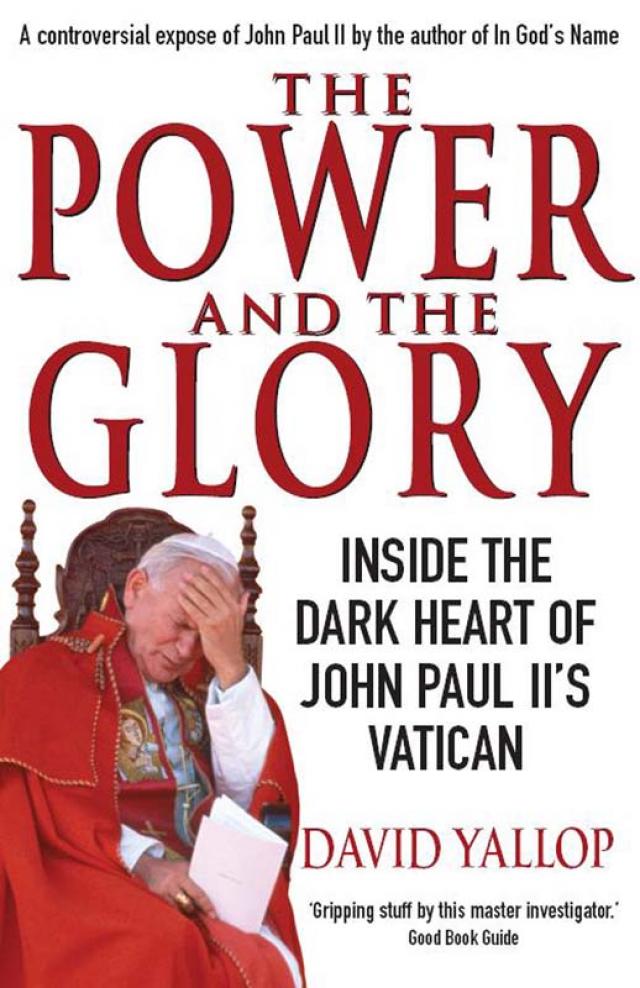


The Power and the Glory
Also by David Yallop
To Encourage the Others
The Day the Laughter Stopped
Beyond Reasonable Doubt
Deliver Us From Evil
In God’s Name
To The Ends Of The Earth
Unholy Alliance
How They Stole The Game
The Power and the Glory
Inside the Dark Heart of
John Paul ll’s Vatican
David Yallop
CONSTABLE • LONDON
To the memory of my mother,
Una Norah Stanton,
And my son, Stuart Adam,
gone too soon, far too soon.
Constable & Robinson Ltd
55–56 Russell Square
London WC1B 4HP
www.constablerobinson.com
First published in the UK by Constable,
an imprint of Constable & Robinson Ltd 2007
Copyright © Poetic Products Ltd. 2007
The right of David Yallop to be identified as the author of this work has been asserted by him in accordance with the Copyright, Designs and Patents Act, 1988
All rights reserved. This book is sold subject to the condition that it shall not, by way of trade or otherwise, be lent, re-sold, hired out or otherwise circulated in any form of binding or cover other than that in which it is published and without a similar condition including this condition being imposed on the subsequent purchaser.
A copy of the British Library Cataloguing in
Publication Data is available from the British Library
ISBN 978-1-84529-673-5
eISBN 978-1-47210-516-5
Printed and bound in the EU
Contents
List of Illustrations
Preface
Part 1
1 God’s Will?
2 ‘It Depends on Whose Liberation Theology . . .’
3 A Very Polish Revolution
4 Appointment in St Peter’s Square
Part 2
5 Vatican Incorporated I
6 Papal Politics I: A Holy Alliance?
7 The Market Place
8 The Jewish Question
9 Beyond Belief
10 Papal Politics II: After the Cold War
11 Thou Shalt Not . . .
12 Vatican Incorporated II
13 The Village
Epilogue
Author’s note
Notes
Bibliography
Index
List of Illustrations
The young Karol Wojtyla with his parents. Copyright © Corbis
The Solvay Quarry. Copyright © Topfoto
Poster of ‘The Cavalier of the Moon’ in which Karol Wojtyla performed two months before the outbreak of the Second World War. Copyright © Topfoto
Karol Wojtyla at the time of his ordination in November 1946. Copyright © Popperfoto
John Paul II on the day of his election. Copyright © Corbis
Lech Walesa and Bishop Henryk Jankowski, the Lenin shipyard, Gdansk, 29 August 1980. Copyright © Getty Images
Riots on the streets, 2 May 1982. Copyright © Corbis
Lech Walesa with Pope John Paul II. Copyright © Getty Images
Wojtyla with Cardinal Stefan Wyszynski. Copyright © Corbis
Pope John Paul II with the Reagans. Copyright © Getty Images
Cardinal Bernardin. Copyright © Corbis
Pope John Paul II with Nicaraguan President Daniel Ortega. Copyright © Corbis
Archbishop Romero. Copyright © Getty Images
Attempted assassination of Pope John Paul II in St Peter’s Square. Image author’s own
Pope John Paul II with Galtieri of Argentina, copyright © Corbis, and Marcos of the Philippines, copyright © Getty Images
A list of allegedly abusive priests in New England dioceses. Copyright © Getty Images
Reverend Tom Doyle. Copyright © Corbis
Father Bob Hoatson leading protestors at the installation of Archbishop Sean Patrick O’Malley. Copyright © Getty Images
Pope John Paul II at Auschwitz. Copyright © Corbis
Pope John Paul II in Ireland. Copyright © Getty Images
Bishop Marcinkus in Nigeria in 1982. Copyright © Corbis
HIV and AIDS in Africa. Copyright © Topfoto
Theologian Hans Küng. Copyright © Topfoto
Vatican spin-doctor Navarro-Valls. Copyright © Corbis
Statues of the Virgin Mary outside a souvenir shop in Medjugorje, Bosnia. Copyright © Getty Images
Papal endorsements by the score. Copyright © Corbis
Pope John Paul II at the Gemelli hospital recovering from throat surgery, 6 March 2005. Copyright © Getty Images
Preface
Within the opening pages of In God’s Name I publicly thanked a great many people who had provided me with assistance in a variety of ways during the research for that book. In doing so I was merely repeating a lifelong habit. After naming these individuals I wrote the following:
‘Among those I cannot thank publicly are the people resident within Vatican City who contacted me and initiated my investigation of the events surrounding the death of Pope John Paul I, Albino Luciani. The fact that men and women living within the heart of the Roman Catholic Church cannot speak openly and be identified is an eloquent comment on the state of affairs within the Vatican.’
The hunt by the Curial hierarchy after the book was published was not confined to anonymous informants. The Vatican also went after some of those I had publicly thanked. Precisely how many suffered I do not know but among their number was Father Bartolomeo Sorge SJ, the editor of Civilta Cattolica, described by Vaticanologist Peter Hebblethwaite as ‘a man of impeccable orthodoxy and at the same time an influential figure on the Christian Democratic scene’. He was dispatched from Rome to Palermo. Father Romeo Panciroli had been the long-serving Vatican Press Officer at the time of my research. Less than six months after the initial publication of In God’s Name he was replaced by Navarro-Valls. Panciroli was sent to Africa. One of Navarro-Valls’ first acts was to remove the vital tessera or press card from Phillip Willan. Phillip, a freelance journalist, had acted as one of my primary researchers and interpreters. A journalist in Rome without Vatican accreditation is in for a very lean time. He had presumably been found to be guilty by association. The fact that I alone was responsible for what was written counted as nothing. He was frozen out for the best part of two decades.
During Spring 1998, a new Vatican manual was published with Papal approval. In it there is a warning to all Vatican staff that ‘disclosing pontifical secrets is punishable by instant dismissal’. In light of the above, I have concluded that the overwhelming number of those who so kindly assisted me must remain unidentified. Within the book a number of non-Vatican sources are identified and a bibliography gives the reader an indication of written sources.
Some time in the near future, Pope John Paul II will be beatified. Soon after that event he will be canonised. In life much was claimed for Karol Wojtyla; in death the acclamation has reached such levels that early sainthood cannot be far away for the Pope from ‘the far country’.
What was once the fifth step towards beatification, the nomination of a promotor fidei – in popular language the ‘devil’s advocate’, an individual whose duty it was ‘to point out any flaw or weak points in the evidence adduced, and raise all kind of objections’ – has been abolished. It was revoked by John Paul II. I have yet to hear a satisfactory explanation that justifies the abolition. Does the biblical injunction ‘And ye shall know the truth, and the truth shall make you free’ no longer have a place within Christianity in the twenty-first century?
When the beatification process involves a figure as controversial as the late Pope, a rigorous investigation which lays open every facet of Karol Wojtyla’s entire life is paramount. Demonstrably the current rush to sainthood does not envisage exhaustive enquiry. Wojtyla’s lectures and writings in the 1950s on Marxism and Communism in which he spoke and wrote very positively on both Marxism and Liberation Theology are not, as of late 2006, going to be considered. How deeply the extravagant claims that have been made for Pope John Paul II – his fight against the Nazis and subsequently against the Communist regime . . . his creation of Solidarity . . . his achievement in overthrowing European Communism – how deeply these and other acclaimed aspects of the Wojtyla Papacy will be investigated has yet to be established. Before the end of January 2006, the Vatican had received over two million letters concerning ‘the life and virtues of Pope John Paul II’.
Speaking to a gathering of Catholic journalists in the Vatican in December 2002 Karol Wojtyla remarked:
‘What does it mean for a Catholic to be a professional journalist? A journalist must have the courage to search for and tell the truth, even when the truth is uncomfortable or not considered politically correct . . .’
PART 1
Chapter 1
God’s Will?
‘WHEN ONE POPE DIES, we make another one.’ So runs a popular saying in Rome. They were particularly busy in 1978. It was the year of three popes. The death of Pope Paul VI on 6 August 1978 surprised very few Vatican observers. Indeed, as his reign entered its sixteenth year, some reporters already began to write in the past tense. The reign of his successor, Albino Luciani, who took the name Pope John Paul I, was different.
One month after his election, Albino Luciani received an extensive and very detailed interim report
* * *
His death stunned the cardinals. As they gathered in Rome in October to elect a new pope, many were clearly frightened. Albino Luciani – Pope John Paul I – had been murdered.1 No Cardinal uttered that conclusion in public, of course; the party line as decreed by Secretary of State Cardinal Jean Villot held more or less steady during the three months period of sede vacante – the empty throne. Nonetheless, questions were raised behind General Congregation doors; the Pope’s death was both sinister and politically momentous: under the Vatican constitution all of Luciani’s reforms would die with him unless his successor chose to implement them. At stake were profound issues such as discipline within the Church, evangelisation, ecumenism, collegiality, world peace and a subject that now pre-occupied most of the Cardinals – Church finances.2 The man they had elected had indeed immediately instigated just such an investigation; now he was dead.
Cardinal Bernardin Gantin voiced the fears and confusions of many when he observed, ‘We are groping in the dark.’ Cardinal Giovanni Benelli, a man who had been particularly close to the ‘Smiling Pope’, made no attempt to hide his thoughts: ‘We are left frightened.’ Many cardinals were shocked not only by the sudden death of a perfectly fit man in his mid-sixties but by the orchestrated lies peddled by Villot and those under him. They knew that a Vatican cover-up was under way.
In Rome, in off-the-record briefings to reporters, the Vatican machine quickly spun three stories about the late Pope. The first – alleging weak health – is fully examined within In God’s Name as is the second exercise which attempted to demolish Luciani’s remarkable talents and reduce him to a grinning simpleton. ‘Really it’s a blessing in disguise that he died so soon; he would have been such an embarrassment to the Church.’ This attack on the late Pope was mounted particularly by members of the Roman Curia. As with lies about his health, many of the media fell for it and stories directly inspired by this disinformation appeared throughout the world’s press.
The third story was a traditional platitude. Luciani’s work was done: the Lord had taken him away. Thus Cardinal Siri:
‘. . . this death is not a complete mystery, nor is the event totally opaque. In thirty-three days this pontiff completed his mission . . . With his style so close to the Gospel, it can be said that Pope John Paul I opened an era. He opened it and then quietly went away.’ He was echoed by Cardinal Timothy Manning, ‘ . . . he made his statement and then dropped off the stage.’
Other princes of the Church took another view:
‘Why the lies about his health? All this nonsense about operations? Why are they lying about who found the Pope’s body? Why the lies about what he was reading? What are the facts about these changes that were to have occurred the following morning? Changes within the Vatican Bank?’
Villot stonewalled on these and a host of other questions. His blanket response, that it ‘was God’s will’, convinced very few. Cardinal Benelli’s icy response was, ‘I thought it was God’s will that Cardinal Luciani was elected. The Lord giveth and the Lord taketh?’
Inside the Vatican village the customary intrigue, vindictiveness, rumour, counter-rumour and character assassination got under way for the election of the new pope. The Curia went ruthlessly about its task of ensuring as far as possible that all rivals to their own man, the reactionary Archbishop of Genoa, Cardinal Siri, were dispatched into oblivion. But as they cut a swathe through the opposition, the Curia was also busy organising defence strategies just in case their man was not elected.
Before departing on the 7.30 a.m. flight to Rome from Warsaw on 3 October Karol Wojtyla, Archbishop of Cracow, Poland, interrupted his schedule to have an ECT examination on his heart and take the print-out with him. It may have seemed extraordinarily prudent for a cardinal who had attracted less than a handful of votes in the August Conclave. But he was aware that the Vatican was peddling lies about the late Pope’s medical history. It would be even easier to pump out rumours about a candidate’s health, especially one such as himself, whose medical history revealed a pattern of illnesses. Certainly, some of Wojtyla’s colleagues viewed his actions as signs that he knew that he would not be returning to Cracow.
During the previous five days, Wojtyla had spent much of his time with his invaluable friend and ally, Bishop Deskur, in Rome. This friendship went back to their years together in the secret wartime seminary in Poland. Since the war, Deskur had guided Wojtyla through the labyrinth of Vatican politics. Never would his help be more needed. Karol Wojtyla listened very carefully as Deskur listed the strengths of this rival candidate, the weaknesses of another. Then he had lunch with other countrymen including Bishop Rubin. These meetings left Karol Wojtyla in no doubt that this time he was a genuine candidate. Those who were pushing his candidacy realised that if the Italians could not unify around one of their own contenders, then the cardinals they had been lobbying would be aware of a stunning alternative. Karol Wojtyla was now obliged to draw on the acting skills he had honed as a young man. Externally a picture of detached calm, the inner self was agog at the prospect that came more clearly focused before him. So much of his early life had been a preamble to this moment. He believed deeply in divine providence and again and again would offer divine intervention as the explanation for his good fortune. Providence, in the shape of a good contact, a patron or a protector, called with remarkable frequency on Wojtyla.
In May 1938 the Archbishop of Cracow, Adam Sapieha, came to Wadowice to give the sacrament of confirmation to those who were about to graduate. The student assigned to the task of welcoming Sapieha in the name of the college was Karol Wojtyla, speaking in Latin. When the young man had finished, there was a thoughtful expression on the face of the Archbishop. ‘Will he enter the seminary?’ he asked religious teacher Father Edward Zacher.
Karol responded for himself. ‘I’m going to study Polish literature and philology (language).’
The Archbishop was disappointed: ‘What a pity.’
Sapieha was destined to become one of Wojtyla’s early protectors. There had been others before, especially his father. By the time that Karol senior died in February 1941, providence had already ensured that while many of the twenty-year-old’s peer group would perish before the end of the Second World War, he would survive; his French tutor, Jadwiga Lewaj, had a quiet word with her good friend Henryk Kulakowski, the president of the Polish section of Solvay, a chemical firm with a large plant in the Cracow suburb of Borek Falecki. At the time all able-bodied Polish males were candidates for forced labour in Germany or working on border fortifications on the Eastern Front. Either route led to a brutal and usually short life. Working at Solvay carried a large range of benefits. It was in some respects a self-contained village with residential homes, containing a surgery with a resident doctor, staff canteen, a shop and a gymnasium. Apart from his wages and the perk of vodka coupons that could be traded on the black market, Karol Wojtyla also carried at all times his guarantee that he would have a good war: an Ausweis, or identity card, that indicated that the bearer was employed in a kriegswichtig industry, work that was essential to the Third Reich’s war effort. The caustic soda the company created had a variety of uses, not least in the production of bombs.
It was during his wartime years at Solvay that a vocation for the priesthood first stirred within Karol Wojtyla. At this time Archbishop Sapieha had created a secret seminary and in August 1944 Karol moved with a number of other young men into the safety of his residence. Wojtyla was ordained as a priest on 1 November 1946. Two weeks later, Sapieha, newly promoted to cardinal, sent Karol Wojtyla to Rome to study for his first doctorate. The archbishop had already marked out Wojtyla for fast-track treatment. The special consideration shown to Wojtyla extended to making funds available so that during the vacations he could tour around Europe along with a fellow priest.


