Deadly Memory (Living Memory Book 2), page 8


Of course, Charlie wasn’t just mimicking the sounds Samira made; he was understanding them. He was parsing the structure of the English language and learning how to put the pieces together to communicate thought. She couldn’t imagine that in his place, surrounded by the squawking language that the males of his species used, she would have come close to such quick comprehension. It made her wonder if maniraptors were humanity’s intellectual superiors.
They’d been practicing for weeks, and every day, he astounded her with his progress. He even learned to pronounce her name properly, though the ‘S’ came out a lot breathier than a human would do it. So far, their conversations had been restricted to practical, concrete things, mostly nouns she could communicate by pointing and verbs she could pantomime.
“Sa-mi-ra...eat...meat,” Prey told her.
“Yes, I eat meat,” she said. “I eat plants, too.”
“Samira...eat...meat...today.”
Samira looked at Paula. “I did eat a chicken sandwich in the cafeteria today. Is he asking me a question, or is he telling me?”
“No question,” Prey said. “Telling.”
Samira raised her eyebrows, once again startled by his quick understanding. “How do you know I ate meat today?”
“Smell meat.”
She pointed to her mask. “No smell,” she said. “Wear suit.”
“Samira touch meat,” he said. “Samira touch suit.”
That couldn’t be right, could it? His sense of smell couldn’t be that good. Samira pointed at Paula. “Paula eat meat?”
“No. Paula eat plant.”
“He’s right,” Paula said. “I had a salad.”
“How is that possible? Do we have some kind of seal breach?” Samira looked back at Charlie. “Did I eat meat yesterday?”
“Not understand.”
“Yesterday. Before sleep. Samira eat meat before sleep?”
“Different meat,” Prey said.
“I had a ham sandwich yesterday,” she said. “I think he really can smell it.”
“What is...sandwich?” he asked.
“Sandwich is food. A kind of food. Food made from plants.”
“Sandwich is plant food.”
“Yes. Well, it’s one kind of plant food, but we usually put some kind of meat inside. It’s...hard to explain. Don’t worry about sandwiches.”
“Not understand.”
“Never mind. Don’t worry about it.”
“Not understand worry.”
“Forget it. It’s not important.”
Prey snarled in frustration. Whenever he didn’t understand something, he expressed his frustration in ways that might have sent her running for cover if there hadn’t been a thick sheet of glass between them.
“Samira smell,” Charlie said.
Now it was her turn not to understand. “Yes, I can smell. Not as well as you.”
“No. Smell no suit.”
She turned the phrase over in her head, trying to understand.
Charlie snarled again. “Samira no suit. Smell. Smell no suit.”
Comprehension hit her. Of course. He was frustrated with struggling through this limited speech when he had a much easier way. “He wants me to smell him,” Samira said. “He wants to communicate through scent, the way he would with his own kind.”
“It’s too dangerous,” Paula said.
“I don’t even have to go in there. I’ll take off my helmet, and if I fall over, you can drag me out of here.”
“He could kill you,” Paula said. “He could dominate you and make you do something against your will.”
“Do what? Open the cage? I don’t even know how. Come on, it’s low risk, and the risk is all to me. He just wants to send me a memory or a thought. He’s made such an effort to learn to speak; the least we can do is let him communicate what he can in his own language.”
Paula was silent for a long time. Finally, she nodded. “Okay. Under one condition. We tie you down.”
“What?”
“I don’t know what he could make you do. Hurt yourself. Kill me. We’re not doing this unless I know we can do it safely.”
Samira shrugged. “Whatever it takes.”
Alex brought in a chair and some adjustable canvas straps used to tie equipment to dollies during transport. He strapped the back and rear legs of the chair to a support beam that held up the ceiling, and then strapped Samira into it at arms, legs, and waist.
“The things we do for science,” she said. No one laughed. If Samira could have just pulled off her helmet immediately, she wouldn’t have been so nervous about it, but all of this set up was increasing the suspense. She knew what it felt like for another person to have complete control over her choices, and it was horrible. Charlie was the source of those chemicals, with a lifetime of experience using them. What might he do to her mind?
“Okay,” Alex said. “Are you ready?”
Samira nodded, not trusting her voice. With a tearing sound, Alex pulled away the Velcro that held her helmet seal in place and lifted the helmet off her head. The cool air struck her damp hair, and she involuntarily took a deep breath of fresh air. Without the suit’s faceplate, the colors around her seemed brighter. She looked at Charlie, whose feathers, jaws, and teeth seemed closer and sharper than before.
He didn’t waste any time. A rich aroma flooded the room. Samira jerked her head back, alarmed, afraid that Paula was right after all, and he was dominating her into submission. Then she saw the tyrannosaur.
It wasn’t that she stopped seeing the room. It was more like her brain stopped paying attention to the input from her eyes, seeing the vision in her mind more brightly and clearly than the real world around her.
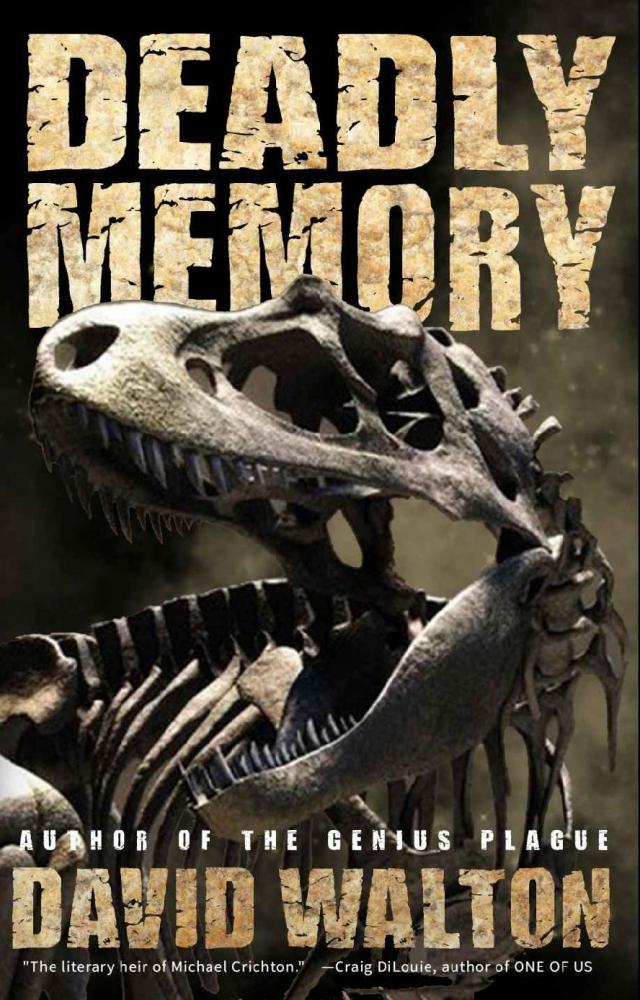
Despite only having seen fossils and artists’ reconstructions, Samira recognized the creature in front of her as an Asian tyrannosaur, a Tarbosaurus, of which dozens of skeletons had been found in the Gobi Desert in Mongolia. This was no desert, though. It was a flooded plain of short vegetation, like a rice paddy, with river channels crossing through it. The tyrannosaur stood on a hill out of the water, perched on a rock like a giant, ungainly parrot.
A closer look told her that it really was a rice paddy, or something equivalent. This was agriculture, plants that had been intentionally cultivated. She quickly saw why—a herd of hadrosaurs, at least a hundred strong, lumbered through the water, chewing placidly on the vegetation. Three male maniraptors, responsible for pasturing the herd, cowered behind the beasts, afraid of the tyrannosaur. A lone female maniraptor—their leader—faced off against the predator, although it towered over her, outweighing her by tons.
As soon as Samira had processed the scene visually, the emotion of it washed over her, one of overwhelming terror. Not just the fear of bodily harm, but the fear of loss. Samira became Prey, the youngest and smallest of the males, and the female was his mother. He was only a child, learning the work under her dominance and guidance.
He squealed as his mother spread her feathers wide, trying to make herself appear larger to the giant predator. She flooded the air with scents to dominate the beast and send it away. It was rare that tyrannosaurs entered maniraptor territory at all. The borders were patrolled and regularly renewed with strong scents that warned predators away. Prey had never seen one before, nor heard of one coming near where maniraptors lived.
This one was huge, though, five tons at the least, and seemed unperturbed by the smells Prey’s mother was creating. It opened massive jaws crammed with needle-sharp teeth, and the small part of her that still knew she was Samira was surprised when instead of a roar, it made a sharp screech. To Prey, however, the noise was terrifying, and even his mother took a hop backwards before stopping again to hold her ground.
The tyrannosaur dipped its jaws toward her, but as it did, it caught a stronger dose of her scent. It paused and snorted, then scratched at its face, confused. Prey’s view was partially blocked by the herd of hadrosaurs, but he saw her step forward, renewing her scent and trying to drive the tyrannosaur back.
It did retreat at first, whipping its giant head back and forth in confusion. Then its eyes focused on her, and without warning, it attacked, astonishingly agile for its bulk and—like a bird, Samira thought—landed claws-first on Prey’s mother, pinioning her small body and driving its open mouth like a battering ram down on top of her. She died in an instant, crushed, and when the beast’s head came up again, it tore half of her lifeless body away in its jaws.
Prey screamed. Samira felt the anguish of his loss tear through her, reliving his emotion as if it were her own. The other males scattered, but he stayed, unable to tear his eyes away. The hadrosaurs stayed as well, too stupid to run, or else intelligent enough to know that once the tyrannosaur had made a kill, it was no longer a threat. Prey watched in horror as the beast lowered its head for another grisly bite.
The memory cleared, and Samira found herself shaking in her chair, wracked with sobbing, her face running with tears. Alex and Paula crouched on either side of her, shaking her and calling her name. “I’m all right,” she managed to say. She tried to lift her hands to her face, but they were still strapped down.
My name is Samira, she thought. I’m a paleontologist. I’m human. That creature wasn’t my mother, and she died sixty-six million years ago. She meant nothing to me.
She still felt raw with grief. When she could catch her breath, she said in as calm a voice as she could manage, “I’m okay. It’s done. Can you release me now?”
“Give it a moment,” Paula said.
Samira lifted her head and looked at Prey—at Charlie. He looked back, his alien face unreadable. Why had he chosen that memory to show her? Was he trying to evoke her sympathy? She might have been angry at him for manipulating her emotions, but he had just communicated with her more fully and profoundly than with any of the English words he had learned. And whatever his intentions, she did sympathize with him.
More than his intelligence or the speed at which he had learned to speak, it was this direct experience of his consciousness that convinced her. This animal in the cage in front of her was a person. She’d known it intellectually before, but now it felt as real to her as it did when she thought of Paula or Alex or Beth. This sharing of memories was a closeness beyond anything she had experienced with any human, even her sister. A glimpse into the soul of another like what novels tried to do, but even the best of them gave only a poor reflection of reality. No human could touch another human mind like this.
She wondered if the experience had to be rendered truthfully, or if Charlie could embellish the memory, or even invent it from whole cloth. She believed it was a true story, but really, she didn’t know. Its immersive detail seemed hard to fake, but she didn’t know what he was capable of. Perhaps they told fiction as well, only crafted from scent and emotion. He was a person; she was certain of that. But how much could she trust him?
Back in Paula’s office over a welcome cup of tea, Samira insisted that Beth be brought from her anatomy lab before she would tell them what she’d experienced. She’d been through an emotional ordeal, even if it wasn’t hers, and felt a strong need to have her sister close by. When Beth arrived and sat next to her, Samira entwined a hand with hers and described what she had seen as thoroughly as she could, her voice hitching a few times with emotion at the memory. Shortly after she finished, Dan Everson joined them, and she explained it all over again.
“I think Charlie chose to share that because it was an emotional memory,” Samira said. “He wasn’t just passing information. He wants me to know him. To empathize with him about the death of his mother, which must have been a very significant moment in his life.”
“And it worked,” Paula said.
“Well, yeah. It was wonderful. I mean, it was awful, but the ability to directly experience what someone else is feeling? To actually become them for a time? We can never do that. Even close family members you’ve lived with for decades can only guess from outside cues. We can never know another human being, not the way Charlie’s people know each other.
“We can speculate all we want about consciousness and self-awareness, but the only person I can really know about for sure is me. I assume you’re self-aware because you act like me and talk like me. But Charlie wasn’t just talking to me. He wasn’t telling me a story; I was actually experiencing the event as he did. Or at least as he remembered it. I felt what he felt. There’s no doubt that I was in a conscious and self-aware mind.”
Beth asked some questions about anatomy, and Samira described the tyrannosaur and the hadrosaurs in as great a detail as possible. They agreed with her assessment that the tyrannosaur was a Tarbosaurus, consistent with recovered skeletons. Of particular interest was its skin, which had been a mottled gray, with a ragged plumage of thin, feathery strands at its throat. It was very rare to recover skin, hair, or feathers from any fossil, so what dinosaurs looked like on the outside was mostly a matter of guesswork.
The hadrosaurs, although similar in many ways to the known species Saurolophus, had a smaller and differently shaped crest, and they concluded it was probably a new species for which fossils had not yet been uncovered. This didn’t surprise anyone, since of the estimated four thousand different dinosaur species that lived during the Mesozoic period, fewer than eight hundred had been found and named.
Samira, however, kept coming back to the experience itself. “I know there are people here working on the chemical Charlie uses to dominate his prey,” she said. “But shouldn’t we be trying to synthesize this, too? The ability to have other people experience our memories?”
Everson looked at her curiously. “Why? I mean sure, from a scientific perspective, you’d like to understand how it works. But you seem to mean more than that.”
She looked at the others, astonished that they didn’t understand. “This is what the world needs,” she said. “Humans hate and fight one another because they stop believing those in another group are really people. If they could experience life as someone else, really experience it, then how could they hate? They would understand.”
Everson frowned. “Seems a bit simplistic. People fight other people because they have something they want, or because they took something that used to be theirs. People want to gain power and keep power. That doesn’t all disappear because I can experience someone else’s memory.”
“Sure, you’re right,” Samira said. “But it would go a long way, wouldn’t it? Undermining prejudice, breaking down walls? Even in our own country: Imagine if white people could experience what it’s like to live as an African-American? Not just be told about it, but remember facing prejudice, and actually feel it emotionally? What if a city Democrat could experience life as a rural Republican, or vice-versa? Wouldn’t that make a lot of difference?”
“It might,” Everson said, scratching at his short growth of beard. “And if we did go to war, something like that could go a long way towards undermining the enemy’s will to fight. We could do a lot with that. Imagine propaganda that didn’t just show pictures of civilian casualties, but made you actually feel it as if you were right there…”
“No,” Samira said, appalled. “That’s not what I’m saying at all. I’m saying we use it to avoid war.”
“That’s what I’m saying, too,” Everson said.
“No, you’re taking a tool for peace and plotting how to use it to make the other side lose!”
Paula reached toward the teapot that was nestled in a tea cozy on a side table. “Would anyone like another cup?”
Everson stood. “No, I think I’ve had enough.”
“I haven’t,” Samira said. “Do you always run away from conversations when they get uncomfortable?”
Everson met her gaze, but took his time before responding. Samira held the look, not backing down.
“You worry me, doctor,” he said. “You have a remarkably naive outlook on international politics, but you have academic connections in the Far East and a tendency to impulsive action. Not exactly a combination I value in a person read in to one the closest-held secrets of the United States government.”
A chill ran through Samira. She knew Everson had the power to yank her security clearances and deny her access to Charlie, no matter how much Paula valued her contributions. She’d never been one to kiss up to authority, but she felt Beth’s hand in hers, urging restraint, the same as she had in Thailand.
“You talk as if increasing our ability to win a war and trying to avoid one are different,” Everson said. “But they’re the same thing. It’s called deterrence, and it’s been at the center of U.S. military doctrine for over a century. China has three times our population; if we fought them on an even playing field, we’d lose. The only way we prevent conflict is by maintaining such technological superiority that no one dares to fight us. It might seem counterintuitive to you, but strengthening our military capability is how we keep the peace.”
“And how we keep our power,” she said.
Everson’s fists clenched. “Yes,” he said. “Of course, it’s how we keep power. It’s how we keep our wealth as a nation and maintain the systems around the world that provide us with the goods we value. And that wealth and freedom is what makes it possible, among other things, for us to invest in scientific exploration and fossil labs and send paleontologists around the world. I don’t understand why you think I’m your enemy.”
Samira stood, letting go of Beth’s hand. She took a breath before opening her mouth. Controlling her voice felt like backing down to her, and she hated that. White men always thought they should get the last word, and it galled her to let him have it. Maybe the experience with Charlie was affecting her, though, because she could also see where he was coming from and recognize a thread of truth in it.