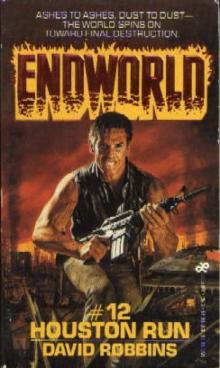
Endworld 29 - The Lords of Kismet, page 3


“That even if things go well, all of you could still die?” Tesla grimly nodded. “I’m afraid so.”
CHAPTER 8
Three Months Later
Like a swarm of bees bustling about their hive, the Family was abuzz with activity. A momentous event would soon take place. An event that might decide whether they became yet another vestige of humanity wiped out in the aftermath of the Big Bang.
The Home, as their Founder dubbed their compound, consisted of thirty acres in northern Minnesota. Kurt Carpenter—filmmaker, survivalist, idealist, albeit with a strong pragmatic streak—had built well. High walls kept their enemies at bay. An inner moat served as an added defense. Six huge concrete bunkers, used for various purposes, occupied the western quadrant. Between the bunkers and tilled fields to the east were cabins for those with families.
That the Family still existed over a hundred years after the latest World War was proof of Carpenter’s foresight. Certain supplies and ammunition had run low, but by then the Family had joined other outposts of civilization in a mutual trade and defense pact. Called the Freedom Federation, it had been a beacon of hope in a world gone mad. Then along came Thanatos with his advanced science and hunger for power, and the Federation was severely weakened. So much so, that even though they defeated Thanatos and the Warriors slew him, when a new threat arose, an adversary unlike any other, the beacon of hope was extinguished.
Blade found it hard to accept. As a member of the paramilitary unit the Federation had created to deal with menaces to its members, he’d traveled extensively. He’d been to the Free State of California and the Civilized Zone—the central Rockies—many times. Both had standing militias and competent leaders. Yet now he couldn’t raise either, by shortwave or any other means. The waveband silence was unsettling. It was as if the Federation had been wiped off the face of the earth.
Blade couldn’t reach anyone else, either. Not the Flatheads in what was formerly Montana, or the frontiersmen who had dubbed themselves the Cavalry and claimed the territory once known as the Dakotas. Nor could he raise the Moles in their underground city.
The Family was on their own.
And never, in their century-plus existence, had they faced a threat as ominous as the Lords of Kismet.
All this went through Blade’s head as he watched Tesla and two other Family scientists perform last-minutes checks on MABEL. A.l.v.i.s literally hovered close at hand, ready with advice and anything else that might be needed.
Blade was so enrapt in the preparations he didn’t notice someone come to his side until he felt a poke in his ribs.
“A carrot for your thoughts,” Hickok said.
“Isn’t it supposed to be a penny?”
“Who carries coins around anymore?” Hickok replied. “Carrots, we’ve got plenty of.”
“I was thinking,” Blade said, “that this had better work or we’ll wind up like the rest of the Federation.”
“You’re bein’ a mite hasty,” Hickok said. “For all we know, some of the others are still kickin’.”
“It’s been too long since we heard from them,” Blade said skeptically. “If they were infiltrated like we were….” He didn’t go into detail. There was no need. Hickok had lived through it, the same as him. The Lords of Kismet had sent a shapeshifter to wipe out the Warriors and bring the Family to its knees. The plan might have worked, too, except that, unknown to the Lords, the shapeshifter had an agenda of its own. The Gualaon, as their kind was known, had let its thirst for revenge interfere with its mission.
“That critter wanted you dead in the worst way,” Hickok said, and chuckled.
Blade didn’t see the humor. “We lost Plato and too many of our fellow Warriors.”
“To a talkin’ iguana who was mad you killed her mate.”
“It made her careless, thank God,” Blade said. “Otherwise she would have destroyed the Home.”
“All the Lords sent was that one. Probably because, compared to the Civilized Zone and the Free State of California, we’re small potatoes,” Hickok said. “A single lizard couldn’t have done that to them.”
“We don’t know what tactic the Lords of Kismet used against them,” Blade said, frowning in exasperation. “The plain truth is, we have no idea what they’re capable of.”
Hickok nodded at the time machine. “I reckon we’ll find out soon enough if that gizmo does what Tesla claims it will.”
“Did I hear my name?” the scientist said, joining them.
“Tell us true, Einstein,” Hickok said. “Now that you’ve had a few months to palaver with that artificial egghead, what are chances of makin’ it back alive?”
“First off, my childhood hero was Nikola Tesla, not Albert Einstein. It’s why I chose his name at my Naming.” Tesla paused and thoughtfully regarded the cage. “And secondly, you’re asking me to compute the odds of using a time-warping device invented by one of our enemies to transport you halfway around the world so you can confront beings who allegedly possess god-like powers and command the loyalty of what might be a legion of reptilian assassins able to change their appearance at will.”
“When you put it that way,” Hickok said.
CHAPTER 9
The sky was overcast, and not just from clouds. Countless tons of dust and ash had been hurled into the atmosphere by the many global-wide nuclear explosions during the Big Blast. Missiles had flown fast and furious, triggering seismic disturbances that resulted in a proliferation of volcanoes in the years after the war. For the longest time, according to the Family’s chronicles, they hardly ever got to see the sun.
Heat lightning crackled in the distance as Blade emerged from D Block for a breath of air. He tried not to dwell on Tesla’s remark. He was well aware of the risks. But they were worth taking. First and foremost, above all else, he was devoted to the safety and welfare of his loved ones and friends, and the Home as a whole. That was part of the reason he became a Warrior. To serve and protect, was how the law officers of old put it, and they were exactly right.
Blade strolled about, smiling at children, nodding at Family members. He couldn’t help but notice the looks some of them gave him. They were well aware of the stakes, too. The Family’s very survival depended on the outcome.
Blade closed his eyes and rubbed them. Some days, it seemed as if he had spent his whole life fighting to safeguard the Family from one threat or another. He would give anything to put an end to the ceaseless strife, to have the world be a place of peace and harmony. But that was a pipe dream, as they used to say. The real world wasn’t like that. The real world was a festering pit of hates and prejudices enflamed by power mongers out to control everyone and everything.
The Lords of Kismet were a case in point. All he knew about them was that they were an ancient race that once mingled with humankind but for some reason, ages ago, they had retreated underground and bided their time for millennia, waiting for humanity to weaken enough that they could rise up and take over.
Many of their Machiavellian machinations were carried out by shapeshifters known as Gualaons. If the one that infiltrated the Home was to be believed, they had been around since the days of the dinosaurs. Where their shapeshifting ability came from, he couldn’t begin to guess. They were formidable creatures. That they served in thrall to the Lords of Kismet must mean the Lords were even more formidable. That in itself was deeply troubling.
Blade tossed his head to dispel his gloomy thoughts, and walked on. For a short while, at least, he would try to forget his troubles. Maybe go to his cabin and spend time with Jenny and Gabe. He hadn’t seen much of his wife and son these days.
About to turn, Blade heard his name called. A boy of twelve or so was running toward him. Lean and gangly, the boy sported a crew cut and upper front teeth a beaver would envy. “Howard, isn’t it?” he said when the boy came to a stop.
“Yes, sir,” Howard answered, puffing slightly. “My father sent me to find you. He’d like to speak to you, sir, if you have a minute.”
Blade’s brow puckered. The boy’s father was the Family Chronicler, whose job it was to record the Family’s ongoing history for posterity, just as the Chroniclers before him had done. To be chosen for the post was quite an honor.
Everyone at the Home had a title, thanks to their founder, Kurt Carpenter. In order to avoid the social inequality that resulted when one group of people set themselves above others, as had happened in the old days when those who called themselves ‘politicians’ lorded it over everyone else.
Carpenter sought to make everyone socially equal. Accordingly, everyone was given a title tied to their line of work; as Warriors, as Tillers, as Blacksmiths, as Librarians…..the list went on. And no one group was to exalt itself over the others.
“Do you know I’ll be sixteen in four years?” Howard unexpectedly asked.
“I do, in fact,” Blade said.
“I want to change my name to Conan and be a Warrior like you and Hickok and the others.”
“Oh?” Blade considered the boy a little young to have made up his mind already. “Why Conan?”
“I’ve read some great books,” Howard said. “About this guy, a barbarian as big as you, who goes around battling monsters and saving pretty ladies.”
Blade smothered a chuckle. “Is that what you think Warriors do?”
“You fight a lot,” Howard said. “That would be fun.”
“Ah,” Blade said. “And your father is okay with this?”
“Well,” Howard said, and sheepishly bowed his head and poked at the grass with his shoe. “Not exactly. He’s sort of hoping I’ll follow in his footsteps. But scribbling in journals is so dull.”
“Someone has to record events so those who come after us can learn from them,” Blade said.
“My father talks like that all the time,” Howard said, and grinned. “But I don’t have to do it if I don’t want to, right? I’d rather be a Warrior more than anything.”
“A lot of boys do at your age.”
“What does my age have to do with it?”
“We’ll talk about this again in a few years,” Blade said. “See if you still feel the same.” He placed his hand on the boy’s shoulder. “Right now why don’t you take me to your father so I can find out what he wants.”
“He says he’s puzzled by something,” Howard revealed, “and he‘s hoping you can solve the mystery.”
“Lead the way,” Blade said.
CHAPTER 10
The Chronicler had an office in E Block, adjacent to the Family’s extensive library. Lovecraft was his name, which he’d taken at his own Naming, decades ago.
The ceremony itself was another legacy of their Founder’s. Kurt Carpenter had worried that future generations would forget all that had gone before. Those who forget history, as he so often quoted, are doomed to repeat it. In an effort to prevent that, and to instill a sense of learning from the past, Carpenter initiated a special practice. At the age of sixteen, every Family member was given a choice. They could keep the name they were given at birth—or they could choose another, preferably from the historical archives. Most opted for the latter.
Over the years it had become traditional to pick a name that reflected the profession they aspired to. Thus, most of the Warriors bore names of warriors and fighters from the past, like Hickok, Geronimo, Spartacus and Ares. Their last Leader had chosen Plato in honor of the wise Greek of yesteryear. Their new Leader had been a student of Plato’s in the Family school, and idolized him. In homage to his mentor, he’d chosen the name Socrates. Their chief Scientist adopted the name of a genius called Tesla.
Blade had chosen his own only after a lot of thought. He almost went with Bowie, out of his high regard for the legendary knife-fighter who died at the Alamo. For a short while as a boy he’d toyed with Tarzan, and then d’Artagnan. But he’d outgrown thumping his chest, and swords never appealed to him as much as knives. Really big knives, like those strapped to his waist. Patting them now, he grinned.
Entering E Block behind Howard, Blade followed the boy across the library to the Chronicler’s office. The door was closed. Howard knocked, a voice called out for them to enter, and Howard opened it and stepped aside so Blade could precede him.
“After you, sir.”
Lovecraft was at his desk, a mahogany affair that had been around since before the Big Blast. At the moment, the Chronicler—a spindly man with a crew cut—was bent over a journal, writing. He looked up and showed his buckteeth in a smile. “Blade. Thank you for coming.”
“Howard said you have a mystery for me to solve.”
“That I do,” Lovecraft said. He motioned at the boy. “Run along and play, son. I’ll be tied up a while.”
With a nod, Howard scampered away.
Blade settled into a chair barely big enough for someone his size. “How goes the chronicling business?”
Lovecraft leaned back, laced his long fingers, and cracked his knuckles. “I do the best I can given my limited resources. Take this Lords of Kismet business. I wish we knew more about them so I could enter it into the Chronicles.”
“Makes two of us,” Blade said.
“In fact,” Lovecraft said, “they are partly the reason I asked to see you. What with your impending departure, as it were, I wanted to brush up on your previous experience with the time machine.”
“MABEL,” Blade said.
“Excuse me?”
“We call it MABEL.”
“You’ve given it a name?”
“Thanatos did,” Blade explained. “According to A.l.v.i.s, he gave everything names. It was a fetish with him.”
“Interesting. I’ll have to enter that tidbit in the Chronicles, too.” Lovecraft took another journal from a corner of his desk and opened it.
Every page was filled. He flipped them until he came to the one he wanted, and tapped it. “This is the narrative of your previous—and I can’t believe I’m saying this—travel back in time.”
“I couldn’t hardly believe it myself,” Blade admitted, “and I was there.”
Lovecraft smiled. “Yes, well. I can see how disorienting the experience would be.”
“You have no idea.”
“Based on the accounts that the three of you provided, it’s a miracle any of you survived.”
“Don’t remind me.”
“I’m sorry to stir bad memories,” Lovecraft said. “But there’s a particular aspect that puzzles me. Specifically, the Mountain Man, as they were called, that you encountered.”
“What about him?”
Instead of answering, Lovecraft rose and went to a metal file cabinet. Opening the bottom drawer, he carefully removed an ancient leather-bound book, a thick file in a manila folder, and several paperbacks that showed their age. He brought everything over, cleared a space, and gingerly set it all down. “Do you know what these are?”
“Sure don’t.”
“Really? I would have thought your father….” Lovecraft stopped and pursed his lips. “But then, maybe he didn’t know. Maybe he never delved into it as deeply as I have.”
“Into what?”
“Into your past, and who you truly are,” Lovecraft said. “And for that matter, who Hickok and Geronimo really are, as well.” He placed his hands flat on the desk, leaned toward Blade, and grinned like the proverbial cat that had just eaten a canary. “Would you like to hear more?”
CHAPTER 11
Like many in the Family, Blade was never very curious about his surname. Why would he be, when surnames were so rarely used? Most were called by their first name until their Naming. After the ceremony, the one they had picked was how they were known.
From what Blade gathered, though, surnames were quite common before the Big Blast. People were called Mr.-or-Ms-whoever. Or they were bestowed titles, such as Senator or President or CEO.
Kurt Carpenter wanted none of that in the Family. No titles. No false trappings of power. No aggrandizement of any kind. Family members must be treated as equals.
Blade couldn’t remember when he was first told his surname. He imagined it had been imparted to him when he was a small boy, but since they never used it, he’d hardly given it any mind.
“Do you realize,” Lovecraft now remarked, “that I am undoubtedly the only person in the Family who knows the given names of everyone in the Home?”
Blade shrugged. “It’s good that someone does, I suppose.”
“My interest in your given name perked considerably when I learned the identity of the Mountain Man you spent time with when Thanatos sent you and your friends back in time.”
“Nate King,” Blade said.
“Nathaniel King, to be precise.” Lovecraft said. Sitting back, he made a teepee of his fingers and placed them under his chin. “Surely you wondered about that?”
“A lot was happening. I had more important things to worry about. Like staying alive.”
Lovecraft nodded. “Understandable. But it must have seemed…..odd. What did you do? Chalk it up to coincidence?”
Blade straightened in his chair. “You’re saying it wasn’t?”
“You were born Michael King, were you not?”
“So? Thanatos sent us back centures. Back then there must have been a lot of people with the name King. Hundreds, probably.”
“More likely thousands.”
“There you go. A lot of us never use our given names. I haven’t used mine in decades. To be honest, I chalked it up to a fluke.”
“In this particular instance, it wasn’t.”
Blade was dumfounded.
“I’ve checked and double-checked the genealogy files, looking for mistakes I might have made. But it’s there, as plain as can be.” Lovecraft tapped the antique leather-bound book. “Like a number of Mountain Men, Nate King kept a journal. Here it is. How your father acquired it, I will never know. But in conjunction with other documents and records, I feel confident in saying that Nathaniel King was, in fact, an ancestor of yours.”
CHAPTER 8
Three Months Later
Like a swarm of bees bustling about their hive, the Family was abuzz with activity. A momentous event would soon take place. An event that might decide whether they became yet another vestige of humanity wiped out in the aftermath of the Big Bang.
The Home, as their Founder dubbed their compound, consisted of thirty acres in northern Minnesota. Kurt Carpenter—filmmaker, survivalist, idealist, albeit with a strong pragmatic streak—had built well. High walls kept their enemies at bay. An inner moat served as an added defense. Six huge concrete bunkers, used for various purposes, occupied the western quadrant. Between the bunkers and tilled fields to the east were cabins for those with families.
That the Family still existed over a hundred years after the latest World War was proof of Carpenter’s foresight. Certain supplies and ammunition had run low, but by then the Family had joined other outposts of civilization in a mutual trade and defense pact. Called the Freedom Federation, it had been a beacon of hope in a world gone mad. Then along came Thanatos with his advanced science and hunger for power, and the Federation was severely weakened. So much so, that even though they defeated Thanatos and the Warriors slew him, when a new threat arose, an adversary unlike any other, the beacon of hope was extinguished.
Blade found it hard to accept. As a member of the paramilitary unit the Federation had created to deal with menaces to its members, he’d traveled extensively. He’d been to the Free State of California and the Civilized Zone—the central Rockies—many times. Both had standing militias and competent leaders. Yet now he couldn’t raise either, by shortwave or any other means. The waveband silence was unsettling. It was as if the Federation had been wiped off the face of the earth.
Blade couldn’t reach anyone else, either. Not the Flatheads in what was formerly Montana, or the frontiersmen who had dubbed themselves the Cavalry and claimed the territory once known as the Dakotas. Nor could he raise the Moles in their underground city.
The Family was on their own.
And never, in their century-plus existence, had they faced a threat as ominous as the Lords of Kismet.
All this went through Blade’s head as he watched Tesla and two other Family scientists perform last-minutes checks on MABEL. A.l.v.i.s literally hovered close at hand, ready with advice and anything else that might be needed.
Blade was so enrapt in the preparations he didn’t notice someone come to his side until he felt a poke in his ribs.
“A carrot for your thoughts,” Hickok said.
“Isn’t it supposed to be a penny?”
“Who carries coins around anymore?” Hickok replied. “Carrots, we’ve got plenty of.”
“I was thinking,” Blade said, “that this had better work or we’ll wind up like the rest of the Federation.”
“You’re bein’ a mite hasty,” Hickok said. “For all we know, some of the others are still kickin’.”
“It’s been too long since we heard from them,” Blade said skeptically. “If they were infiltrated like we were….” He didn’t go into detail. There was no need. Hickok had lived through it, the same as him. The Lords of Kismet had sent a shapeshifter to wipe out the Warriors and bring the Family to its knees. The plan might have worked, too, except that, unknown to the Lords, the shapeshifter had an agenda of its own. The Gualaon, as their kind was known, had let its thirst for revenge interfere with its mission.
“That critter wanted you dead in the worst way,” Hickok said, and chuckled.
Blade didn’t see the humor. “We lost Plato and too many of our fellow Warriors.”
“To a talkin’ iguana who was mad you killed her mate.”
“It made her careless, thank God,” Blade said. “Otherwise she would have destroyed the Home.”
“All the Lords sent was that one. Probably because, compared to the Civilized Zone and the Free State of California, we’re small potatoes,” Hickok said. “A single lizard couldn’t have done that to them.”
“We don’t know what tactic the Lords of Kismet used against them,” Blade said, frowning in exasperation. “The plain truth is, we have no idea what they’re capable of.”
Hickok nodded at the time machine. “I reckon we’ll find out soon enough if that gizmo does what Tesla claims it will.”
“Did I hear my name?” the scientist said, joining them.
“Tell us true, Einstein,” Hickok said. “Now that you’ve had a few months to palaver with that artificial egghead, what are chances of makin’ it back alive?”
“First off, my childhood hero was Nikola Tesla, not Albert Einstein. It’s why I chose his name at my Naming.” Tesla paused and thoughtfully regarded the cage. “And secondly, you’re asking me to compute the odds of using a time-warping device invented by one of our enemies to transport you halfway around the world so you can confront beings who allegedly possess god-like powers and command the loyalty of what might be a legion of reptilian assassins able to change their appearance at will.”
“When you put it that way,” Hickok said.
CHAPTER 9
The sky was overcast, and not just from clouds. Countless tons of dust and ash had been hurled into the atmosphere by the many global-wide nuclear explosions during the Big Blast. Missiles had flown fast and furious, triggering seismic disturbances that resulted in a proliferation of volcanoes in the years after the war. For the longest time, according to the Family’s chronicles, they hardly ever got to see the sun.
Heat lightning crackled in the distance as Blade emerged from D Block for a breath of air. He tried not to dwell on Tesla’s remark. He was well aware of the risks. But they were worth taking. First and foremost, above all else, he was devoted to the safety and welfare of his loved ones and friends, and the Home as a whole. That was part of the reason he became a Warrior. To serve and protect, was how the law officers of old put it, and they were exactly right.
Blade strolled about, smiling at children, nodding at Family members. He couldn’t help but notice the looks some of them gave him. They were well aware of the stakes, too. The Family’s very survival depended on the outcome.
Blade closed his eyes and rubbed them. Some days, it seemed as if he had spent his whole life fighting to safeguard the Family from one threat or another. He would give anything to put an end to the ceaseless strife, to have the world be a place of peace and harmony. But that was a pipe dream, as they used to say. The real world wasn’t like that. The real world was a festering pit of hates and prejudices enflamed by power mongers out to control everyone and everything.
The Lords of Kismet were a case in point. All he knew about them was that they were an ancient race that once mingled with humankind but for some reason, ages ago, they had retreated underground and bided their time for millennia, waiting for humanity to weaken enough that they could rise up and take over.
Many of their Machiavellian machinations were carried out by shapeshifters known as Gualaons. If the one that infiltrated the Home was to be believed, they had been around since the days of the dinosaurs. Where their shapeshifting ability came from, he couldn’t begin to guess. They were formidable creatures. That they served in thrall to the Lords of Kismet must mean the Lords were even more formidable. That in itself was deeply troubling.
Blade tossed his head to dispel his gloomy thoughts, and walked on. For a short while, at least, he would try to forget his troubles. Maybe go to his cabin and spend time with Jenny and Gabe. He hadn’t seen much of his wife and son these days.
About to turn, Blade heard his name called. A boy of twelve or so was running toward him. Lean and gangly, the boy sported a crew cut and upper front teeth a beaver would envy. “Howard, isn’t it?” he said when the boy came to a stop.
“Yes, sir,” Howard answered, puffing slightly. “My father sent me to find you. He’d like to speak to you, sir, if you have a minute.”
Blade’s brow puckered. The boy’s father was the Family Chronicler, whose job it was to record the Family’s ongoing history for posterity, just as the Chroniclers before him had done. To be chosen for the post was quite an honor.
Everyone at the Home had a title, thanks to their founder, Kurt Carpenter. In order to avoid the social inequality that resulted when one group of people set themselves above others, as had happened in the old days when those who called themselves ‘politicians’ lorded it over everyone else.
Carpenter sought to make everyone socially equal. Accordingly, everyone was given a title tied to their line of work; as Warriors, as Tillers, as Blacksmiths, as Librarians…..the list went on. And no one group was to exalt itself over the others.
“Do you know I’ll be sixteen in four years?” Howard unexpectedly asked.
“I do, in fact,” Blade said.
“I want to change my name to Conan and be a Warrior like you and Hickok and the others.”
“Oh?” Blade considered the boy a little young to have made up his mind already. “Why Conan?”
“I’ve read some great books,” Howard said. “About this guy, a barbarian as big as you, who goes around battling monsters and saving pretty ladies.”
Blade smothered a chuckle. “Is that what you think Warriors do?”
“You fight a lot,” Howard said. “That would be fun.”
“Ah,” Blade said. “And your father is okay with this?”
“Well,” Howard said, and sheepishly bowed his head and poked at the grass with his shoe. “Not exactly. He’s sort of hoping I’ll follow in his footsteps. But scribbling in journals is so dull.”
“Someone has to record events so those who come after us can learn from them,” Blade said.
“My father talks like that all the time,” Howard said, and grinned. “But I don’t have to do it if I don’t want to, right? I’d rather be a Warrior more than anything.”
“A lot of boys do at your age.”
“What does my age have to do with it?”
“We’ll talk about this again in a few years,” Blade said. “See if you still feel the same.” He placed his hand on the boy’s shoulder. “Right now why don’t you take me to your father so I can find out what he wants.”
“He says he’s puzzled by something,” Howard revealed, “and he‘s hoping you can solve the mystery.”
“Lead the way,” Blade said.
CHAPTER 10
The Chronicler had an office in E Block, adjacent to the Family’s extensive library. Lovecraft was his name, which he’d taken at his own Naming, decades ago.
The ceremony itself was another legacy of their Founder’s. Kurt Carpenter had worried that future generations would forget all that had gone before. Those who forget history, as he so often quoted, are doomed to repeat it. In an effort to prevent that, and to instill a sense of learning from the past, Carpenter initiated a special practice. At the age of sixteen, every Family member was given a choice. They could keep the name they were given at birth—or they could choose another, preferably from the historical archives. Most opted for the latter.
Over the years it had become traditional to pick a name that reflected the profession they aspired to. Thus, most of the Warriors bore names of warriors and fighters from the past, like Hickok, Geronimo, Spartacus and Ares. Their last Leader had chosen Plato in honor of the wise Greek of yesteryear. Their new Leader had been a student of Plato’s in the Family school, and idolized him. In homage to his mentor, he’d chosen the name Socrates. Their chief Scientist adopted the name of a genius called Tesla.
Blade had chosen his own only after a lot of thought. He almost went with Bowie, out of his high regard for the legendary knife-fighter who died at the Alamo. For a short while as a boy he’d toyed with Tarzan, and then d’Artagnan. But he’d outgrown thumping his chest, and swords never appealed to him as much as knives. Really big knives, like those strapped to his waist. Patting them now, he grinned.
Entering E Block behind Howard, Blade followed the boy across the library to the Chronicler’s office. The door was closed. Howard knocked, a voice called out for them to enter, and Howard opened it and stepped aside so Blade could precede him.
“After you, sir.”
Lovecraft was at his desk, a mahogany affair that had been around since before the Big Blast. At the moment, the Chronicler—a spindly man with a crew cut—was bent over a journal, writing. He looked up and showed his buckteeth in a smile. “Blade. Thank you for coming.”
“Howard said you have a mystery for me to solve.”
“That I do,” Lovecraft said. He motioned at the boy. “Run along and play, son. I’ll be tied up a while.”
With a nod, Howard scampered away.
Blade settled into a chair barely big enough for someone his size. “How goes the chronicling business?”
Lovecraft leaned back, laced his long fingers, and cracked his knuckles. “I do the best I can given my limited resources. Take this Lords of Kismet business. I wish we knew more about them so I could enter it into the Chronicles.”
“Makes two of us,” Blade said.
“In fact,” Lovecraft said, “they are partly the reason I asked to see you. What with your impending departure, as it were, I wanted to brush up on your previous experience with the time machine.”
“MABEL,” Blade said.
“Excuse me?”
“We call it MABEL.”
“You’ve given it a name?”
“Thanatos did,” Blade explained. “According to A.l.v.i.s, he gave everything names. It was a fetish with him.”
“Interesting. I’ll have to enter that tidbit in the Chronicles, too.” Lovecraft took another journal from a corner of his desk and opened it.
Every page was filled. He flipped them until he came to the one he wanted, and tapped it. “This is the narrative of your previous—and I can’t believe I’m saying this—travel back in time.”
“I couldn’t hardly believe it myself,” Blade admitted, “and I was there.”
Lovecraft smiled. “Yes, well. I can see how disorienting the experience would be.”
“You have no idea.”
“Based on the accounts that the three of you provided, it’s a miracle any of you survived.”
“Don’t remind me.”
“I’m sorry to stir bad memories,” Lovecraft said. “But there’s a particular aspect that puzzles me. Specifically, the Mountain Man, as they were called, that you encountered.”
“What about him?”
Instead of answering, Lovecraft rose and went to a metal file cabinet. Opening the bottom drawer, he carefully removed an ancient leather-bound book, a thick file in a manila folder, and several paperbacks that showed their age. He brought everything over, cleared a space, and gingerly set it all down. “Do you know what these are?”
“Sure don’t.”
“Really? I would have thought your father….” Lovecraft stopped and pursed his lips. “But then, maybe he didn’t know. Maybe he never delved into it as deeply as I have.”
“Into what?”
“Into your past, and who you truly are,” Lovecraft said. “And for that matter, who Hickok and Geronimo really are, as well.” He placed his hands flat on the desk, leaned toward Blade, and grinned like the proverbial cat that had just eaten a canary. “Would you like to hear more?”
CHAPTER 11
Like many in the Family, Blade was never very curious about his surname. Why would he be, when surnames were so rarely used? Most were called by their first name until their Naming. After the ceremony, the one they had picked was how they were known.
From what Blade gathered, though, surnames were quite common before the Big Blast. People were called Mr.-or-Ms-whoever. Or they were bestowed titles, such as Senator or President or CEO.
Kurt Carpenter wanted none of that in the Family. No titles. No false trappings of power. No aggrandizement of any kind. Family members must be treated as equals.
Blade couldn’t remember when he was first told his surname. He imagined it had been imparted to him when he was a small boy, but since they never used it, he’d hardly given it any mind.
“Do you realize,” Lovecraft now remarked, “that I am undoubtedly the only person in the Family who knows the given names of everyone in the Home?”
Blade shrugged. “It’s good that someone does, I suppose.”
“My interest in your given name perked considerably when I learned the identity of the Mountain Man you spent time with when Thanatos sent you and your friends back in time.”
“Nate King,” Blade said.
“Nathaniel King, to be precise.” Lovecraft said. Sitting back, he made a teepee of his fingers and placed them under his chin. “Surely you wondered about that?”
“A lot was happening. I had more important things to worry about. Like staying alive.”
Lovecraft nodded. “Understandable. But it must have seemed…..odd. What did you do? Chalk it up to coincidence?”
Blade straightened in his chair. “You’re saying it wasn’t?”
“You were born Michael King, were you not?”
“So? Thanatos sent us back centures. Back then there must have been a lot of people with the name King. Hundreds, probably.”
“More likely thousands.”
“There you go. A lot of us never use our given names. I haven’t used mine in decades. To be honest, I chalked it up to a fluke.”
“In this particular instance, it wasn’t.”
Blade was dumfounded.
“I’ve checked and double-checked the genealogy files, looking for mistakes I might have made. But it’s there, as plain as can be.” Lovecraft tapped the antique leather-bound book. “Like a number of Mountain Men, Nate King kept a journal. Here it is. How your father acquired it, I will never know. But in conjunction with other documents and records, I feel confident in saying that Nathaniel King was, in fact, an ancestor of yours.”