Wilderness Double Edition 15, page 1


The Home of Great Western Fiction!
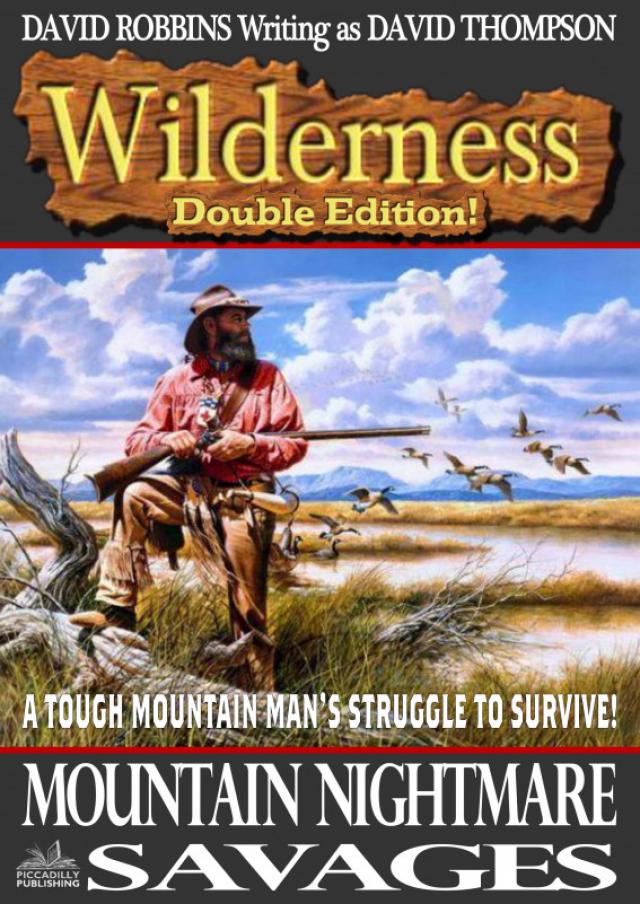
Mountain Nightmare
Frontiersmen are drawn to the wilderness of the Rockies by the quest for freedom, but in exchange for this precious liberty they must endure a life of constant danger. Nate King and his family have faced every vicious predator in the mountains, both human and animal, and triumphed. But what of a predator that is neither human nor animal … or a little of both? Nate and his neighbors have begun to find tracks and other signs of a being the Shoshones know as one of the Old Ones, a half-man, half-beast creature that preys on humans and kills simply for the sake of killing. Can the old legends really be true? And if they are, how can even the best hunter on the frontier survive becoming the hunted?
Savages
Frontiersmen living in the untamed Rockies are surrounded every day by endless dangers, including attack by hostile Indians. But to Nate King and his family, the local tribes are simply people like them, people trying to live free in the glorious mountains, and many of them have become their friends. It is only when Nate’s son, Zach, sets out with his fiancée to visit her relatives in St. Louis that Zach meets savages of a very different kind—vicious white cutthroats who kidnap his beloved. Zach is far from home, with much to learn if he hopes to save the woman he loves. But he knows one thing—he’ll save her if it’s the last thing he does. Then he’ll give those savages a dose of civilizing … frontier style.
WILDERNESS DOUBLE EDITION
29: MOUNTAIN NIGHTMARE
30: SAVAGES
By David Robbins Writing as David Thompson
First Published by Leisure Books in 1999
Copyright © 1999, 2018 by David Robbins
First Edition: August 2018
Names, characters and incidents in this book are fictional, and any resemblance to actual events, locales, organizations, or persons living or dead is purely coincidental. All rights reserved. No part of this book may be reproduced or transmitted in any form or by any means, electronic or mechanical, including photocopying, recording or by any information or storage and retrieval system, without the written permission of the author, except where permitted by law.
This is a Piccadilly Publishing Book
Series Editor: Mike Stotter
Text © Piccadilly Publishing
Published by Arrangement with the Author.
WILDERNESS 29: MOUNTAIN NIGHTMARE
One
Two
Three
Four
Five
Six
Seven
Eight
Nine
Ten
Eleven
Twelve
Afterword
WILDERNESS 30: SAVAGES
Chapter One
Chapter Two
Chapter Three
Chapter Four
Chapter Five
Chapter Six
Chapter Seven
Chapter Eight
Chapter Nine
Chapter Ten
Chapter Eleven
Chapter Twelve
About the Author
To Judy; Joshua, and Shane.
WILDERNESS 29
MOUNTAIN NIGHTMARE
One
Old Charlie Walker had lived in the Rockies for the better part of thirty years. Not quite as long as Shakespeare McNair and a few of the other old-timers, but long enough to qualify him as one of the most experienced mountaineers alive. Old Charlie had trapped every creature under the sun. He’d lived with half a dozen Indian tribes and knew the ways of the red man as well as any white ever could. He’d endured icy winters without end, inferno summers without cease.
In short, Old Charlie had pretty much seen and done it all. There wasn’t much that surprised him anymore, which made it all the more remarkable when he shuffled down to the gurgling stream near his cabin for a drink early one morning and saw some strange tracks.
Charlie had eased onto his aching knees, placed a hand flat, and was bending forward to dip his grizzled chin into the sparkling water when he noticed the prints to his left. He stared at them a moment and thought to himself, No, that can’t be. Then he slaked his thirst.
Some men were partial to scalding hot cups of coffee, or even tea, first thing every day. Not Old Charlie Walker. Give him fresh, clear, cold water, and lots of it.
When Old Charlie raised his dripping jaw, the tracks were still there. He stared at them some more, completely confounded. They defied all logic. They were as out of place as a grizzly’s tracks would be in the heart of New York City.
Sitting back, Old Charlie wiped his mouth with the back of a gnarled hand. Buckskin covered his lanky frame from head to toe and a beaver hat that had seen better days was perched on his gray mane of hair.
“Well, I’ll be,” Old Charlie said aloud. Talking to himself wasn’t unusual. Many of his kind picked up the habit of voicing their thoughts. The sound of a human voice lessened their loneliness a trifle. Charlie was unique in that he held whole conversations with himself, and had once punched himself in the nose when he angrily disagreed with an idle comment he’d made. “What do you have to say about this, hoss?”
“I don’t rightly know,” he answered himself. “Damned peculiar, is what it is. If’n I didn’t know any better, I’d swear someone was playin’ a trick on me.”
“Who’d be that ornery?” He could think of a few: McNair, that rascal Joe Meek, Running Elk, possibly, and maybe Striped Wolf of the Crows. But it would be a lot of trouble to go to, whittling the feet and—
Old Charlie bent low, his brow knitting. “Hellfire!” he exclaimed. They weren’t impressions made by carved wood. They were real! He saw where the toes had splayed when the maker of the tracks shifted position. And again, where the toes dug in for purchase as the figure climbed the bank.
“I must be drunk,” Old Charlie said. “Yet I can’t be. I ain’t had a drop of rotgut since I visited Bent’s Fort back in—” He stopped, unable to recollect exactly when that had been. Seven years ago? Ten?
His curiosity mounting, Old Charlie rose and followed the tracks. They paralleled the stream for another thirty yards, giving his small cabin a wide berth, then veered into dense forest. Old Charlie stopped, unsure whether to go on or fetch his rifle and possibles bag. All he had with him was a pistol and a Green River knife.
There was a time when Old Charlie never ventured ten steps from his place without being fully armed. But the Blackfeet and Bloods hadn’t been spotted in his neck of the woods in a coon’s age, and he’d skinned the last griz on that particular mountain back in ’32. He considered it safe to go a little farther.
Advancing in among the pines, Old Charlie heard a chipmunk chitter and a sparrow sing. Proof that no predators were abroad, four-legged or otherwise.
The ground was hard here, so the prints were much more difficult to find. The impressions and scuff marks were so faint, in fact, that if Old Charlie hadn’t known what to look for, he’d never have spotted them. It made him wonder if he had blundered by other such tracks in the past and just not realized it.
“This reminds me of that time up in the Tetons,” he commented. “When I was with Yellow Hand’s band, and we came on those gigantic footprints left by something none of us had ever heard tell of.” He paused. “Only, these here weren’t made by the same critter, were they, you fool?”
“Who are you callin’ a fool?” Old Charlie demanded.
The tracks wound steadily deeper into the woods. At a clearing no wider than Old Charlie was tall, he drew up short in amazement. “If this don’t beat a pig a-pecking!” A new set of tracks joined the first, coming from the west. Then both sets headed off side by side.
“Must be the missus,” Old Charlie joked, and guffawed. Everything on God’s green earth had a mate—but two of these things was as beyond belief as the existence of only one. “I reckon I’ll keep on a little ways yet.”
The prints bore toward a ravine, a narrow, boulder-strewn defile barely wide enough for four horses to ride abreast. With the sun perched on the horizon, scant light penetrated. Enough, though, to reveal that the tracks were luring him into its murky recesses.
“I reckon I’ll come back later,” Old Charlie announced. But he couldn’t resist venturing in. Just twenty or thirty feet or so, he told himself. It wasn’t quite as dark as he’d believed, and he had no trouble trailing the tracks as they wound farther and farther along until he came to a cleft on his right. The footprints disappeared into it.
“That’s that,” Old Charlie said, since he surely couldn’t follow any farther. He’d have to dig for a month of Sundays, and even then he had no inkling of how far back the cleft ran. Stooping, he put his face to the opening and felt a soft, cool breeze on his skin. “It’s a deep one, no doubt about it.”
Old Charlie started to uncoil, then froze. Something had moved back in there. He was certain. Peering intently, he saw the thing move again, a swift, flitting motion. A vague shape materialized, too indistinct to note details. It was there, and it was gone.
“I know you’re in there!” Old Charlie informed them. The likelihood of being in any danger never occurred to him. Not given his size, and the pistol. “Step out so I can get a good look at you!”
Nothing happened, and Old Charlie scratched his chin. “It could be they’re afraid of me,” he guessed. “It could be they think I’ll smash them to pieces, or keep one of ’em as a pet.” Which wasn’t as crazy a notion as it seemed. A friend of his had tamed a wolverine once, impossible as that sounded. Caught a young one and hand-fed it until it was old enough to fend for itself. Damned if the vicious critter didn’t like to visit his friend now and again, and eat jerky right out of the jasper’s palm.
“Howdy, there,” Old Charlie said, smiling to show his good intentions. “I’m as peaceable as a parson. So don’t be scared none.”
More movement ensued. The shape reformed, slightly to the left. Glittering pinpoints marked its eyes. Reflection of the light, Old Charlie figured, but couldn’t understand how they gleamed so brightly when there wasn’t enough light back in there to read by. His smile widened. “Come on out. Show yourself. I’ve a hankerin’ to be your friend, if’n you’ll let me be.”
Another pair of gleaming eyes flared in the darkness. Old Charlie’s didn’t much like how they slanted, or how reddish they glowed. But he wasn’t one of those people who disliked something just because it was different.
“I’ve got some vittles back at my place,” Old Charlie mentioned. “Killed me an elk last week, and there’s plenty left. How’d you like a nice, juicy haunch? With wild onions and dried berries?”
Charlie’s own mouth watered at the prospect. He hadn’t had breakfast yet and was starved to death. “Come on out of there. Or at least a little closer so I can see you better.”
None of the blazing eyes budged.
“I’m as poor as Job’s turkey, but I don’t mind sharin’. How about it?”
To Old Charlie’s astonishment, a third set of eyes blossomed. “Tarnation!” he blurted. “You’re worse than rabbits!”
A trilling filled the cleft, a sound the likes of which Old Charlie had never heard, low-pitched and eerie, like the caterwauling of a painter late at night, only with a lot of hissing and growling mixed in. Old Charlie didn’t like it one bit.
“I’ve tried to be civil, but you’re wearin’ my patience thin. Either show yourselves or I’m leavin’.”
Nothing happened.
“Suit yourselves,” Old Charlie said, greatly disappointed. He’d have loved to see them so he could brag about the encounter on his next visit to the Shoshones or Crows. The former, especially, would find it mighty interesting.
All of a sudden, with no logical explanation, the red eyes vanished.
“Rude critters,” Old Charlie muttered, rising. His joints objected, and he had to stretch to relieve a kink in his spine. “Reminds me of the time I visited the Piegans. Middle of the winter, yet not a one would see fit to admit me to their lodge.”
Enough is enough, Old Charlie mused, tramping away. He glanced over a shoulder every so often on the off chance the creatures were trailing him. No such luck. However, soon the sensation of being watched crept over him, which he blamed on his nerves. Striding into the open at last, he breathed a sigh of relief and bent his legs homeward.
The sparrows had stopped singing, and the chipmunks no longer chattered. Old Charlie paused several times to scour the vegetation, but if the things were out there, they were keeping exceptionally well hidden. “Reminds me of the Sioux, how they sneak around like specters,” he remarked.
Old Charlie wasn’t worried. He had the pistol, and compared to the creatures he was as big as Goliath. He could stomp them to a pulp without half trying. Tittering at the notion, he ambled to within sight of his cabin. As soon as he emerged from the trees, his mule started acting up, braying and kicking her hooves as if a silvertip were in the vicinity. “Behave yourself, Martha!” he scolded, afraid she’d bust out of the corral and he’d have to chase her down. The last time she broke out, it’d taken him four days to find her. Mules could be downright ornery when they wanted.
Martha kept braying and kicking. As he approached she came to the rails, her long ears pricked toward the forest, her gaze fixed at a point beyond him.
Old Charlie spun. For a fleeting instant, so fleeting he was uncertain whether he saw what he saw, a face seemed to be framed between a couple of bushes, a face so grotesque, so completely and utterly inhuman, that a shiver involuntarily rippled through Charlie and he took a step backward in alarm. Just like that, the face was gone, as if it had never been, leaving him to question whether it had been there or had merely been a trick of the shadows.
“I wasn’t brought up in the woods to be scared by owls,” Old Charlie tried to assure himself, but he was glad when the cabin door was shut and barred and he was safely seated at the crude table he had built with his own two hands, chomping on some of the elk meat, throwing it down his gullet cold.
“I reckon I’ll be jumpin’ at my own shadow next,” Old Charlie said. “My days are numbered, sure enough.” Being skittish was yet another sign he was on the wane. His strength was nowhere near what it had once been, his muscles and bones sore more frequently than they weren’t. And just the other day he’d gone outdoors without putting on his moccasins, the first time in his whole life he’d forgotten.
Old Charlie decided to stay close to the cabin the rest of the day. He tinkered with a broken trap, worked at mending a torn pair of britches, and in the middle of the afternoon gathered enough firewood to last a month. As the sun dipped toward the emerald western peaks, a knot of anxiety formed in his gut, apprehension he couldn’t shake no matter how hard he tried. Toward evening he watered and fed Martha, and by sunset he had the front door barred and the shutter drawn over the only window.
Snug as the proverbial bug, Old Charlie kindled a fire in the stone fireplace and placed a pot of elk stew on to boil. Soon the fragrant aroma filled the room. He hunkered over the pot, poking at chunks of meat, eager for them to get done. As he waited, he whistled a bawdy tune common in taverns.
Supper was Old Charlie’s favorite meal. It meant his work was done for the day and he could relax until sleep claimed him, along about midnight, usually. From a cupboard next to the window he took a tin bowl and a silver tankard he’d brought clear from Missouri, an heirloom that had belonged to his grandpa. Setting them on the table, he rummaged in a drawer for his spoon, a battered implement that had seen almost as many winters as he had. He rarely used it anymore, but tonight he had an urge to eat like civilized folks.
Ordinarily, Old Charlie liked to wash his food down with black coffee. Tonight, to help quell his nerves, a stronger brew was called for. In the far corner was a section of planking that lifted when pulled, and under it, in a hole over a foot deep, was Old Charlie’s precious hoard, the last of his ale. He’d meant to save it for a special occasion. But now he filled the tankard to the brim and left the jug on the table.
Except for the crackling of flames, the cabin was quiet as Old Charlie filled the tin bowl and plopped himself down. He ate with relish, treating himself to a swallow of ale every few bites. “This is as good as life gets,” he commented to the four walls.
A warm feeling spread outward from Old Charlie’s stomach, filling him with a sense of well-being and contentment. Belching, he sat back and patted himself. All his fears seemed so silly, all his anxiety so much mist. He would fill his pipe and have a smoke later, then turn in and sleep like a newborn until morning.
Old Charlie grasped the spoon and lowered it into the stew. It was halfway to his mouth when the sensation of being watched came over him again, a sensation so intense and overpowering that he dropped the spoon and jumped to his feet, nearly upending the chair. A glance showed the door and window were both shut tight, and he chided himself for being foolish.
“I’m gettin’ worse than a cat on a porch full of rocking chairs,” he quipped. He resumed eating, lading heaping portions of meat into his mouth and chomping like a starved lynx.
The warmth, the meat, the ale, they all restored Old Charlie’s happy mood, and he hummed as he walked to the fireplace for a second helping. He was leaning toward the pot when a skittering noise behind him stiffened him so abruptly, he rapped his skull on the fireplace. Pain spiked him, and as he turned, the room spun like a child’s top.
“What on earth—?” he mumbled. It had sounded like a mouse, but that couldn’t be. All the gaps between the logs had been plugged, and his floor was solid planking from end to end. He’d obtained the boards in trade from settlers bound for the Oregon country, fools who overloaded their wagons and had to dispose of half their belongings shortly after crossing South Pass. It’d taken a heap of work, but he was one of the few mountaineers who could boast a solid floor.