

Chandelier, page 29


A few seconds into the download several people appeared. A couple of guys, a woman, all young, thin, looking dressed-up a little, as if they’d just had a nice dinner somewhere. Another woman came into view. Her legs dipped into the top of the screen and moved toward the bench. The men kicked a box around, back and forth, jabbing at each other’s ankles, trying to steal it. On the screen they were fast but clumsy, likely drunk. She could see that they were laughing. But there was no sound. Only a dream-like rub of movement.
Then, there he was. Georgia’s father.
Hugo Walser. Unmistakable. He stepped into the right of the screen and stumbled forward, saying something, shouting, waving his hand, bent down and, moving crab-like, backwards a few feet, the men forming a staggered line, tapping the box between them. Her father limped slightly. The leg of his suit looked scuffed or torn. An impromptu soccer game ensued for the next few minutes, the tourists making several attempts to get the box past Hugo. He caught it in his hand. He blocked it with his outstretched leg. But finally, they poked it past him and threw their arms in the air and ran around as if it was the final in the World Cup and nothing less. Her father too was exultant, sharing in their ecstasy. He jumped up and down, his mouth popping open in a theatrical oval. The players tapped the box between each other a half dozen more times, but their makeshift ball had crumpled, its sides collapsed now by the abuse of play. It fluttered loosely along the ground.
The tourists waved at Georgia’s father, then slipped across the bottom of the screen.
In the last twenty seconds of the footage, her father is bent over catching his breath, his big palms on his knees. He’s exhausted. He’s all alone now, no one else there, as far as she could see. There’s the edge of the park bench, a curved trunk of the tree. He stands up straight and looks around. He looks up at the CCTV camera, the first time he’s even aware of it, Georgia thought. He seems amused, it looks like. She thought he might be laughing. For a second, he hunches forward. For someone’s benefit, he lifts his arms in victory again, looking straight at the camera. Then, Hugo, the failed architect, father and husband, bows, just like an actor, and stumbles out of sight.
That’s where it stops. Where he stops, Georgia thought, forever.
38
Rain. Absolute heavy cascades of rain. After gulping down doses of warm rice, kimchi and coffee, they packed gear and hustled the bags into the car through the sluicing gusts before sun-up. Ji-tae locked the townhouse, dropped the keys into the mail slot, dashing to get into the car. In the murk, wipers brushed the street in and out of focus. Georgia looked at Becca, skeptical of any hopeful forecasts. Ji-tae stayed focused on the road. In the parking lot, they hydro-foiled through a monster puddle before the car rolled to a stop beside a set of guardrails. They sat listening to the deluge thumping the car’s roof until it seemed to ease off. Ji-tae had rechecked the weather radar, which showed the last edge of the storm.
“Let’s look at the water,” Ji-tae said.
“C’mon, mate. We’re here, right? Let’s just do this,” Becca said.
She tugged on the handle and pushed the door open. They unstrapped their boards from the rack. Before they even saw the water, they could hear the ocean, like cannon shots as each wave collapsed onto the shore. They jogged down the wet sand. Ahead of them, in the lifting dark, were shaggy lines of foam surging toward the beach. There was no one in the water. No one in sight. Without a context it was hard to estimate size, but the waves had height. Definite height. Ji-tae was cackling with delight.
“This looks nuts,” Georgia said.
Seagulls ganged over their heads. Ji-tae looked at Georgia, smiling wildly, reaching down to strap his leash to his ankle and tucking his board into his armpit. She didn’t know if he’d ever seen waves this high at Haeundae, but he began to look serious as he studied the horizon, assessing the whole shoreline as he sized up the direction of the tide for where they should launch out. The marbled water, brown with mixed sand, pulled at their heels from a backwash. They jogged north up the beach for a few hundred metres, then waded in. The swells were messy, shotguns of force, not moving in clean lines but with short, overlapping hashmarks of curling crests. Before they could get waist deep, they were all knocked flat on their asses.
“It’s better farther out,” Ji-tae said. He pointed to a new set breaking south toward land. “It’s okay. But be careful.”
They climbed onto their boards and started paddling hard, digging with deep scoops through the smaller waves before the big ones came. The sea was icy. Becca and Georgia were both sidewinded by tide, breath knocked out of them. Up ahead, Ji-tae looked back, anxious to test the swell. He had stopped paddling and waited. “Maybe it’s too high,” he warned. Georgia and Becca pushed past him, signalling their decision and responsibility.
The beach break was a crescent-shaped inlet, the headland protected from the storm surge. Here, the surf was calmer, leaving a channel relatively navigable. Knee-paddling now, the three of them fought for deeper water and found a takeoff area where the swell started to lift and break south. Watching where the lines formed, Ji-tae paddled for open ocean to merge with the current’s momentum. Matching it, he popped up for a few seconds before getting walloped by a churning linebacker of foam. Instead of disappointment, his eyes flashed with elation in the challenge he’d been hunting for. The waves curled and rounded up into beautiful shapes. But for Georgia and Becca, the whitewater was choppy, unpredictable, and time after time they were pitched into a trough and battered around before corking to the surface.
Georgia was struggling, flustered. The water was breaking left and she paddled toward a set that was sketching out ruffled white lines in the distance. But she hadn’t waited to get her breath back. So, when she stood up, anxious, already winded and off-balance, she was too slow, too behind the break. And the wave collapsed.
There wasn’t even time to strategically bail.
The heavy wall banged her off her board and drove her straight under. Instinctively, she got her arms down. How close to the shore? If she went down too hard, the waves could smash her into the seafloor, break several bones, knock her out.
As the foam hit her, she’d been breathing out.
Her lungs were empty.
She thrashed, managing to boil to the surface. But as she emerged the second wedge of the wave train shoved her down again before she could take some air. The surfers call it getting rag-dolled, when you’re pushed underwater, no up or down, tossed and dragged this way and that, lifted toward air then sucked back toward the bottom. Ji-tae had talked to her about keeping calm in a wipeout. But this was more complicated. It was a terrifying loss of control coupled with panic.
It was drowning.
She had resisted the tragic impulse to inhale. Rising, she got battered once more by a brick load of water. Then her head broke a trough’s surface. Long enough for a lungful of oxygen. A moment later she was washed clear of the set, gasping and grateful her leash hadn’t snapped nor her board had bashed her skull in. Ji-tae and Becca shouting. She raised her hand, too winded to shout back.
They paddled with her back to shore.
She told them she was fine, they should go back out, the waves wouldn’t wait. “I’ll join you in a second.”
She watched Ji-tae carving his board across the face of the wave, almost disappearing behind the curtain of surf before emerging at the foaming edge of the tube. She was happy for him; happy they’d stayed and gambled on the conditions. Becca was taking a beating but kept at it. The barrels were coming along consistently now, lifting and curling in sets of three or four. They were beautiful, exciting, so full of potential, but as Georgia tried to paddle back out, she was fighting hurdles of alarm. She couldn’t steady her breathing. Fear. Closing in on the tremendous breakers detonating at the impact zone, she was spooked. Positioned for another wave, her nerve failed and she let the surge pass. She was done. Defeated.
A nearby crest started to peak.
What do I have left? she thought.
Ji-tae was shouting. She checked for him. He was near shore, untangling his leash before launching out again. He raised his hand.
She turned her head to see what he was pointing at.
Below the horizon, three thick lines of white crests were scrolling toward her, the water beneath a glassy, cobalt blue. They were a long way off, and could just as easily flatten out, shift and swallow themselves and become something benign.
Georgia wasn’t far from the takeoff zone and started paddling hard. Pushing up and planting her feet on her board, she crouched loosely as she slid along the shallow, fast line. She was too tired, wrung out, her arms stretched, her gut wobbly. The fear returned. She couldn’t help but think that if she got held down underwater this time, she wouldn’t have the strength to resist panic. She’d do something stupid, decide faultily and pay for it. Glancing back toward the beachfront, she located herself. They’d chosen a mid-rise office tower as a marker for the lineup. She was just south of it. She checked the incoming waves. Small breaks swished past, until the darker, deeper energy of the ocean thrust up, and a blue wall rose.
A first peak blew past. She swayed in the trough and for a moment the surface grew peaceful and she thought she’d missed her last chance. The shore had disappeared, still hidden beyond the crashing foam of the last wave. And when she turned her head to inspect the horizon, it also had been swallowed by the returning swell, the second wave of the set bulking toward the sky. She turned her board. She didn’t overthink. The spontaneity bypassed her anxiety. She dug her arms past her elbows in deep strokes, then hesitated, thinking, Fuck, stop, then paddling again, even faster, as the lip began to break. She could see the white foam crackle and sizzle along the crest’s top, feathering, like a spark moving down the fuse of a cartoon dynamite stick.
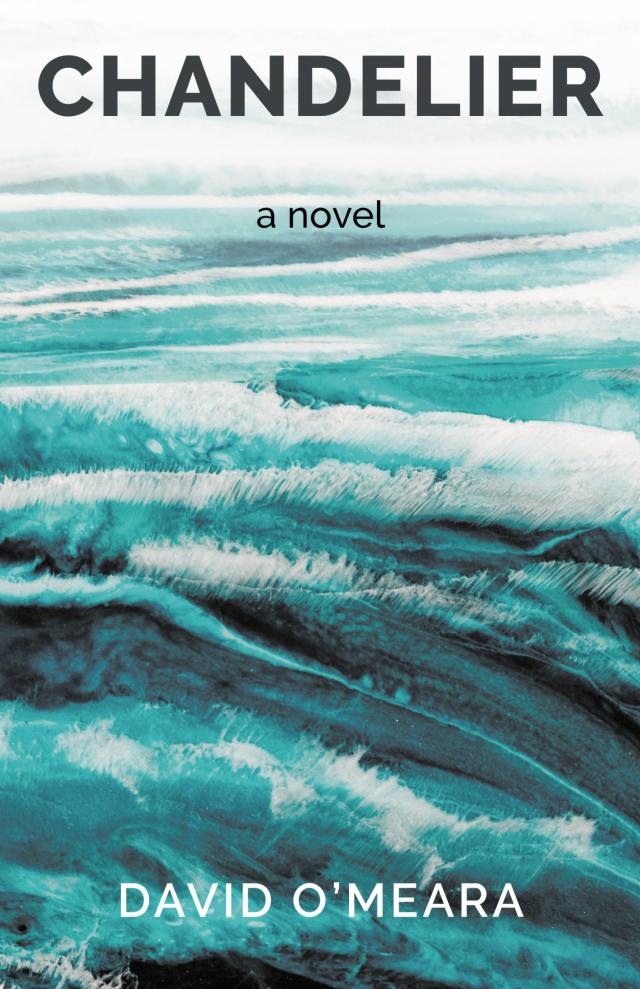
Then it started to curl. She pushed forward with harder plunging strokes. She had stopped too early before and dropped too late. This time she got ahead of the curtain of water that was bending over her head. She ripped like a shot inside the barrel. It had height, but wasn’t monstrous, so she kept low, crouched and bouncing lightly on the board to pump herself forward. Ji-tae had told her that if she got inside, it was best to stay in the middle and let the force of the wave carry her out. If she grazed the top, or got caught in the plunging foam below, she’d get ricocheted and pummelled. How long was she in there? Five seconds? Ten? Time paused as she slid across a rising wall of the ocean’s journey coming to its culmination, swirling around her in a shrug of green and azure. She could feel the water detonating at her heels while she focused on her escape in the tunnel ahead as the wave shimmered in an ongoing oval collapse. Surfers call it the chandelier, that breaking fringe of foam that frames the barrel’s exit. There is a grace area between panic and calm. You can’t stay there forever. But you need to try even as you plan a way to exit. The magic, she understood, was to balance between the tumbling edges as long as possible before the walls crumple and close you in.
Gratitude
To the City of Ottawa and the Ontario Arts Council (and their juries) for financial assistance during the writing of this book.
To Silas White for believing in this book, and to Cecilia Chan, Rebecca Hendry, Luke Inglis, Corina Eberle, Rafael Chimicatti and everyone at Nightwood Editions for your meticulous attention and support.
To Janine Young. It’s a gift to have an editor who is on the same wavelength, values and encourages nuance, character and the shape of a phrase. Much appreciation.
For crucial direct feedback at various stages on the manuscript, I am deeply indebted to Dorothy Jeffreys, Marisa Gallemit, Kevin Hersak, Harold Hoefle, Missy Marston and Andrew Steinmetz.
To my parents, whom I miss dearly, and to cherished family and friends.
Photo credit: Rémi Thériault
About the Author
David O’Meara is the award-winning author of five collections of poetry, most recently Masses on Radar (Coach House Books). His books have been shortlisted for the Gerald Lampert Award, the ReLit Award, the Trillium Book Award and the K.M. Hunter Award, and have won the Archibald Lampman Award four times. His poetry has been nominated for a National Magazine Award, quoted in a Tragically Hip song and used as libretto for a pastoral cantata for unaccompanied chorus, written by composer Scott Tresham. He is the director of the Plan 99 Reading Series and he was the founding Artistic Director for the VERSeFest Poetry Festival. He lives in Ottawa.
David O'Meara, Chandelier


