

Tom Morris of St Andrews, page 1


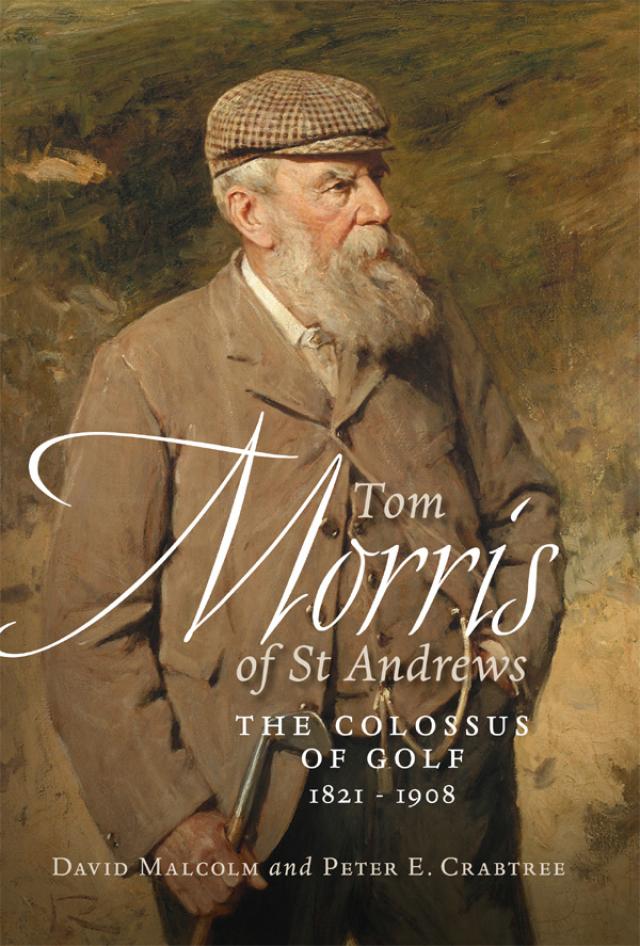
TOM MORRIS
OF ST ANDREWS
TOM MORRIS
OF ST ANDREWS
The Colossus of Golf
DAVID MALCOLM PETER E. CRABTREE
This eBook edition published in 2011 by
Birlinn Limited
West Newington House
Newington Road
Edinburgh
EH9 1QS
www.birlinn.co.uk
First published in 2008 in a limited edition by Rhod McEwan at Glengarden Press Published for the trade in 2010 by Birlinn Ltd
Copyright © David Malcolm and Peter E. Crabtree 2008, 2010
The moral right of David Malcolm and Peter E. Crabtree to be identified as the authors of this work has been asserted by them in accordance with the Copyright, Designs and Patents Act 1988
All rights reserved. No part of this publication may be reproduced, stored or transmitted in any form without the express written permission of the publisher.
eBook ISBN: 978-0-85790-107-1
British Library Cataloguing-in-Publication Data
A catalogue record for this book is available from the British Library
Contents
Acknowledgements
Introduction
1 Roots in the Links
2 The Way of a Weaver
3 The Kirk, the School and Apprenticeship
4 ‘A Kind of King Amongst Them’
5 Foundations for the Popularity of the Game
6 The Gutta Affair
7 Marriage and Movement
8 Sowing Seeds in the West
9 A New Beginning as an Era Ends
10 The ‘Honest Toun’ Park
11 Genesis of Tournament Golf
12 ‘Cast in the Very Mould of a Golfer’
13 The Apostles of Golf
14 Home to Roost
15 ‘Leddies Gowf’ and Caddy Cantrips
16 A Champion in the Making
17 The Finest Rounds Ever Played
18 Renovations in Making the Play
19 An Unlikely Match
20 A Tied Match in West Lothian
21 American Connections
22 Recognition and National Acclaim
23 The Beginning of the End
24 The Ultimate Tragedy
25 Heartache
26 An Unmarked Grave in Australia
27 ‘Generous with His Time and Spirit’
28 The Road War
29 A Felon in the Family
30 The Last Great Match
31 Characterising the Game
32 Death in Alabama
33 Family Affairs
34 The Gathering Storm
35 Links in Conflict
36 New Facilities on the Links
37 A Time of Strife
38 The High Priest of Golf
39 The Old Order Changes
40 A Constant Benefactor
41 In Social Limbo
42 In Testimony
43 Honours as Willie Park Dies
44 The Evangelist and a Place of Pilgrimage
45 Relinquishing the Barrow and Spade
46 Playing Through
47 Now the Labourer’s Task Is O’er
Epilogue
Notes to Chapters
Bibliography
Index
Acknowledgements
Many people have provided help and advice during the preparation of this work, and without their assistance this book could not have been completed.
We have benefited from the knowledge and support of David Hamilton and have called upon the knowledge and experience of Philip Truett. We appreciate their input, enthusiasm and encouragement. We also thank those who have been constructive in criticising the text, helped with historical accuracy and interpretation, guided in medical matters or have given encouragement: Gordon Christie, Margaret Grubb, Duncan Lawrie, Robert Smart, Robert Burnett, Malcolm Foggo, Jim Barclay, Sir Roddy MacSween, David Dobson, John Di Falco, Paul Dhillon, Kevin Costello, John Pyne, Steve McPherson, Ian Bunch and Roger Taylor. From Yorkshire, we are indebted to Christine Dewar, Ben Downs, Sir Harry Ognall and John Pearson for their editorial assistance and advice. Special mention must be made of the researches of Noel Terry in Melbourne, Australia, regarding David Strath.
Specialists in many libraries have been supportive and helpful. In St Andrews University Library Archives, Dr Norman Reid, Rachel Hart, Cilla Jackson and Moira Mackenzie have been tireless in their efforts. In the West Lothian Local History Library, Sybil Cavanagh sourced images and information and described the Whitburn township in mid-nineteenth century in words that no photograph could convey. In Darien, Georgia, Buddy Sullivan was encouraging and his writings were essential for an understanding of the life of the lumberman on the Georgia Tidewater. The help of the staff of Darien’s Ida Hilton Public Library, the services of the staff of the Probate Court and Library in Mobile, Alabama, and the archivists of the University of South Alabama are appreciated.
Many libraries, museums and galleries have been visited. Among these, special thanks are given to the staff of the British Library Newspapers at Colindale, the British Library at St Pancras and Kew in London, the National Portrait Gallery, London, the National Archives of Scotland, the National Galleries of Scotland and the National Library of Scotland, Edinburgh Public Library, Glasgow’s Mitchell Library, the Carnegie Library in Ayr, South Ayrshire Council’s Rozelle House Galleries, North Ayrshire Council Museums Service, the McManus Galleries and Museum in Dundee, Aberdeen University, the National Trust for Scotland Photographic Library, the St Andrews Preservation Trust and the Royal Collection at Windsor.
Golf club secretaries, councils and management committees have been unhesitating in providing records and images. Special thanks are due to the St Andrews, Thistle and New Golf Clubs of St Andrews, the Prestwick and Prestwick St Nicholas Golf Clubs, North Berwick, Gullane, New Luffness, Carnoustie, Bruntsfield, Earlsferry Thistle, Irvine, Glasgow, Royal Troon, Royal Liverpool, Royal North Devon, Royal Blackheath, Valderrama, Shinnecock Hills Golf Club and the National Golf Links of America.
We appreciate the help received from The Royal and Ancient Golf Club of St Andrews. Peter Dawson, the Secretary, and Aubyn Stewart-Wilson, the Members’ Secretary, have been most supportive. Peter Lewis, Director of the British Golf Museum, and Angela Howe, the Assistant Director, have been unstinting with their help and guidance.
The help and input from the descendants of Tom Morris has been invaluable. Mrs Sheila Walker has allowed us access to family archives and records. Lady Morrow generously made available documents and images held by her family. Likewise, Andrew Rusack has been of the utmost help. Susan Tucker has added to our knowledge of the early Hunter family life in Darien and Mobile.
In the course of the preparation of this book, some of our friends who made significant contributions have died. We hope that our work contributes to their memory. John Behrend and Tom Jarrett were both inspirational and informative in their writings and conversations. Alistair Johnston of St Andrews was the last of the great club-makers and his knowledge and guidance was invaluable. Joseph Tiscornia made his extensive collection of clubs, balls, documents and photographs available to us and Dr Ronald Cant generously shared his wide knowledge of nineteenth-century St Andrews with us. We are particularly indebted to them.
Finally, we are especially grateful to our wives, Ruth and Peggy, and our families, for their tolerance, understanding and, above all else, patience, throughout the progress of this work.
Introduction
Over 58 million people play golf worldwide. The game has generated more economic activity and employment than any other sport and, despite the huge sums competed for by professional players, golf remains synonymous with good conduct, honesty and integrity.
This book is about how one man, Tom Morris of St Andrews, presided over the greatest period in the development of golf. It is about how he, more than anyone before or since in any game, stamped his individual character upon his sport and how, in large measure, he made golf what it is today.
Born in a linen weaver’s cottage in St Andrews in 1821, he was un-educated even by the standards of his day but, by the time of his death in 1908, he had become a figure of international renown. He was the friend of dukes and earls, prime ministers and politicians, judges and felons, golfers of every calibre and caddies of every kind. When he was buried with all the pomp and ceremony befitting an eminent Victorian, The Times eulogised him in a long obituary. Newspapers throughout the world reported his funeral, followed by his interment below the effigy of his son, Tommy, amidst the ruins of St Andrews Cathedral.
In the course of his long life, he witnessed huge social and scientific changes in the world, none more so than in the game of golf that he had, in many respects, overseen and directed.
When Tom Morris was born, golf was little more than a parochial Scottish pastime played by a few hundred Scots on some twenty rudimentary courses, where conditions were almost entirely left to nature. By the time of his death, the game had expanded to become the most popular and geographically widespread of all sports. North America, much of Europe and the colonies of the British Empire had enthusiastically embraced golf, and the name of Tom Morris was synonymous with it. He was painted by artists, honoured by poets, patronised by royalty, revered by The Royal and Ancient Golf Club and showered with praise and affection by golfers everywhere. Tom Morris was a sporting hero in an age of heroes, as well as golf’s first iconic figure.
Time, place and circumstance clearly helped Tom make his mark in golf. In his formative years, the Links of St Andrews and The Royal and Ancient Golf Club were already at the centre of the game and the Town was considered ‘The Home of Golf’. When the gutta ball came to replace the feathery and the railway network reached every corner of the land, golf was on the threshold of rapid expansion. Tom Morris found himself in the right place at the right time.
From his start in the game as an apprentice feather ball-maker with Allan Robertson to his very reluctant retirement as ‘Custodian of the Links’ of St Andrews more than 60 years later, his is a remarkable and very human story, blessed with great triumphs but blighted by even greater tragedies.
Tom Morris was, of course, a great golfer. The record of Tom and Tommy, father and son, in the Open Championship stands as an enduring memorial to their golfing superiority. Between them they won eight of the first twelve Opens and are still respectively the oldest and youngest players to have won the Championship. Tom relinquished his Open title to 18-year-old Tommy in 1868, taking second place that year – a family performance unlikely ever to be repeated. Tom’s 13-stroke victory in 1862 remains the largest winning margin and Tommy’s four Open Championship wins in succession are unequalled – his was the first name to be engraved on the Claret Jug, the new Open Golf Championship Trophy, when it was first presented in 1872.
This book is not a catalogue of the golfing achievements of Tom Morris. While it is important to understand that it was his big money matches with Willie Park, and subsequently those of Tommy and Davie Strath, that established golf as a popular spectator sport, in order to appreciate Tom’s total contribution to golf, it is necessary to look beyond his merely playing the game.
Tom Morris was the first golf professional engaged by a club to provide a golfing service to its members. He was arguably the first professional to design and build a course from scratch, and his first, at Prestwick, testified to his insight and creativity and set standards for all to follow. His development of St Andrews into the ‘Old Course’ that we know today has stood the test of time, and remains the most popular Open Championship venue and the most famous golf course in the world.
To understand the man and his character we must look at his family life: his marriage, the birth and death of his first son and the birth and upbringing of his second son, Tommy; the family’s move to Prestwick, the birth of his sons and daughters there and the friendships they forged there; the marriages his children made and how they impinged on his life; Tommy’s unlikely match with Margaret Drinnen who tragically died giving birth; his only daughter Lizzie’s marriage to James Hunter, who amassed the family’s fortune before his bizarre death in the Bay of Mobile in America – half a world away from his wife and children in St Andrews – and Tom’s younger sons, the enigmatic James and the paraplegic John.
This book chronicles the life of a family man who outlived his wife, all of his children and their spouses, who was left alone with his grandchildren but who bore the cruel blows of fate with fortitude. It is about the people, the places and the events in Tom Morris’s life that shaped his character, a character that he transferred to the game of golf.
It is over 100 years since the only other biography of Tom Morris was published. It is perhaps uncharitable to suggest that the Reverend W. W. Tulloch put little effort into his work, but he clearly laboured under the constraints of Victorian sensitivity and the fact that his subject was still living. We have been under no such burdens. After many years of research, we have related Tom’s life as it was, his strengths as well as weaknesses, and have laid to rest some of the myths perpetuated and embellished over the years. We hope that in some small way we have brought Tom Morris to life in these pages.
Authors’ Note
Every effort has been made to trace copyright holders of works quoted in this book. We ask the indulgence of any copyright holder whom we have been unable to identify.
Errors are inevitable in a work of this scope and scale and we apologise for them. We have verified the facts from source documents wherever possible, but there will always be different interpretations of events in the life of such a significant historical character. It is our earnest hope that topics raised within this book will encourage further research.
1 Roots in the Links
Tom Morris’s ancestry can be traced back in St Andrews, as far as the earliest records permit, to a seventeenth-century namesake.1 All the Morris families were handloom weavers who, for five generations, played a central role in the affairs of the Weavers’ Craft Guild, having continuously at least one family member amongst its office-holders until the demise of the trades guilds in the mid-nineteenth century. Tom’s earliest ancestors knew St Andrews at its greatest and through the generations witnessed its descent into penury as, first, the Reformation stripped it of its ecclesiastical wealth, and then the Union of the Crowns of Scotland and England in 1603 diminished its political status and importance as a centre of learning.2 The Union of the Parliaments of England and Scotland in 1707 reduced St Andrews to an insignificant, decaying, provincial Scottish township, a relic of its great past.
Despite the ravages of ecclesiastical and political change in St Andrews, golf remained at the core of this small university town on the east coast of Scotland. As early as 1552, Archbishop Hamilton, on being granted the rights of harvesting rabbits from the Links for food and skins, was reminded that the townspeople reserved their hereditary rights to pasture animals, dig turf and play golf. Golf was sufficiently commonplace in the Town for the Kirk Session records to mention it as a distraction from Sunday worship. In one such record in 1583, Alexander Miller and his two disobedient sons along with two other miscreants were warned about playing golf when they should have been in the Kirk.
Golf, as we know it today, first flourished on the east coast of Scotland and St Andrews has long been the most important venue of the game. The golfing ground within the ancient links land of whin-covered dunes, bordered by the North Sea to the east and the estuary of the River Eden to the north, was a natural place to play golf. It is not surprising that it became the best and most testing arena for the early game and the premier place of play for the golfing gentry.
Although it is not known if Tom Morris’s earliest ancestors played, there is circumstantial evidence that his great-grandfather did. John Morris was born in 1722 and married Janet Robertson in 1744, sister of Patrick and William, members of a golf ball making family already two generations established in the craft, with premises both in Leith and St Andrews.3 John and Janet had four surviving children and their eldest, John, born in 1752, was undoubtedly associated with golf on the Links of St Andrews.
It was during the early childhood of this John Morris, Tom’s grandfather, that an event of crucial significance took place that profoundly affected the future importance and prosperity of the Town. In 1754 twenty-two ‘Noblemen and Gentlemen of Fife’ gave a silver club to be played for over the Links and the Society of St Andrews Golfers was effectively formed, ultimately becoming The Royal and Ancient Golf Club in 1834 upon being granted Royal Patronage by King William IV.4 Today, it is the premier club in the world, governing the game in all countries except the United States of America and Mexico.
That Tom’s grandfather John and his great-uncle Robert were golfers is indisputable, for both figured prominently in a ten-year legal dispute known as the ‘Dempster Case’, or colloquially, as the ‘Rabbit Wars’, a bitter battle over the breeding of rabbits on the Links of St Andrews. In November 1797, a penurious St Andrews Town Council had sold the Links to Thomas Erskine who was Provost of the Town and Captain of the Golfing Society. The Links consisted of about 50 acres of arable land and 250 acres of sandy dunes covered with thick gorse and scrub. Within this area of dunes was a narrow strip of undulating grassland with humps and hollows interspersed with areas of flat plains. It was this small crook-shaped area of about 12 acres that constituted the golf course. Whether or not the Town Council had a right to sell the Links is a topic debated to this day, but sell the Links they did, with the reservation in the terms of the sale that, ‘always no damage or hurt be done to the golf links’.


