

Sana, Sana, page 1


ADVANCE PRAISE
“Praise forever to the warrior healers who transform the world by opening their hearts. This anthology models the self-compassion that we need to live as our complex evolving selves. These writers are now my teachers for life. May we understand our healing as creation, reclamation, and multi-generational love. This book is here to bless you in all directions.”
—Alexis Pauline Gumbs, PhD, author of Undrowned: Black Feminist Lessons from Marine Mammals and Dub: Finding Ceremony
“With Sana, Sana: Latinx Pain and Radical Visions for Healing and Justice, editors David Luis Glisch-Sánchez and Nic Rodríguez Villafañe have ushered forth a timely, biting anthology of Latinx perspectives on contemporary social and historical culture; as the social and the historical are framed by settler colonialism, capitalism, the violence of individual and collective trauma, antihuman phobias and other structures of dominance. The question raised here, grounded in Latinx, feminist and queer thought, in the idea that ‘healing requires witness,’ is, simply put, how can those of us who have been harmed intergenerationally and across worlds, across time, create and define what we mean by reparation(s). Sana, Sana arrives at a critical moment in twenty-first century abolitionist practice.”
—Alexis De Veaux, author of JesusDevil: The Parables
“Sana, Sana is a transformative anthology that mixes raw emotions, trauma, self-awareness, politics, spirituality, and sometimes even humor. Shared narratives of pain and collective transformation are expressed through poetry, storytelling, and testimonios, envisioning a different kind of world. It is a manual for Latinx hope.”
—Lawrence La Fountain-Stokes, author of Translocas: The Politics of Puerto Rican Drag and Trans Performance
“First you have to name it. Say it. Unearth it. Then stomp it. And scream. Twirl it. Open to the Sky and howl it. Cry. Step into the Circle. It’s ritual. Sacred Openings that beckon us to dance and laugh and Love and feel and heal anyway. This is what Sana, Sana gives us. Mirrors. Pathways. Shimmering Light. All of this and so much more. Now is the perfect time to read this book. And Receive.”
—Sharon Bridgforth, writer, performing artist, and author of bull-jean & dem/dey back
“Without apology, the voices in this anthology reveal the complexities of living with pain while simultaneously pursuing healing and justice. Whether exploring the intersections of race, gender, sexuality, or class, these works remind us that we are never alone in our pain and do not have to be alone in our healing. These stories are rooted in the power of community, connection—and ultimately love. Sana, Sana demonstrates that we all have healing tools at our disposal whether that be music, prayer, Vicks VapoRub, sewing, or simply taking shots with a friend over Facetime. The poems and essays in this collection define the reclamation of our power to heal ourselves and our communities as holy work. This work is necessary, bold, unflinching, and a timely addition to contemporary Latinx literature.”
—Elisabet Velasquez, author of When We Make It: A Nuyorican Novel
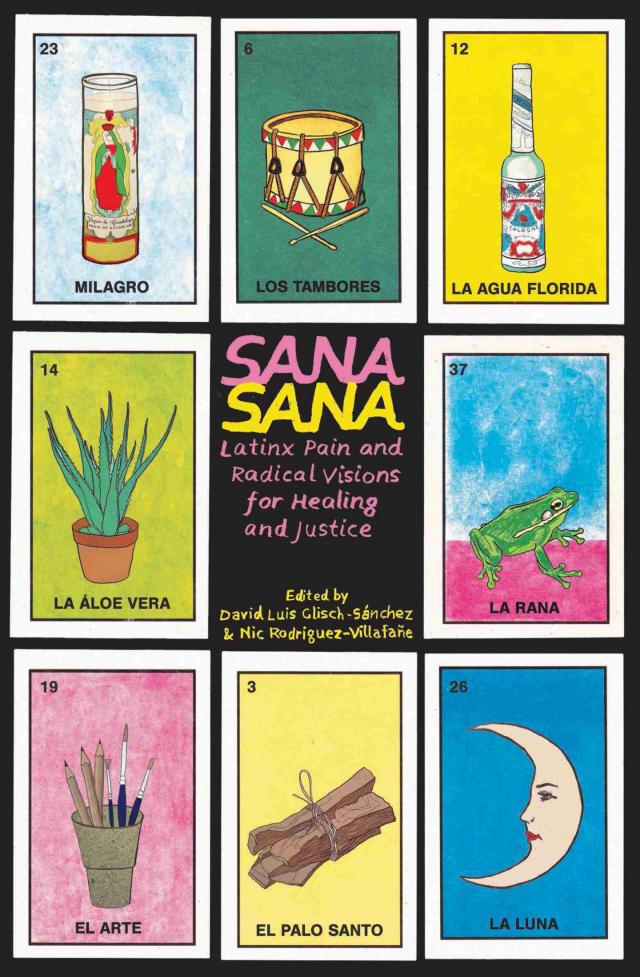
Sana, Sana: Latinx Pain and Radical Visions for Healing and Justice
© David Luis Glisch-Sánchez and Nic Rodríguez-Villafañe
© Individual contributors
This edition © 2023 Common Notions
This work is licensed under the Creative Commons Attribution-NonCommercial-ShareAlike3.0 Unported License. To view a copy of this license, visit creativecommons.org/licenses/by-nc-sa/3.0/
ISBN: 978-1-942173-78-6 | eBook ISBN: 978-1-942173-94-6
Library of Congress Number: 2023938225
10 9 8 7 6 5 4 3 2 1
Common Notions
Common Notions
c/o Interference Archive
c/o Making Worlds Bookstore
314 7th St.
210 S. 45th St.
Brooklyn, NY 11215
Philadelphia, PA 19104
www.commonnotions.org
info@commonnotions.org
Discounted bulk quantities of our books are available for organizing, educational, or fundraising purposes. Please contact Common Notions at the address above for more information.
Cover design by Josh MacPhee
Layout design and typesetting by Graciela “Chela” Vasquez | ChelitasDesign
Printed by union labor in Canada on acid-free paper
Sana, Sana
Latinx Pain and Radical Visions
for Healing and Justice
David Luis Glisch-Sánchez and
Nic Rodríguez-Villafañe, editors
Brooklyn, NY
Philadelphia, PA
commonnotions.org
Table of Contents
Introduction
David Luis Glisch-Sánchez & Nic Rodríguez Villafañe
PAIN: SPEAKING THAT WHICH WANTS TO REMAIN UNSPOKEN
1. Self-Care
Cynthia Estremera Gauthier
2. Counterstory as Catharsis: Alejandra’s Deepest Wound
Aja Y. Martínez
3. The Collective Body
Susana Victoria Parras
4. Perpetual Chillona
Daisy Muñoz
5. Writing the Storm
Daniel Shank Cruz
6. You’re Not a Regular Mexican
Jennifer Hernandez Lankford
7. I wasn’t born where the earthquakes are hitting
Frankie A. Soto
8. How to tell my Novio, Mamá, Abuela
Lysz Flo
9. Grieving in Spanglish: A Glossary of Loss
Christian A. Bracho
HEALING: MAKING OURSELVES WHOLE
10. for when our blood runs motherless
Gisselle Yepes
11. How Latin Trap Helped Me Heal from the Biggest Romantic Heartbreak of My Life
Raquel Reichard
12. Her·me·neu·tics
Edyka Chilomé
13. Pa’lante Moments
Claude M. Bonazzo-Romaguera
14. Pacienca: How Learning to Sew Helped Me Heal
Esperanza Luz
15. andrea and i do shots over facetime
Gabriella Navas
16. After the Funeral
Yulissa Emilia Nuñez
17. La Leyenda del Vaporu/The Legend of Vaporub
Sinai Cota
18. A Salt Eaters Litany
Nic Rodríguez Villafañe
19. Pyrite
Sofía Quintero
20. La Luz
Kate Foster
JUSTICE: DEFIANT WORLDMAKING
21. A Recommendation
Edyka Chilomé
22. Mariposa
Marcela Rodriguez-Campo
23. Fierce Gorditx Coming Home
Dafne Faviola Luna
24. Time Travel
Hector Luis Rivera
25. “Do you see me?”: Musings on the Pain of Anti-Blackness or Black Denial/Rejection in Latinx Spaces
Biany Pérez
26. ode to the upside-down flag stamp on every letter i mail
Gabriella Navas
27. Ode to Amara La Negra, after Melania-Luisa Marte
Lysz Flo
28. Altagracia
Amaris Castillo
29. I come from dreams
Ana Miramontes
30. Revolutionary Dreams, Fevered Pursuits
David Luis Glisch-Sánchez
About the Editors
About the Contributors
About Common Notions
Introduction
David Luis Glisch-Sánchez & Nic Rodríguez Villafañe
Queridx:
Thank you for witnessing. As a sacred part of healing, witnessing allows us to see ourselves as whole and healthy—an act of pure rebellion in a world so titillated by our constant subjugation and conquest. We hope that you find that this anthology listens as well as poses questions and strives for answers. And just when we seem to find the rhythm of peace, something else arises. Healing is not linear. Each voice in this anthology uses the pages to desahogar, a direct translation says to vent, but the literal meaning is to undrown. Here in this anthology, you will find writers who release that which keeps their throats on fire. Letting go of secrets and burdens, unraveling our papelitos guardados.1 May we no longer drown from the memories of pain left unsaid. As many have experienced trauma, our instinct is to silence ourselves, to swallow our pain. We know this is one way why generational legacies of trauma continue to exist. What if the one way to interrupt this legacy of pain, is to begin with the honest sharing of our stories?
The idea for Sana, Sana was birthed from the experiences that David (coeditor) had in interviewing queer and trans Latinxs about their encounters with social harm and learning the narratives they created and responded to around pain, trauma, and healing. In the dozens of hours of recorded conversations, it was clear: Latinx folx not only had a lot to say about pain and healing, but each, in their own way, yearned to talk about, share, and express these hard truths. Although the method was collaborative, this initial project was singularly driven and conceived of by David. All the while the collective need that was expressed repeatedly in the process was simply that Latinx folx needed their own space where a multitude of voices, testimonios, and knowledges could be expressed, heard, and engaged with. An anthology seemed like the most appropriate vehicle to hold and nurture this need.
From the beginning, it was apparent that this effort required more than one pair of guiding hands. Nic’s experience as an organizer, gifts as a poet, calling as a healer, and depth as an intellectual made them an ideal and desired coconspirator a
The project was introduced to the wider public via social media in January 2021, and within hours, hundreds of people had begun to share the call for submissions. During a time when so many of us were in isolation (almost a year into the COVID-19 pandemic) and hungry for connection, the call for this anthology served as a bridge for folks to share stories and histories and parts of their pain and healing. In this age we find ourselves, so many are searching to find a true set of customs that belong rightfully to self. In this time of feeling lost in the braided storylines of conqueror and conquered, it might just be that participating together in the ritual of storytelling is the most fundamental act of living. In reclaiming this birthright, we take back our humanity. It is about saying and doing what we need/want to imagine and heal. Each voice in this anthology offers a space to talk and feel pain, while also offering the hope of what it means to imagine, heal, and make promises to and for a more just world.
We take as our title, the beginning words of the popular Latinx, Caribbean, and Latin American children’s folk saying “Sana, sana colita de rana ponte buena para mañana …,”2 a common refrain given to children when they get hurt. In fact, the opening words “Sana, sana” provide a calm but firm command to heal. The saying operates as an emotional and spiritual salve to reassure the hurt child that despite whatever pain they might be feeling and experiencing in that moment, healing is a technology and process that is open and available to them. In this same way, it is our intention that the anthology be a reminder to all people that healing is not a commodity for the few, but a resource for all, and that justice is just another name for healing the collective body.
The anthology is divided into three general themes. It can be read from beginning to end, or as individual sections. As a reader you have the freedom to choose which section feels most aligned with your own present journey.
PAIN: SPEAKING THAT WHICH WANTS TO REMAIN UNSPOKEN
Pain is the word we give to a constellation of emotions and feelings that at their root are trying to communicate one thing: all is not well. Pain, whether collectively felt or individually experienced, is an invitation for change, a call for addressing harm, a demand for bringing into balance that which is out of it. Pain in its most understood form is physical, usually associated with some form of injury, illness, or disease; however, it more often than not manifests itself emotionally, psychologically, and spiritually. The pieces in this section wrestle with this multidimensional nature of pain, leaving us with the overarching message that Latinx pain must be expressed, must be named, must be acknowledged. In some of the most poignant pieces we learn that the words we choose to use to describe our pain are hard earned and often require us to evolve or create our own languages to capture the enormity of it.
Through poetry, fiction, memoir, and creative nonfiction, we come to observe that Latinx pain is a wide-branched tree with many deep and varied roots. We see how systemic forms of white supremacy, settler colonialism, misogyny, hetero- and cis-normativity, and global capitalism have created the context and provided the source material for the violence and traumas affecting Latinx people. Pain often lives for people in the constantly negotiated distances between community and self, safety and silence, or acceptance and complicity. Aja Y. Martinez’s memoir essay, “Counterstory as Catharsis: Alejandra’s Deepest Wound,” vividly showcases how deeply etched familial trauma is experienced and that only through the physical act of writing, the author could begin to untangle the memory of hurt. In different flashbacks, Martinez time hops through the multidimensional space a wound can occupy. In remembering, we may see the wound, and in retelling the memory we may encounter catharsis.
We also see that Latinx pain has not only been sourced from the outside, but also from within. That, as Audre Lorde warned, we have taken the master’s tools to create our own houses of harm and terror. As examples, the poems of Lysz Flo, “How to tell my Novio, Mama, Abuela”––reflect on and depict the all too long history of internalized white supremacy in the forms of anti-Black racism and colorism. Corrosive forces that have eaten away at the bonds of family and community.
It is our hope that through the unflinching gaze of all the contributors’ work, a reckoning will occur in the mind, heart, and spirit of you, that at last allows us to take a firm hold of our individual and collective pain and understand the many complex truths that result if and when we do.
HEALING: MAKING OURSELVES WHOLE
If we start with the proposition that healing is the process of making ourselves whole or remembering our wholeness to begin with, then the authors whose pieces appear in this section of the anthology remind us of the everyday resources and intergenerational traditions we have access to that can nurture, support, and guide our healing. Healing is a birthright for all humanity, not the commodity or experience of a special few. The ideas and lessons found in these works ask us to consider how dominant ideologies of race, gender, sexuality, class, ability, and spirituality have colonized our very understanding of what healing is, should look like, and how it needs to unfold.
Sinai Cota’s poem “La Leyenda del Vaporu/The Legend of Vaporub” uses memory to conjure hope: “… I’d dream of her healing hands, warm, trying to make me feel better at night as my airway struggled to supply enough oxygen to my brain.” Many readers will resonate with Cota’s illustration of this childhood staple of healing, found in the medicine cabinets of many Latinx households. Whether the tools and practices we reach for take the form of a loving friendship, a cherished childhood memory, working with our multitudes of ancestor helping spirits, sacred ceremonies and rituals that pre-date the imposition of Christianity over our African and Indigenous cosmologies, or the hypnotic rhythm of music that dresses our wounds, we come to realize that healing is found in the ordinary and not the extraordinary.
Our everyday lived experiences are a cultural expression of magic. Raquel Reichard’s “How Latin Trap Helped Me Heal from the Biggest Romantic Heartbreak of my Life” illustrates a type of mysticism in healing that happens in the surrender of our sounds. Reichard reminds us that the expression of reggaeton and Latin trap, “musica urbana,” the underground, a genre historically imbued in controversy over its sexual and explicit content—is at its core—the most expressive of human experience. Reichard allows us to be part of her healing from heartbreak, a most intimate wound. In reggaeton/Latin trap she finds not only transmutation, but transformation:
These frequent reggaeton parties aren’t mending my broken heart alone—my ongoing self-awareness and self-care practices are doing most of that work—but they are helping me regain a confidence in myself that I thought was gone forever and allowing me to discover a sexy that I never even knew existed. Pero tú ‘ta grande, ‘ta madura/Pasan los años y te pones más dura I take a sip of champagne between laughs as Bad Bunny sings through a speaker in my hotel room, where I celebrated my 28th birthday last July.
Reichard illustrates this kaleidoscopic process of heartbreak, recovery, and rediscovery, through a cherished youthful expression of music and dance. Perreo has shown itself to be the music of revolution, the anthem of young Puerto Ricans during the uprisings of summer 2019, where thousands of Puerto Ricans demanded the Governor resign (he did). The expansive possibilities of the genre of music can be seen in Reichard’s essay, where she reminds us that healing can only take place in the present, not the past, evoking a sort of future world making for our individual and collective selves.


