

Dashboard Elvis is Dead, page 1


PRAISE FOR DASHBOARD ELVIS IS DEAD
‘I loved this book. It covers decades, continents and a wide cast of brilliant characters, all with seemingly impossible depth … sharp dialogue, vivid descriptions and sideways views of the world … If you want a book that combines brilliant writing with loads of action against a backdrop of well-known real events, Dashboard Elvis is Dead is a great pick’ Katie Allen
‘David F. Ross has written a rich and rewarding novel that takes in the culture and social history of both Scotland and the USA, beautifully weaving stories together over decades before bringing them together in a manner which is devastating … proves that David F. Ross is only getting better. And considering his body of work that’s some achievement’ Alistair Braidwood, Scots Whay Hae
‘Gripping, gritty and gloriously written, David F. Ross captures characters, places and moods like few other writers. A real talent; a triumph of a novel’ Martin Geissler
‘A mesmerising road trip through the America of Kerouac, Warhol and Reagan. Dashboard Elvis may be dead, but this book is full of vibrant, authentic, colourful life’ Stuart Cosgrove
‘This is an ambitious, sweeping novel. The intertwined stories draw you in, asking fundamental questions about fact and fiction. Taut and gritty, Dashboard Elvis Is Dead interrogates truth, and pulses with life’ Donna McLean
‘A masterclass in transatlantic intertwining storytelling from one of Scotland’s finest writers’ Derek Steel
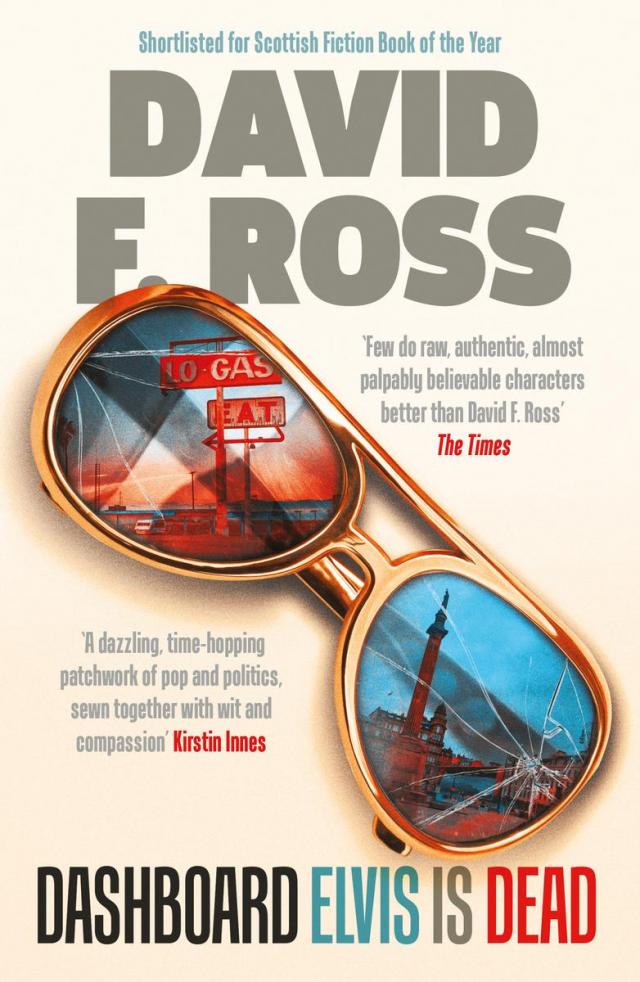
‘A dazzling, time-hopping patchwork of pop and politics, sewn together with wit and compassion’ Kirstin Innes
‘With a rawness and sensitivity that is visceral, this is another extraordinary novel from David Ross’ Random Things through My Letterbox
‘A stunning piece of historical and contemporary fiction. Nothing I can say can do it justice. Just read it and you’ll know what I mean’ From Belgium with Booklove
PRAISE FOR DAVID F. ROSS
‘Hardboiled tartan noir with a musical edge, streetwise intelligence and exactly the sense of humour you’d hope to find’ A. L. Kennedy
‘Warm, funny and evocative’ Chris Brookmyre
‘Few do raw, authentic, almost palpably believable characters better than David F. Ross’ Patrick Barclay, The Times
‘David Ross has carved out an enduring place for himself among contemporary Scottish novelists’ Alastair Mabbott, Herald Scotland
‘A real new talent on the Scottish literary scene’ Press & Journal
‘This is a book that might just make you cry like nobody’s watching’ Iain MacLeod, Sunday Mail
‘By turn hilarious and heart-breaking, more than anything Ross creates beautifully rounded characters full of humanity and perhaps most of all, hope’ Liam Rudden, Scotsman
‘A deeply compelling story about ambition, failure and interpersonal history’ Ewan Morrison
‘It’s an amazing book, brilliantly interwoven, giving me the same feeling I had reading James Kelman when I was younger’ Douglas MacIntyre, Creeping Bent
‘Ross tends to eschew purple prose in favour of the black-and-blue kind, and here, it’s as raw as a raked stud on a shin’ George Paterson
‘Ross’s fifth novel is his most mature and his most accomplished to date’ Sergio Burns, Ayrshire Magazine
‘It’s great when a book surprises you. This is a story with a punch, clouded by memory and regret’ The Bookbag
‘Simply a brilliant debut novel’ John Niven
‘Powerful and punchy, with well placed, darker-than-dark humour’ LoveReading
‘As warm and authentic as Roddy Doyle at his very best’ Nick Quantrill
‘A solid gold hit of a book!’ Colin McCredie
‘Full of comedy, pathos and great tunes’ Hardeep Singh Kohli
‘Dark, hilarious, funny and heart-breaking all at the same time’ Muriel Gray
‘Just brilliant’ Bobby Bluebell
Dashboard Elvis Is Dead
DAVID F. ROSS
For Nadia. Your independent spirit is the soul of this.
And for Jude and Jamie,
and those they encountered along the way.
‘The story is not in the words; it’s in the struggle.’
—Paul Auster, The New York Trilogy
‘Everybody has their own America … a fantasy America that they think is out there … pieced together from scenes in movies and music and lines from books.’
—Andy Warhol
Contents
Title Page
Dedication
Epigraph
PART ONE: 1983 – The Land of the Free
A State of Independence (1)
The Ballad of the Band (1)
A State of Independence (2)
The Ballad of the Band (2)
A State of Independence (3)
The Ballad of the Band (3)
A State of Independence (4)
The Ballad of the Band (4)
A State of Independence (5)
The Ballad of the Band (5)
A State of Independence (6)
The Ballad of the Band (6)
The Razzle Rodeo Club Incident
A State of Independence (7)
PART TWO: Jamie – Down and Out in Glasgow and London
There’s no truth, only perspective…
PART THREE: Jude – Another New York Trilogy
(Act i) 1988–1995
(Act ii) 1995–2001
(Act iii) From Then to Now
PART FOUR: Mother Glasgow
Dashboard Elvis Is Dead
Postscript
Acknowledgements
The Inspirations
The Music
About the Author
Other books by David F. Ross, available from Orenda Books
Copyright
YES!
8th October 2014
The word is written in chalk on a small, wall-mounted blackboard behind the hotel’s tiny reception desk. It sits under four other words: Thought for the day. I look at it intently, moving closer.
YES!
The exclamation mark is less obvious than the letters. It could be mistaken for a crack in the surface. As if letters and punctuation were put there by different people and at separate times. The power of – or comfort in – positive thinking? Defiance in the face of defeat? From my brief time in the city, I understand these to be indigenous Glaswegian traits.
Have a nice day, I hear from behind me.
Impersonal platitudes. A gift to the world from America, my homeland. No need for a response, and it doesn’t receive one from me. The young concierge then asks, Have you had a nice day? and another hotel guest ignores his act. He needs a new scriptwriter.
The lobby doors swoosh apart. On the outside, the cold is like a mugger. It rushes me. Steals my breath. It takes minutes for my respiratory rate to recover. I’ve been in colder places than this. Much colder. It’s a reminder of how unprepared I am. It is October. I’m primed for incessant rain, sapping the soul. But this cold is unexpectedly raw. A grey pallor coats Buchanan Street, the city’s public spine. The atmosphere somber. Almost devoid of color. Heavy-clad people, angled into the wind’s bitterness, collars up, heads down. In a hurry. Sensing the cloudburst that is threatening to migrate from the west. I attribute this feeling to the aftermath of the brutal referendum. Three weeks ago, Scotland voted to remain part of the United Kingdom. This city houses the highest percentage of the losers.
I observe the monochromatic urban tapestry. It is my one recognised talent. I lift the lens. Point, focus and…
Click: Two old men drop crumbs as a determined band of pigeons congregate around their feet.
Click: A young, tattooed couple kiss aggressively in a sheltered doorway. Consumed by – and consuming – each other. Each has a dog tied to their ankle by its lead. The ugly beasts sit obediently, heads turned outwards. Sentinel gargoyles, guarding the wet embrace.
Click: A woman with a young child looks up into the rain and points at a shiny, black statue of a man on a horse. The statue is wearing a traffic cone. As is the horse. The child appears uninterested.
Click: A tall, monolithic building draped in a vast banner. The words PEOPLE MAKE GLASGOW on a shocking backdrop of pink bursting out of the grey.
Click: An enthusiastic busker murders a familiar song. Only its chorus identifies the victim. All I need is an independent state of mind, he croaks. The song, once obscure, now as universally identifiable with its country of origin as whisky, tartan and an Australian actor with his face painted saltire blue. Of late, this song has descended from hopeful anthem for the ‘early days of a better nation’, to a lament for a lost opportunity. As I can personally testify, it is a song for all seasons. I’m drawn to the busker not just because of the song. But also because of the gaudy, gold-framed, Elvis-style shades that conceal his eyes. I shudder at the cracked lens, visible when I zoom in to his haggard face. It immediately reminds me of Matt back in 1983. Poor, fucked-up Matt.
The busker drags the refrain out for far longer than in the original song. He’s enjoying an audience of one. I wait for him to finish before advancing. The open guitar case in front of him has a few coins in it. I suspect he contributed most of them to encourage others. But I’ve taken his picture and his downward glances confirm that there’s a price to pay. He smiles broadly. Yellowing incisors frame a tunnel-like gap where the front ones used to be.
I applaud and reach into a deep pocket to pull out a note. It’s a twenty. Far more than the performance de
Fuck sake! The busker sighs. Twenty quid? Ah’ve nae change, hen.
He’s unwilling to give up the coins, but I don’t want them anyway. I put up a palm and his blotched, reddened face lights up.
Cheers, missus. Ye’ll be rewarded in Heaven, ya wee stoater, ye.
He might be high.
I lift the camera and click some more. Capturing a truth. Getting my money’s worth. The busker poses like a professional boxer. His head covered by a dirty white sweatshirt hood. He pulls back his coat to reveal a large YES written across the shirt underneath. He draws a finger under the word, underlining that he was one of the 45% minority. It briefly occurs to me that he could be the musician behind the once-famous song. The battered, pock-marked skin suggests he is certainly old enough. I smile at the ridiculousness of the notion; at the fantastical odds that such a coincidence would represent.
For hours I’ve been documenting the people who make this famous Victorian city what it is. Recording the transition of a country as its identity changes. It’s not why I’m here though. Not really. I arrived in Glasgow months ago, searching for several elusive people who might still be here.
The cold has diminished, replaced by a drizzling dampness that must gnaw at the bones of the old. It’s the type of rain that nags like toothache. That seeps into the pores over weeks rather than drenches a surface in minutes. I long for the warmth of the sun. It’s been thirty years, but I still miss the Texas heat, if little else about my birthplace.
The light is leaving. Sodium paints glittering patterns in puddles until vehicles spray them. The scurrying citizens avoid them instinctively, tuned in to the rhythm. But I’m caught. Doused by a bus I didn’t see coming, like I’m a Jackson Pollock canvas. But my attention is caught by a gallery of posters on the other side of the junction. Lights change. The traffic halts. And I cross with the multitude. Ten posters in a row; the same smiling woman. Each poster daubed with graffiti. Scribbled penises drip onto her face on seven. Teeth blacked out on four. FREEDOM, in speech bubbles for all ten, but six of those have the word FUCK added above by a different hand.
The ten posters reflect in their own ways the outcome of the vote. The smiling woman is Anna Mason. One of the slippery people from my past. She is now the rising political star of the Scottish National Party. Their recent loss may yet be her gain. I had hoped to interview her about her plans for her future and about her tumultuous past. But Anna has closed that down. The song defiantly sung by the street busker earlier connects us – emotionally, but financially too. So, I’m waiting. Sometimes doing nothing is best – it allows circumstance to step in and deliver what we seek.
Yes?
A medium Americano please?
The barista looks up sharply. The drawl, no doubt.
Tae sit in?
Yeah. Thanks.
Milk wi’ that?
No. No thanks.
Anythin’ else?
No. That’s it. Thank you.
I’m forced to pay with a card. The busker’s twenty was the only currency I had. It’s a busy establishment. Bustling with activity. Backgrounding the hubbub, I detect the sounds of inoffensive Americana: middle-of-the-road music from my teenage years. Given that much of my free time here has been spent contemplating that period of my life, and the people I shared it with, I welcome the serendipity. It comforts me.
There is a free table at the window. I drape my saturated coat around the thick industrial radiator next to my seat. Steam visibly rises from it. I’ve only just opened my notepad when an old woman catches my eye. Raindrops drip from her horn-rimmed spectacles. As she removes them, she looks directly at me, and I can’t help thinking that her motherly look provokes the words that I scribble on the pad:
I landed at Momma Em’s sprawling Ingleside home in the summer of 1983, after the life-changing trauma of Matt’s brain injury.
Momma Em was a warm, assertive Donna Reed sort – a mom to many children she hadn’t birthed. But not to me. I wanted her to take me into her family. To treat me like the other kids instead of a hired hand. To be the mom that I’d wanted Delphine to be – but that she never could. But there was a distance between us. Momma Em didn’t entirely trust me, and perhaps that explains why I reacted the way I did after the fire that disfigured Rabbit.
I’m approaching this endeavor in reverse order. Where the journalist records and then transcribes, I find myself writing arbitrary sentences, then committing my memories to tape, using these notes as cues. My professional writing process has always been rigidly structured. The spoken word gives me the freedom to improvise.
The old woman struggles with a tray containing a pot of tea, a cup, and a large piece of cake on a plate. Her bag hangs from a meaty forearm by its frayed straps. Perhaps acting as ballast. As the old woman sails closer, she seems to nod, smile, and wink at the same time, and in doing so, she reminds me again of Momma Em. The similarity recalls a notion I’ve long held on to: that coincidences might simply be fate’s suggestions.
Haw, hen, is it aw’right if ah sit doon here, next tae ye? says the old woman.
I’m sorry? I reply.
It’s the rapid delivery that confuses me. I’m still adjusting to it.
Whit for? Whit’ve ye done? she says.
Uh … I’m sorry. I didn’t hear you properly.
Yer spare seat, hen. Anybody usin’ it?
Before I can answer, the tray is down, and the bag has colonized the seat.
Ah, no. Please, I say.
Her bag is moved to the floor. The old woman drops onto the seat. She sighs with relief.
Thanks, lovely. This weather, eh? Bloody burst ye. There’s a guy doon Argyle Street buildin’ a big bliddy ark. An’ folk aw lined up tae buy tickets for it.
She cackles. She pours her tea. Three heaped spoonfuls of sugar disappear below the surface. She stirs determinedly while looking around herself. Then, just as I begin writing:
So where are ye fae, hen, f’ye dinnae mind me askin’? That accent’s no’ Govan anyroads, eh?
The undulating rhythm of the woman’s speech is captivating. Listening to Glaswegians in full flow is like being blindfold on a rollercoaster: exciting, life-affirming, and a little bit scary all at the same time. I slowly close the notepad, preparing to respond. But by time I look up again, the old woman is already elsewhere.
How ye, Sadie, hen?
Aye, no’ bad Eileen, says a doppelganger. She shakes the water from a small umbrella as she strolls towards us. She looks quizzically at me.
Did ah hear right … your Charlie’s wife’s back? Sadie asks.
Naw, says Eileen. Who did ye hear that fae? She tuts. That wee midden’s long gone. Robbed him blind when he went inside, the bitch. Aye, good riddance tae bad rubbish. He’s been put through enough. Tryin’ tae get himsel’ sorted oot.
That’s good. Tell him ah’m askin’ efter him.
A nod of Eileen’s head suffices. Eileen pats my knee. The touch jolts me. She leans forwards, stern-faced, as if she is about to accuse me of something.
This lovely lassie’s just gie’d me her spare seat. She’s no’ fae Glesga, are ye hen? Eileen’s speech has slowed, allowing me to understand it better, but the exaggerated annunciation has me feeling like an imbecile.
No, I’m from the States … Texas, originally.
Ooh, lovely, says Sadie. John Wayne an’ Red Adair an’ they chewy chocolate bars that stuck tae yer wallies, ’member them?
Uh…
Eileen laughs at my puzzlement. She points at me to reinforce it.
D’ye know, ah walked in an’ ah wis thinkin’ that her skin looked far too tanned tae be fae ’roon here.
I suddenly stiffen. I’m primed for a slight, but none comes. Sadie guffaws at her friend’s observation. It’s a loud, hearty look-at-me type of laugh. I imagine it being forged in a large family where loudness was rewarded with attention. Maybe I should have been louder?
The old women laugh on together. It doesn’t feel like a continuation of the previous laugh. It doesn’t seem to be prompted by anything else though. Just two old friends laughing contentedly at nothing.


