All the Way to the Gallows, page 1


Contents
An Introduction to The Enchanted Bunny
The Enchanted Bunny
An Introduction to The Noble Savages
The Noble Savages
An Introduction to Airborne All The Way!
Airborne All The Way!
An Introduction to Cannibal Plants From Heck
Cannibal Plants From Heck
An Introduction to The Bond
The Bond
An Introduction to Mom And The Kids
Mom And The Kids
An Introduction to The Bullhead
The Bullhead
An Introduction to A Very Offensive Weapon
A Very Offensive Weapon
ALL THE WAY TO THE GALLOWS
BY DAVID DRAKE
All the Way to the Gallows
David Drake
A collection of side-splitting science fiction shorts includes tales of paratrooper goblins, space cops and their politically correct alien supervisor, a band of mercenary elves, and a collaboration with Larry Niven.
ALL THE WAY TO THE GALLOWS
This is a work of fiction. All the characters and events portrayed in this book are fictional, and any resemblance to real people or incidents is purely coincidental.
Copyright © 2004 by David Drake
All rights reserved, including the right to reproduce this book or portions thereof in any form.
A Baen Books Original
Baen Publishing Enterprises
P.O. Box 1403
Riverdale, N.Y. 10471
ISBN: 0-671-87753-4
eISBN: 978-1-61824-432-1
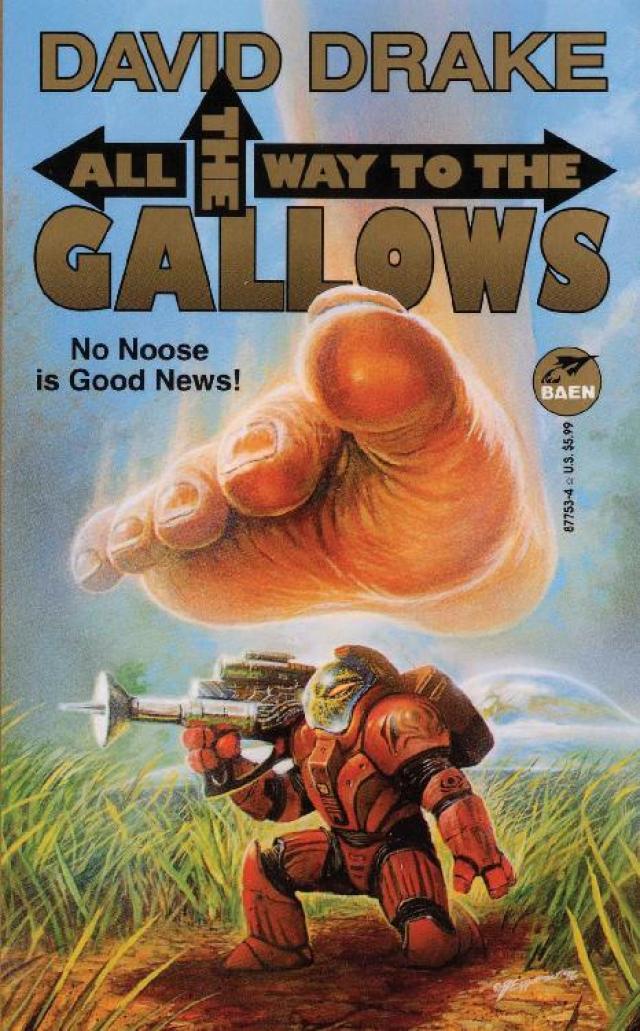
Cover art by Bob Eggleton
First printing, June 2004
Distributed by SIMON & SCHUSTER
1230 Avenue of the Americas
New York, N.Y. 10020
Printed in the United States of America
Electronic Version by Baen Books
www.baen.com
L. Sprague de Camp, one of the top writers of the Golden Age of Science Fiction (and still going strong!), was a great influence on me as an SF writer. Over the years I've encouraged Jim Baen to bring out new editions of some of Sprague's best work.
One of the pieces was "The Undesired Princess," a 1942 lead novel from John W. Campbell's legendary fantasy magazine Unknown Worlds. While some of the stories that appeared in Unknown/Unknown Worlds were pretty darned grim, the magazine's keynote was intensely logical fantasy with a lighter touch than, say, stories in Weird Tales. "The Undesired Princess" could stand as the paradigm for the "typical Unknown story."
The trouble with the piece is it's only 40,000 words long – too short for modern book publication. Jim said he'd republish the de Camp if I'd write a novelet in the same style to bind in with it.
I wrote "The Enchanted Bunny."
The Enchanted Bunny
Joe Johnson got into the little car of the airport's People Mover, ignoring the synthesized voice that was telling him to keep away from the doors. Joe was trying to carry his attache case – stuffed with clothes as well as papers, since he'd used it for an overnight bag on this quick trip to see the Senator – and also to read the wad of photocopy the Senator had handed Joe in front of the terminal "to glance through on the flight back."
The Senator hadn't wanted to be around when Joe read the new section. He must have thought Joe wouldn't be pleased at the way he'd handled the Poopsi LaFlamme Incident.
The Senator was right.
Joe sat down on a plastic-cushioned seat. At least the car was empty except for Joe and the swarthy man – was he an Oriental? – the swarthy Oriental at the far end. When Joe flew in the day before, he'd shared the ride to the main concourse with a family of seven, five of whom–including the putative father–were playing catch with a Nerf ball.
The doors closed. The People Mover said something about the next stop being the Red Concourse and lurched into gentle motion.
Joe flipped another page of the chapter over the paperclip holding it by the corner. It was about that time that I met a Miss LaFlamme, a friend of my wife Margaret, who worked, as I understand it, as a dancer of some sort....
Good, God Almighty! Did the Senator – did the ex-Senator, who was well known to be broke for a lot of the reasons that could make his memoirs a best-seller – really think he was going to get away with this?
The publishers hadn't paid a six-figure advance for stump speeches and homilies. They'd been promised scandal, they wanted scandal–
And the Senator's rewrite man, Joe Johnson, wanted scandal, too, because his two-percent royalty share was worth zip, zilch, zero if The Image of a Public Man turned out to be bumpf like this.
" ... stopping at the Red Concourse," said the synthesized voice. The car slowed, smoothly but abruptly enough that the attaché case slid on Joe's lap and he had to grab at it. More people got on.
Joe flipped the page.
–helping Miss LaFlamme carry the bags of groceries to her suite. Unfortunately, the elevator–
The People Mover shoop-shooped into motion again.
Joe tightened his grip on the case. One of the new arrivals in the car was a crying infant.
Joe felt like crying also. Senator Coble had been told about the sort of thing that would go into the book. He'd agreed.
An elevator repairman at Poopsi LaFlamme's hotel had lifted the access plate to see why somebody'd pulled the emergency stop button between floors. He'd had a camera in his pocket. That had been the Senator's bad luck at the time; but the photo of two goggle-eyed drunks, wearing nothing but stupid expressions as they stared up from a litter of champagne bottles, would be great for the back jacket. . . .
Except apparently the Senator thought everybody–and particularly his publishers–had been living on a different planet when all that occurred.
"In a moment, we will be stopping at the Blue Concourse," said the People Mover dispassionately.
Joe flipped the page. Unfortunately, pornographic photographs, neither of whose participants looked in the least like myself or Miss LaFlamme, began to circulate in the gutter press–
And the Washington Post. And Time magazine. And–
The car halted. The people who'd boarded at the previous stop got off.
Joe flipped the page. –avoided the notoriety inevitable with lega proceedings, because I remembered the words of my sainted mother, may she smile on me from her present home with Jesus. "Fools' names," she told me, "and fools' faces, are always found in public–"
Damn! Joe's concourse!
The People Mover's doors were still open. Joe jumped up.
The paperclip slipped and half the ridiculous nonsense he'd been reading spewed across the floor of the car. For a moment, Joe hesitated, but he had plenty of time to catch his plane. He bent and began picking up the mess.
The draft: might be useless, but it wasn't something Joe wanted to leave lying around either. The swarthy man–maybe a Mongolian? He didn't look like any of the Oriental races with which Joe was familiar–watched without expression.
The car slowed and stopped again. Joe stuffed the papers into his attaché case and stepped out. He'd cross to the People Mover on the opposite side of the brightly lighted concourse and go back one stop.
There were several dozen people in the concourse: businessmen, family groups, youths with back-packs and sports equipment that they'd have the dickens of a time fitting into the overhead stowage of the aircraft on which they traveled. Nothing unusual–
Except that they were all Japanese.
Well, a tourist group; or chance; and anyway, it didn't matter to Joe Johnson. . . .
But the faces all turned toward him as he started across the tile floor. People backed away. A little boy grabbed his mother's kimono-clad legs and screamed in abject terror.
Joe paused. A pair of airport policemen began running down the escalator from the upper level of the concourse. Joe couldn't understand the words they were shouting at him.
The policemen wore flat caps and brass-buttoned frock coats, and they were both drawing the sabers that clattered in patent-leather sheaths at their sides.
Joe hurled himself back into the People Mover just as the doors closed. He stared out through the windows at the screaming foreign crowd. He was terrified that people would burst in on him before the car started to move–
Though the faces he saw looked as frightened as his own must be.
The People Mover's Circuitry shunted it into motion. Joe breathed out in relief and looked around him. Only then did he realize that he wasn't in the car he'd left.
There were no seats or any other amenities within the vehicle. The walls were corrugated metal. They'd been painted a bilious hospital-green at some point, but now most of their color came from rust.
Scratched graffiti covered the walls, the floor, and other scribblings. The writing wasn't in any language Joe recognized.
Joe set his attaché case between his feet and rubbed his eyes with both hands. He felt more alone than he ever had before in his life. He must have fallen and hit his head; but he wasn't waking up.
The car didn't sound as smooth as a piece of electronics any more. Bearings squealed like lost souls. There was a persistent slow jarring as the flat spot in a wheel hit the track, again and again.
The People Mover–if that's what it was now–slowed and stopped with a sepulchral moan. The door didn't open automatically. Joe hesitated, then gripped the handle and slid the panel sideways.
There wasn't a cr
Joe got out of the vehicle. It was one of a series of cars which curved out of sight among twisted buildings. The line began to move again, very slowly, as Joe watched transfixed. He couldn't tell what powered the train, but it certainly wasn't electric motors in the individual cars.
There was a smell of sulphur in the air, and there was very little light.
Joe looked up. The sky was blue, but its color was that of a cobalt bowl rather than heaven. There seemed to be a solid dome covering the city, because occasionally a streak of angry red crawled across it. The trails differed in length and placement, but they always described the same curves.
The close-set buildings were three and four stories high, with peak roofs and many gables. The windows were barred, and none of them were lighted.
Joe swallowed. His arms clutched the attaché case to his chest. The train clanked and squealed behind him, moving toward some unguessable destination. . .
Figures moved half a block away: a man was walking his dogs on the dim street. Claws or heel-taps clicked on the cracked concrete.
"Sir?" Joe called. His voice sounded squeaky. "Excuse me, sir?"
They were very big dogs. Joe knew a man who walked a pet cougar, but these blurred, sinewy forms were more the size of tigers.
There was a rumbling overhead like that of a distant avalanche. The walker paused. Joe looked up.
The dome reddened with great blotches. Clouds, Joe thought–and then his mind coalesced the blotches into a single shape, a human face distorted as if it were being pressed down onto the field of a photocopier.
A face that must have been hundreds of yards across.
Red, sickly light flooded down onto the city from the roaring dome. The two "dogs" reared up onto their hind legs. They had lizard teeth and limbs like armatures of wire. The "man" walking them was the same as his beasts, and they were none of them from any human universe.
A fluting Ka-Ka-Ka-Ka-Ka came from the throats of the demon trio as they loped toward Joe.
Joe turned. He was probably screaming. The train clacked past behind him at less than a walking pace. Joe grabbed the handle of one of the doors. The panel slid a few inches, then stopped with a rusty shriek.
Joe shrieked louder and wrenched the door open with a convulsive effort. He leaped into the interior. For a moment, he was aware of nothing but the clawed hand slashing toward him.
Then Joe landed on stiff cushions and man's lap, while a voice said, "Bless me, Kiki! The wizard we've been looking for!"
"I beg your pardon," said Joe, disentangling himself from the other man in what seemed to be a horse-drawn carriage clopping over cobblestones.
It struck Joe that he'd never heard "I beg your pardon" used as a real apology until now; but that sure wasn't the only first he'd racked up on this trip to Atlanta.
The other man in the carriage seemed to be in his late teens. He was dressed in a green silk jumper with puffed sleeves and breeches, high stockings, and a fur cloak.
A sword stood upright with the chape of its scabbard between the man's feet. The weapon had an ornate hilt, but it was of a serviceable size and stiffness. Joe rubbed his nose, where he'd given himself a good crack when he hit the sword.
A tiny monkey peeked out from behind the youth's right ear, then his left, and chittered furiously. The animal wore a miniature fur cloak fastened with a diamond brooch.
The monkey's garment reminded Joe that wherever he was, it wasn't Atlanta in the summertime. The carriage had gauze curtains rather than glazing over the windows. Joe shivered in his cotton slacks and short-sleeved shirt.
"I'm Delendor, Master Sorceror," the youth said. "Though of course you'd already know that, wouldn't you? May I ask how you choose to be named here in Harnisch?"
Kiki hopped from Delendor's shoulder to Joe's. The monkey's body was warm and smelled faintly of stale urine. It crawled around the back of Joe's neck, making clicking sounds.
"I'm Joe Johnson," Joe said. "I think I am. God."
He clicked open the latches of his attaché case. Everything inside was as he remembered it, including the dirty socks.
Kiki reached down, snatched the pen out of Joe's shirt pocket, and hurled it through the carriage window at the head of a burly man riding a donkey in the opposite direction.
The man shouted, "Muckin' bassit!"
Joe shouted, "Hey!"
Delendor shouted, "Kiki! For shame!"
The monkey chirped, leaped, and disappeared behind Delendor's head again.
"I am sorry," Delendor said. "Was it valuable? We can stop and . . . ?"
And discuss things with the guy on the donkey, Joe thought. "No thanks, I've got enough problems," he said aloud. "It was just a twenty-nine-cent pen, after all."
Though replacing it might be a little difficult.
"You see," Delendor continued, "Kiki's been my only friend for eight years, since father sent my sister Estoril off to Glenheim to be fostered by King Belder. I don't get along very well with my brothers Glam and Groag you know ... them being older, I suppose."
"Eight years?" Joe said, focusing on a little question because he sure-hell didn't want to think about the bigger ones. "How long do monkeys live, anyway?"
"Oh!" said Delendor. "I don't–I'd rather not think about that." He wrapped his chittering pet in his cloak and held him tightly.
Joe flashed a sudden memory of himself moments before, clutching his attaché case to his chest and praying that he was somewhere other than in the hell which his senses showed him. At least Kiki was alive. . . .
"Estoril's visiting us any day now," Delendor said, bubbly again. Kiki peeked out of the cloak, then hopped to balance on the carriage window. "It'll be wonderful to see her again. And to find a great magician to help me, too! My stars must really be in alignment!"
"I'm not a magician," Joe said in a dull voice. Reaction was setting in. He stared at the photocopied chapter of the Senator's memoirs. That sort of fantasy he was used to.
"After you help me slay the dragon," Delendor continued, proving that he hadn't been listening to Joe, "I'll get more respect. And of course we'll save the kingdom."
"Of course," muttered Joe.
Kiki reached out the window and snatched the plume from the helmet of a man in half-armor who carried a short-hafted spontoon. The spontoon's ornate blade was more symbol than weapon. The man bellowed.
"Kiki!" Delendor cried. "Not the Civic Guard!" He took the plume away from his pet and leaned out the window of the carriage as the horses plodded along.
"Oh," said the guardsman–the cop–in a changed voice as he trotted beside the vehicle to retrieve his ornament. "No harm done, Your Highness. Have your little joke."
"Ah... " Joe said. "Ah, Delendor? Are you a king?"
"Of course not," Delendor said in surprise. "My father, King Morhaven, is still alive."
He pursed his lips. "And anyway, both Glam and Groag are older than I am. Though that wouldn't prevent father.... "
Joe hugged his attaché case. He closed his eyes. The carriage was unsprung, but its swaying suggested that it was suspended from leather straps to soften the rap of the cobblestones.
God.
"Now," the prince went on cheerfully, "I suppose the dragon's the important thing ... but what I really want to do is to find my enchanted princess."
Joe opened his eyes. "I'm not . . ." he began.
But there wasn't any point in repeating what Delendor wouldn't listen to anyway. For that matter, there was nothing unreasonable about assuming that a man who plopped out of midair into a moving carriage was a magician.
The prince opened the locket on his neck chain and displayed it to Joe. The interior could have held a miniature painting–but it didn't. It was a mirror, and it showed Joe his own haggard face.
"I've had the locket all my life," Delendor said, "a gift from my sainted mother. It was the most beautiful girl in the world–and as I grew older, so did the girl in the painting. But only a few weeks ago, I opened the locket and it was a rabbit, just as you see it now. I'm sure she's the princess I'm to marry, and that she's been turned into a bunny by an evil sorceror."