

Demon Night, page 1


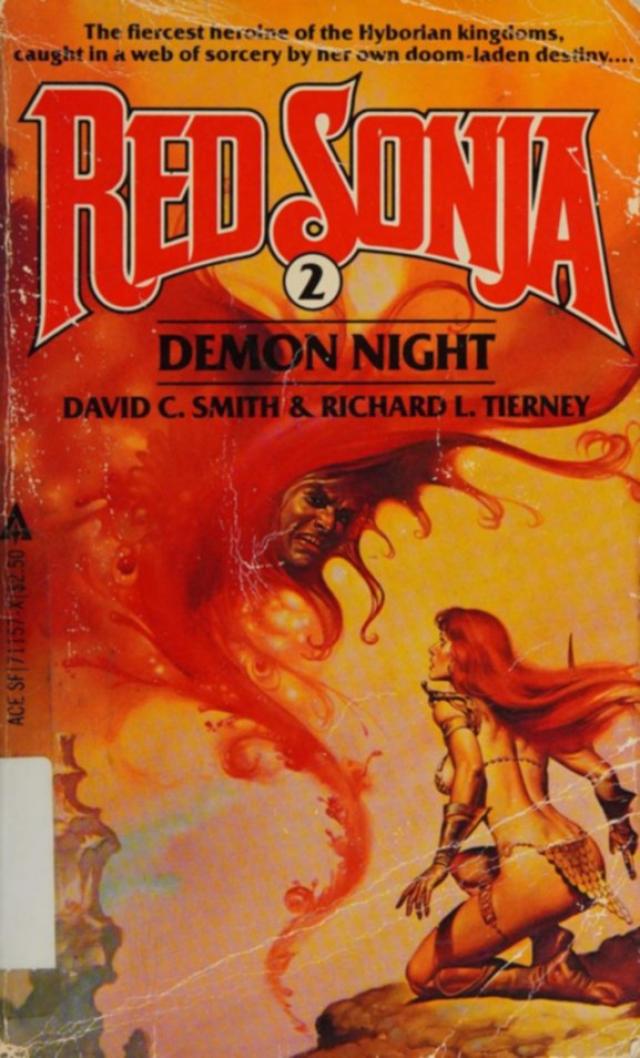
Table of Contents
Front Cover
Prolog
PART I:
Chapter One
Chapter Two
Chapter Three
Chapter Four
Chapter Five
Chapter Six
Chapter Seven
PART II:
Chapter Eight
Chapter Nine
Chapter Ten
Chapter Eleven
Chapter Twelve
Back Cover
“Know also, O prince, that in those selfsame days that Conan the Cimmerian did stalk the Hyborian kingdoms, one of the few swords worthy to cross with his was that of Red Sonja, warrior-woman out of majestic Hyrkania. Forced to flee her homeland because she spurned the advances of a king and slew him instead, she rode west across the Turanian Steppes and into the shadowed mists of legendry.”
—The Nemedian Chronicles
PROLOGUE
Before I left my cradle—at my birth—
My road was laid and every thorn was strewn;
My heritage is the waste lands of the earth,
My heart strings turned to one long changeless groan.
Before I saw the light of day my cup
With wormwood, gall and venom was filled up.
—Robert E. Howard:
“The Years Are as a Knife”
She awoke with a start, throwing back her blanket, sitting up on the cot and reaching for her knife, all in one motion. The hoarse yells that had awakened her rose again, from somewhere deep within the walls of the fortress, carrying a message which she sensed spelled danger for her.
“Captain Vos is dead—murdered! Captain Vos is murdered!”
With the lithe surety of a cat the woman rose soundlessly, placed her booted feet to the floor. drew knife from scabbard and stood tall, waiting. In the ghostly gray light of pre-dawn the facets of her scale-mail glinted dimly.
Footsteps sounded down the hall—many footsteps—together with the clank of armor and the scrape of metal being drawn from sheath and scabbard. Silently the woman waited, right hand upraised and holding her knife, left paused tensely on sword pommel. The footsteps sounded closer—closer—and then her door was kicked in.
“Hyrkanian she-devil!”
She crouched back in the sudden glare of light, shoulders against the closed window shutters. The flickering torches limned her scarlet mane and gave her smooth flesh a pallid tint.
“That’s her!”
“Take her!”
One of the men laughed brutally—a tall, dark-bearded man with fiercely gleaming eyes. Coming ahead with his knife held ready, he said:
“What, Red Sonja—no blood on your dagger? Cleaned the steel so soon, hey? Did you think we wouldn’t suspect you—outlander?”
The woman called Red Sonja straightened; the knife in her fist twitched dangerously; her sapphire eyes darted from one scowling face to another. “Vos is dead?” she asked.
“Don’t claim you didn’t know!” shouted a stout rogue from the rear of the throng that crowded her door. “Lieutenant Keldum saw you!”
“Keldum!” Sonja’s eyes flashed back to the bearded man who had first accused her. “You say you saw me slay Vos?”
Keldum smiled confidently, arrogantly. “Aye, she-devil of Hyrkania. And now—”
“You lie!” Her hand jerked back and flashed forward, and a streak of bright silver leapt from her fingers.
Keldum had not guessed her sudden action. It was only his reflexes that saved him from the thrown dagger—and perhaps the fact that Sonja was still slightly tired from her slumber. It was not Keldum who took her dagger in the throat but the rogue behind him. Keldum heard the man go down, gargling and gasping as Sonja’s steel drove through his gullet.
Sonja drew free her sword, smashed open the shutters behind her, leaped to the stone sill and dropped. Her room was on the ground floor; she struck the grass instantly and began running even before she had fully regained her balance.
Keldum led the charge to the window. “Stop her!” he bellowed. “I want her alive!”
“Take her!” yelled another.
“Where’s the patrol?”
“Get that Hyrkanian woman!”
Keldum jumped through the window and the others shoved through behind him, stumbling and crowding in their haste. Red Sonja made it to the nearby stables, leapt astride her saddled roan, jerked its rein, and galloped from the place. The roan’s hoofs kicked up mud and dirt as it raced through the ground-hugging morning mists, away from the yells and gesticulations of Lieutenant Keldum and his angry soldiers.
“Where’s the patrol?” roared Keldum. “Ten pieces of silver for the man who takes her!”
“Close the gates!”
“Take that woman!”
She did not ride for the gates, which were closing, but for a small, torchlit postern in the southern wall. The two guards there, roused from sleep by the commotion, snatched up their spears. Then they began to vie with one another, pushing and shoving for position. The lieutenant’s reward-offer was working against him.
Reckless in his wrath, Keldum tore the bow from a nearby soldier, nocked an arrow and let fly at Sonja’s horse. The arrow sped high in the uncertain light, barely missed Sonja and buried itself in the wall of the fort.
“Mitra!” Keldum swore in disgust and threw the bow into the mud. “Guards! You at the postern—stop her!”
But Red Sonja was too quick. She lunged for the postern gate, her hands a blur; behind her she left a trail in the mud—one guard with a gash through his throat, another with a split skull.
“To the stables!” Keldum roared madly. “Get your horses and provisions—quickly. I want that woman!”
His soldiers hesitated, uncertain whether to follow his commands but wary of his temper.
“Vos is dead—I’m captain of this fort now,” Keldum yelled, shaking his fists in the air. “I want a troop of men to go with me. Gevem—take the men! Get provisions! She’ll not escape justice!”
He’s become as a madman, Gevem thought as he hurried to the stables. The red-haired witch has wrapped him in some sorcery.
And Keldum watched, standing still, shivering with tension and anger at being thwarted, as the Hyrkanian woman sped on horseback, far south and east, into the steppeland—a tiny dot of movement lit by the rising sun of the new day.
PART I:
Saureb
Let obscene shapes of Darkness ride the earth,
Let sacrificial smokes blot out the skies,
Let dying virgins glut the Black Gods’ eyes,
And all the world resound with noisome mirth.
—Robert E. Howard:
“Which Will Scarcely Be Understood”
Chapter One
East of Zamora Sonja rode, beyond the border fort that had been the command of the late Captain Vos. The land dipped low and wide and flat, with waving grasses. To the east were the deep forests and dark rivers and cool highlands that Sonja remembered from her girlhood—beyond the kingdom of Turan and the Sea of Vilayet. But here, where she rode, was a limbo between the Hyrkanian lands and the western world. It was a naked land—not quite a desert, perhaps, but worth nearly as little to anyone passing through. At midday, despite a sun, the skies above this steppeland were gray and hazy, as bleak as the land itself.
Red Sonja rode alone through the sparse bunch-grass and the stunted thorn trees, and she rode quickly, the only figure of life out on the still, vacant expanse—a tall woman on a roan, both worn from three days of relentless travel. She wore a short, sleeveless tunic of scale-mail armor, light but protective enough for this clime, though inadequate for heavy battle. At her hip hung a longsword—as heavy and dutiful a weapon as any warrior’s. Other than her mail, boots and doeskin gloves, she wore naught; her limbs were bared to the warming sun, and her fiery red hair streamed loose in the breezes. She held her horse’s reins securely, urging it on without desperation.
She swivelled in her saddle and looked behind, watching for signs of pursuit. Far away sat the low hills she had passed over this morning; she could not discern upon their gentle slopes any sign of the rogues who followed her. Yet that meant nothing. They might be hidden in a dip or a valley; they might be far closer than she imagined, despite the lead she had managed at the outset.
“Fools! Dogs!” she muttered to herself. “Give chase to me, Keldum, and by Erlik, I’ll gut you and every Zamoran in your—!”
Suddenly, far behind her, Sonja spied kites and vultures gathering, ringing in a lowering wheel—small black dots hovering, far away against the gray clouds of the north.
Over what? A victim of Keldum’s temper, left to rot? Refuse from his last camp?
Most likely. Sonja had encountered no other signs of life out here in three days.
But she saw nothing else. She faced south again, studied the low, harsh terrain and sighed heavily at the sight of endless steppe, somber skies and dull sun. How much longer could she subsist on thorn apples and roots? Mitra! What evil star had guided her since her birth? What vindictive fate had chosen to force upon her homeless wanderings since her girlhood? And now—how fast and how far must she flee to be safe from this latest mischance that Fate had laid on her shoulders?
Captain Vos had been a pig—a sorry example for an officer in command of a border fort on some far-flung frontier. Chance had led Sonja—already worn and road-weary— to Vos’ fort. Vos had been intrigued by Red Sonja’s sword and scale-mail, but more by the way her fl
Keldum, she felt certain, had slain him. Keldum—proud, vain, ambitious, no doubt, for Vos’ captaincy. And, like Vos, he had followed her every move with burning eyes.
She sighed, prodding on her mount. The sun was sinking toward the west, and Sonja felt her energy dropping with it. She came upon a small, shallow pond; the water in it was old and turning stagnant, but it nourished her weary mount. At the top of a small hill in the brown, wind-blown sea of dry grass, Sonja looked back for Keldum and his troops—and spotted them. She guessed that she was a half day’s journey ahead.
But if she had spotted Keldum and his men, then surely they had spied her as well.
The sun died slowly, losing itself in the thin branches of silhouetted scrub trees to the west. Purple and gray shadows began slowly to fill up the hollows like dark waters pooling across the land. Sonja saw the low moon, waxing toward full, grow visible amid the deepening gray and purple of the eastern sky, along with a sprinkling of stars.
But there were no other travelers—no herdsmen or riders, no Caravans or mounted troops. Upon all the vast face of the steppeland, where the timeless wind of the earth blew, there was no one save Sonja herself and the pursuers behind. She wondered at that, more than casually. These were inhospitable lands, to be sure, yet adequate for grazing and bounded on the west and east by Zamora and Khauran, Turan and Shem—important nations of strength and arms and wealth. Why, therefore, no hint—not a trace—of caravans or mounted bands of nomads?
Strange, indeed, thought Sonja.
She looked behind again, in the dying light of the day, but could no longer see Keldum and his troops against slope or grassland. The air was becoming chilly.
Tired, she pressed on. Her roan, she knew, was nearly exhausted. It would not do to push the animal beyond its limits. She felt the labored breathing of its lathered sides, the ribs working strongly between her thighs, the head drooping on the tired neck. Not far ahead appeared a grove—a small cluster of short thorn trees and berry bushes atop a hillock. Little protection, truly, but good for rest, and the hillock would afford a vantage position.
Dismounting, Sonja led her horse up the slope. Day had nearly vanished; the moon shone pale and clear, and she saw well enough by its light to make her way briskly. “Easy, now,” she whispered to her mount, coaxing it, - stroking its muzzle. “We’ll rest here a while, eat a bit and—”
Then, gaining the top of the hillock, Sonja saw lights — through the thin curtain of trees.
Lights, in the south.
“Erlik!”
They were stationary lights, many of them, betraying but dimly the walls and towers of some habitation of man. A small city, perhaps, but—here? In the midst of this wasteland?
A city, where she had seen no sign of rider nor army nor caravan for over three days?
Sonja led her horse to a berry bush, tied it, stretched her weary muscles and combed her hair back with her hands. She turned to the north again and looked down into the low, broad plain that had taken her three days to cross.
She had suspected all along that the terrain here gradually sloped upwards; now, from atop this hillock, Sonja saw that the land farther south dipped as well, but more sharply—a shallow bowl in the midst of the steppeland, small but effectively hemmed in by hill and mountain and outcropping. There was even a low mountain range to the west.
A small, hidden valley with a lighted city in its center.
“Erlik’s tears!” Sonja muttered. The night cooled about her, a chill breeze touched her, and for a moment she shivered.
Her horse coughed in its exhaustion. Sonja held its reins again and stroked its neck.
“Just a bit farther, then,” she said, soothing her mount, “and we’ll have a home for the night. An inhabited city. Surely, whoever’s down there can spare some straw and water and bread.”
As if for luck, or out of habit, Red Sonja lightly touched her sword pommel, reminding herself of it, before gathering up her horse’s reins once more and leading it down the south side of the hillock.
How faraway the city lay, she could only guess. Its lights, however, were not greatly obscured or misted by long distance; and although no sounds carried to her through the still night, Sonja thought she would reach the gates soon.
At the foot of the hillock, she mounted her roan again and slapped it ahead, feeling a surge of new vitality from the animal. And so Red Sonja rode down into the valley, away from the grove and her distant pursuers, towards the lights of the strange city, while the white moon shone low in the wind-breathing skies.
* * *
Captain Keldum was a large man—tall, heavily muscled, stern-visaged, a warrior and a son of warriors. He was also a man of violent passion and iron will—and tonight his temper was as dark as the sky beyond the pale moon, and growing darker.
He sat on his steed staring south, across plains dimmed by the fallen night, spying no sign of the renegade Hyrkanian woman.
“She rides fast,” said Gevem, his second-in-command. “Was it necessary to pursue her so far, and with this large a force? Perhaps we should let her—”
“Fools!” Keldum snarled. His anger caused Gevem and the other soldiers near him to look away. “Did you think Mitra would lead her into our hands? Did you think the sun would help us to track her? A woman!” Keldum’s eyes hardened as the possibility of failure grew in his mind. Then, suddenly, he laughed. “That Hyrkanian she-devil has made fools of all of you—and left Captain Vos’ death unavenged, unless we return with her.”
Two hundred soldiers sat silent on horseback, scratching their beards or spitting off to the side. But none dared answer him in his unpredictable mood—not even Gevem, his right-hand man.
Keldum’s agitation subsided; he shot a stern glance at Gevem, and Gevem coughed uneasily and nodded toward the south.
“We spotted her just as the sun went down, Captain. If we follow the stars, we’ll have her before the moon sets—with luck.”
“Aye, if she camps, Gevem—and if our horses don’t give out first, and if these sons of dogs could make better time under moonlight than sunlight. How much longer do you think our mounts can carry us without rest? Red Sonja would like it if we ran ourselves to death, by Anu!”
Gevem sighed heavily and eyed the horizon.
“No, Gevem, no,” Keldum growled decisively. “We make camp. Here.” He slapped his hands together and called out to his troops: “Dismount, and bivouac. We’ll take up the search in the morning.” Then he swung down from his horse and turned to Gevem. “We’ll divide ranks. I’ll take half the troop to the southeast before dawn, you take the others due south. We’ll find the witch. She may circle east to head back toward her homeland, and I’m not going to allow that.”
“Understood, Captain.” Gevem nodded, slapped his chest, and dismounted with a tired groan. Keldum nodded shortly, led his horse to a stump and took down his bedroll, preparing himself for the night some distance away from the men of his command.
The moon rose high. The Zamorans arranged themselves in a circle in the dry grass, but did not build the fires that might give away their location. They ate their rations cold, washing them down with water or tepid wine. Some passed the time with small talk; others, barely able to move, made to sleep.
Gevem strolled among the men and wondered why his commanding officer found it so necessary to catch the Hyrkanian; avenging Vos’ death could not mean all that much to Keldum. With a weary sigh he sat himself under a scrub bush, fumbled with the cork of a wineskin—and heard the approach of one of the soldiers.
A lean, craggy-visaged man with a tattoo on his forehead came over to Gevem and sat beside him in the moonlight.
“Keldum makes you angry with his temper?” he whispered. “He makes you wonder why he chases the flame-haired woman? Aye, I know—Keldum’s tongue is a whip, and his temper like a serpent—quick to strike, never apologetic.”
Gevem shrugged warily. The man was Peth, one of many mercenaries who had drifted into the patrol service, probably to collect a few months’ pay and drift on. But Gevem had overheard some of the men’s small talk about Peth.


