

The Harrowing of Doom, page 2
part #1 of Marvel Untold Series
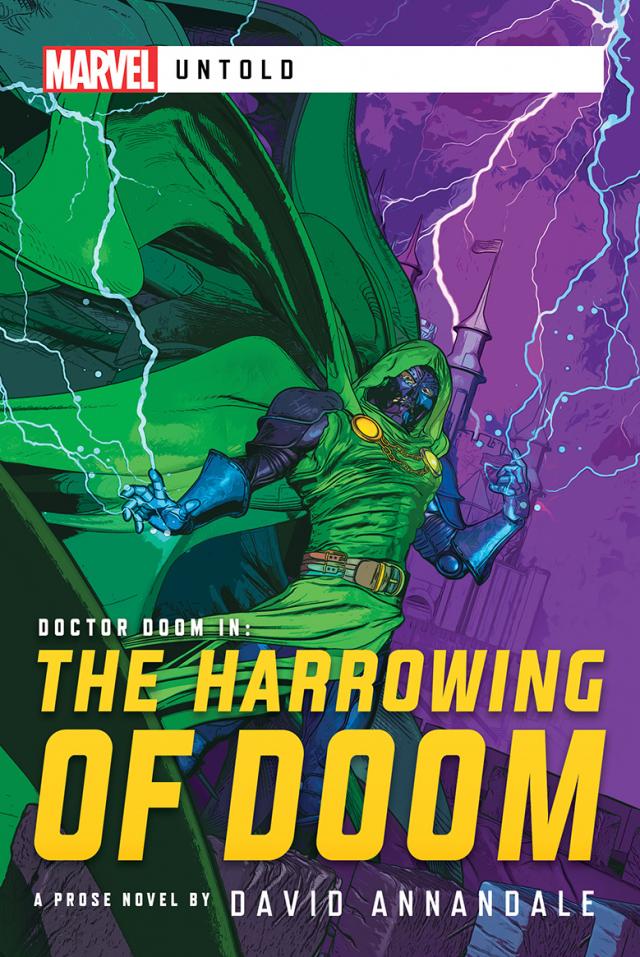


My terms, though you do not know it.
“Maria von Helm,” he called. “Doom has come, and will speak with you.”
He waited. The wind blew his cape, but he was as still as the stone. He waited, knowing she had heard him. He was immovable as the mountain, and more patient. She would answer him before he spoke again.
The cave entrance extended less than ten feet into the mountainside before it turned sharply, hiding the rest of the dwelling from the outside. After several minutes, a shadow appeared around the wall, preceding the emergence of the witch of Sivàr.
She walked slowly toward Doom, stopping just before the threshold. The few feet that separated them might as well have been a gulf of leagues. The sorceress stood straight, though she showed the erosion of her haunted years. She would have been in her seventies, but she had the lines of someone who had experienced thirty years more. Her eyes were dark, barely visible beneath her lids, and glinted with power. Her grey hair was cut short, as if roughly hacked with a knife. She wore a simple black robe whose edges blurred with the shadows of the floor. Her expression was wary, defiant.
“Why are you here?” Helm asked.
“There is something we must do together.”
She grunted. “I don’t think so. We have never had anything to do with each other. It is better that way.”
“Only that isn’t really, true, is it?” said Doom. “The past has a common hold on us.”
“That past is long dead.” Helm shifted, as if preparing to leave.
Doom remained motionless. He was not going anywhere. “It is the past that brings me here,” he said. “It is the past that means you will agree that we must work together. I do not think you will turn your back on Cynthia von Doom a second time.”
Helm jerked as if struck. “I never turned my back on her,” she murmured.
Doom said nothing, waiting.
“I failed her,” Helm said, the truth as hard to contain now as grief had been all those years ago. Her voice was heavy with more than forty years of guilt.
Cynthia von Doom had been Helm’s friend, and her mentor. Helm had learned from her, studied with her. “You fought at her side against Baron Vladimir Fortunov,” Doom said. “You tried to stop his atrocities against our Romani clan. You were not at her side the night she died, though.”
She did not deny it. “I tried to stop her from summoning Mephisto. I knew the cost would be too high.”
“You knew the power he gave her would kill the innocents she wanted to protect?”
“I didn’t know what the cost would be. Just that it would be terrible. I tried.”
“‘I tried,’” Doom repeated. “How often do we use those words to excuse our failure?”
Helm was silent.
“All the time,” Doom said, answering his own question. “We use them all the time. Oh, I have tried too, sorceress. I have tried.” He bit the words off and spat them out. “I have fought for my mother’s soul, year after year after year, and I have failed her, failed her, every single time. I did not stop fighting for her, though. Why did you?”
Again, no answer.
“I finished the work that you and she began. You did not defeat Baron Vladimir. Quite the reverse. He became King Vladimir, and then his persecutions truly knew no limits. I stopped them. I slew the king.”
“Our grief took us in different directions,” Helm said.
It certainly did. Helm had withdrawn from the world after Cynthia’s death. She had delved deeper and deeper into the occult sciences, growing in wisdom and power. Yet that power had been idle, doing little more than warning off any who would wish Helm harm, or seek to conscript her to their cause. Helm’s single focus had been to prepare for her own inevitable encounter with the powers of Hell. She had been present when Cynthia had summoned Mephisto, and Hell never forgot anyone who drew its attention.
Her obsession meant that she and Doom had lived by an unspoken contract. She did not seek to interfere with his governance of Latveria, or in any of his projects. In return, he ignored her and let her be. They had never spoken. He had been an infant the last time she had tried, tried, to alter the course of events in Latveria for the better.
“And this is where your grief took you,” said Doom. “Your grief, and your fear. This is where you have been hiding for all these years. Perhaps you do not like to think of this as a hiding place. Retreat, a sanctuary, a strong point. Are these the words you would prefer? Are they the lies you wish would give you peace?”
“I have no peace.”
“I believe you. Neither do I.”
“I believe you, too,” said Helm. “But even though the past imprisons us, that is not enough to make me work with you.”
“Yet you will.”
“Oh? Do you think you can force me? Are you going to match your sorcery against mine?”
“We might both prefer that I do not,” Doom said calmly. “Nor do I have to, because you will not refuse me.”
“I already have,” said Helm. “There is nothing you can say that would interest me.”
There were few who had dared speak like that to him who were still alive. He felt no anger today, no ruffled pride. Her defiance amused him, because he knew how this encounter would end. “And if I said you could liberate yourself from the past?” said Doom. “If I showed you the chance of redemption?”
That held her. She breathed in heavily, then exhaled, her sigh becoming a plea. “How?”
“By freeing the soul of my mother.”
Her eyes had widened with hope. Now they narrowed again. “Do not try to fool me with a false dream,” she said. “Of course I would wish to free her. That means more to me than you know.”
I know exactly what it means to you. It would mean not just that you had made amends to the past, but that there was hope for your own escape from Hell’s clutches.
“But I know what happens on Midsummer Night,” Helm continued. “The tremors from your battles reach even to here. I cannot join you in them. There is no hope there. There is only futility.”
“Of course there is,” said Doom. “That is why I do not ask you to join me in the Midsummer rite. I know I cannot change the outcome of those duels. I am no longer interested in making Hell agree to release her. I will no longer play its game to its preordained conclusion.”
“What do you plan to do?”
He had her interest again.
“I am going to storm the gates. I am going to harrow Hell.”
The sorceress stared at Doom. Disbelief and hope and excitement chased each other over her face. He had spoken to her fears and her regrets, and he had her now. This is your moment of capitulation. You’ll realize that, perhaps, in times to come.
“You can do this?” Helm croaked.
“With your help. Our mastery of sorcery is different, because our disciplines of focus are different. United, imagine our power. Remember what you and my mother could do together. Imagine that a thousand-fold. You and I will lay siege to Hell, and it will not withstand us.”
Helm gazed at him. Doom sensed her trying to take his measure, and weighing the risk of destruction against the end of fear. At last, she said, “Yes.”
That was all. A single word, barely loud enough to hear over the wind. With it, Helm committed herself to the full scope of the great work that lay ahead of them. With it, she made herself his more than she could possibly imagine.
Helm took a step back and to the side. The runes on the standing stone faded away. Victorious, Doom entered.
“Let us speak of the triumph to come,” he said.
Chapter 2
It was two days after the Walpurgis Night celebrations. The remains of the bonfire in the square before St Peter Church had still not been entirely cleared away. The blackened logs marred the central paving stones. It was raining, and ashy water ran in streaks from the dead fire. The blot nagged at Father Grigori Zargo as he stood in the shelter of the church porch after vespers, seeing off his parishioners as they filed out. He avoided looking at it, resolutely concentrating on the faces of the people as they stopped to speak with him, but it was there in the corner of his eye, the flaw that could not be ignored.
Zargo mouthed blessings and pleasantries. They came too easily, too automatically, and his mind kept turning to the bonfire. He wondered, as he did every year, if the delay in the clearing of the square was the result of a deliberate policy. He wondered if it amused Doom for the remnants of the pagan rite to linger outside the church, as if a point were being made about their equal standing in Latveria. Because that was how Zargo saw the Walpurgis Night celebrations. They were utterly removed from any Christian sense of the date. Older beliefs had taken over. The fact that a saint had given her name to the night was forgotten. In Latveria, the night roiled with the occult, the magical, the superstitious. Evil was fought with other evil. If Doom was making a point, it wasn’t necessary. Zargo hardly needed reminding. After all, almost every person he now greeted he had seen dancing before the bonfire. He was painfully aware of the retreating tide of faith.
One of the faces drew his full attention. “Hello,” he said to Ilona Sandor. “It’s good to see you.”
“You too, Father.” Sandor took his hand and smiled.
They had known each other a long time. They had been friends since childhood, and that, as Zargo measured the years, was two lifetimes ago. For a time, they had followed the same calling as adults. Over ten years ago, his had changed. More grey in his beard now. More grey in Sandor’s red hair, too.
Thunder rumbled, and the rain came down more heavily, white sheets of water hammering pavement. People hurried out of the square, but Sandor lingered.
“Nasty evening,” she commented.
“You were lucky to be spared this on Walpurgis Night,” said Zargo, unable to keep all the bitterness from his tone.
“We were,” Sandor agreed.
“Did you enjoy yourself?” he asked.
She gave him a knowing look. “Yes. Yes, I did. You saw me?”
“I saw everyone in the square.”
“You spent the night in the church again.” In prayer. Or at least, as much as he could, when he wasn’t driven to punish himself by watching the revels.
“Yes.”
She sighed. “Why do you put yourself through that every year?”
“Because I have to. Does anyone remember that Walpurgis is the name of a saint?”
“Oh, I’m sure they do,” Sandor said, avoiding his gaze.
“Did you?”
She grimaced apologetically.
“You see? The pagan rite is so strong, it’s taking the name away from the saint. It’s turning Walpurgis into a word that means witchcraft. Especially here.”
“And you’re going to turn that around by yourself, through prayer?”
“Probably not. But I still have to try.”
Sandor put a hand on his arm. “You’re too hard on yourself. And on us. St Peter was not empty this evening. It won’t be tomorrow, either, or the next day.”
“What does that mean?” This was not a question he would have asked anyone else. It would be wrong for him to show distress to his flock, especially distress that could be interpreted as doubt. His and Sandor’s paths had diverged, and they had grown apart, but they were still close. She knew him better than anyone else. “What is the nature of the faith being practiced here?”
Sandor laughed uneasily. She glanced at the sheeting rain, then said, “That sounds like the opening to a conversation better suited to a quiet booth in a tavern.”
“Please don’t make light of this,” said Zargo.
“I wasn’t trying to.”
“Then please tell me, what does it mean for you, Ilona, to take part in opposed communions?”
“That isn’t something I’ve ever given thought to.”
Zargo pressed harder. “Are your prayers in here any different from the chants on Walpurgis Night? Are they just another form of incantation?”
Sandor wasn’t laughing now. “How far are you going to take these questions, Grigori?” she asked softly. She looked around again, nervously this time, and when she faced him, her expression was stern. “Remember where we are.”
This is Latveria. “Sorry,” said Zargo. If he had gone much further, he might have said something that might reach the wrong ears. He had verged on condemning witchcraft. “I must be tired.” Now there was an incantation. It was the formulated phrase that washed away all seriousness from the words that came before it. Just overtired. I didn’t mean anything. Don’t listen to me.
“That must be it,” Sandor said. “Get some rest. You’ll feel better.”
Zargo nodded, sad that this, like so many other conversations in his life, had to end before it had truly begun, and cancel itself out. He and Sandor would utter pleasantries now, and then part. Nothing has happened. There is nothing to see. There is nothing to question us about. “Blessings upon you,” he said.
“Thank you, Father. And with you.”
There. The standard phrases, void of real meaning, serving only to ease the social mechanics of departure.
Sandor left the shelter of the porch and jogged off across the square. Zargo watched her until she vanished, and with her the conversation they might have had. He stared at the rain, and at the vague, dark blot of the bonfire remains. Then he stepped out into the downpour and walked slowly towards the site of the burn. He was drenched in seconds. Water slicked his hair and poured down his neck. It ran into his eyes, and he had to keep wiping his face just to be able to see where he was going. He sloshed through puddles, his cassock taking on extra pounds of sodden weight.
He stopped in front of the blackened bones of the bonfire and let the storm beat down on him.
So. What was the point of all that? What did he really think he could accomplish? Was he trying to browbeat Sandor into some kind of repentance?
I wouldn’t do that to her. I wouldn’t be that unfair.
Only he had come very close to doing precisely that.
Let him who is without sin cast the first stone.
He winced and took his penance under the rain. He had no right to chastise Sandor or any other member of his congregation, not with his history. No one who knew anything about Latveria had the right to condemn its people for hypocrisy. Not when their absolute monarch was a sorcerer. Not given the things that every Latverian knew to be true about the supernatural, things that did not require faith because dark miracles were witnessed so often, they might seem mundane if they were not so terrifying.
What chance did mere faith have against the omnipresent reality of witchcraft?
This is the way things are.
He stared at the soaked, charred logs, and tried not to turn them into a metaphor for his struggle. He could not change anything in Latveria. Yet he had to try. And yet he could not fight as hard as he might without incurring the wrath of its ruler. This was his paradox. He wanted to be a rock and a refuge for his flock, but he did not want to be noticed by Doom. All that was left was to struggle on in the most unobtrusive and foredoomed ways.
Coward. You pointless coward.
Pointless cowardice or pointless martyrdom. At least the former didn’t seem as stupid, he supposed.
There was no let-up of the rain. It was trying to smash him down into the paving stones. He could not get any wetter, but he was tired of punishment, so he turned around and made his way back to the church. His cassock clung to his body like a soaked curtain, impeding his gait. His shoes squelched.
He paused when he crossed the threshold, standing at the end of the nave, dripping onto the marble floor. He gave the hem of his cassock a desultory wring, then walked on towards the altar. The servers had cleaned up and left, leaving him alone. He was very conscious of the space, of the emptiness in the air. He looked up at the height of the gothic vault, and the cold distance between himself and the ceiling. Instead of inspired awe, he felt alone. It was as if Walpurgis Night had stained the church, the bonfire and the revels draining it of its strength.
That isn’t true. Nothing has changed here. I’m the one who has weakened.
He knelt at the altar. He began to pray for strength, had just lowered his head to his clasped hands, when the church door slammed shut with a reverberating boom.
Zargo jumped to his feet and whirled around.
Doom was striding up the nave toward him.
I have been noticed.
Zargo’s knees shook. His throat was suddenly so dry he could not swallow.
The tread of armored boots echoed up the vaults of St Peter. The stained glass windows seemed to tremble at the monarch’s step. Zargo felt as if he were sinking down through the floor of the church. He had never seen Doom this close. Doom was tall, but his presence turned him into a colossus. He filled Zargo’s vision and consciousness until it seemed he should burst through the tiny walls and roof of the church. A faint hum and metallic clicks came from Doom’s armor, and Zargo suddenly knew what the machinery of fate sounded like. Doom stopped a few paces away, and that was too close for what remained of Zargo’s courage. He looked up at the mask and quailed before its titanium grimace. Even worse were the eyes, looking out from behind rectangular slits, eyes that had seen so much, eyes that knew, where Zargo had only the weak fabric of belief. Doom’s hooded cape, somehow untouched by rain, draped the metal of the armor, its dark green suggesting the sorcerous power of the natural framing the wizardry of technology.





