

Star Barbarian, page 14
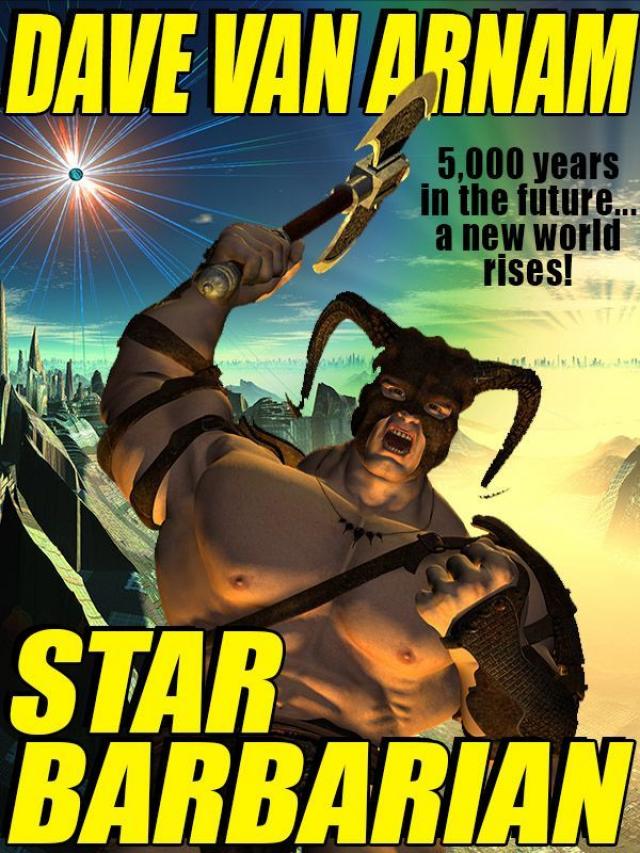


There was a howl of pure animal joy from the peoples of the tribe; then first one, a few, greater numbers were throwing themselves on the ground, heads to Jamnar—till at last all had prostrated themselves.
It was the sign of voluntary submission, the same that he had made to Astaphar, goddess of the fyzur and once more of Arteleon—voluntary submission to him!
Once more the surge of prideful joy filled his chest till he felt it must break asunder in a great glow of light.
Now in truth they were prepared to be his people!
CHAPTER TWELVE
Day of the Lightnings
“Liur, chief of Ktethe sept, is second son to Borzon Kan of Ksalash,” said Jamnar to his septate chiefs gathered before him that afternoon. “Hence there would have been no doubt of Ksalash anger at our taking of Ktethe lands. By ordinary, they would be right; and I would not have done it. But the conspiracy runs not only to Liur, but to Borzon himself—they have conspired against us even before we moved. I would have talked with them, proposed a settlement—they would not even await it.”
“Ye need not persuade us to join you, lord,” said Pazand of Pazand sept. “You know we will follow you without question or fear; you are the favored of Astaphar and the Forbidden Ones, and we are but dry wood waiting for your flame!”
“Nay, Pazand, I require your faith, but also your patient attention; for you must know certain things. It is because of this conspiracy hatched against us by the departed one—“(slain by the Spear itself, Kezile was no longer to be spoken by name in the presence of the Spear, which Jamnar held imperiously as he spoke to his chiefs)”—that we must move before, long before, I had planned. There is much to teach you about new ways of warring; I now must settle for a very few.”
“Say on, then, my Kan,” said Pazand, then grinned and declared, “Then we will follow you anyway, just as we would have!”
Jamnar looked at the ground for a moment, then allowed himself to grin in Pazand’s spirit. “Your loyalty is deep enough to shame me, did I not insist upon what I know.
“Still, for now it is enough for you to know we fight in new ways from now on. There can be no turning back. We have not the choice in the matter, after all, with three such enemies raised suddenly against us, and so soon after our dark time that the shadow of what has passed over this people still remains in our souls.
“Your hardest lesson will be this, and your hardest order to obey, yet obey it you must or we all are swept away into ruin and death forever, and the name of Arteleon will become as the name of huThartesh, a memory of past dead things. You all will fight when I say fight—”
“Yea!” they all shouted, drawing daggers and swords and clashing them together.
Jamnar grinned again, while inside him a caution whispered that he must not let excitement swerve him.
“You will fight if I say to—but you must not fight, when that is my order,” and his voice, pitched lower, cut through their enthusiasm.
Now Pazand frowned.
“We had of course heard of your new ways from those you have been teaching them to directly. Yet we thought they were only for small and roving bands. Surely no war can be fought without fighting?”
Nay, surely not,” agreed Jamnar equably. “Surely, too, you must agree, we cannot defeat three tribes by striking them vigorously with the butts of our new stunguns?”
And he looked about the assembled chiefs.
Pazand said nothing, but his brow wrinkled with thought.
Presently Hramon of Hramon sept coughed and spoke, seeing that Pazand, who had the right, did not.
“Lord Chief, it would be folly so to misuse such wondrous weapons. Yet truth to tell we understand them little. They are not like spinspears, swords, arrows, daggers—we know not their use. And we have not the numbers of them required to arm us all with them, so what concern to those of us who have them not? Fifty stunmen, as you call them, know all that is needful. The rest of us shall fight as we are bidden—as always.”
“Noble Hramon,” said Jamnar, “you freely admit you know not the use of the new weapon, and it is no shame in you that this is true. It is, after all, a new thing in the Viadhash entirely. Hearken, then, to your arrogance, knowing not their use but dictating their use as if you did.
“These fifty weapons used properly mean more than all the rest of the men and women in the tribe—but they must be used with the tribe, or rather with its army.
“I cannot hope to teach you the strategy and tactics of the new weapon in the short time we have, save for this: the army of Arteleon must seem to yield the day when I call for this to be done. Yea, it is a hard saying for fighting men, I know it well. But you will retreat when I order it, and in such seeming disarray as will convince Borzon he needs only hasten to follow you to win the day. Eager for glory and plunder, and the chance to defeat us without his two dubious allies, Borzon will then attack—whereon our stunmen will win the day!”
“A hard saying you termed it, and a hard saying it is,” said Pazand, interrupting Hramon, whose face was red with sudden anger. “But we said we would follow you, and we will. We are your people and you are our Kan, favored of the Higher Ones.
“And this I say to you other chiefs,” Pazand added, rising to his feet and turning to face them all, “that the stunmen can win the day in such a plan. Upon the Lord Chief’s speaking, I grasped the meaning of it. Consider its simplicity, then, and how it cannot fail. We are not strong, my brothers, no, no, we are not,” and he spoke over the mutter of angry protest, “and we must needs turn to our wits. Who then is here without his?”
This baldfacedly audacious challenge took them all aback; none spoke, fearing a round of chuckles.
Pazand stared at them a moment, then sat down, signing to Jamnar that he has done.
“Very well,” said Jamnar. “My hunters have been scouting the land for stunmen ambushes, beyond the Zhindabu. Word also comes that Ksalash has not gathered in all its septs yet, and hence will be in some disarray should we attack quickly enough. It may be our easiest victory.”
And he began to explain in greater detail what he had worked out with Envaro and Prosperon.
* * * *
The day was uncommonly hot. Jamnar stood on a knoll overlooking the field, and the sweat ran down his face.
Below him, in a shallow valley half a day’s march east of the Zhindabu, two armies struggled—or the appearance of two armies.
For Jamnar had sent only half his fighting men into the valley, drawing the unsuspecting Borzon into committing himself to battle. The rest of Jamnar’s men remained in reserve beyond the knolls surrounding the western exit of the valley, should the stunmen not be able to manage the flood of men expected soon to be attempting to follow retreating Arteleon.
The valley was narrow, so that the five hundred men he had committed to the battle appeared much more massive; and the front of actual fighting was correspondingly narrow—one of the reasons Jamnar had picked the spot, since the narrow front would minimize casualties.
The fight had not been going on long, and Jamnar did not intend for it to last much longer. The problem was that Ksalash septs, the hunter-scouts told him, had been joining the main body of Borzon’s men as late as the previous night. The Ksalash army was disorganized, disordered by the extra haste which Jamnar’s unexpectedly swift invasion had forced.
He refused to allow himself to brood over the stabbing conflict below; he knew men would die this day and his only care was that the number should not be great.
Envaro rode up, his kaphal staggering with exhaustion and the heat.
“You must give the signal, Jamnar—the Ksalash are not all on the field, but they already outnumber our poor forces far too much for them to hold safely much longer.”
Envaro’s face was worried, very worried for him. Jamnar studied him a moment, and looked over again at the field of battle, as much of it as he could see for the dust that was beginning to rise.
Should he trust Envaro’s judgment and order the supposed retreat—perhaps too soon to entice sufficient Ksalash men into the trap to justify his schemings?
Or should he wait yet another while for more Ksalash septs to move forward and throw themselves into the lines—perhaps to gain the day for Ksalash in spite of all Jamnar’s clever plans?
He nodded. It was unsafe to wait any longer. “Very well.”
And he signed the twenty men who waited at the base of his knoll to pass the word to the fighting men.
The battle was being fought at the narrow center of the valley, hemmed in with steep-edged hills. A stream made impassable marsh of half the valley’s available width.
Jamnar watched as his messengers tried to make themselves heard, struggling through the masses of fighting-men, watched while for an endless time it seemed none would obey his orders after all, so rapt in bloodlust were they.
But several dozens finally began breaking away from the left of the Arteleon line, running back to the western exit of the valley. Presently more followed from the left, till the line was dangerously unbalanced.
But the Ksalash men did not pursue the dissolving left, instead swerving in to attack the center—where they were futilely jammed in with the men of their own center in a heaving useless mass.
Meanwhile the Arteleon right had also begun full-scale retreat, and the Ksalash left made the same mistake its right had, attempting to push in against the main body in the center.
Now the softness of the ground began seriously to hamper the Ksalash, while the Arteleon center at last began drifting backwards.
Envaro was beating his kaphal happily around its thick-skinned neck, laughing and shouting at the success of Jamnar’s maneuver, till the kaphal turned its head around and blinked at him several times in dumb protest at such treatment. Envaro stopped abashed, then turned to Jamnar, still laughing and with the tears coming down his face.
“It’s going to work! Ksalash still does not realize all our men are retreating! Pazand held the front of the center so well they did not realize Pazand was virtually the last sept remaining in the fight!”
It seemed true to Jamnar also, but he restrained his joy, conscious of a deep chagrin that he had not planned things so that that confusion following on his retreat order had been so great. The next time, he would have to make better plans...
Now Pazand—holding the center as first sept—too was retreating, turning, racing back as fast as they could in the searing heat of midday. Dozens were caught from behind and pulled down by Ksalash men, but even now Ksalash seemed slow to realize the day was seemingly won.
A visible gap now opened up between the Ksalash line and the retreating Arteleon; and Jamnar for the first time began to wonder if he had seriously miscalculated. Would Ksalash fail entirely to attack, after all that sacrifice and planning?
Something like apprehensive fear began stirring deep in his stomach, and he tried to wipe his sweaty face with his sweaty hands, and cursed low under his voice.
Envaro heard and turned. “Does it not go well?” he asked.
“Aye,” said Jamnar, “if Ksalash will but waken to pursue our men!”
Envaro’s eyes widened at this new thought, and he turned his attention back to the field once more.
But of a sudden, Ksalash seemed as a man to understand what had happened in front of them, and raised a jeering joyful shout, clashing their swords in derisive triumph.
Then they surged forward like the first wave of the great western tides of summer, straight toward the western end of the valley, where copses of bothrau almost sealed it off. Past the bothrau retreated the last of Pazand sept.
To the west of the valley a flatter, wider plain spread, and along this plain, north, west, south, fled the men of Arteleon as fast as they could, spreading out like split water in every direction.
The vanguard of Ksalash now reached the bothrau and saw the proof that their enemies were finally defeated—each obviously fleeing for himself, completely demoralized!
Enthusiastically the Ksalash struggled through the exit to the valley, past the bothrau trees, and themselves spread out onto the plain to pursue their enemies.
After a time Envaro began looking worriedly at Jamnar once more. “Are there not enough of them through the pass yet? Do you not wait overlong to give the signal.”
Jamnar made himself smile confidently. “Patience. I want them to get the full taste of victory before they are struck down. It will make it easier, afterwards, to convince them of our invincibility. If they are to be subject to us in the future, it will keep them less restive.”
So they watched as the army of Ksalash disordered itself steadily in its eagerness to come to grips with its defeated enemy.
Calmly Jamnar watched until more than a third of the force had debouched onto the plain. Another third were crammed into the narrow throat of the valley, and the remainder were trying to make those ahead move faster.
Making sure his stungun was not set at “blast” he raised it and aimed in the general direction of the rear of the Ksalash army, still in the valley.
The narrow bolt of energy streamed out at the men below, and a rank of rearward men slumped soundlessly.
It was the signal.
Flaring lightnings stabbed out in all directions at the men of Ksalash, whipping quickly back and forth carving rows of fallen men everywhere they touched.
The shouts of Ksalash triumph turned to screams of uttermost terror.
In thirty seconds, at least half the Ksalash were down, and the rest had broken apart and were fleeing any way they could.
But the relentless stunguns continued to pour fiery beams among the crowds of enemy.
Within two minutes nearly all the Ksalash were lying motionless on the ground, heaped carelessly like broken branches after a storm.
The stunguns began to wink out, though a few continued to search out individual Ksalash fleeing back into the valley or out onto the plain.
Now the reserves Jamnar had held back appeared from deeper in the thick bothrau copses, and quickly began removing the weapons from their fallen enemies.
The battle was over.
* * * *
In huThartesh the people went mad with joy. Great fires of celebration roared at every open spot in the encampment, and music was everywhere. The ceremonial stump-drums, used only in the time of victory, boomed out their mighty messages of triumph.
A large tent, though not a third the size of the old Great Tent of Raham, stood on the site of the Kan’s tent. In front was once more raised a dais, on which sat Jamnar Kan and his picked counselors, and Borzon, Kan of Ksalash, with many of his septate chiefs.
Elsewhere in the camp the dazed prisoners were kept in thornbush circles. These men were perhaps a fourth of the army that had fought the day before; Jamnar had permitted the rest, disarmed, to return to their homes. It was not his intention to disrupt, nor to turn Ksalash into a sullen conquered people.
Borzon Kan sat on the dais, motionless, silent, as his conquerors caroused through huThartesh. He was a giant of a man, with a hairy chest and a bald head that gleamed in the firelights with a sheen of sweat.
Jamnar had been talking earnestly with him for some time.
“And you will understand that my people would have been outraged,” he said, “had I not allowed some form of entertainment for them. They have been most foully done to, as I know you know; they craved release in this for a time.”
Borzon grunted, then spoke.
“Illorvu is a fool, and Gaharn is a villain, and Liur... Liur had a smooth face and a mouth that spoke lies to me. Were all these things not true, I would not now be here, nor my people cast down even as yours were. We too have priests of Shaphath; but I think now my people will tear them to pieces if they remain with us, which I do not think they are fools enough to do. Let your people rejoice; ours would have done the same to you.”
“Nay, not the same,” said Jamnar instantly. “For I have a thing to tell you of. Envaro suspected Liur of deep ambitions toward your seat of power, and questioned him after he revived last night. He has admitted turning your thoughts to evil ways, to plottings with the Kans of the west that you would not else have dreamt of doing. Indeed, he convulsed and died even as he told Envaro, which proves his words were true since Astaphar did not permit him to live longer than time enough to speak truth—then no more lies.”
“It is all the same to me,” said Borzon wearily. “I await what comes, though I wonder that you have not yet brought your prisoners out to roast them in yon fires. What vengeance do you plan for us, then, more hideous than that?”
Jamnar looked at the Lord Chief of Ksalash; his face showed resignation, but no fear. Jamnar reached out and clapped him on the shoulders with his hands outstretched.
“No vengeance, Borzon, but alliance!”
Borzon blinked, and shook his head slightly as though not having heard.
Jamnar went on. “I would have traded you Ktethe lands for lands of ours to the south, without this useless warfare; now I have the power to take it and all your lands and offer you nothing but life, and slavery. But this I will not do; hunters know the cage is not for the beast of the forest, nor slavery for good fighting men. I am satisfied that you did not seek this conflict, and I offer you alliance. Arteleon to lead, Ksalash to follow, but both to share in the rewards.”
“Which are?” Borzon had assimilated Jamnar’s words now, though he did not appear to put much faith in them.


