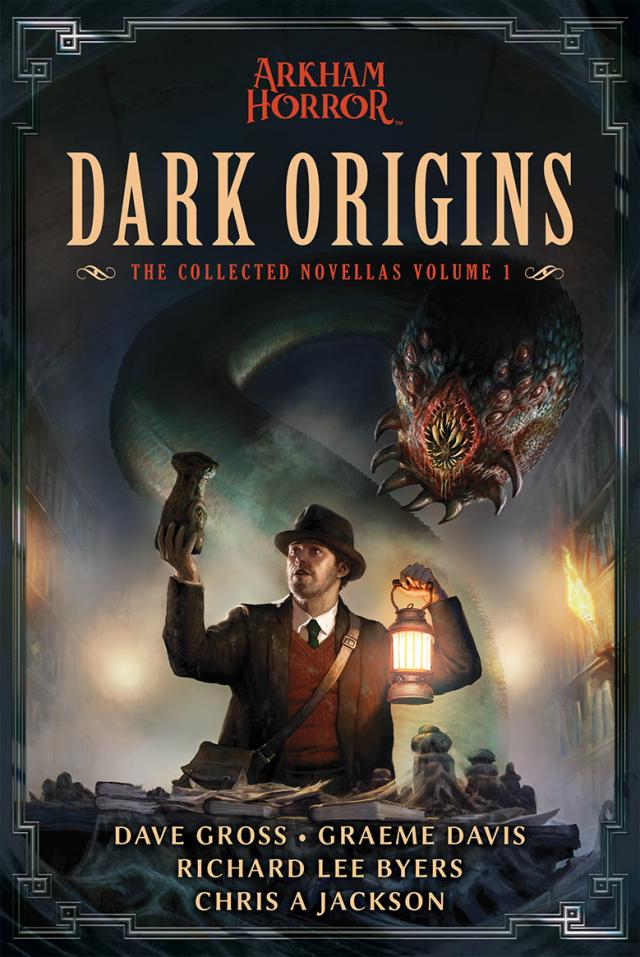
Dark Origins, page 1
part #1 of Arkham Horror: The Collected Novellas Series


Arkham Horror
It is the height of the Roaring Twenties – a fresh enthusiasm for the arts, science, and exploration of the past have opened doors to a wider world, and beyond…
And yet, a dark shadow grows over the town of Arkham. Alien entities known as Ancient Ones lurk in the emptiness beyond space and time, writhing at the thresholds between worlds.
Occult rituals must be stopped and alien creatures destroyed before the Ancient Ones make our world their ruined dominion.
Only a handful of brave souls with inquisitive minds and the will to act stand against the horrors threatening to tear this world apart.
Will they prevail?
This collection first published by Aconyte Books in 2021
ISBN 978 1 83908 118 7
Ebook ISBN 978 1 83908 119 4
Copyright © 2021 Fantasy Flight Games
All rights reserved. Aconyte and the Aconyte icon are registered trademarks of Asmodee Group SA. Arkham Horror and the FFG logo are trademarks or registered trademarks of Fantasy Flight Games.
This novel is entirely a work of fiction. Names, characters, places, and incidents are the products of the author’s imagination or are used fictitiously. Any resemblance to actual events, locales, organizations or persons, living or dead, is entirely coincidental.
No part of this publication may be reproduced, stored in a retrieval system, or transmitted, in any form or by any means, electronic, mechanical, photocopying, recording or otherwise, without the prior permission of the publishers.
This book is sold subject to the condition that it shall not, by way of trade or otherwise, be lent, re-sold, hired out or otherwise circulated without the publisher’s prior consent in any form of binding or cover other than that in which it is published and without a similar condition including this condition being imposed on the subsequent purchaser.
Cover art by Anders Finér
Distributed in North America by Simon & Schuster Inc, New York, USA
ACONYTE BOOKS
An imprint of Asmodee Entertainment Ltd
Mercury House, Shipstones Business Centre
North Gate, Nottingham NG7 7FN, UK
aconytebooks.com // twitter.com/aconytebooks
Hour of the Huntress
Dave Gross
Chapter 1
The whistle’s shriek yanked her out of an asylum nightmare. A simultaneous jolt threatened to fling her to the floor before she caught the armrest. For an interminable instant, she wasn’t sure whether she was Izzie, locked in an unwanted steam bath, or Jenny, a passenger on a slowing train.
“Last stop!” the conductor called. “Arkham, Massachusetts.”
Jenny sat upright. Heart pounding, she measured her breaths to calm herself. “Hold on, Izzie,” she muttered. “I’m coming.”
Steam washed past the car windows. The brakes squealed, and the engine ceased huffing. The other passengers, all men, had already risen from their seats. In their brown suits and wire-framed cheaters, they looked like bankers returning from Boston appointments.
None had tried striking up a conversation during the journey. Under the circumstances, Jenny considered that a relief. Still, it made her wonder just how rumpled she must appear. As the only woman in the car, she had expected some attention. In Paris, Jenny hadn’t been able to walk from her flat to the café without parrying three flirtations and a proposition.
Izzie’s letters had spilled out of the literary journal as Jenny dozed. The journal lay on her lap, opened to the last page of Hemingway’s “Hills Like White Elephants.” On the day she left Paris, she’d searched half a dozen shops to see what the editor had done with Ernest’s latest. She finally bought a copy at Shakespeare and Company along with a few packages of Gauloises.
As Jenny gathered the fallen pages of Izzie’s letters, she glimpsed an unsettling passage:
…prints in the woods. I mean, it was a man in a dark cloak! He was just standing there watching me while those dreadful screams went on and on and…
Jenny folded the letter. It was insane.
Of course, the doctors had said the same of Izzie when they committed her.
After months of visiting her sister in the sanitarium, Jenny had escaped her family’s drama to live with their aunt in Paris. Izzie made her own escape much later, with her psychiatrists’ tentative approval. Despite her guilt at abandoning Izzie, Jenny wrote to her. After months of wounded silence, Izzie began to respond. Gradually, they became confidantes once more, as they had been as girls. Just as Jenny had begun to think the worst was past, the weird events described in Izzie’s recent letters dashed Jenny’s hopes.
The train came to a halt. Jenny tucked the last page in with the rest of the letters and shoved the magazine back into her handbag.
When the station agent opened the door, the men rushed out. Jenny called after them, “You fellows really know how to shake a girl’s confidence!”
No one looked back. That was fine. When Jenny felt low, a little sass always cheered her, even when it went unappreciated.
The men dashed across the platform to elbow each other at the taxi stand. The sun had set, and the station’s electric lights lent their faces an anxious pallor.
“What’s gotten into them?” Jenny asked herself. If anyone had cause for haste, it was she. Unfortunately, she had no clear idea where to find the hotel room she’d reserved from Boston. Worse, she had no idea where Izzie was staying in Arkham. The return address had read only “General Delivery.”
Jenny stepped down from the train. The gray-haired station agent offered his hand. With the other, he touched the brim of his cap and bowed, cautious of a bad back. “Miss.”
Jenny favored him with a smile. Despite her fellow passengers, it appeared courtesy was not quite extinct in Arkham.
A breeze scattered leaves across the platform. Maple red and oak yellow skittered about her feet, along with a crumpled orange handbill. Jenny retrieved the flyer and held it up to the light.
ARKHAM HARVEST FESTIVAL
October 22–30
Independence Square
Parade & Pageant
Harvest King & Queen
Formal Ball
Hay Rides
Harvest Festival Feast
Wholesome Fun for the Whole Family
Volunteers contact the chairwoman, Mrs Winthrop Olmstead
The text was banal enough, but Jenny gasped at the accompanying image. It was a crude depiction of a man’s face, rough as though carved into a long-eroded stone. The man’s hair and beard appeared braided, but Jenny knew that what seemed like braids in this crude print were willow fronds. She’d seen the same image on a medallion she owned, one she had paid a Marseillais jeweler to duplicate for Izzie. They were two of a kind and – as far as Jenny knew – only two.
Jenny’s hand went to her throat, only to touch her traveling pearls. Before she could panic, she remembered she had secured the medallion in her luggage. In one of her letters, Izzie had asked whether she still wore it, so Jenny had brought it along as a lucky charm. Perhaps it had been lucky, for its appearance on the flyer confirmed Izzie was in Arkham.
“I said, come for the festival, miss?” asked the old station agent.
“Oh!” Jenny lost the flyer to a gust of wind. “No, I’ve come to, ah, visit my sister.” She stopped herself from saying “find my sister.”
Behind the station agent, a truck pulled away from the taxi stand, luggage heaped in the bed. Jenny recognized her “gBe”-monogrammed luggage pasted with stamps from across Europe, the Near East, and North Africa.
“Is that–?” said Jenny.
“Don’t worry, miss. Bill Washington’s taking those to the hotel. All you need is a…” There were no more taxis waiting in the queue. The station agent checked his watch and frowned. “I’m sure another will be along any time.” He shuffled back to his office.
The man’s dubious tone did little to reassure Jenny. She wondered just how long she would have to wait. The only other person remaining on the platform was a strapping young lad in oily coveralls. He’d unloaded a sidecar from the train and was attaching it to a red motorcycle. She couldn’t see his face, but he had shoulders to make a rugby player envious. A plume of blue smoke rose above his newsboy cap.
Another gust of wind blew across the platform. Jenny rubbed her arms, wishing she’d worn a sweater. From somewhere in the surrounding dark, she heard a piteous cry. At first it sounded human, but when it came again she decided it must be an animal, perhaps a lamb. Jenny considered what the Harvest Festival feast meant for livestock.
“Good luck escaping the supper table, little fellow.”
As the train engine began its slow chuff to depart, the mechanic moved to the motorcycle’s other side. Jenny glimpsed a huge wrench clenched in a fist that was all knuckles and sinew. The light in the station agent’s office went out. A moment later, so did the lights on the platform.
“Hey, Charley!” the mechanic shouted in a high voice. “I’m working here!”
“Sorry, Lonnie.” The platform light came back on. A moment later, Charley emerged from the office, locked the door, and began to walk away.
“Excuse me!” called Jenny. “Where are you going?”
“Sorry, miss. That was the last train, so I’m off duty.”
“You don’t expect me to wait alone for a taxi, do you?”
The old man said, “Lonnie will keep an eye on you until another taxi comes ’round. Won’t you, Lonnie?”
The big wrench rose up from behind the motorcycle and waved assurance.
Jenny didn’t like it, but she saw little alternative than to make the sort of fuss she considered beneath her dignity. Besides, it wasn’t as though she couldn’t take care of herself if this Lonnie proved frisky.
That’s what she liked to tell herself, anyway.
Jenny fished the cigarette case out of her handbag and fumbled with the holder. After another gust of wind, she gave up struggling with a light. As she stuffed it all back in her handbag, she noticed a figure standing just beyond the station’s far corner.
Cloaked in shadow, the figure looked taller and straighter than Charley. Besides, Jenny had seen the station agent walk off in the opposite direction.
“Who’s there?” She left her hand in the bag, hoping a would-be masher would think she had a derringer.
The man stepped forward. There was something strange about the way he moved. Only his shoulder and one leg came into the light. The shadows pooled beneath his coat, and the leg looked crooked. One could almost imagine a hoof where his foot should be.
Jenny recalled the e e cummings poem about spring with its goat-footed balloon man. Unlike the whistling faun in the poem, the figure on the platform remained silent. Lines from Izzie’s letter came to mind next: …it was a man in a dark cloak! He was just standing there watching me… Cold dread oozed down Jenny’s spine.
Showing fear only encouraged bad men, so Jenny pushed her bluff. Forming a pistol with her fingers, she pointed the bag at the stranger. “Show yourself.”
It was difficult to look menacing without removing the gun that wasn’t in her handbag. For a long, cool moment, the figure stood still.
Then he took a step forward.
“I’m warning you,” said Jenny. She kept the warble out of her voice, but it stuck in her throat like a pigeon trapped in the chimney.
The stranger took another step.
A hand fell on Jenny’s shoulder. She whirled around, and the pigeon escaped. “Aaah!”
A big wrench clattered to the platform floor. Lonnie shrieked back, higher and longer than Jenny. The cigar bounced down the front of the greasy coveralls and sparked on the platform floor. Jenny got her first good look at the mechanic.
Lonnie wasn’t a big strapping lad after all. She was a big strapping lass. The revelation did nothing to diminish the threat of her big fist quivering beside her freckled cheek, poised to strike.
“Sorry!” both women shouted.
“I didn’t mean to startle you, miss.” Lonnie lowered her fist. Her cheeks flushed – whether from excitement or embarrassment, Jenny couldn’t tell.
“There’s a man,” said Jenny. She pointed to where he had been, but there was no one there. “Oh, he’s gone.”
“Ain’t that always the story?” Lonnie retrieved her cigar. As she rose, her lopsided grin exposed a missing eyetooth.
Jenny sighed, tension pouring out of her trembling arms. She flailed for a moment before extricating the “gun” from her handbag. “That kind of story I can handle,” she said. “It’s just that with this wind and the dark and the breeze and the leaves…”
“Yeah. Spooky.” Lonnie looked down at her. The mechanic stood a good six feet tall. Her work shirt fit tight over cannonball biceps. When she grinned, the muscles on her neck stood out. “Listen, I don’t mind sticking around, but I don’t think there’s going to be another cab. You ain’t the only one in Arkham’s got the heebie-jeebies these days.”
“Oh?” said Jenny. “Do tell.”
“I guess it’s old hat to those from the big city, but in a small town like Arkham, people get shook up when young girls go missing.”
Jenny clenched a fist to stifle the shakes. She couldn’t tell whether it was fear or rage that made her tremble.
“‘Girls’, plural?” said Jenny. “How long has this been going on?”
“Since the end of summer, I guess.”
Jenny estimated intercontinental postal delivery times. Izzie couldn’t have been a victim of the current wave of kidnappings – unless she had been its first victim. She considered lightening the mood by paraphrasing Wilde’s adage that losing more than one looks like carelessness. She decided it was not the moment for a joke.
“Listen, Miss…?” said Lonnie.
“Barnes.”
“Lonnie Ritter; Ritter’s Plumbing and Motor Shop. Wait, I got a card.” She dug inside the bib pocket of her overalls and produced a rectangle of dingy paper. She brushed it off with the heel of her hand but passed it to Jenny when it became obvious she was only making it dirtier.
“Say, Lonnie,” said Jenny, dropping the card into her bag. “How would you like to earn a fare?”
“Yeah?” Lonnie tapped ash off her cigar and looked Jenny’s French dress up and down. “A fancy lady like you isn’t afraid to ride in a sidecar?”
“I’ll drive the bike myself as long as you tell me the way to the Continental Hotel.”
“No way! Papa ordered this rig special. Anybody gets a scratch on the Big Chief, he’d murder ’im. And me, too! Hop in.”
Jenny stepped into the sidecar, avoiding the big toolbox Lonnie had set on the floor. Lonnie straddled the bike and pulled down the brim of her cap. “I oughta have goggles,” she sighed. “With an aviator’s cap, I’d look just like Amelia Earhart.”
“Who’s she?”
“Who’s Amelia Earhart?! Why, she’s only the pilot of The Canary, which set a new altitude record for women! I shook her hand in Boston.”
Jenny directed a pointed glance at Lonnie’s heroic arms. “And has Miss Earhart regained the use of that hand?”
“Ha!” Lonnie gripped the handles. She started the engine on the second kick. With a roar, the bike flew off the platform and onto the street. Lonnie spat out her cigar. Jenny held onto her hat.
As they rounded the first corner, the sidecar rose a foot off the ground. “What do you weigh?” yelled Lonnie. “Ninety pounds sopping wet?”
Jenny made an effort to smile as if she’d received a compliment, but she felt her stomach lurch. She gripped the safety bar and hoped it wasn’t obvious she was hanging on for dear life.
They drove past several factories and warehouses, dark but for lonely beacons at the guard stations. Black shadows pooled beneath loading docks and water towers. The only building still filled with lighted offices was labeled “Arkham Advertiser” in big white letters. Jenny smelled ink. She heard the hum and clatter of a printing press.
The industrial buildings gave way to residential blocks. Clotheslines crisscrossed the dark alleys between brick tenements. Jenny tried not to imagine they were enormous spider webs. As Lonnie drove past a row of storefronts, the motorcycle headlight raked across a sign reading “Curiositie Shoppe.”
“How quaint,” said Jenny, but Lonnie didn’t hear her over the roar of the Big Chief’s engine.
They passed a sign marked “Miskatonic River” and ascended a raised bridge. To either side, the ripples of dark currents reflected light from the waterfront streetlamps.
South of the river, Lonnie took the next turn a little slower – a courtesy that saved their lives.
A horned figure rose shrieking before them. Lonnie squeezed the brakes so hard the rear wheel rose up along with the sidecar. The rig swung around, forcing Jenny face-to-face with the interloper.
“Blaaaah!” Toothy jaws gaped at Jenny, unleashing a hellish stench.
“What the devil?” bellowed Lonnie.
“Naaaah!” blatted the goat. Its coat was black except for a rusty red patch around one eye and horn. A rope hung from its neck, the frayed end wet with saliva.
Jenny recoiled from the animal’s barnyard pong. Its muzzle followed her into the sidecar, dipping down to forage. She rescued her handbag and stepped up onto the seat. The goat nipped at the toes of her Mary Janes. She kicked, not too hard for fear of angering the beast. “Shoo! Get away, you cad!”
Lonnie guffawed. “Is that how you deal with mashers in the city?”