Paddavissie, page 2
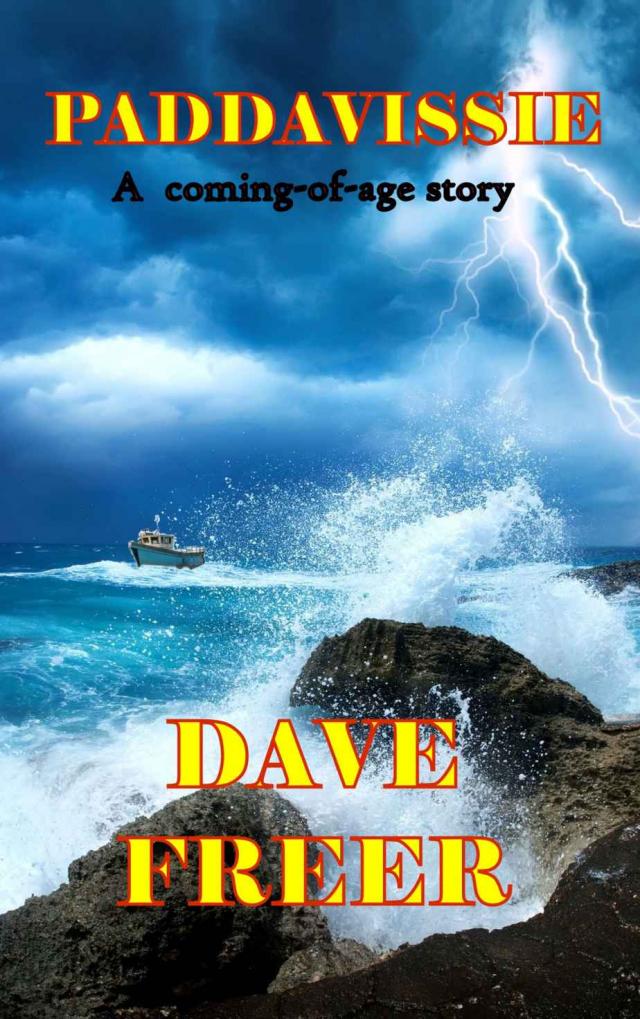


It was so murky it was difficult to tell which way to swim out. Luckily I had the hoop-net rope to follow up, up, up under the curving wall of the bottom of Bess. It seemed a terribly long way, and almost too much like hard work to bother to swim in that cold. Then suddenly I could see the silver of the top of the water. I began to breathe out, so that I could breathe in the moment my head was out of the water. I rose with a wave. In the middle of a wave. I was swimming desperately, my lungs as empty as Hennie’s head. I could see the air on either side of me. I just couldn’t reach it.
Then my face broke through the surface. I sucked air. Sucked it deep into my lungs. Again and again. Nobody says ‘thank you God for letting me breathe’, until they try doing without it. Somebody from the deck shouted, “Is it loose?”
I didn’t have spare breath for talking. I held up three fingers. Then I managed to say, “One free.”
I was cold and scared after getting my hand stuck. Looking up at the faces looking down at me… I knew I would have to go down again. Now. Before I got too cold.
I took some deep breaths and pulled myself down again, away from the warm air. It is strange underwater, away from the movement and noises. The only sound there was the creak and slap of waves on the ship. And some other strange creaks and whistles out of the depths below me. I couldn’t help thinking that I, the shark fisherman, was in the sharks’ world now. Now my eyes stared into the murky water, looking out for things in the dark. I seemed to get to the propeller a lot quicker this time. It always seems easier a second time you do something. I was much more careful this time too. Maybe that was why I just couldn’t get the rope free. Also my hands were cold and stupid and weak. Coming up I knew that I was too cold to go down again. I was shivering. My teeth were chattering and I could not stop them.
“Out,” I called in a weak voice to those on the boat. “T-t-t-too cold.”
They lowered a long-line float, and I managed to pull myself on to it. A minute later strong hands pulled me on to the boat and my Dad was rubbing me dry with an old overall, before he wrapped me in his jacket. It was so warm. So beautifully warm.
I looked at the crew. I had to tell them. “I c-c-can’t get it l-loose. It is t-too c-c-cold and too d-deep, and the rope is t-too tangled.” I was still stuttering from the cold.
At least I wouldn’t have to go back into that horrible cold water.
CHAPTER 5
I AM A FISHERMAN
There was silence. They all looked at me. They looked… shocked. I was ashamed. Then I was mad. I was only a kid! Why couldn’t the grown-ups do what had to be done? It was not my problem. I was only a kid. Then I understood that they hadn’t thought of me as a kid. They had thought of me as a fisherman. Part of the crew. Part of the boat. If I wanted to be a fisherman, I would have to do what had to be done. I couldn’t be a fisherman when I wanted to be, and become a kid again when it was too hard.
My Dad said, “Well, at least you tried, boy.”
I bit my lip. Looked at the faces of the crew. I knew what I’d have to do. “Give me five minutes. I will try again.”
The Skipper looked at me. I was still shivering. “Make little Abie some coffee. Make it hot and sweet,” he said to one of the crew. Then he sat down next to me. “Listen. I’ve got another idea. Can you bring the other end of the rope, the end with the hoop-net on it, up to the top?”
I nodded. He gave me a slap on the shoulder. “Bring it up. I’ll make a plan.”
So a little later, with the hot coffee still splashing around inside me, I went over the side again. I didn’t jump this time. I was lowered down on the float. I found myself pulling my toes up to try and stay out of the water. Then I was in the sea again, as the float rolled me into the water. It seemed even colder now. Letting go of the float and taking hold of that hoop-net rope was the hardest thing I have ever done.
I swam down for the third time. This time I was shivering before I got to the propeller. I felt rather than looked around the big propeller blades, until I found the rope going down. I pulled at it.
It didn’t move. I pulled harder, and suddenly it came towards me. I started swimming for the top, pulling the rope. The net, with its heavy iron hoop dragged me down. I had to try harder just to move. I was shivering and my teeth were chattering so badly that it was hard to swim at all. But I knew I could get out. That gave me the extra strength I needed.
Half a minute later I was out from under the boat, and then my head was back in the air. But I was so cold! I was sure I could not pull myself onto the float and hold onto it. I was also too scared I might drop the rope I had dived to fetch, and the weight it was pulling down, so I had to struggle to swim. I didn’t want to have to do that again.
“Gaff!” I yelled. Someone lowered it down to me. I put the rope over the big hook, and fed rope up as they pulled it up onto the deck. Only when the rope was safely up did I let go of the other end, and swim to the float.
I was too cold to pull myself on to it. My hands just wouldn’t close on the rope. My Dad saw what was happening. He kicked off his sea-boots and came down the rope. He pulled me up out of the water and held me, as the men pulled us up, laughing and joking.
While I was getting dry the Skipper tied both the ends of the hoop-net’s rope to the anchor bolt, and started the engine. With the ropes tied up they couldn’t wind around the propeller shaft. The propeller cut through them instead. The propeller was free. We were out of trouble. The rainy edge of the storm was not quite with us.
We weighed anchor and sailed over to the long-lines. We’d hit the ‘dik’ and soon there were seventy sharks on the boat. It was beginning to rain hard, and every man in the crew worked like mad, with lightning flashing, and sea picking up. But I wasn’t part of it. I was in the engine room, by the Skipper’s orders. It is the warmest place on the boat. I sat and drank coffee, wearing every spare piece of clothing my Dad could find or borrow. By the time we got into harbor, just ahead of the worst of the storm, I was nearly warm again.
It was a week later that I found out my new name on the Bess. There was a new man coming to sea with us. He took one look at me and said, “Go on, brat. Get lost. This is men’s work here. Go on. Scat!” As if I was a cat or something.
Geel Jan stepped up to him, his big hands on his hips. He winked at me, his raisin face crumpling as he smiled, before he turned to the crewman. “Listen here. You leave our Paddavissie alone. He’s earned his site on this boat. He can swim.”
Included here: A free sample of ‘WITHOUT A TRACE’ A MG novel for boys.
CHAPTER 1
HISTORY
“Universes, endless parallel universes, may lie right next to next to ours. They are as unreachable as the stars. Or are they?”
You’ve heard of the Bermuda triangle? You know, where compasses suddenly start to spin wildly, with a sudden darkness at noon, where ships and planes sometimes just disappear. When they’re gone, they’re just... gone, and nothing ever comes back. There are other places where this is supposed to happen too. There’s a spot deep in the Gobi, and another above the Java Trench. And then... there’s the Wild Coast.... some very strange things have happened there. Over the years Portuguese Carracks, British East Indiamen, and, in 1908, the Waratah have disappeared off that coast.
On the 27th of July in 1981 my granddad flew his Piper Cherokee out from the little bumpy airstrip on our farm, in the direction of Port St. Johns. He flew off to go and take a swarm of bees out of a friend’s holiday cottage. He flew out of our lives, and for all anyone knew out of this world. He and his plane were “missing”. They’d just disappeared, disappeared without a trace. No wreckage was ever found.
Then the problems started.
For starters he was in trouble with the security police. Politics, guns. They reckoned Granddad was a gun-runner. My old man says it was quite possible. He says his dad was up to anything, provided it was totally lunatic. Everyone had thought he was a rich man, but it seemed he owed a lot of money. There was very little money in his bank account.
Then the story came out. He’d drawn out twenty thousand Rand the day before he flew, and bought Krugerrands with it. He’d been buying gold for years, it seemed. Suddenly, nobody believed he’d crashed anymore. Everyone said he’d cut and run. Everyone but my dad.
“My father never ran away from anything in his life!” That’s what he said to the papers then. That’s what he said to me maybe a thousand times since. My dad was twenty three then, not even married a year, and still having a grand old time at University. Me, I was three months old.
Suddenly he wasn’t a rich man’s son anymore. Suddenly he didn’t have any friends. Three days later he didn’t have a wife either. She left him with a baby boy, a stack of debts and no future.
He’d lost everything but the farm. Fortunately, my grandmother had left that to Dad. Granddad couldn’t be proved to be dead, so my father never got to see Granddad’s will. Granddad was well insured, but Dad couldn’t claim anything because Granddad wasn’t legally dead. The plane was insured too, but it was just “missing”.
Dad had to sell what the creditors hadn’t taken. Most of the livestock, almost all of the farm implements, Granddad’s cars, radios, TV, and antique furniture went. Dad had no money to replace anything that broke down. While there was still money owing there was no chance of credit from anyone.
Granddad had built quite nice staff houses, with electricity and running water, and paid his employees far more than anyone else in the district. This had made all the local farmers mad at him. Apparently one of them had come around to the farm and had a shouting match with him about how he was “spoiling the Kaffirs”. Granddad had picked him up and tossed him into a rose bush.
The old man had also never been scared to speak his mind about anything, and it seemed he’d trod on a lot of toes talking about the way the farmers treated their laborers. The result was, now that Dad needed help, he found that even those people whom Granddad didn’t owe money to, treated him as if he was a scorpion on a picnic blanket.
Dad couldn’t possibly afford to pay the all the farm workers. Eventually only one family stayed, but some months Dad couldn’t find the money to pay them either. Still, because of the way Granddad had treated them, they stayed with us. They had a few cows and goats and a patch of mielies, so nobody starved. They were more like friends than laborers though.
Often the only customers Dad could find for the farm produce were the local black people, because no one in town would buy from him at a fair price, and he had no transport to take our stuff anywhere else. Fortunately, virtually everyone who had ever worked for Granddad came to the farm to buy from Dad. Dad spoke Zulu and even Xhosa — because we were pretty near the borderland between the two languages — and people liked that. “Respect begets respect,” he always said. I was never too sure what ‘begets’ meant. I think it had something to do with the way people greeted him.
Dad just kept trying. Somehow he made enough money to pay cash for everything. Somehow we made it through the droughts. Nothing was going to stop my Dad from paying off the debts, proving he was an honest man, and making the farm rich again. He loved the place and he was going to keep it. If I’d known it was something special, I’d have been really proud of him. I suppose I didn’t. I just thought that was the way grown-ups (especially my dad) behaved, when I was a little kid. I guess my old man was the centre of my universe. He told wonderful stories. About Granda’Al, about the San, about the Zulu wars. He was interested in that kind of thing.
So I grew up on the farm. We were dirt poor, but nobody told me about it, so I didn’t know. The farm was a bit wild, and run down, but we had electricity from the Pelton wheel, plenty of milk, fruit, mielie meal and eggs. Occasionally we’d eat a chicken. My milk brother, Amos, and I ran after the chickens, rode the pig and generally got chased out of every kind of trouble. He was the best friend you could ever have to grow up with.
Fat Mamma Lena, who’d raised us both, looked after us in a cheerful lazy fashion, usually just telling one of her older daughters to make sure we didn’t kill ourselves. The big old house was bare, as most of the furniture had been sold, but the kitchen with its smoky wood-burning stove was always warm.
When I was six, I started going across the river to Mevrou Cronje to learn my letters. She was a kind, gruff old lady, a widowed ex schoolmistress, who thought everyone ought to be able to read. On her stoep she taught me and a few of the other farm workers’ kids to read, write and count. She never said a word about me being the odd one out with straight black hair and a sunburned nose, when the other kids were lucky enough not to get sunburned. Dad said I look black Irish, but I wouldn’t have minded just being sunburn-proof dark brown back then.
Then I turned eight and I had to go to town to school. I couldn’t understand why I couldn’t just go to the local farm school with Amos, but that was the law back in 1988. One law for whites and one for black people. Pretty dumb, but that was the way it was.
School was the worst thing that ever happened to me. All the other kids knew each other. Their clothes were new. All of them had shoes. I had horny bare feet, threadbare shorts and a khaki shirt one size too small. Even the teachers sort of steered away from me.
It must have been a week before any of the other kids even spoke to me. It was the class bully, a brute called Butch Visser. He was nearly a head taller than me, and maybe five kilos heavier. He said “Hey, thief! Why aren’t you in jail?”
I didn’t answer straight away. I was still translating everything anyone said into Zulu, and I couldn’t believe what he was saying. He must have thought I was scared.
“Why do you stink, thief!” He closed in on me, standing too close.
“I’m not a thief!” I blurted, scared and hurt.
“Well your granddad was, so you must be. He was a thief and he ran away! He owed my dad money.” He leaned over me and I had to look up to see his face.
My best goodnight stories ever since I could remember had been about my crazy Granda’ Al. Stories about places with wonderful names like Casablanca and Tangiers. About small boats and misty nights. I could recite some of them, word for word. Dad always finished every story with these words “He was a real man, son. He never ran away from anything in his life!” I didn’t have to think about what to say. I just yelled “My granddad never ran away from anything in his life!” Then my nerve broke, and I ran away, crying.
The whole of the class took it up, and rest of the day in class there were whispers of “Crybaby, thief!” Then came the next break. They all stood round me, all the kids in my class, and even some of bigger kids, jeering and shoving. “Crybaby! Runaway! Thief!”
Finally a passing teacher broke it up, and I sneaked off to the far corner of the field to blub in peace. I didn’t come in when the bell rang. The teacher sent Butch to fetch me, and I nearly ran away again.
You can buy the rest of the story here. Without a Trace.
Table of Contents
CHAPTER 1
CHAPTER 2
CHAPTER 3
CHAPTER 4
CHAPTER 5
Dave Freer, Paddavissie