

The Disciple, page 1


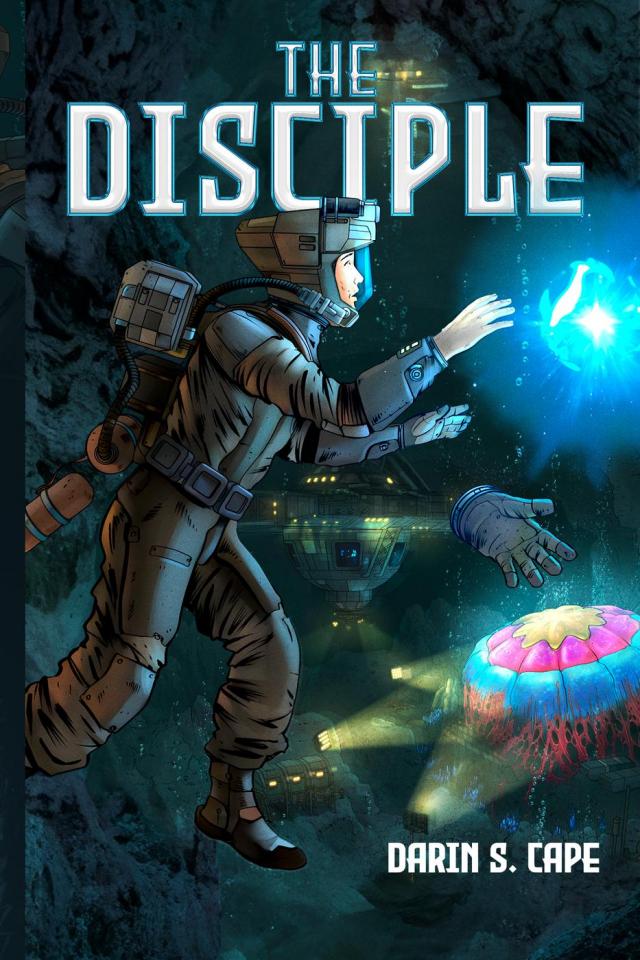
The Disciple
The Hand of God, Volume 1
Darin S. Cape
Published by SHP Comics, 2023.
The Disciple
This is a work of fiction. Similarities to real people, places, or events are entirely coincidental.
THE DISCIPLE
First edition. November 1, 2023.
Copyright © 2023 Shawn Hainsworth.
Table of Contents
Title Page
Copyright Page
The Disciple (The Hand of God, #1)
About the Author
About the Publisher
How can we discover the ultimate source of life in the universe? Each revelation unfolds exponentially more dimensions of possibility. It is not within our capacity, as human beings, to advance any set of facts with either epistemological or teleological certainty. Happily, we must be content with the endless quest for knowledge.
– Dr. Samuel J. Friedmann
Director of Xenobiology International Marine Exploration Institute
Every night, before I fell asleep, Jesus appeared at the foot of my bed. His long hair touched his shoulders, his eyes were kind and bright, and he wore a rough, gray robe that faded to white around the edges. He was exactly like Mama’s pictures of him. The first night he visited, I asked if he could see my Daddy on Mars. He said yes. When I asked what Mars was like, he said it was dry and rocky—like Nazareth.
When I told Mama, she said it was a sin to make up stories about Jesus. But Jesus still came to visit me every night. He said Daddy was good, but he missed me. When Mama asked if Jesus came to visit me again, I lied and said no. Maybe she knew I was lying, because the next night she put a snake in my room.
In the morning, I saw the snake curled up in the blanket at my feet. I’d seen lots of snakes before and I knew it was a copperhead. I wasn’t afraid. They won’t hurt you unless you bother them. Its eyes stared at me from beneath the covers. It was Mama’s way of testing me to see if I was telling the truth about Jesus.
A DECADE LATER, JOHN Haggerty stood on the edge of his mother’s grave, his fingers slowly released a handful of dirt. All the faithful, her only friends, were in attendance. Waves of conflicting emotions rushed through John as her coffin was lowered into the earth, but mostly, he felt relief. She was gone, and with her, the guilt he had carried with him since he was a child. He couldn’t remember a time when he didn’t feel guilty, guilty for not being devout enough, pure enough, or selfless enough to satisfy her. He resented living in a rundown shack that leaked in the summer and was drafty in the winter. He hated being hungry and poor and he hated her for driving his father away.
Colton Dixon, known locally as the Old Blind Pig, stood next to him, a snake wrapped between his fingers as he muttered in tongues. John remembered the first time he saw Colton handle a snake. He watched with fascination and terror as the serpent slithered between Colton’s fingers, its forked tongue flashing out and disappearing again. Now, as a student of biology, he just felt sorry for the snake. Looking around at the congregation, he was overwhelmed by pity and disgust. A few more hours and he would be on a plane back to Boston and could, finally, leave his childhood behind.
John’s mother was passionately devoted to God, but God hadn’t put food on the table, nor did prayer keep her from getting sick as her body wasted away. John only visited her once during the two years of her prolonged illness. He found her lying on dirty bed sheets, her body decimated, the smell of urine filling the room. Church members delivered meals once a day, washed her body, and prayed with her. When he arrived, John barely recognized her gaunt form, except for her eyes, which still shone with the light of a true believer. Her suffering was further proof of her devotion. It made him sick.
The first day, he cleaned everything in the house, as if he could wash away all her pain and suffering. The smell of bleach filled the house, stinging his nose, and he wished there was something else that he could do. For two weeks, John shuffled around the small room as his mother read from the Bible and prayed. He knew she wanted him to join her, but he couldn’t, that was something he could never do. Never again would he supplicate himself to a heartless God. He only asked her once to go to a hospital, knowing it would be in vain. He wanted to cry, to throw his arms around her, to beg her to seek treatment. “Please, mama.” There were so many things he wanted to say but couldn’t.
Finally, mercifully, she died. He sat holding her hands, looking into her eyes as she gasped slowly, her mouth opening and closing in vain, like a fish on land struggling to draw in a quickening breath. She drew one final gasp, looked at him, and fell back on the bed, the light in her eyes extinguished. He sat next to her for a long time and wept. He cried for himself, for the passing of this woman he hated and loved. He cried for her wasted life, for her devotion to a pitiless God. Why had He made her suffer, this poor pathetic woman. Was she now reaping her reward in Heaven? He wanted to believe it was possible.
John, now nineteen years old, was alone in the world. His father had died ten years earlier in an explosion caused by a gas leak at the icehouse prototype facility he was constructing on Mars. John saw the letter marked “International Space Exploration Agency,” and knowing it was about his father, he secretly steamed it open. He read the formal announcement describing his father’s death, then resealed it for his mother to find when she returned home. That evening, she burned the letter without opening it or saying a word.
John’s relationship with Jesus ended when he was twelve. His mind rebelled against his mother’s strict control. He spent more time away from home, taking long walks in the woods when he wasn’t in school. He often saw Colton during his rambles, sitting by himself, listening to the forest. Colton could sit for hours in the same position. John would pass him on his way out in the morning and find him in the same position that afternoon when he returned for lunch.
One day, John asked Colton to join him on his walk. Colton nodded and followed him without saying a word. While Colton never spoke that day, John found his company soothing, and soon they walked together almost every day. Blind since birth, Colton possessed an extraordinary ability to perceive any critter they passed in the woods. As they walked the rambling paths, Colton would tap John quietly on the shoulder and point. Following Colton’s finger with his eyes, John would be rewarded with a brief glimpse of one of the many denizens of the forest: a mink sliding into the river, a toad poking its head out of a hole, a snake slithering through the fallen leaves, or a bird alighting from a branch.
Colton taught John to be patient and observant. After walking for a while, they would find a spot to rest and sit quietly. Initially, John couldn’t stay still for more than a few minutes, but as soon as he began to fidget, Colton would place his large hand on his shoulder. Colton’s touch was calming, as if his hand could drain away John’s nervous energy, tethering him to the moment. John’s conscious mind would recede into the background, and he became aware of the patterns and activity around him: water running, a breeze rustling through the trees, birds singing, insects feeding, and predators of all sizes patiently stalking their prey.
Spending time with Colton in the woods was as close as John would come to a religious experience. In these moments, he felt the divinity of creation and could see himself as he truly was—a single life among the billions of creatures that inhabited the Earth. John found comfort in this feeling of insignificance. It freed him from the constant obligation to do God’s will, as well as the guilt of never being able to live up to God’s expectations. His mother’s God was wrathful and vindictive, eager to punish every transgression. Her concept of God made John feel weak, helpless, and sinful. Being with Colton made John feel calm and connected to the Earth and its inhabitants.
After several months, Colton began to teach John how to handle serpents. Whenever they encountered a snake, Colton would get close to the ground and reach out his hand. At first, John thought the snake would strike, but Colton’s movements were slow and unthreatening as he allowed the snake to explore his hand and arm with its tongue. The serpent would gradually curl itself around Colton’s arm, resting its head in the crook of his elbow. When John was ready, he held out his hand, allowing the snake to explore his fingers. Usually, the snake would remain on Colton’s arm, but occasionally, it would slide its head between John’s fingers and slowly make its way up his forearm.
A few months after John handled his first snake in the woods, Colton gave him one to handle during church. His mother beamed as she watched her son carry the snake down the aisle. He had finally found his calling. That night, she read to him from Mark 16, “These signs will accompany those who have believed: in My name they will cast out demons, they will speak with new tongues; they will pick up serpents, and if they drink any deadly poison, it will not hurt them; they will lay hands on the sick, and they will recover.” Most importantly, she no longer questioned him about his long absences from the house. He was doing the Lord’s work now.
By age fifteen, John had learned how to act like a devoted servant of God and an obedient son, yet a deep chasm grew between him and his mother. He was receiving more respect within the church but was losing his faith. His mother didn’t understand the transformation within him or how he was growing away from her and her God.
During the summer before his sophomore year, John ventured, for the first time, to the public library, a place his mother had strictly forbidden him to enter. “Too many dangerous ideas and false prophets,” she would say. John stood awkwardly, working up the courage to approac
“Do you have any books on snakes?” he managed to stammer when she looked at him.
“Is this for a school project?” she asked in return.
“No, ma’am. I just like snakes,” John replied as if confessing a sin.
“What grade are you in?”
“I’ll be starting tenth grade in the fall, ma’am.”
“Well, this is a book for younger children,” she said, walking briskly toward one of the bookshelves, “but it’s very popular.” She handed him a book called Everything You Need to Know About Snakes and Other Scaly Reptiles. A picture of a big, green snake graced the cover.
“I think that book has been here longer than I have,” she said with a smile .
John took the book, running his hand over the worn cover. The spine had been taped several times to keep the book from falling apart.
“Can I read it?” he asked.
The librarian looked at him more closely. “Of course,” she replied. “Do you have a library card?”
“No, ma’am,” John replied. “Are they expensive?”
“No,” she said, smiling again. “They’re free. Once you have a library card, you can take the books home with you, if you bring them back on time.”
John found a small chair in the corner and sat down, carefully opening the book. Inside were pictures of all kinds of snakes that he had never seen before—cobras, black mambas, and even ones that lived in the desert. There were descriptions of how each snake’s venom worked, some capable of killing a person within minutes. He also saw pictures of snake charmers who played music to make the snakes dance.
When it was time for the library to close, the librarian tapped him on the shoulder.
“I see you’re enjoying the book,” she said.
“Yes, ma’am.”
“Well, you can come back tomorrow if you like. Be sure to bring a piece of mail with your parent’s name and address on it and I’ll make you a library card.”
“All right,” John said and ran home. He pocketed a letter he didn’t think his mother would miss and came back the next day. The librarian, Mrs. Abernathy, took a shine to him and started setting aside books that she thought might interest him. He took the long walk to the library every day after school, and on Saturdays, he would tell his mother he was going to the woods to look for snakes.
The sun dropped quickly, the service ending. The final shovel of brown earth was placed gently on top of his mother’s grave. John stood numbly, knowing that once he turned away, he would never return.
“She’s in a better place,” a husky voice said behind him. John turned to see the Reverend Elder reaching out a hand to him.
“Thank you, sir,” John said, taking the hand and lowering his eyes.
“Your mother was a pillar of our community and will be sorely missed.”
“Yes, sir,” John replied, playing the dutiful son one more time. He greeted everyone, said all the right things, and effusively praised his mother’s life and faith.
At last, Mrs. Abernathy approached him.
“How are you enjoying MIT, John?” she asked with a big smile.
John wrapped his arms around her and smiled brightly. “I didn’t realize you would be here,” he said. “There’s so much I want to tell you.”
Mrs. Abernathy had been John’s savior and the only reason he had been accepted into MIT. She recognized the scope of his intelligence and curiosity and guided his education outside of the classroom, challenging him with more complex texts and concepts in history, literature, and science. His school grades went from a C average to straight A’s.
By the time John was a junior, his personal studies had exceeded the high school’s curriculum, especially in biology. Since biology was not a subject in which Mrs. Abernathy had much expertise, she steered him toward a professor at the local community college. During the fall of his senior year, she encouraged him to apply to the best universities, wrote glowing letters of recommendation, and supported him through every step of the application process. When he received a full scholarship from MIT, she could not have been more excited if John was her own son.
As the last of the congregants drifted away, John stood, rooted to the ground. A light rain fell, rivulets pooling in the freshly dug brown earth. John remembered the last conversation he had with his mother before he left for college.
“Blasphemer!” she screamed, slapping him on the sides of his head. “Heathen!”
“No, mama,” he cried, his ears ringing under her blows.
“Who put these ideas in your head?” she asked, gripping him by the shoulders.
“No one,” John said, tears streamed down his face.
“Liar,” she replied. “I’ve a mind to go down to the library right now.”
“No, mama, please,” he pleaded. John was at least a foot taller than his mother, but he cringed in front of her.
“You deliberately disobeyed me. You threw open the door and invited Satan into our house. Well, I won’t have it. I won’t have the Devil in my house. You walk out that door and you just keep on walking, you hear me.”
“Please, mama,” was all he could reply. It was futile to explain he was no longer the same person she raised, how he yearned for knowledge, and how science was now his faith. He still loved her, still believed in God. Science was a way of understanding God, of understanding His creations.
“Get out of my sight,” she said at last, turning away from him.
AS HE STOOD ON THE banks of the Charles River, John watched the carved wooden boats of the crew team slice through the water. Behind him was Killian Court and the dome of the Maclaurin building, known to the students as building ten. In front of him, the Harvard bridge connected Cambridge to Boston. It was a beautiful, crisp, fall day and the sun was shining on the MIT campus, but it was not enough to raise his spirits. Since arriving, John had been struggling to fit in, feeling intimidated, overwhelmed, and lonely.
The other students seemed so much smarter and more accomplished than him, having attended some of the best high schools in the world. He was too shy and awkward to make friends, afraid to speak up in class, to risk exposing himself as a fraud. He came close to giving up, but there was nothing left for him at home. What would he say to Mrs. Abernathy after she had worked so hard to give him this opportunity?
The campus grew colder as fall turned to winter, and students spent most of their time inside their dorms or the libraries studying for midterms. John felt the pressure intensely. Choosing to leave was one thing, failing out another. The night before his first exam in organic chemistry, he heard a loud voice that shocked him out of his concentration. He turned, thinking someone was playing a prank on him, but there was no one there. John dreamed of his mother that night. She appeared to him as she was the day he had left, her graying hair pulled back, her eyes cold and severe.
“Blasphemer,” she said. “You invited Satan into our house.”
John woke in a cold sweat. Blasphemer echoing in his head.
John earned the highest grade in his class on his organic chemistry midterm. He also performed exceptionally well in his other classes, and for the first time, he started to believe that he could succeed at MIT.
The next semester, John took the class that would change his life, “Introduction to Xenobiology,” taught by Dr. Samuel Friedmann. Dr. Friedmann was a prodigy, completing his doctorate at the age of twenty-three. In his lectures, he speculated on the possibility of an extraterrestrial origin for life on Earth. Dr. Friedmann radiated brilliance but also an intense, almost childish, curiosity. He jumped rapidly from topic to topic. In a single lecture he might cover diverse topics in geology and evolution, diving into the chemical structures of amino acids and end by discussing specific human genome variations. Many students found the lectures too eclectic and difficult to follow, but John was mesmerized.
At this time, John started to have a recurrent dream about his father. They were together on Mars, riding in a rover across the red rocks. Dark clouds rolled overhead. Streaks of lightning illuminated the landscape. His father was driving too fast, but he was not afraid.


