

A Snake Falls to Earth, page 1


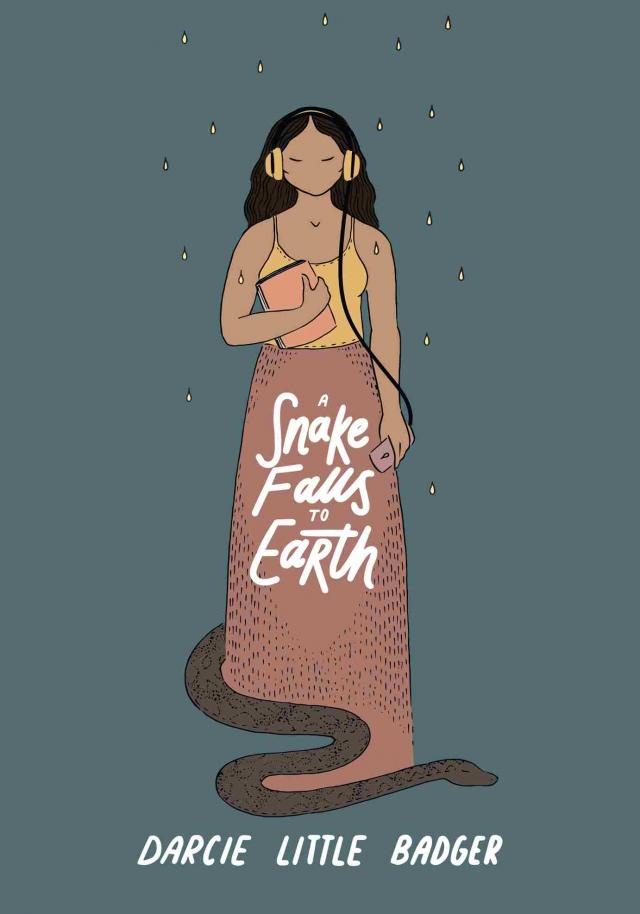
Dear Reader,
Since the COVID-19 pandemic began, it has often felt hard to find hope. Amid crises of racial violence and new COVID variants and burnout in the workplace, many of us have escaped into fiction for solace. In A Snake Falls to Earth, author Darcie Little Badger doesn’t shy away from the crises that we’re facing, whether it’s climate change or the language loss faced by Indigenous communities under colonization. But for Darcie, hope is always somewhere to be found.
“There’s this sense of almost fatalism, that the world is going to end,” she says. “The way I think about it is: maybe. But my responsibility is to fight for the best version of the future that I can.”
The book follows Oli and Nina, two very different people in very different circumstances — Oli, a cottonmouth snake from the Reflecting World where animal people roam and Nina, a teenage Lipan Apache girl in our world. Nina and Oli have no idea the other exists. But a catastrophic event on Earth, and a strange sickness that befalls Oli’s best friend, will drive their worlds together in ways they haven’t been in centuries.
Darcie, who holds a PhD in oceanography and worked as a scientific editor before writing full-time, incorporates things she learned as a scientist into her work and finds hope and solace in the natural world. “It’s difficult for me to even write fantasy without acknowledging the cool, interesting, and beautiful things about the world we live in,” she says.
We hope you enjoy Nina and Oli’s story, and that it brings you some hope in this world that can feel so despondent. If you feel so moved, feel free to tag us on social media @LevineQuerido.
Cheers,
Team Levine Querido
This is an Arthur A. Levine book
Published by Levine Querido
www.levinequerido.com • info@levinequerido.com
Levine Querido is distributed by Chronicle Books, LLC
Copyright © 2021 by Darcie Little Badger
All rights reserved
Library of Congress Control Number: 2021931960
Hardcover ISBN: 978-1-64614-092-3
Ebook ISBN: 978-1-64614-114-2
Published November 2021
With love, I dedicate these stories
to my mother, protector of knowledge
to T, healer of animals great and small
and to the families we find in unexpected places.
CONTENTS
Nina, Age 9
Cottonmouth is Cast from Home
Nina, Age 13
Cottonmouth is Hunted by a Monster
Nina, Age 13
Cottonmouth Meets the Coyote Sisters
Nina, Age 14
Cottonmouth Meets Cooper’s Hawk and a Sinister Stranger
Nina, Age 15
Cottonmouth Meets a Bounty Hunter
Cottonmouth Reaches a Fork in the Road
Nina, Age 16
Cottonmouth Challenges Death
Nina, Age 16
Cottonmouth Meets the Scribes
Nina, Age 16
Cottonmouth Hatches a Plan
Nina, 3 Days Before Landfall
Cottonmouth Journeys to the Fourth Peak
Nina, 3 Days Before Landfall
Cottonmouth Meets an Originator
Cottonmouth Falls to Earth
Nina, 3 Days Before Landfall
Nina, 2 Days Before Landfall
Cottonmouth Stars in an Action Movie
Nina, 2 Days Before Landfall
Cottonmouth Confronts an Impostor
Nina, 2 Days Before Landfall
Cottonmouth Remembers Flowers
Nina, Shortly Before Landfall
Cottonmouth, Hawk, and the Coyote Sisters Fight the Wind
Nina, Cottonmouth, and Coyote Fight a Tornado
Cottonmouth Returns
Nina, Shortly Before Landfall
Cottonmouth’s Heart Breaks
Nina Defies the Nightmare
The Knight Flies Away
Two Weeks Later
One Year Later
Acknowledgments
About the Author
Some Notes on This Book’s Production
n the hospital bed, her delicate body cradled between thin white pillows, Rosita dreamed. Pictures in metal, plastic, and wooden frames surrounded her, displaying images of friends and family, giving the appearance of an audience. However, the only visitor in the room was Nina, who sat on a tin chair beside the hat rack-shaped IV pole.
Nina couldn’t stop looking at the sepia-toned photograph in an oak frame. Propped on the window ledge, it featured a portrait of Great-Great-Grandmother Rosita as a young woman. The picture came from an era long before digital cameras. In those days, people posed in front of a boxy camera and had to wait days to learn whether they’d blinked. In her portrait, young Rosita wore a hundred strings of pale seed beads around her neck, against her buckskin-clothed chest. Some had glinted, each glass bead a mirror for the sun. Young Rosita’s fine black hair had symmetrically framed either side of her face. With dark, intense eyes, she’d stared directly at the camera lens, as if challenging the photographer to blink first. In most old-timey photos, the subjects didn’t smile, but young Rosita’s lips quirked in the suggestion of stifled laughter, as if she’d remembered a joke, one she could barely wait to share.
In the hospital room, Rosita’s hair fanned across her pillow in thin white wisps. Her eyes, now opening slowly and wearily, were sunken; advanced age had sculpted her face against the contours of her skull, revealing sharp ridges that had once been hidden by plump cheeks. Without her dentures, Rosita’s thin lips curled inward. Rosita looked toward Nina. Did she need something? Water? More medicine? In anticipation, Nina opened the speech-to-text translation app on her phone.
“Don’t worry,” she said. “Dad’s coming back soon, and after lunch, Grandma will visit.” Nina’s father was speaking with doctors beyond the closed door. “Are you okay for now? A … abuelita?” Great-Great-Grandmother didn’t speak much English. Unfortunately, Nina knew even less Spanish, but her attempt to communicate worked, because at the word Abuelita, Rosita’s lips quirked, creating the same anticipatory, gentle smile that shone from the old photograph.
“Quieres escuchar una historia?” she asked, her voice raspy but strong. The translator on Nina’s phone automatically typed out the question: Do you want to hear a story?
Nodding, Nina scooched her chair closer, flinching at the nails-on-chalkboard screeeeech of metal legs scraping against the smooth white floor. Rosita patted her cradle of pillows, finding a gray remote control between them. One press of an arrow-shaped button caused the back of her bed to lift with a soft mechanical whir, gently raising her into a sitting position.
“Esto es importante.”
This is important.
“Recuerda nuestra historia.”
Remember our history.
Again, Nina nodded, hiding her confusion. The first time Rosita said historia, the phone app had translated the word as “story.” Now, it translated the word as “history.” Which version did her great-great-grandma mean?
As Rosita began to speak, it occurred to Nina that the app was an imperfect interpreter, despite its 4.8-star rating and how it had worked for her in the past. Most of the story Rosita was telling now was being classified as an “unknown language.” How was that possible? The app had advanced linguistic AI and could understand thousands of global dialects. Occasionally, Rosita used a Spanish phrase, but they were so sporadic, Nina couldn’t piece together the story—history?—using the Spanish translations alone.
However, Nina didn’t dare interrupt her great-great-grandmother. In her nine years on earth, she had never heard the elder speak like this before, as if each word was connected, one flowing into the next. At last, her voice raspy with overuse, Rosita said two last words: el pesadillo. In the silence that followed, she turned away, closed her eyes, and snuggled back into her pillows.
According to the translator, el pesadillo meant “the nightmare.”
“Did you have a bad dream?” Nina asked. Gingerly, she touched Rosita’s vein-threaded hand; finding it to be cold, Nina entwined their fingers together. “Abuelita?”
This time, there was no smile. Just deep, steady breaths.
“Abuelita? Are you okay?” How could she ask that in Spanish? The word bien meant “good,” right? “Are you … bien??” Nina started panicking. “Dad! Dad, help!”
In an instant, her father and a nurse in pink scrubs jumped into the room—they must have been standing right beyond the door. Nina’s father wore his best pair of tattered blue jeans and a black felt cowboy hat, the fancy one embellished by yellow and red beadwork around the rim. “What’s happening?” he asked.
“She stopped talking and fell asleep, Dad.”
The tension seeped from the nurse’s stance. “Oh, honey,” she soothed, pressing a button on the bed that made it flatten out, “your great-great-grandmother gets very tired, but that’s okay. She needs lots of rest to recover.”
“Dad, just now, Abuelita told me a story,” Nina explained. “I … think.”
“That’s great! She’s feeling like herself again.” Rosita was an entertainer, the keeper of ten thousand stories, each stranger than the last. Now and then, she’d share one with Nina, and though she was sure much of the nuance was lost in translation, the app had usually been able to capture the essence of her words.
“Do you know what this means, Dad?” Nina held up her phone, sharing the jumble of nontranslated words
“Hm.” Her father stepped near the window, waving Nina close. After studying the screen, his brow split by a vertical wrinkle of concentration, he guessed: “It may be an Apache dialect. Rosita’s parents spoke Lipan, ’round when our people had to go culturally incognito for survival.”
“Wait, what?”
“Shh,” her father hushed, glancing across the room, where the nurse in pink was taking Rosita’s blood pressure. “Don’t wake her up.”
“Sorry,” Nina whispered. “I just didn’t realize Rosita understood it, too.” Years ago, Nina’s parents taught her that Lipan needed to be “revitalized”—people knew phrases, simple sentences, and words, but nobody spoke it fluently. Not even Rosita. Plus, that timing didn’t make sense. If baby Rosita had survived the U.S. government’s attempts to slaughter Texas Natives, she’d been alive during the 1800s, which would make her over 150 years old.
Sure, Nina’s family tree had a lot of centenarians, but humans didn’t get much older than 100, right? Was Nina in the presence of a record-breaking elder?
Possibly. Stranger things had happened.
“I didn’t, either,” Nina’s dad said, and kept reading the story transcript. “The spelling’s messed up, but that’s Lipan for ‘home’ …” He scrolled through the wall of text, pausing near the end. “That phrase probably means ‘animal person.’ Gawd, what a treasure. Save her words, okay? We may never understand, but …” Now, he turned to regard the sepia portrait in the oak frame. “… it’d be a shame to lose them.”
After that morning, Great-Great-Grandma Rosita spent a week longer in the hospital, surrounded by her photographs and family. When awake, she told fanciful, ancient stories about the days when humans and spirits lived together. Stories with titles like “Coyote Person Traps the World’s Sweetest Ballad in a Locket” or “Clever Sisters Escape from Kidnappers and Spend the Winter with a Groundhog Family.”
On the last day, when Rosita was at her strongest, Nina prompted: “Abuelita, um, what about el pesadillo? Que es … la historia … del pesadillo?”
The smile again. Slight, knowing. And gone just as quickly, as if carried away by a flood of sorrow. When Rosita spoke, she tilted her head toward Nina’s phone, which translated:
That was the last story my mother told me. Remember, she said. Creator, I was so young when my parents died. Now, I carry sounds without the meaning. Isn’t that sad?
“¿Cuántos años tienes?” Nina whispered, scooting to the edge of her seat. In response, Great-Great-Grandmother only shrugged.
“It’s okay,” Nina continued, leaning over the bed to kiss Great-Great-Grandmother’s forehead.
Later that year, Rosita died in her home. It happened peacefully, everyone said. As if she had simply decided, “Tonight’s the night,” shut her eyes, and strolled into the underworld during a gentle dream. Born among family in the tumbleweed-spawning desert, Rosita had no official documents listing her birth date. But when Nina’s father removed her portrait from its frame to scan the image for her wake, he found a single date written on the back: 1894.
can’t remember when I learned about the path to anywhere-you-please. It’s one of those stories everybody seems to know, like a persistent thread of gossip. But I’ll never forget the day it found me, completely by chance, in the terror of Robin-Kept Forest. Thing is, I didn’t realize the path was special until I’d already walked it. Where would I be now if I’d known?
Momma was overprotective; she didn’t chase me from home till I was fifteen years old. It happened during a calm midsummer morning. I was napping on the riverbank, dreaming about the sunlight. Real sunlight, the kind that’s so bright and warm, it almost burns. You can still bask in the dimly radiant light that slips into the Reflecting World, my home of spirits and monsters. The pseudosun, we call it. But it’s no perfect substitute. Without so much as a greeting, Momma plopped a rucksack full of supplies onto my chest, and hissed, “Wake up, Oli. You’re ready.”
I clutched the bag in a death grip against my skinny chest, hoping I was just having a nightmare. “Really? Today?”
“Yes, today. Of course today. When else is there, little snake?” She dropped a tightly folded blanket on top of the rucksack, and the weight of densely woven sheep wool caused me to hiss with discomfort and sit up, shifting the parcels’ combined weight to my lap.
“Can I live down the river?” I asked, fumbling for my spectacles. The world sharpened when I slipped them over my eyes.
“If you do, it better be so far downstream that I never see your scaly tail again, kid.” At my dismayed gasp, Momma’s expression softened, and she added, “If I let all my children stay here, we’d run out of food, space, and patience.”
“You could make one exception?” I ventured. “For me?”
“Absolutely not. That’d be unfair.” Momma pointed south with her nose. “Leave now, and you’ll reach the dammed town before nightfall. The beavers usually have room for a lodger.”
“And if they don’t?” I muttered.
“Pfft. You’re a cottonmouth,” she snickered. “Sleep under a bush.”
As if to demonstrate, Momma switched from her false form to her true form. She slithered out of her dress and bared curved, venom-filled teeth in my direction, warning me to skedaddle.
“Okay, okay.” With a final, wistful look at my favorite sunning rock and the family cottage, a squat dome of moss-covered stones, I heaved the rucksack over my shoulder and scooped up the blanket. Its fabric, which smelled of sage and smoke, felt dense under my fingers.
“Goodbye, Momma,” I said.
She remained silent until I’d turned my back on home and started trudging down the riverside. “Goodbye, Oli. You’ll be all right.”
I should have been prepared for my ousting, should have already scoped out the territory for my new home. It wasn’t as if Momma had failed to give me forewarning. That winter, she’d borrowed a massive loom from the sparrow woman who lives across the valley. Then, she’d haggled for brown and green wool at the market. “I’m making you a good blanket,” she warned me, “and it’ll be my last gift to you.” But Momma spends most of the day in her snake form. Her fingers—in her own words—feel like alien appendages. They’d moved hesitantly over the spun yarn, warp strings, and batten. I thought I had another year. Guess she had been determined to finish by summer.
That haste was for the best. If she’d sent me away during a cold season, I probably would have frozen solid outside the cottage. Even in our false form, cottonmouths do poorly in low temperatures. I suppose that’s one reason why Momma’s last gift was a thick blanket.
I walked in a glum daze until my stomach tickled with hunger. Momma had probably packed rations in my rucksack: chewy smoked fish and dense, honey-soaked cornbread. But I didn’t want to break into the emergency food so soon. There’d be fresh meals at the dammed town. Rich stew, baked yucca, and fire-seared corn with juicy kernels. I may even have a mug of thick chocolate if a trader from the south had visited recently. The thought of a warm feast urged me forward. I even tried jogging, only falling back into a brisk walk because the rucksack kept thumping against my back. I’d changed into a tunic, but the fabric did little to cushion my bony spine and shoulders.
It’d been several years since my last trip to the dammed town during a family outing by boat, but if I recalled correctly, I didn’t need to run to reach the dams before the pseudosun set. Everything will be fine, I told myself. And it was.
Until I reached the split in the river, a wishbone-shaped division of my path. I hesitated, trying to remember whether I should follow the right or left branch of the bifurcation.
That’s when I realized that I couldn’t remember ever seeing the split before, much less which direction would take me to town. It was too easy to nap on the warm deck of a riverboat. I’d never been awake for this part of the journey.
For a couple minutes, I searched my surroundings for anyone who could help. Although there were crickets in the grass and silvery minnows glinting under the ripples of the river, they weren’t animal people like me. Believe it or not, there are a lot more animals than animal people in the Reflecting World. If I had to rank us by numbers: plants, fungi, and animals—in that order—are most abundant. Then animal people. Then monsters. Then others.


