

The Pirate's Wife, page 1


PRAISE FOR THE PIRATE’S WIFE
“Well-researched and absorbing.”
—Judy Batalion, New York Times bestselling author of The Light of Days
“A beautifully researched consideration of the marriage between Captain Kidd and his remarkable wife, Sarah. It is always a thrill when a writer shows us a world we think we already know in a new light, and Daphne Palmer Geanacopoulos has done just that.”
—Madeleine Blais, Pulitzer Prize winner and author of In These Girls, Hope Is a Muscle
“A rollicking yarn replete with romance, buried treasure and revenge, The Pirate’s Wife enthralls!”
—Heath Hardage Lee, award-winning author of The League of Wives
“This compelling portrait of Sarah Kidd’s turbulent life, and her indomitable spirit, is full of dramatic twists and turns that will leave you wondering if there is any truth to the legend of Captain Kidd’s hidden treasure.”
—Eric Jay Dolin, author of Black Flags, Blue Waters
“The Pirate’s Wife falls under the category of narrative nonfiction but reads like a lively historical novel. I sailed right along with this saga. A jolly good ride.”
—Sally Cabot Gunning, author of The Widow’s War
“Geanacopoulos has achieved something historical scholars dream of: bringing to light a fascinating story that is as entertaining as it is factual.”
—Tracey Enerson Wood, internationally bestselling author of The Engineer’s Wife
“A lively tale of the remarkable Sarah Kidd. Pirate lovers worldwide will rejoice!”
—Marcus Rediker, author of Villains of All Nations
“A deeply researched and richly imagined exploration.”
—Pamela D. Toler, PhD, author of Women Warriors
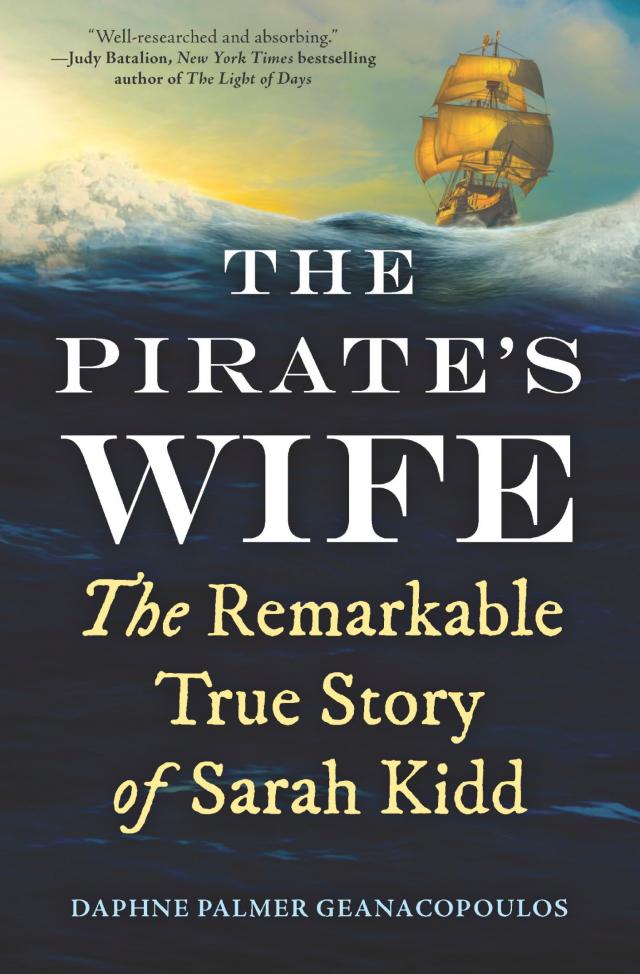
The Pirate’s Wife
The Remarkable True Story of Sarah Kidd
Daphne Palmer Geanacopoulos
Dr. Daphne Palmer Geanacopoulos is a historian, journalist and author of The Pirate Next Door: The Untold Story of Eighteenth Century Pirates’ Wives, Families and Communities. Her writing has appeared in the New York Times, the Washington Post, Southern Living, Virginia Business and other outlets. She lives in South Yarmouth, Massachusetts, with her husband, David.
To the memory of my grandmother, Juliette Marie Wehrmann Palmer
Contents
Prologue
Chapter 1
Chapter 2
Chapter 3
Chapter 4
Chapter 5
Chapter 6
Chapter 7
Chapter 8
Chapter 9
Chapter 10
Chapter 11
Chapter 12
Chapter 13
Chapter 14
Chapter 15
Chapter 16
Chapter 17
Chapter 18
Chapter 19
Chapter 20
Chapter 21
Chapter 22
Chapter 23
Chapter 24
Chapter 25
Chapter 26
Chapter 27
Chapter 28
Acknowledgments
Endnotes
Bibliography
Index
Prologue
Sarah Kidd lay in a weakened state in the bedroom of her Manhattan mansion. A highly contagious lethal disease raged through the colony striking young and old, rich or poor, Black or white. It was September 12, 1744, and the seventy-four-year-old Sarah had first taken to her bed to get warm under her soft quilts and to rest her head on the goose down pillows. Then the chills, fever, and fatigue set in. She was nearly certain she had contracted the deadly disease everyone called diphtheria. As a precaution, she asked her family and friends to stay at a safe distance. She arranged for soft foods and a soothing drink made from the medicinal herbs in her garden to be left outside her bedroom door.
Her mind wandered in a fever-induced haze. She closed her eyes and remembered herself in another time and place. She was a young woman with her husband, Captain William Kidd, on his pirate ship, the Saint Antonio, a vessel laden with gold, silver, and jewels. As his closest confidant, she learned that he’d buried some of his stolen treasure for safekeeping, and he described to her where it was hidden. She was not to tell a soul. For more than forty years, since his death in 1701, Sarah, the pirate’s wife, kept his secret safe. Not even her five children knew. She alluded to it in her will, noting that she had assets in “the City of New York and elsewhere.” She did not identify “elsewhere.” Sarah worried about the consequences if her children were caught with stolen pirate loot. Her strong instincts told her it was best to leave well enough alone.
As she thought back over her life, not all of her memories were fond ones, especially the time when she was a pirate’s wife. But now the memory of the hardships and heartbreak had softened and Sarah wouldn’t have traded it for anything. She felt proud, very proud, to have been a pirate’s wife and she wore the title as a badge of honor.
Sarah repeated a prayer as her condition worsened: “Almighty God, have mercy on my soul and pardon and forgive me all my sins & offences so that I may after this Miserable Life arise with our savior Jesus Christ.”1 She became delirious from the fever and shook uncontrollably. The sheets were soaked with her perspiration. Still, the thought of that secret weighed on her, as well-kept secrets do.
As she prayed for forgiveness she may have thought it was time to identify “elsewhere” to her three children who paced downstairs in the sitting room.
It wasn’t long before Sarah developed a sore throat that felt like a razor when she swallowed. She tried to speak, but it hurt so much she could only whisper. Her daughter, Elizabeth Kidd Troup, peeked through the keyhole to check on Sarah. The once vigorous woman now appeared very small among the many furnishings and tasseled curtains. She looked pale in her white cotton bedclothes and so frail lying on her side facing the door. Elizabeth saw her mother’s lips moving, mouthing words, but she could not hear her. She strained through the keyhole to hear what she might be whispering. Elizabeth called for her brothers, William and Henry, who had stepped outside on the front stoop that faced the harbor. The cry of the seagulls seemed to signal the alarm. Elizabeth told them to hurry. Each took a turn at the keyhole looking and listening. Sarah’s breathing was loud and strained as she gasped for air. The three of them looked at each other with tears in their eyes when the room fell quiet. There was not a sound, not even a whisper.
For over three hundred years treasure hunters have scoured the North American eastern seaboard trying to find where “elsewhere” is. That secret is with Sarah, buried in the churchyard of Trinity Church Wall Street in Manhattan.
1
Sarah’s New World
The lookout on the ship carrying passengers from England in 1684 spotted the bustling seaport at the tip of Manhattan first. On board was fourteen-year-old Sarah Bradley, her father, Captain Samuel Bradley, and her two younger brothers, Samuel Jr. and Henry. Sarah was weary from the voyage, an arduous weeks-long journey across the Atlantic. She had packed her bags with her most treasured possessions and left her home in England at the insistence of her father.1 From the deck of the ship she glimpsed her new homeland for the first time—the former Dutch colony of New Netherland, now England’s crown jewel, New York. As the ship approached the harbor, the landscape came into full view. To the left was the Hudson River and to the right, the East River. Windmills, church steeples, and tiled rooftops filled the skyline of the small settlement, a triangle of land one mile long and half a mile wide inhabited by Dutch, English, French, and Jewish settlers.2 Dozens of ships filled the harbor and Sarah heard the clanging of ropes against tall wooden masts, the fluttering of sailcloth, and the shouting of orders from captains to their crew. Barrels, boxes, sacks, and chests were lowered into waiting boats and ferried to the long dock that jutted out like a strong burly arm. Men pushing carts and wheelbarrows over cobblestone streets hurried to the warehouses that lined the shoreline dropping off their collected goods. The sights, the sounds, and the smells—sweet fragrances of spices and oils, the salt spray, and the nose-turning stench of rotting fish and raw sewage from the free-roaming pigs,3 were overwhelming.
Captain Bradley, a mariner and owner of transatlantic vessels,4 told Sarah he’d heard that the ships that entered Manhattan’s seaport carried valuable cargo—some worth more than fifty thousand pounds—from faraway places like the West Indies, Europe, and Madagascar.5 His seafaring mates touted New York as the land of opportunity—a place where great riches could be had. Sarah knew trade was just one of the reasons her father brought their family to New York. They had lost their mother and the loss had been devastating. Now a single father, Captain Bradley wanted to leave the difficult past behind and make a fresh start. The New World held the promise of a better life for all of them.
Soon after arriving in Manhattan, Bradley met William Cox, a well-dressed, wealthy merchant who specialized in flour, the colony’s most important trade good. A generous man with a paternal nature, he was an older bachelor in his midthirties. The two men quickly struck up a mutually beneficial relationship: Cox had money to invest in transatlantic voyages; Bradley had the connections to assist Cox in his business interests overseas. He also had a lovely daughter. Cox filed for a marriage license with Sarah Bradley in February 1685 and paid the governor a mandatory fee of half a guinea for his approval.6 (The fee was a welcome addition to the governor’s modest salary.) Two months later they were married in Manhattan on April 17, 1685.7
At fifteen, Sarah was a young bride, even for that time.8 Most women in the seventeenth century married between the ages of twenty and twenty-two.9 Cox was one of the richest men in the colony and Manhattan’s most eligible bachelor; of all the available prospects he’d met while living in Manhattan for nearly a decade,10 he chose Sarah. The rejected matrons must have wondered what was so special about the teenage newcomer. The clucking hens gossiped about the girl who disembarked carrying a suitcase that appeared too heavy for her size—a case which she carried close to her, protecting memories of her past. Cox knew right away when Captain Bradley introduced him to Sarah that she was the one. He wasted no time because he knew other suitors would quickly notice she was special and mature beyond her years.
Her maturity likely came from the loss of her mother. As the only female left in the Bradley family, she may have taken over her mother’s household responsibilities. There is no mention of Sarah’s mother, Mrs. Samuel Bradley, in the historical record and it is unclear for how long Sarah had been without her,11 but Sarah learned from her mother’s early modeling or a female caregiver the traditional English values that the husband was the “head of household,” in charge of the public domain of business and politics, and the wife was the keeper of the private sphere of home and family. Sarah likely took care of her younger brothers, did the cooking, and managed the household while her father worked to support the family. As a mariner, he was often away and she carried the heavy burden on her small shoulders. She turned the tragic loss into a positive life lesson doing all that her mother would have wanted her to do and becoming, in all likelihood, like her, “lovely and accomplished.”
Sarah brought to the marriage her most prized possessions. Her silver collection was substantial and included a tankard, cup, plate, sugar box and spoon, a saltcellar, porringers, tumbler, and two spoons. The total weight was 114 ounces, or about 7.125 pounds,12 a very heavy dinner set. Silver was a sign of wealth and an investment in silver was only made when there was a surplus of funds.13 Her collection may have belonged to her mother. It was so important to her she would do anything to keep it, including taking on the colonial authorities, as we will see.
She also brought her needlework. Almost all young girls in the seventeenth century were taught needlework, but hers shows that her parents valued education and they paid a tutor to teach her skills beyond the basic embroidery techniques. Her “chimneypiece,”14 was a colorful framed embroidered picture of a theme or event meant to be hung above a fireplace as the room’s decorative focal point. To create it, Sarah learned the fundamentals of arithmetic. She measured, counted, added and subtracted the stitches on her fabric. Sarah would have completed the chimneypiece after she completed at least one marking sampler. She would have undertaken a marking sampler when she was as young as five or six years old and learning basic embroidery stitches, the alphabet, and numbers. This early training was in preparation for her later adult responsibilities of sewing clothes and keeping track of her linens for her future family. Linens, such as handkerchiefs and napkins, were valuable household goods and she labeled hers by cross-stitching her initials and a number on one of the corners.15
Sarah also embroidered a coat of arms, a heraldic representation of her family name.16 Not every young girl made a coat of arms but Sarah had an interest in her family history. With the help of her tutor she researched and read about the Bradleys from records kept at the College of Arms in London, an ancient institution founded in 1484.17 With her nimble fingers and clever and inquisitive mind, she created needlework using an assortment of skills gleaned from her upper-class upbringing.
Sarah’s wedding may have been held at the small Anglican church inside the fort, a star-shaped structure located at the southwest corner of Manhattan originally built as the headquarters of the Dutch West India Company to protect the colony against threatening outsiders.18 But most weddings were performed by a justice of the peace at the bride’s home.19 Samuel Jr., Henry, Captain Bradley, and Cox’s mother, Alice Bueno Cox (his only immediate family in Manhattan), would certainly have joined in the celebration eating and drinking traditional English wedding fare. Sarah served a wedding cake of dried fruits and spices and posset, a drink made of hot milk curdled with wine, ale, or other alcoholic liquor and flavored with nutmeg and cinnamon.20 Captain Bradley had to have felt immensely proud. He found Sarah a good man. With his daughter’s future secure and the Bradley family solidly established in polite New York society, his dream of a better life for all of them had come true, all within the first year of their arriving in the New World.
2
William Cox and the She-Merchant
Sarah moved into Sawkill Farm, Cox’s country home north of the seaport in “Haarlem” (present day 74th Street and the East River). The 19¼-acre working farm named for the Sawkill Creek next to it is where Cox operated his milling operations. Legislation passed in 1678 called The Bolting Act gave New York an exclusive monopoly to mill and export flour.1 It mandated that all grain for export from the New York area had to be ground, processed, and packaged in New York.2 Governor Edmond Andros granted a flour-bolting concession to a handful of merchants that he knew and trusted to create a product of the highest quality. The economic future of the colony depended on it. Cox and his business partner, John Robinson, were among the chosen and they became exceptionally wealthy during the monopoly.3 Cox became so wealthy he was able to purchase Sawkill Farm from Robinson in 1683, two years before he married Sarah, for £160, a large sum of money for the time.4
The purchase price of £160 reflects how quickly Manhattan real estate appreciated. Sawkill Farm was half of the 38¼-acre patent known as “The Riker and Lawrence Tract” near the present-day Roosevelt Island.5 Robinson purchased the entire Riker and Lawrence Tract for “a quit rent of half a bushell of good winter wheate” in 1678.6 And just fifty years earlier, in 1626, the director general of the Dutch West India Company, Peter Minuit, purchased the entire 22,000-acre island of Manhattan from the Indigenous people there for 60 guilders or $24 (about $1,143 in 2020 dollars).7
Sarah quickly learned real estate was her future; it was a currency that separated the haves from the have-nots. Land, more than money, was a symbol of wealth and social status in the new emerging colonial economy.
Sawkill Farm had a grist mill, a main house, several single tenements for the enslaved workers, a buttery, vegetable and herb gardens, acres of pastures for the horses, and plenty of woods. The surrounding areas were wilderness and farmland and this area was in the Out Ward, one of the six wards that divided up Manhattan. The Out Ward got its name for being outside the city and Cox knew the area well as its alderman on the city council.8
The farm was a cool place to escape the summer heat, but if Sarah wanted to return to the city, she could use one of Cox’s two horses and ride on rutted trails for fourteen to fifteen miles. Or she could take a local boat called a sloop—a sailboat with a single mast that typically has one headsail in front of the mast and one mainsail behind the mast—for a two-to three-hour ride down the East River to the harbor where she first glimpsed her New World.
The production of flour was the activity of the farm and Cox’s enslaved man, Titus, worked alongside him.9 Cox purchased large quantities of grain when it was in season from dealers and local farmers and processed it into white flour, grinding it to an exact standard of fineness. The flour was then sifted and packed in wooden casks held together with a dozen hoops that tightly sealed the casks to preserve the flour’s freshness. The heads of the barrels were stamped with a fire-hot branding iron to identify the contents. “SF 196” meant “superfine” white flour and the “196” was the weight in pounds that the barrel contained. By law, the barrels were required to weigh 196 pounds. Cox and Titus made sure the casks were packed full and level, measuring, adding, and subtracting the contents until they were just right. Then the casks were carefully transported to the seaport in a wagon pulled by one of Cox’s horses and loaded onto ships bound for the West Indies where the flour was used to make bread to feed the enslaved workers and the plantation owners.


