

Going on the Turn, page 1


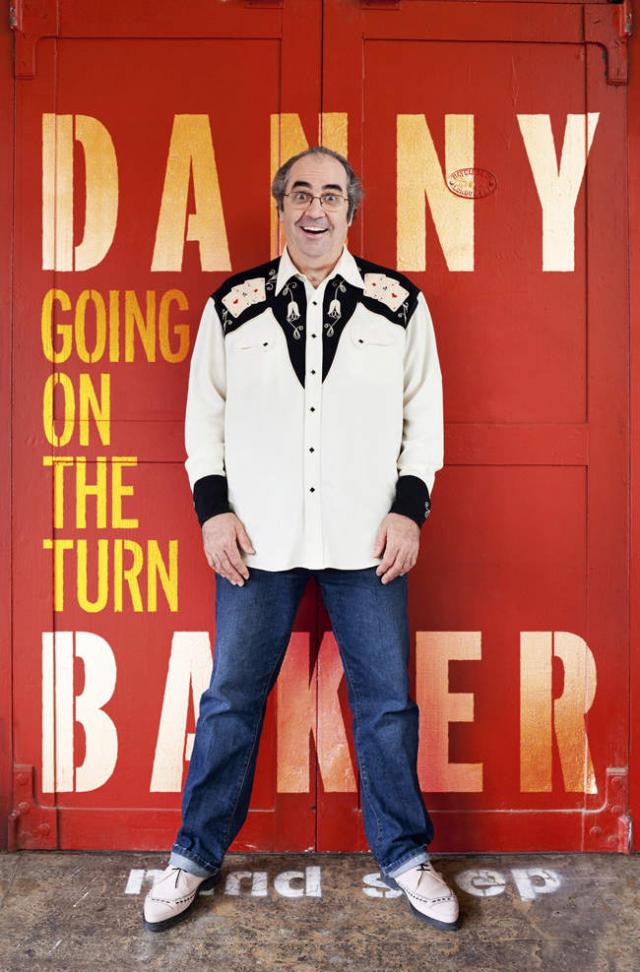
Going on the Turn
A MEMOIR
This book is for Wendy, Bonnie, Sonny and Mancie.
Of course it is. Everything is.
Almighty thanks to Alan Samson at Weidenfeld & Nicolson whose barely suppressed sighs and patient drumming of fingers as I offered various phantom deadlines on this mighty work became as a mother’s heartbeat to me.
‘It is impossible to enjoy idling thoroughly unless one has plenty of work to do.’ – Jerome K. Jerome
Frederick Joseph Baker (1928-2008)
Elizabeth Kathleen Baker (1931-2017)
Michael Edward Baker (1952-1982)
Contents
Title Page
Dedication
List of Illustrations
Prologue
1. (I’m The) Urban Spaceman
2. Get ’Em Out By Friday
3. Look Out (Here Comes Tomorrow)
4. The Low Spark Of High-Heeled Boys
5. It’s All Over Now
6. He Who Would Valiant Be
7. Somebody Said Your Name
8. Spirit In The Sky
9. Dance In the Smoke
10. Quicksand
11. Do You Believe In Magic?
12. Solid Air
13. Remake/Remodel
14. Strictly Confidential
15. Men Of Good Fortune
16. Not Dark Yet (But It’s Getting There)
17. Resurrection Shuffle
18. Roll Away The Stone
19. Just One Victory
Coda
Also by Danny Baker
Illustrations
Copyright
List of Illustrations
Mum and Dad with my sister at the Festival of Britain, 1951.
Love this photo of Spud (centre & insert) pointedly ignoring pleas for dockers not to strike.
With Mum, 1960.
With Dad in our back garden.
1965.
1974. Chugging a beer while ignoring the ectoplasm.
1976. Oxford Street. Punk figurehead Mark Perry and I photo-bombed by old girl looking for her bus.
1979. At the NME.
Bored of rock stars I began interviewing comics. Starting at the top with Bob Monkhouse.
1982. Spud overlooking the Thames from landing of a council block. The Mayor of London’s office stands there today.
Holding Bonnie and Sonny on our wedding day.
I have no idea where this photo was taken. It looks like Holland.
With Wendy in the 1980s. Note the tremendous product placement.
With Chris Evans and Billie Piper, Palm Springs 2001.
Chris Evans and I late for a TFI script meeting. By which I mean they’d already been open twenty minutes.
Chris and I leaving the studio after the last ever TFI Friday.
An extraordinarily amusing mask of a horse’s upper jaw. You’re welcome.
I can’t cook. But I enjoy butchery. Apparently.
With Chas & Dave. Possibly the most cockney photo ever taken.
Correction: THIS is the most cockney photo ever taken. With Tommy Steele in a pie-and-mash shop.
Danny Kelly and I feeling absolutely no pain in the 1990s.
Ah, that’ll be Peter O’Toole and Ronnie Fraser with me, then.
Two old vaudevillians reminisce. My sunglasses and the trees make it appear I am wearing a wig.
Knocking about with the Stones in Chicago.
To be clear: this is me wearing a wig.
Emerson Lake and Palmer. Tailors would measure Greg and I, just for the exercise.
On air and on form.
And still I grow. Elton holding a picture of me from when we first met in the early 70s.
This is David Kuo. You see, he is real.
The Treehouse on air at BBC London with Baylen Leonard.
Producer Julia McKenzie would dress up the studio every single day. It changed with the seasons.
Peter Kay – probably the show’s biggest fan. Note boxes of mini-discs in foreground.
The radiation mask into which I was bolted daily.
At the Sony Awards and telling Roger Daltrey he should have turned it in after ‘Substitute’.
Sony Awards, post-treatment, with Rhod Gilbert. Dear Lord, I should not have been out.
Ah, life seems to be returning once more. A flagrantly hedonistic shot.
Recovering in Portugal. The biscuit is a prop. I could no more have eaten it than flown home by flapping my arms.
Sonny and I moments before I explained what hereditary baldness was.
Back in the world. The whole family enjoying my bandana/wig combo over Mancie’s halo.
My gals: Mancie & Bonnie.
Unaware of the camera, this reflective study is among my favourites.
The Bakers. Islamorada, Florida 2014.
And that’s that.
Prologue
In 1968 ITV broadcast an episode of the children’s programme Lost in Space in which Will, the young boy of the family marooned on a faraway planet, discovered that the image he saw when he looked into a mirror was not simply a reflection of himself but another ‘him’ entirely, living a separate life on the other side of the glass. I cannot tell you how profound an effect this had on me. It struck me as not only entirely plausible, but just about the most mind-blowing thing I had learned since my brother explained to me that our parents were not related like the rest of us but simply a boy and girl who had got together by chance. That information pole-axed me for days afterwards and similarly, after the space show was over, I sat on the edge of our settee so mentally exploded that I could not quite conjure up the necessary impetus to lift my rear end fully away from the fabric of our three-piece suite. In truth, it always took extra effort to haul oneself away from the sort of deep, heavy sofas favoured by my parents; huge mauve monolithic structures that provided the furniture world’s answer to Al Capone’s bulletproof car.
So for about two minutes I hovered there, bum slightly raised and vacillating above the base cushion like a jockey entering the home stretch still with a chance of third place. My mind was whirling. How could I have gotten to fully ten years old without somebody alerting me to this parallel universe lurking just a veneer away, complete with a parallel me. A twin! I always suspected I was – that must be why so many of my contemporaries struck me as slightly backward misfits. But how to make contact with me/him?
I figured that in order to get this other self to break cover I would need to undertake an extended period of staring deep into my own reflection – and for this, absolute privacy would be paramount. The last thing I needed was my father catching me in the act as I ogled myself, trance-like, nose a half-inch from the full-length glass in his wardrobe door, murmuring, ‘It’s all right, you can come out now.’ That would be as bad as the time he caught me kissing a photo of Dusty Springfield in, coincidentally, the Daily Mirror. On that occasion I had bluffed my way through the trauma by insisting I had dropped a piece of chewing gum on to the paper and was retrieving it, no-hands style. For about two hours afterwards I kept walking into his line of sight while theatrically over-chewing a non-existent Wrigley’s so he would know how much that piece of gum meant to me. I thought I was carrying it off brilliantly until he said, ‘You’re fucking gone, you are! I hope there’s room in the van when it comes round tonight.’ (The ‘van’ was a vehicle the old man often referred to; according to him, lunatic asylums toured the streets looking for new inmates much in the way rag and bone men sought out broken-down gas cookers.)
Finally gathering enough wherewithal to escape the pull of our settee’s mass, I hurried along the short passage that led to the downstairs toilet where a fair-sized mirror hung on the wall behind the cistern. Sliding the toilet door closed behind me, I leaned across the fixture itself and stared into the convex oval glass. And there I was. Or rather, there HE was. For quite some time we regarded each other, neither of us making the slightest move. I figured if I gave it long enough, ‘he’ would eventually crack and by dint of his flickering lip or the infinitesimal raising of an eyebrow, we could begin our secret relationship.
In the programme, Will had crossed into Mirror World right off the bat and gone off with his reflection to have an adventure. Though this was my ultimate aim, I was sensible enough to realize that it would probably require a few more trips to the toilet before we could embark on thrills like that. In fact, even though I tried to communicate telepathically so hard that my eyes were literally bulging out of my head, nothing happened – which was doubly disappointing, seeing as he appeared to be doing the exact same in trying to contact me. In the end I relaxed my stare and, in a soupy tone of voice that I hoped would indicate total empathy with his reticence, I said, ‘I’ll be here if ever you want me to come and play.’
As soon as I said it, I was jolted back into the here and now. All thoughts of a Mirror World shattered in an instant as I literally hauled in my neck and stood, hands clenched in horror. How loud had I said that? The prospect of having been overheard was all too real; not only did this toilet stand a mere two feet from our constantly occupied kitchen, but its frosted-glass window was all that separated any occupant from the communal council estate walkway outside. I often remarked on what a basic design flaw it was that, when we were playing football in the square, should one of the little net curtains on these ‘smallest rooms’ not be fully drawn, it was hard not to notice the fuzzy outline of, say, Lou Brimble at number 13 taking a thundering slash. Understandably, all the women who lived in our block, when
So any stray noises issuing from these frankly exposed fixtures had to be carefully guarded against – doubly so in the case of the wistful bilge I had just broadcast. In those unenlightened days, any passing police officer overhearing the phrase ‘I’ll be here if ever you want me to come and play’ coyly emanating from an open lavatory window was good enough for a couple of years in Pentonville.
One such tragic case lived in a block called Moland Mead at the far end of our estate. A robust and popular part of my father’s set that drank in the cavernous Jolly Gardeners pub on Rotherhithe New Road, he was nevertheless always known as ‘Billy the Bummer’. Appalling, of course, and he had received this distressing epithet long before he was imprisoned merely for being gay. He was addressed thus, if you can imagine such a thing, with little intended malice. Recounting a previous night’s card game at the pub, friends of my dad might say, ‘You missed right out there, Spud. It was a busy table – fuckin’ money going across it! There was George the Fish, Alfie Says, Long John, the Tumble brothers, Billy the Bummer . . .’
The point is, shocking though such casual oppression seems to us now, Billy wasn’t ostracized by the community – only the law. After he was sentenced following a sting at some public toilets near London Bridge, the general reaction was, ‘Silly fucker! How many times he been told he was going to come unstuck if he kept on with that?’ In other words, much the same as it would have been had Billy been a kleptomaniac or an anarchist. When he was released, he came back to his chair in the card school with the usual tales of who he saw in the nick that the others might know and stories of the feuds, fights and fucking about that takes place on any B Wing. Who knows how it really was for him? Like every other aspect of those times and that culture, nobody made an open show of the personal. Besides, in the decades since, the lives and prejudices of the old working class have been so manipulated and inflated by an establishment that seeks to sow division via a guilt that springs chiefly from within, it seems almost irrelevant. Today the demonization is total: all poor people are thick, wicked and ignorant. And they’re to blame.
Little of this fiery polemic was troubling me as I finally broadcast my exit from the downstairs chamber with a smart flush on the chain. I may even have added a superfluous puff on the air freshener to further cement the alibi. In the event, there was no need. Nobody had noted my stay in the bog – it would be many years before I heard anybody use the twee term ‘loo’ – and I slumped back into the reinforced settee cushions resigned to the idea that all portals to alien worlds were closed to me for the time being.
Now here’s the thing. Following that doomed leap of faith in 1968, I found that I couldn’t walk away from any mirror, anywhere, without taking a few seconds to smile broadly into it before making my exit. And when I say smile, I mean a real raised-eyebrow cartoon beam. Often accompanied by a sincere, ‘How’s it going with you?’
On the few occasions I have forgotten to do this, or even suspect I may have, I will go back and correct the oversight. Even in the middle of the night, if I get up and go to the bathroom I will go back immediately if I think I signed off from my reflection without a cheery grin.
On my eventual reappearance after this return trip, my wife will groggily say, ‘Did you forget to smile at yourself?’ When I confirm this, she will sigh. Then we will both lie there, now fully awake and turning over this pointless ritual from different ends of a spectrum that runs from infuriation to embarrassment. In truth, it’s not a spectrum – those are the only two available emotions. I leave you to figure out which of us is feeling what.
I don’t want you to think this is some sort of OCD tic or that I am still waiting for my invite to become the modern-day Alice. I do it chiefly because it’s cheerful and harmless and, if you push me on it, I also think it may have helped shape my fortunes. Had I not smiled into every mirror I have passed since 1968, I genuinely think my life might have turned out very differently. Oh, I know what you’re saying now. You’re saying, ‘Well, how do you like that? This old coot has left it till his third book before letting us in on the fact he’s been as mad as Ajax all along.’
Not so fast! You’ll be relieved to know I did stop grinning at myself in mirrors on 1 October 2010.
Why? Well, as I’ll explain later, it was partly the fault of Spike Milligan. For now though, I think you’ll agree what happened that day was a pretty unequivocal signal to put a stop to the whole vacuous ritual.
It was a few minutes after 1 p.m. on that Friday and I had just put our house phone down following a devastating exchange that had lasted barely thirty seconds. This is how it had played out:
‘Hello!’
‘Is that Mr Baker?’
‘Yes it is . . .’
‘Hello, this is Mr D’Souza’s secretary at Blackheath Hospital.’
‘Oh, right!’
‘You came in this morning for some tests on your neck?’
‘Yes, I did.’
‘Mr D’Souza has asked if you could come back.’
‘Back? Yes, sure. I mean, when’s good?’
‘Today. As soon as possible really.’
‘Today?’
‘Yes. And could you bring someone with you.’
‘Right. OK. Sure. Right. Bye.’
Could you bring someone with you.
That was the phrase that condemned any hope that the call had been routine. I very slowly put the phone back in the cradle and then stood staring at myself in the circular white-wood framed mirror above it on the wall. I did not smile. I suddenly did not know how to. I didn’t seem to know anything any more. I just stared into my own blank eyes in a way you never have to do in everyday life. Mirrors are for checking hair, make-up, shirt colours and whether your silly expression might pass for sober. Mirrors, it suddenly seemed to me, despite all those decades of my secret service, were there for everything else in your life’s picture other than actually seeing yourself. But now there was nothing else to see. I became transfixed on the very centre of my jet-black pupils, trying to even see beyond them, trying to glimpse inside, trying to see if, whoever I now was, was still in there.
Then Wendy’s voice called, surreally normal, from the kitchen downstairs.
‘Who was that, Dan? Dan? Who was it?’
I didn’t answer.
Could you bring someone with you.
Now I heard Wendy was making her way up to see me. She entered the front room and, like you can, immediately sensed something was not right.
Could you bring someone with you.
‘Dan. Dan? Why you looking like that? Who was it?’
(I’m The) Urban Spaceman
By 1996 I wasn’t a TV star any more. I am aware of course that the very phrase ‘TV star’ now has a wonderfully antiquated grandeur that ranks alongside such boasts as having been a noted pavement photographer or champion Charleston dancer in one’s youth. Yet, may a million long-since recycled copies of Radio and TV Times show that a TV star is indeed what I was for about four years in the early nineties. The previous instalments of these memoirs will have explained how this unlikely sensation came to be and how quickly the general public realized what a horrible mistake they had made. Their panic passed relatively quickly, however, and by 1996, without question, my faded national celebrity had been returned to store. Unlike today when you can drop a water bomb out of any window and soak dozens of content creators making programmes for the Internet, twenty years ago, once your TV heat-index hit a temperature similar to that of the Piltdown Man, there was little else for you to do, nowhere else for you to go.
The truth was that I had become overexposed and old hat. Really old hat. A hat so old it made Clement Attlee’s homburg look like a modern millinery breakthrough. Television was now entering its last great boom, one that would ultimately lead to its final bust, and the main catalyst for this combined revolution and suicide note was my great friend Chris Evans. Chris’s shaking-the-medium-by-the-scruff-of-the-neck approach to live TV on both The Big Breakfast and Don’t Forget Your Toothbrush had made most other mainstream TV look positively arthritic. His trademark copper-coloured coiffure shocked and illuminated the medium and came to signify all that was new and daring. Me? I was literally and metaphorically going bald. Thankfully, I wasn’t going broke, even when the big contracts dried up. The prudent financial system I had lived by since leaving school meant I could still live like a king – providing it was one of those long-exiled Balkan kings sometimes exposed by newspapers as they stand on the pavement in Earls Court selling shoelaces from a tray.





