

Chicano Frankenstein, page 1


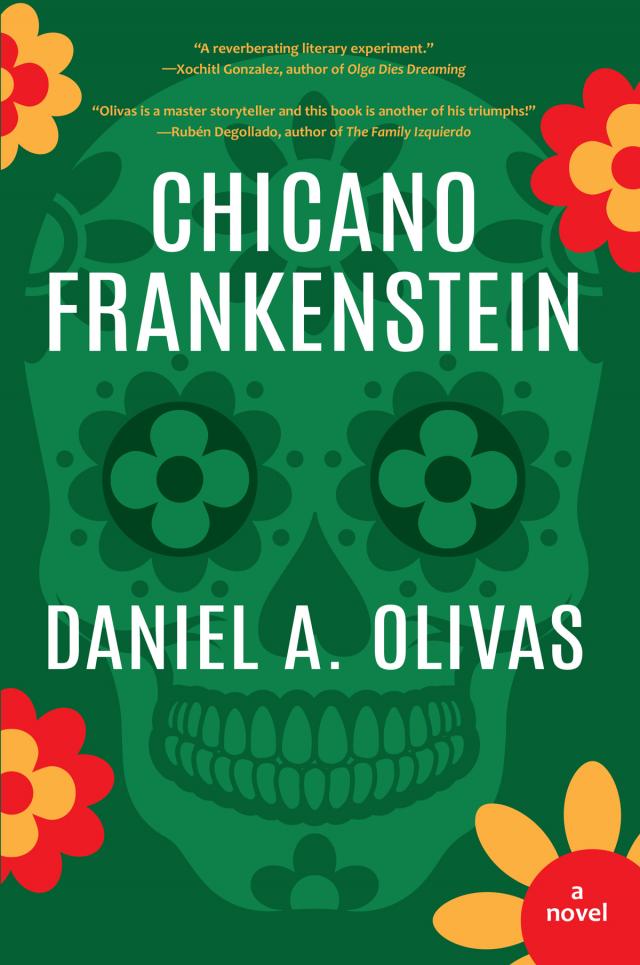
ADVANCE PRAISE
“Haunting in its implications, astute in its observations about how polarized we’ve become around the simple question of what it means to be human, Daniel Olivas’s Chicano Frankenstein is ultimately an empathetic exploration of the heart told in spare, but beautiful prose. Olivas is a master storyteller and this book is another of his triumphs!”
—Rubén Degollado,
author of The Family Izquierdo
“In a near-future Pasadena, Daniel A. Olivas resurrects Mary Shelley’s creation to glorious effect, making it clear who the monsters really are in a world where a cynical government sees resurrected humans as pawns to use, abuse, and discard. The real trick of this speculative political satire is that corruption and peril coexist with compassion, humor, and large doses of Chicano joy. I loved every page-turning minute!”
—Michelle Ruiz Keil,
author of Summer in the City of Roses
“In Daniel A. Olivas’s alt-world political satire Chicano Frankenstein, we follow his reanimated main character, ‘the man,’ in his search for identity in a world that is increasingly hostile to him and his kind. With its tongue firmly planted in its cheek, this important novel is at once frightening and humorous, and I found myself laughing out loud more than once as Olivas cleverly delivered his cautionary message, served with a basket of fresh baked pan dulce.”
—Orlando Ortega-Medina,
author of The Fitful Sleep of Immigrants
“In the genre-bending tradition of Mary Shelley, Daniel A. Olivas’s latest novel Chicano Frankenstein expertly stitches together gothic political satire, science fiction, and existential metafiction to expose the racist and classist hypocrisies that undergird the American political economy under tyrannical right-wing leaders.”
—Eileen M. Hunt,
author of Artificial Life After Frankenstein
“If you’re looking for a reverberating literary experiment in a speedy read, Daniel A. Olivas’s Chicano Frankenstein is the book for you. In this literary pastiche of timeless novels, beloved TV, and familiar political narratives, the love story of Faustina and the man will reanimate your deepest expectations of humanism into new understandings of monstrosity.”
—Xochitl Gonzalez,
author of Olga Dies Dreaming
PAST PRAISE
“… a major American talent.”
—Luis Alberto Urrea, author of Good Night, Irene
“Olivas is adept at establishing character in a sentence or two; he creates an image, a moment of self-deception, in which we come to know these characters intimately and easily imagine their entire lives …”
—Los Angeles Times
“An important voice in Latinx literature.”
—BuzzFeed
“Olivas is a literary marvel.”
—Shelf Awareness
© 2024 by Daniel A. Olivas
All rights reserved. No portion of this publication may be reproduced in any form, with the exception of reviewers quoting short passages, without the written permission of the publisher.
This is a work of fiction. The events described here are imaginary. The settings and characters are fictitious or used in a fictitious manner and do not represent specific places or living or dead people. Any resemblance is entirely coincidental.
Library of Congress Cataloging-in-Publication Data
Names: Olivas, Daniel A., author.
Title: Chicano Frankenstein / Daniel A. Olivas.
Description: Portland, Oregon: Forest Avenue Press, 2024. | Summary: “An unnamed paralegal, brought back to life through a controversial process, maneuvers through a near-future world that both needs and resents him. As the United States president spouts anti-reanimation rhetoric and giant pharmaceutical companies rake in profits, the man falls in love with lawyer Faustina Godínez. His world expands as he meets her network of family and friends, setting him on a course to discover his first-life history, which the reanimation process erased. With elements of science fiction, horror, political satire, and romance, Chicano Frankenstein confronts our nation’s bigotries and the question of what it truly means to be human.”--Provided by publisher.
Identifiers: LCCN 2023034805 | ISBN 9781942436591 (paperback) | ISBN 9781942436607 (epub)
Subjects: LCGFT: Science fiction. | Novels.
Classification: LCC PS3615.L58 C55 2024 | DDC 813/.6--dc23/eng/20240731
LC record available at https://lccn.loc.gov/2023034805
Forest Avenue Press LLC
P.O. Box 80134
Portland, OR 97280
forestavenuepress.com
Printed in the United States
Distributed by Publishers Group West
1 2 3 4 5 6 7 8 9
For my father,
Michael Augustine Olivas (1932–2020)
And for my brother,
David J. Olivas (1960–2023)
CHICANO FRANKENSTEIN
Daniel A. Olivas
Forest Avenue Press
Portland, Oregon
“I am malicious because I am miserable.
Am I not shunned and hated by all mankind?”
―Mary Wollstonecraft Shelley, Frankenstein
“One time he stopped at mid-turn and fear suddenly set in.
He realized that he had called himself.
And thus the lost year began.”
―Tomás Rivera, … y no se lo tragó la tierra /
… And the Earth Did Not Devour Him
PRES. CADWALLADER PROMISES TO SIGN “ANTI-STITCHER” LAW
CAMP DAVID, MD (AP)—Speaking to reporters on Saturday, President Mary Beth Cadwallader pledged to sign a landmark anti-reanimation bill into law on Tuesday after the House and Senate passed it last week. The president said that it would deliver the “final plank” of her ambitious domestic agenda as she aims to boost her party’s standing with voters about three months before the midterm elections.
The legislation—dubbed the anti-stitcher law by its supporters—would ban the medical technology known as reanimation that had been pioneered by German scientists a decade ago. The technology made possible what had only been imagined in folklore and horror novels: the reanimation of once-dead human tissue eventually resulting in over 12 million documented cases of human reanimation subjects in the U.S. alone. The worldwide number is uncertain, though the World Health Organization estimated that there may be more than 100 million reanimated subjects living across the globe.
Due to the recently perfected technology permitting the joining of body parts from multiple cadavers to complete a whole person, the resulting reanimated subjects became commonly known by the crude epithet “stitchers” in a reference to the joining of various body parts that requires, in part, the suturing together of flesh and muscle.
The legislation has strong backing from the country’s religious leaders who had decried animation as playing God. However, organized labor as well as the national and numerous local chambers of commerce lobbied the White House to veto the bill asserting that the reanimation technology benefited the sagging economy by supplying a potentially inexhaustible new source of young, healthy workers.
“This technology can’t be used to reanimate the elderly or infirmed,” observed Carlos Moraga, president of the U.S. Chamber of Commerce. “But it works like a dream to bring back otherwise healthy workers at all levels of the economy, which is good for America. And if we pull the plug on the reanimation industry, we’ll be behind the eight ball with other countries that are going full steam ahead with replenishing their workforce through reanimation.”
Anti-immigrant groups were divided on the issue because the creation of a reanimated population could eventually diminish employers’ reliance on and hunger for low-wage foreign workers. However, those same groups complained that “stitchers” were not “real Americans” and could replace native-born U.S. residents in the near future if reanimation ramped up.
In anticipating a triumphant signing ceremony at the White House, Cadwallader pointed to the bill as proof that democracy—no matter how long or untidy the process—can still deliver for American voters. The president road-tested a line she will likely repeat later this fall ahead of the midterm elections: “Real Americans and human decency won, and the special interests lost.”
Chapter One
THE MAN SAT ALONE at his kitchen island. Today he needed to go into the office, but for now, he wore a white T-shirt, boxers, and slippers. The man looked down at two slices of buttered wheat toast that sat on a plate near a steaming mug of coffee. He breathed in the aroma of his breakfast and attempted to affix a word to what he felt at that moment. The bright morning sun shone through the kitchen window onto his breakfast and illuminated it like a stage where the actors stood frozen before uttering their opening lines. The man considered his breakfast.
What do I feel?
That was the question he often asked himself. The man knew he should feel something as he looked upon his daily morning meal, a meal that never changed, at least not in recent times.
What do I feel?
The man sensed something watching him. He turned his head toward the kitchen window and squinted. Ah! The neighbor’s cat, Nacho, sat at the far end of his apartment complex’s communal backyard on the low retaining wall and stared at him. Not a threat. Just a tiger-striped feline. Nacho blinked, licked its lips, and scurried away. The man turned back to his breakfast and placed both hands, palms down, on either side of his plate. The cool white quartz felt solid, secure on his ski
Is that what I feel? Solid, secure?
The man then focused on the contours of his hands. His left hand was a full two inches longer and an inch wider than his right. And his right hand was much darker than his left. He did feel something.
I feel remorse.
Remorse that his hands were such a mismatch that people often stared and children pointed. Even when he tried to hide the vast differences between his hands by wearing gloves in the winter, people noticed—especially children, whose line of vision brought them eye-to-eye, as it were, with his mismatched appendages.
What do I feel?
Hungry. And so now this breakfast of buttered wheat toast and hot coffee served a purpose. He reached for one piece of toast and brought it to his lips. He held it there for a moment and attempted to confirm that he was indeed hungry.
Yes. I feel hungry.
The man bit into the toast and chewed.
“Is there any of that for me, guapo?”
The man turned and watched the woman walk behind the island, open one cabinet and then another until she found a coffee mug, and pour herself a cup. She turned toward the man.
“Any half-and-half left?”
Before the man could respond, the woman opened the refrigerator, scanned its contents, and emitted a pleased yes! before retrieving a small carton of half-and-half. After the woman lightened her coffee to the appropriate shade of brown, she returned the carton to the refrigerator, walked around the edge of the island, and plopped down on the stool next to the man.
“I hope you don’t mind that I used your very manly-man deodorant, guapo.”
“I don’t mind,” said the man.
“I just wish you had a hair dryer.”
The man noticed the woman’s thick, curly, black hair bounce and set free water droplets that lightly sprinkled the kitchen island and her black pantsuit. The woman smelled like the man’s shampoo mixed with the pungent scent of his Irish Spring deodorant. He liked how she smelled—his Irish Spring took on a subtler scent on her—and appreciated the woman’s glistening hair. The man thought about the woman’s wish that he had a hair dryer.
“Toast?” said the woman.
“Yes,” said the man.
“That’s your breakfast?”
“Yes.”
“Do you have something a little more Mexican?”
“Like what?”
“Pan dulce?”
“No, I don’t.”
“How about a cheese blintz? I’m happy to honor my Jewish stepfather.”
“No, I don’t have that either.”
The woman reached over and snatched the untouched piece of toast.
“Ni modo,” said the woman. “I have to watch my carbs. Healthful wheat toast it is for me.”
They sat in silence as they both crunched on their toast.
After three minutes, she said, “You know, guapo, this is the second time I’ve stayed over.”
“Yes, it is.”
“And this is the second time I’ve wondered if you’ve had something other than toast for breakfast.”
“Yes, it is.”
“And I know you’ve got a thoughtful side to you.”
“I do.”
The woman chuckled at the concise man’s response. In three quick bites, she finished eating the piece of toast and washed it down with a loud gulp of coffee.
“But you do make good coffee, guapo. That, I admit.”
“Thank you,” said the man. A small smile crept onto his freshly shaven face.
The woman stood, put her coffee mug into the sink, walked back to the man, pecked him on his left cheek.
“I’ll bring the pan dulce or maybe blintzes next time,” she said. “If there is a next time.”
“Thank you,” said the man. “I hope there is a next time.”
“Oh, you sweet talker,” said the woman. “Maybe I’ll bring both.”
“Thank you.”
“Need to grab my purse,” said the woman. “I’ve got young lawyers and law clerks to boss around, a law practice to run, corporations to sue, judges to cajole. Are you going to work today too?”
“Yes,” said the man. “After.”
“After what?”
The man thought. “After I go for a run and then make a trip to the pharmacy.”
“Got it,” said the woman. “Life’s errands and exercise wait for no one.”
“I usually run at night. ”
“Well, I guess I ruined your routine last night.”
The man listened as the woman walked away from him to retrieve her purse from the man’s bedroom. The man wondered if the woman was examining his bedroom, and if so, what she thought of it in the light of day. The woman returned after a few moments and stood near the man.
“Hasta luego, my laconic hookup,” said the woman.
“Goodbye,” said the man.
The man stared at his cup of coffee as the woman stood near him. They remained in silence for several seconds listening to each other breathe. The woman eventually turned and walked to the front door. The man stared at his cup of coffee as he listened to the woman clear her throat. After a few seconds more, the woman opened the door and left. The man could discern the woman’s heels click down the walkway toward her car. The woman’s Irish Spring–infused scent lingered. The man nodded and acknowledged what he had observed before: his soap smelled different on her. He appreciated the difference and wondered what the science was behind it, if indeed there was a scientific explanation for it. Perhaps it was all his imagination, nothing more.
The man took another bite of his toast as the woman’s car started up with a vroom.
The man chewed his toast and then took another bite as he thought.
What is her name?
The man concentrated.
Her name…
The man closed his eyes for three seconds, and then his eyes popped open.
Ah! Faustina.
The man felt something, and though he was not yet certain what it was, he knew what he felt was something definable, something provoked by the fact that, if he concentrated, he could retrieve essential information when needed.
The man thought for a moment.
What do I feel?
The man smiled. He finally recognized this feeling, though he did not experience it often. But he knew that he felt it at that moment.
Pride.
The man smiled and emitted a small chuckle. But then his feeling of pride gave way to something else. Something entirely different. The man concentrated again, searching for the right word to describe what he now felt. What was it?
Shame.
The man’s face grew hot. Perspiration covered his upper lip and forehead.
Shame.
The man should have remembered Faustina’s name easily, without effort, because he had said it many times last night in bed as well as on the previous Friday, their first night together. He liked the feel of her name on his tongue. Faustina. They’d met at the annual environmental law conference in Yosemite. The partners at his law firm usually didn’t let the paralegals attend, but they’d had a particularly good year, with three large settlements coming in during the spring and summer. So the partners felt generous enough to hold a lottery to see which of the firm’s five paralegals could go along with the firm’s attorneys to the annual conference. The man won the lottery by choosing the lowest number scrawled on a small brown slip of paper pulled out of a Dodgers cap. His fellow paralegals were collectively rather annoyed since the man was junior to them all. The man did not feel any remorse for being victorious because he had won purely by chance. But now the man experienced a wave of shame because he had not immediately remembered Faustina’s name. And it should have been easy. She was a partner in a boutique firm, and the firm’s name imprinted itself on his memory because he had read Faustina’s business card many times over the last week: GODÍNEZ, TSUKAMAKI & STONE. But his eyes never seemed to move beyond the large letters of the firm’s name emblazoned on the business card, otherwise Faustina’s name would have come to him easily. The man believed that he had a very visual memory. He concentrated. Which surname was hers? Think… think… think… Ah! He remembered that Faustina was the founding partner of the firm, so her surname would be first.


